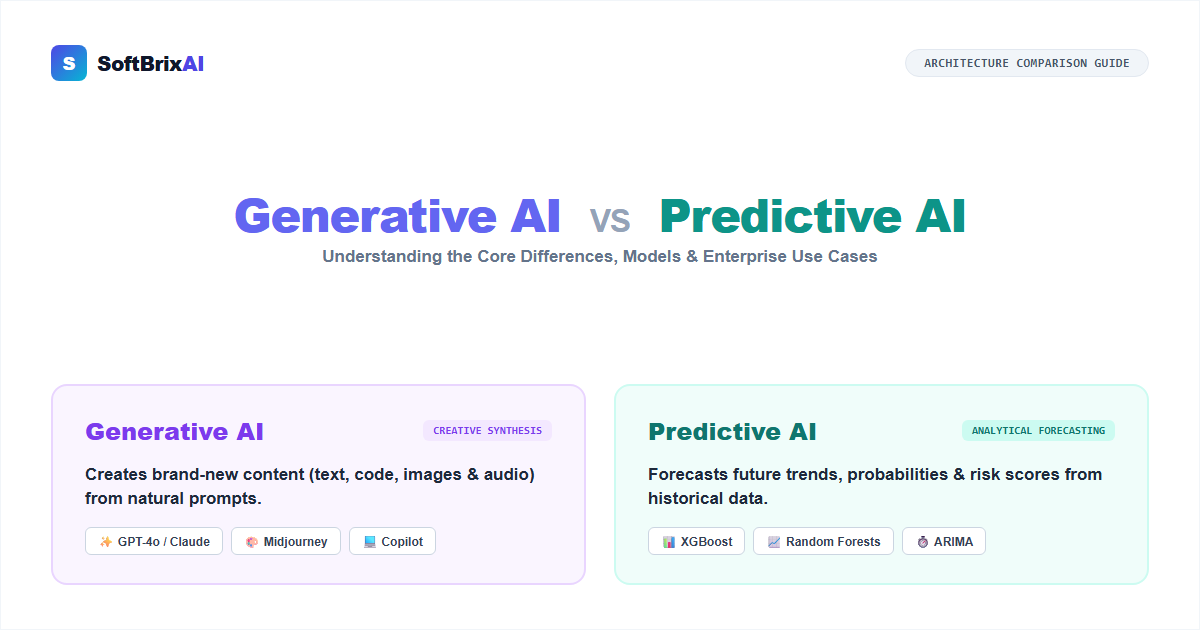
Generative AI creates new content. Predictive AI analyzes existing data to estimate what is likely to happen next. Both technologies represent two of the main practical types of artificial intelligence by business purpose, building on the core mechanics of how AI works and the architectural hierarchy of AI vs machine learning vs deep learning, but they solve different enterprise problems. Generative AI supports content creation, custom AI software development and customer service. Predictive AI supports forecasting, risk assessment, fraud detection, recommendations and logistics.
The choice between generative AI and predictive AI depends on the desired output. Choose generative AI when the output is new text, an image, code, audio or video. Choose predictive AI when the output is a forecast, classification, risk score or recommendation based on historical data. Many organizations use both technologies in the same workflow, often paired with predictive analytics services and enterprise AI consulting.
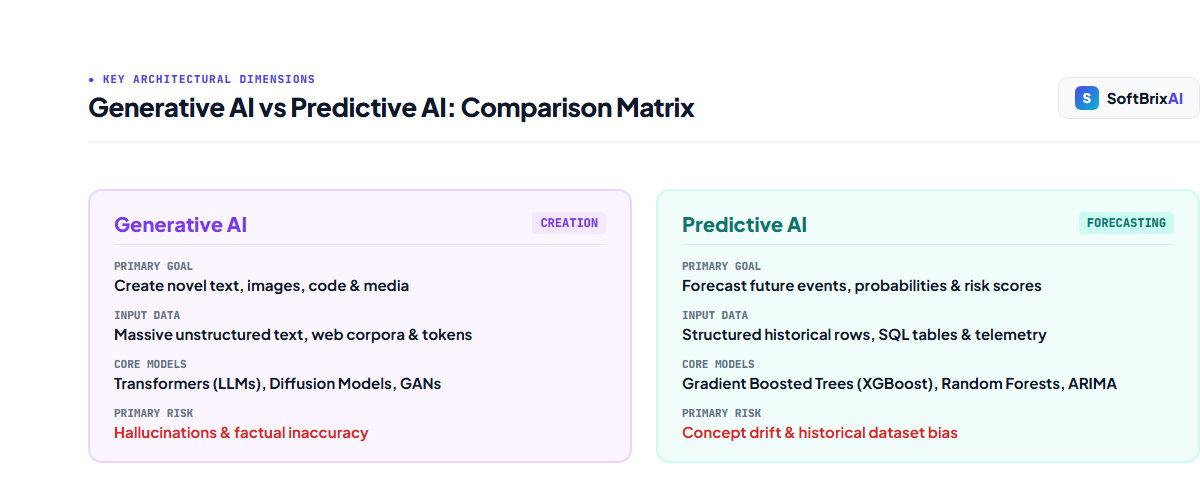
Generative AI vs Predictive AI: Quick Comparison
| Criteria | Generative AI | Predictive AI |
|---|---|---|
| Primary objective | Creates new content from a prompt or input | Forecasts an event, value, trend or category |
| Typical output | Text, images, audio, video, code or synthetic data | A probability, classification, score, recommendation or forecast |
| Common data | Large volumes of text, images, audio, video or code | Historical records with features, labels and outcomes |
| Common models | Foundation models, large language models (LLMs), diffusion models, generative adversarial networks (GANs), variational autoencoders (VAEs) | Regression models, decision trees, random forests, clustering and time-series models |
| Common uses | Chatbots, content creation, coding assistance, synthetic data and molecule design | Demand forecasting, churn prediction, fraud detection, predictive maintenance and inventory planning |
| Main business value | Automates creation and supports personalization | Improves decisions by estimating likely outcomes |
| Main risk | Incorrect, biased or fabricated content | Biased or unreliable predictions caused by poor data or changing conditions |
What Is Generative AI?
Generative AI is a type of artificial intelligence that produces new content in response to a prompt or other input. The content can include text, images, software code, audio and video. ChatGPT generates text, DALL-E generates images, Midjourney generates images and GitHub Copilot generates or completes code.
Most generative AI systems begin with a foundation model. A foundation model is a deep learning model trained on broad data and adapted to many downstream tasks. Large language models are foundation models designed primarily for language, while multimodal models can process more than one type of input or output.
During training, a generative model learns statistical relationships in its data. To understand the foundational mechanics of how these architectures learn parameters, explore our guide on what an AI model is. During inference, the model uses those learned relationships to produce an output that fits the prompt. The output is new in its exact form, but it reflects patterns learned from the training data.
Generative AI Models and Architectures
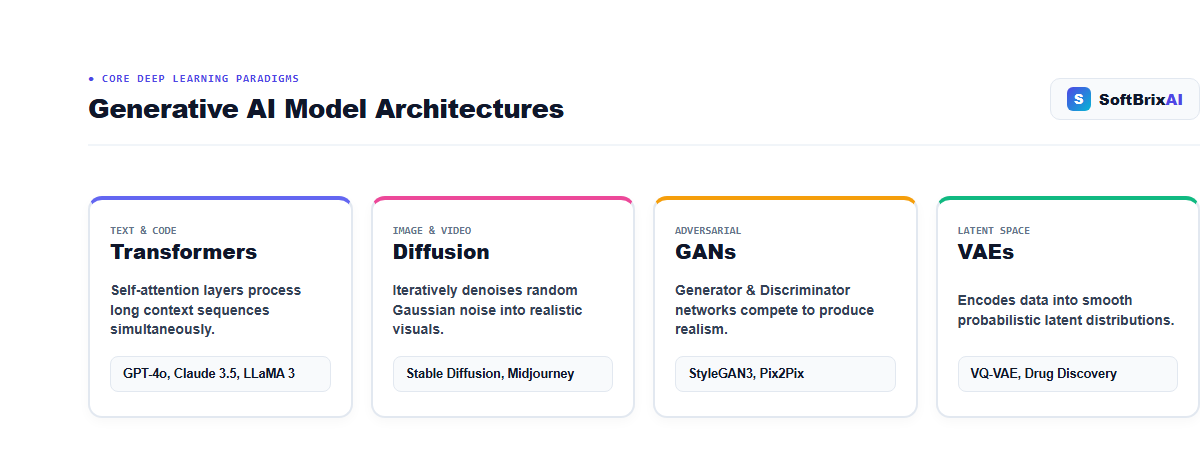
Generative AI uses several model architectures:
- Transformer models process relationships within sequences using attention mechanisms. Transformers support many LLM applications, including text generation, summarization, translation and code generation.
- Diffusion models learn to create content by reversing a process that adds noise to training examples. They are widely used for image and other media generation, as seen across modern visual pipelines analyzed in our review of Gramhir.pro and AI image generators.
- Generative adversarial networks (GANs) use a generator and a discriminator. The generator creates samples, while the discriminator evaluates whether samples resemble the training data.
- Variational autoencoders (VAEs) learn compressed representations of data and use those representations to generate variations.
These architectures differ in their training methods, outputs, computing requirements and failure modes. A model’s ability to produce fluent or realistic content does not guarantee factual accuracy, safety or explainability.
What Is Predictive AI?
Predictive AI uses statistical analysis and machine learning algorithms to identify patterns in historical data and estimate future outcomes. For a comprehensive overview of algorithms like regression and random forests, see our guide on what is machine learning. Predictive AI can forecast sales, detect suspicious transactions, estimate customer churn, predict equipment failure and recommend products.
Predictive AI usually receives structured inputs such as dates, prices, transactions, customer attributes, sensor readings or medical measurements. The model maps those features to a target outcome. The target can be a number, such as next month’s sales; a category, such as high or low risk; or a probability, such as the likelihood that a customer will cancel a subscription.
Predictive AI does not guarantee the future. It estimates likely outcomes from the data and assumptions used to train the model. Forecast accuracy can fall when the data is incomplete, biased, outdated or no longer representative of current conditions.
Predictive AI Models and Methods
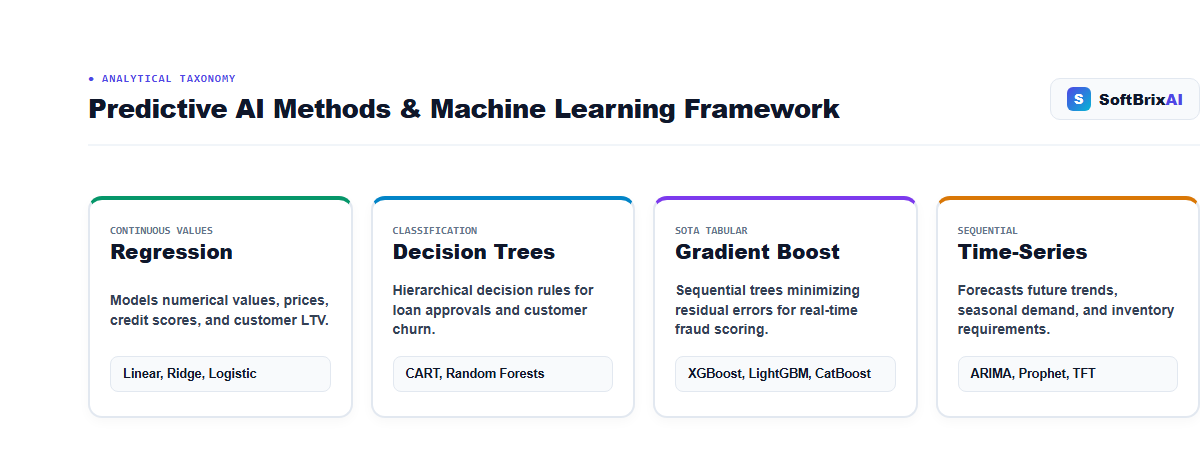
Common predictive AI methods include:
- Clustering groups observations according to shared characteristics. It is useful for customer segmentation and exploratory analysis.
- Decision trees split data into branches to classify observations or predict values.
- Random forest models combine multiple decision trees to produce a final prediction.
- Regression models estimate relationships between variables. Linear regression models a linear relationship between an outcome and one or more predictors.
- Time-series models analyze measurements in chronological order to forecast future values.
Predictive AI can use deep learning, but simpler models often work well for structured business data. A simpler model may be faster to train and easier for business teams to interpret. Model selection should follow the data, outcome, accuracy requirement, latency requirement and explainability requirement.
What Is the Difference Between Generative AI and Predictive AI?
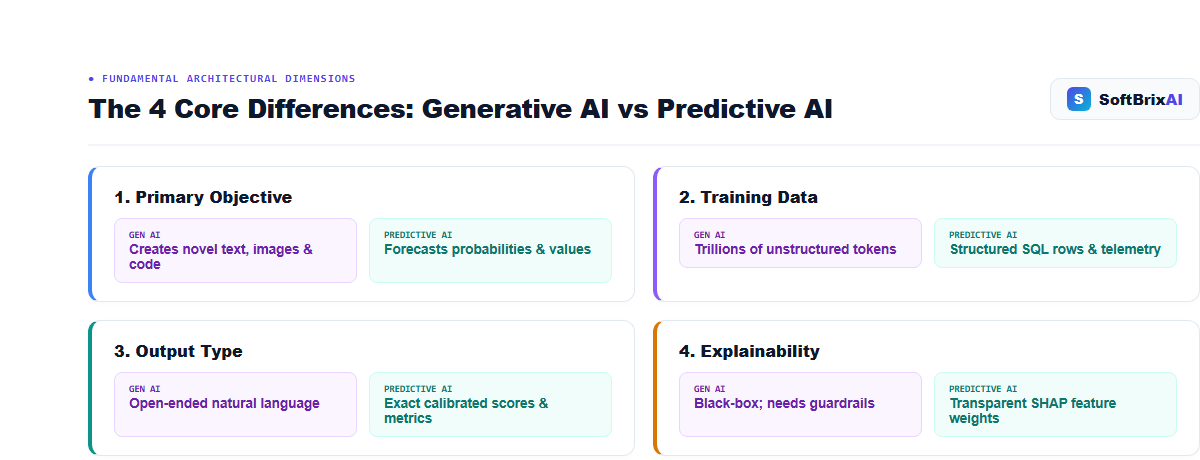
Generative AI and predictive AI differ in four main ways: their objective, data, output and model evaluation.
1. Objective
Generative AI creates content. Predictive AI estimates an outcome. A prompt such as “write a product description” is a generative AI task. A question such as “which products are likely to sell next week?” is a predictive AI task.
2. Input and Training Data
Generative AI models often require broad training data that can include text, images, audio, video or code. Predictive AI models often use more targeted datasets containing historical features and known outcomes. The right data depends on the problem, so neither technology is automatically better for every dataset.
3. Output
Generative AI produces an open-ended output. Several responses can satisfy the same prompt. Predictive AI produces a defined output, such as a number, category, ranking, probability or alert.
A generated answer can be judged for relevance, factuality, style, safety and consistency. A predictive model can be evaluated with measures such as calibration, precision, recall, forecast error and performance on new data, closely aligned with the quality assurance principles in software testing fundamentals.
4. Explainability
Predictive AI models can be easier to explain when they use transparent statistical methods or feature-based models. Generative AI systems can be difficult to interpret because the path from input to output is distributed across many model parameters. Predictive outputs still require human judgment, and an explainable model can produce a poor decision when its data or interpretation is wrong.
Generative AI vs Predictive AI Examples
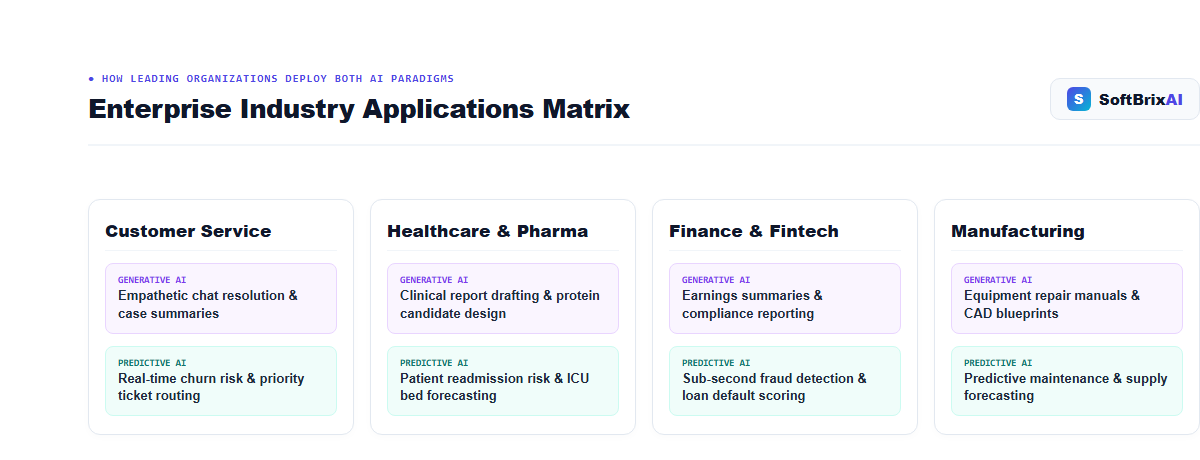
Customer Service
A generative AI chatbot can draft a response to a customer question, summarize a support case or help a service agent find an answer. Predictive AI can estimate which customers are at risk of churn, classify incoming cases by urgency or recommend the next best action.
Marketing and Advertising
Generative AI can create advertising copy, image variations, email drafts and product descriptions. Predictive AI can estimate conversion probability, identify customer segments and forecast campaign performance.
Healthcare
Generative AI can summarize clinical documents, generate synthetic data for testing and support drug discovery by proposing candidate molecules. Predictive AI can estimate disease risk, classify medical images, forecast patient demand or identify patients who may need an intervention. Any clinical application requires validation, governance and appropriate human oversight.
Healthcare teams should match the model to the decision. Generative AI is useful when clinicians or researchers need to transform unstructured material, such as notes, reports or scientific literature, into a draft or summary. Predictive AI is better suited to a defined outcome, such as a risk category, readmission estimate or demand forecast. The model should be tested on representative data, monitored for bias and used with qualified human review, especially when an output can affect diagnosis or treatment.
Generative AI can support drug discovery by proposing candidate molecules, but a generated candidate is not a validated medicine. Laboratory testing, pharmacology, toxicology and clinical development remain necessary before a candidate can support a medical decision.
Finance
Generative AI can summarize financial documents, draft reports and support analyst workflows. Predictive AI can produce financial forecasts, detect fraud, estimate credit risk and identify unusual transactions.
Finance teams can use Generative AI for document-heavy work, including report drafting, research summaries and natural-language access to approved information. Predictive AI is more appropriate for structured tasks such as cash-flow forecasting, credit-risk estimation, transaction monitoring and customer churn prediction. Predictive outputs should include validation and monitoring, since biased data or changing market conditions can make a forecast unreliable. Explainability and transparency matter in finance because stakeholders need to understand how a prediction was produced and how it informed a decision.
A practical workflow can combine both systems: Predictive AI estimates risk or expected performance, while Generative AI prepares a readable explanation for an analyst. The generated explanation should be checked against the underlying data and should not invent reasons that the predictive model did not use.
Logistics and Manufacturing
Generative AI can create maintenance instructions, answer questions about operating procedures and assist with software code. Predictive AI can forecast demand, optimize inventory, schedule resources, plan routes and support predictive maintenance.
Can Generative AI Perform Predictive Tasks?
Yes. Generative AI can perform some classification, extraction and forecasting tasks, especially when the input and output are natural-language text. An LLM can classify a product review, summarize a document or extract fields from an invoice. Generative AI can support predictive analytics by generating synthetic data or by presenting predictive results in natural language.
That capability does not make generative AI the best choice for every prediction problem. A forecasting model built for sales, demand or equipment failure may offer lower cost, lower latency, clearer calibration and better control than a general-purpose LLM. The correct choice depends on the required accuracy, data type, privacy constraints, operating cost and decision risk.
Agentic AI vs Generative AI vs Predictive AI
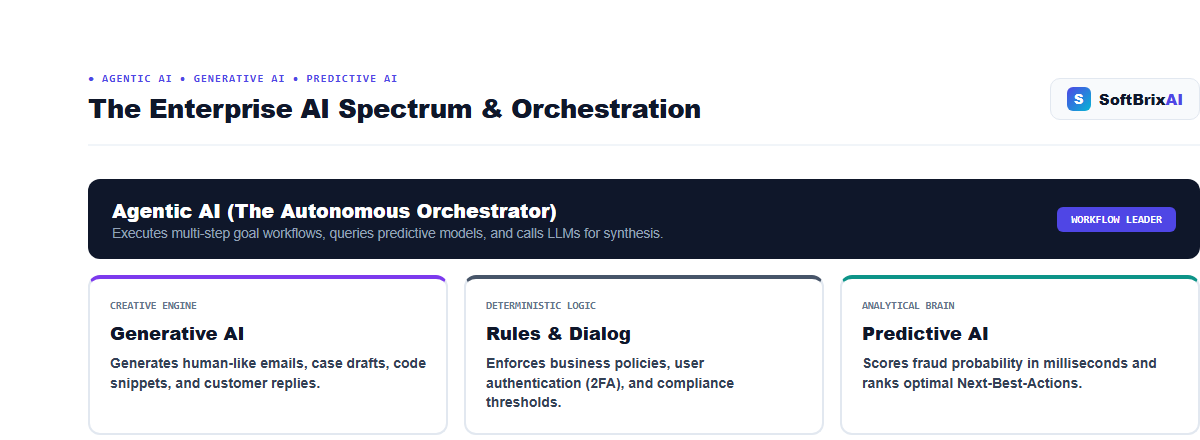
Agentic AI is designed to pursue a goal through a sequence of steps. An AI agent may interpret a request, plan tasks, call software tools, retrieve information and take an approved action. Generative AI often supplies the language or content generation inside that workflow. Predictive AI supplies forecasts, risk scores or recommendations that help the workflow choose an action. For a comprehensive walkthrough of multi-step retrieval loops, explore our guide on what is Agentic RAG.
These categories overlap, but they describe different functions:
- Generative AI creates content.
- Predictive AI estimates outcomes.
- Agentic AI coordinates steps and actions toward a goal.
- Conversational AI focuses on interaction through language or speech.
- Traditional AI is a broad, informal term for systems that perform tasks associated with human intelligence, including classification, optimization and rules-based decision-making.
An agentic customer-service system might use a generative model to write a response, a predictive model to assess customer risk and a tool connection to issue a replacement. The system should require permissions and controls before it takes consequential actions. This dynamic coordination mirrors the fast-moving engineering environments seen among the hottest AI startups in Silicon Valley.
Generative AI and Predictive AI: Benefits and Limitations
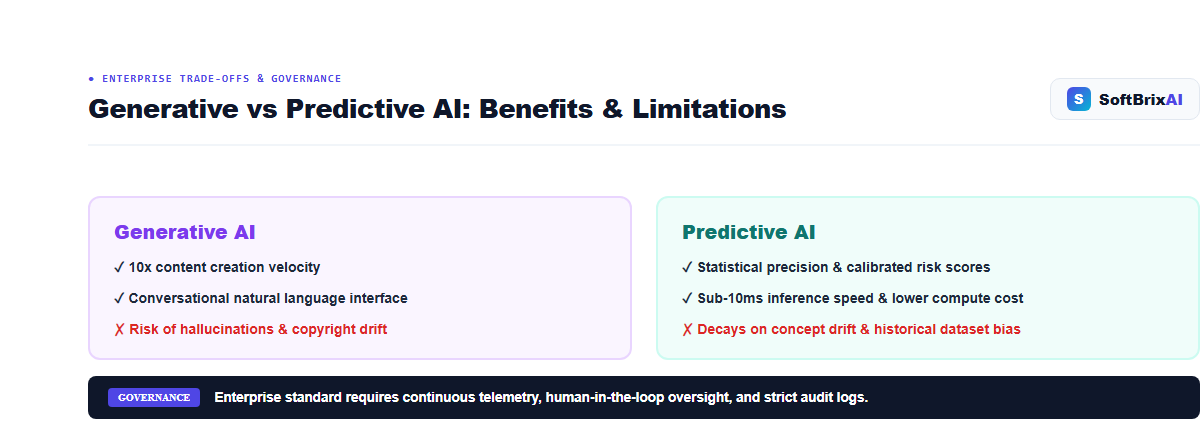
Generative AI can reduce the time required to create drafts, code, images and other content. It can personalize outputs for different audiences and support brainstorming, document processing and customer service. Its limitations include hallucinated information, biased outputs, copyright concerns, data leakage, prompt sensitivity and high computing demand.
Predictive AI can improve planning by estimating demand, risk and resource needs. It can automate repetitive decisions and identify patterns that are difficult to review manually. Its limitations include dependence on representative historical data, sensitivity to changing conditions, false positives, false negatives and limited visibility into unmeasured factors.
Neither technology removes the need for governance. Organizations should define permitted uses, protect sensitive data, monitor performance, test for bias and assign responsibility for decisions. Continuous oversight and drift prevention can be systematically implemented using AI contextual governance frameworks. Explainability is useful, but it does not replace validation or human review.
What About Environmental Impact?
Generative AI can require substantial computing resources during model training and large-scale inference, particularly for models that generate high-resolution images, video or long outputs. Predictive AI can have a smaller computational footprint when it uses compact models and structured data, but resource use varies by model size, training frequency, data volume and deployment scale.
A fair comparison should measure the full system rather than label one category as automatically sustainable. Organizations can reduce unnecessary computation by selecting an appropriately sized model, limiting repeated inference, improving hardware utilization and tracking energy and carbon metrics.
How to Choose Between Generative AI and Predictive AI
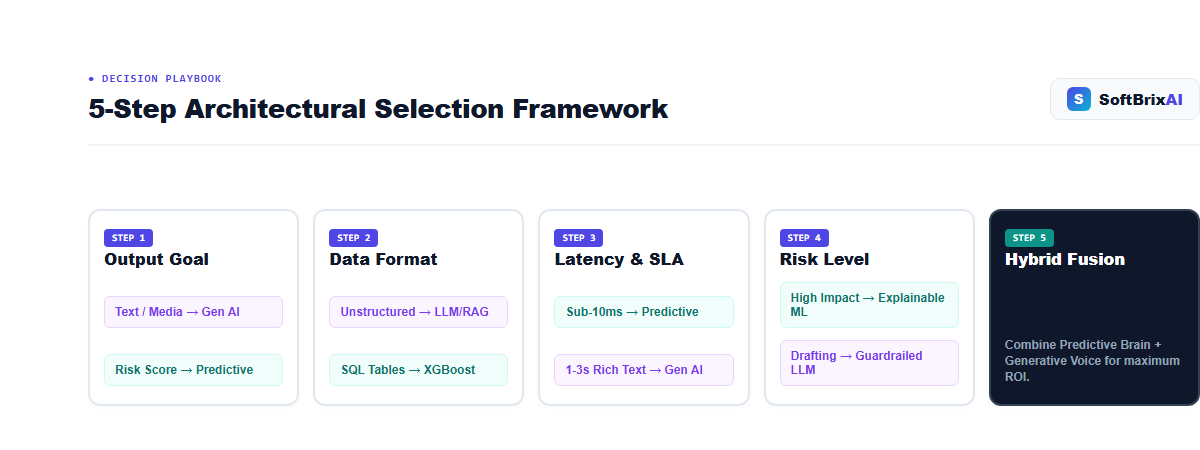
Use this five-step decision process:
- Define the desired output. Choose generative AI for new content. Choose predictive AI for a forecast, score, probability, classification or ranking.
- Check the input data. Identify whether the data is structured, unstructured or multimodal, and confirm that the data can be used for the intended purpose.
- Set performance requirements. Define acceptable error, latency, cost, reliability and calibration before choosing a model.
- Assess risk and explainability. Apply stronger validation and review to healthcare, finance, employment, safety and other high-impact use cases.
- Test the smallest suitable system. Compare a baseline model with more complex options using held-out data and realistic operating conditions, following iterative practices from adaptive software development.
Choose generative AI for content creation, natural-language interaction, document transformation and creative assistance. Choose predictive AI for demand forecasting, fraud detection, churn prediction, risk assessment, recommendations and predictive maintenance. Use both when one system needs to create content while another estimates outcomes.
Generative AI and Predictive AI Work Better Together
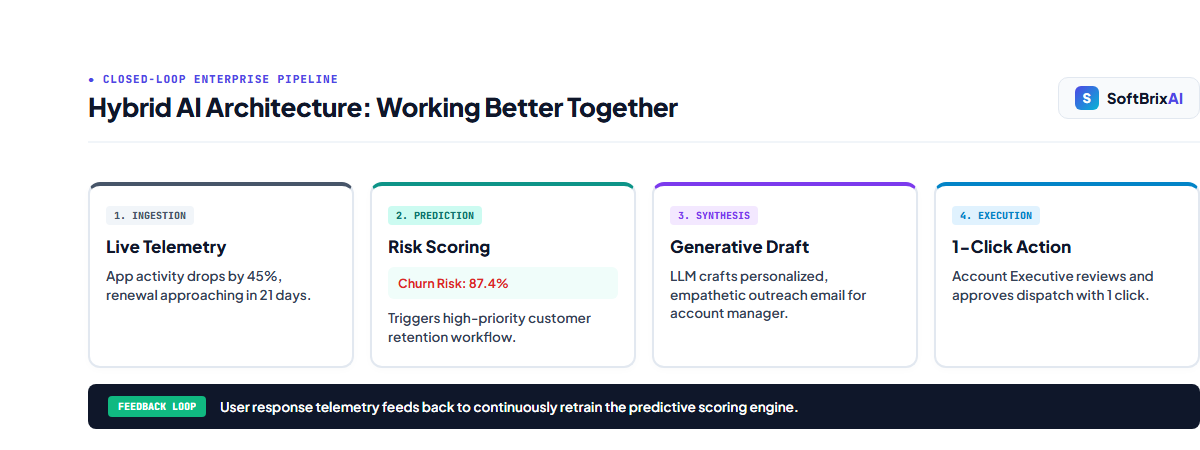
Generative AI and predictive AI are not competing versions of the same tool. Generative AI creates content, while predictive AI estimates what may happen next. A company can use generative AI to write product descriptions and predictive AI to forecast which products will sell. A support platform can use predictive AI to identify a customer at risk of leaving and generative AI to draft a relevant response.
The best technology is the one that matches the problem, data, output and level of risk. Define the decision first, then choose the model that can produce the required result with acceptable accuracy, cost, speed and oversight.
Frequently Asked Questions
Is Generative AI better than Predictive AI?
Neither technology is better for every task. Generative AI is suited to creating content, while Predictive AI is suited to forecasting outcomes, assigning risk scores and identifying likely trends.
What is the main difference between Generative AI and Predictive AI?
Generative AI produces new content such as text, images, audio, video or code. Predictive AI analyzes historical data to estimate a future value, event, category or probability.
Can Generative AI be used for prediction?
Yes. Generative AI can classify text, extract information, summarize documents and support some forecasting workflows. A dedicated predictive model may be a better choice when the task requires low latency, calibrated probabilities, low cost or consistent performance.
What are examples of Generative AI?
ChatGPT, DALL-E, Midjourney and GitHub Copilot are examples of generative AI tools. They generate text, images or software code from prompts and other inputs.
What are examples of Predictive AI?
Demand forecasting, fraud detection, churn prediction, credit-risk scoring, personalized recommendations and predictive maintenance are examples of Predictive AI applications.
Can a business use Generative AI and Predictive AI together?
Yes. A business can use Predictive AI to estimate demand or customer risk and Generative AI to create product descriptions, customer responses or internal reports based on those results.
What data does Predictive AI need?
Predictive AI needs historical data that connects input features with a known outcome. The data should be relevant, sufficiently complete and representative of the conditions in which the model will operate.
Is Generative AI more expensive than Predictive AI?
Cost depends on model size, training, inference volume, hardware, latency and deployment design. Generative AI can require substantial computing resources, while a compact Predictive AI model may be less expensive for a structured-data forecasting task.