Search “gramhir.pro AI image generator” and you will find forty articles describing the same product with the same specifications. A $15 monthly Pro plan. Generation speeds of 3 to 12 seconds. Generative Adversarial Networks (GANs) running a generator network against a discriminator network. Support for 3D render, Anime, Realistic, Watercolor, Digital painting, and Minimalist illustration styles.
None of those articles link to a pricing page. None show a screenshot of the interface. None name a company behind the product.
This article covers what gramhir.pro actually is, where the AI image generator claims came from, what the technical descriptions get right about image generation in general, and which AI image generators you can verify and pay for today.
What Is Gramhir.pro AI Image Generator?
Gramhir.pro started as an anonymous Instagram viewer, not an AI image generator. The original tool let users look up public Instagram profiles, posts, and stories without logging in, and it reported basic analytics like engagement rate and follower counts. It ran under the name Gramho before that.
The AI image generator is a later claim attached to the same domain. Independent reviews published in April 2026 report that the site no longer runs the Instagram viewer and does not deliver the advertised AI image generation either. One review describes the domain as operating as a blog rather than a functioning tool.
That leaves three distinct things sharing one name:
- The original Gramhir Instagram viewer, now offline.
- “Gramhir Pro AI”, an image generator described in dozens of articles but not demonstrably accessible.
- Look-alike domains trading on the search volume the name still carries.
The distinction matters before you enter an email address or a card number anywhere carrying the Gramhir name. For best practices on authoring clear documentation, end-user instructions, and self-service help, refer to our User Manual Guide.
How Does Gramhir.pro AI Image Generator Work?
The published descriptions of how gramhir.pro works are all traceable to the same source text, and that text describes AI image generation in general rather than any specific product. The technology it covers is real. The attribution to gramhir.pro is not verified.
Here is what those descriptions claim, and how each claim holds up against how image generation actually works in 2026.
Core Technology: GAN Architecture Explained
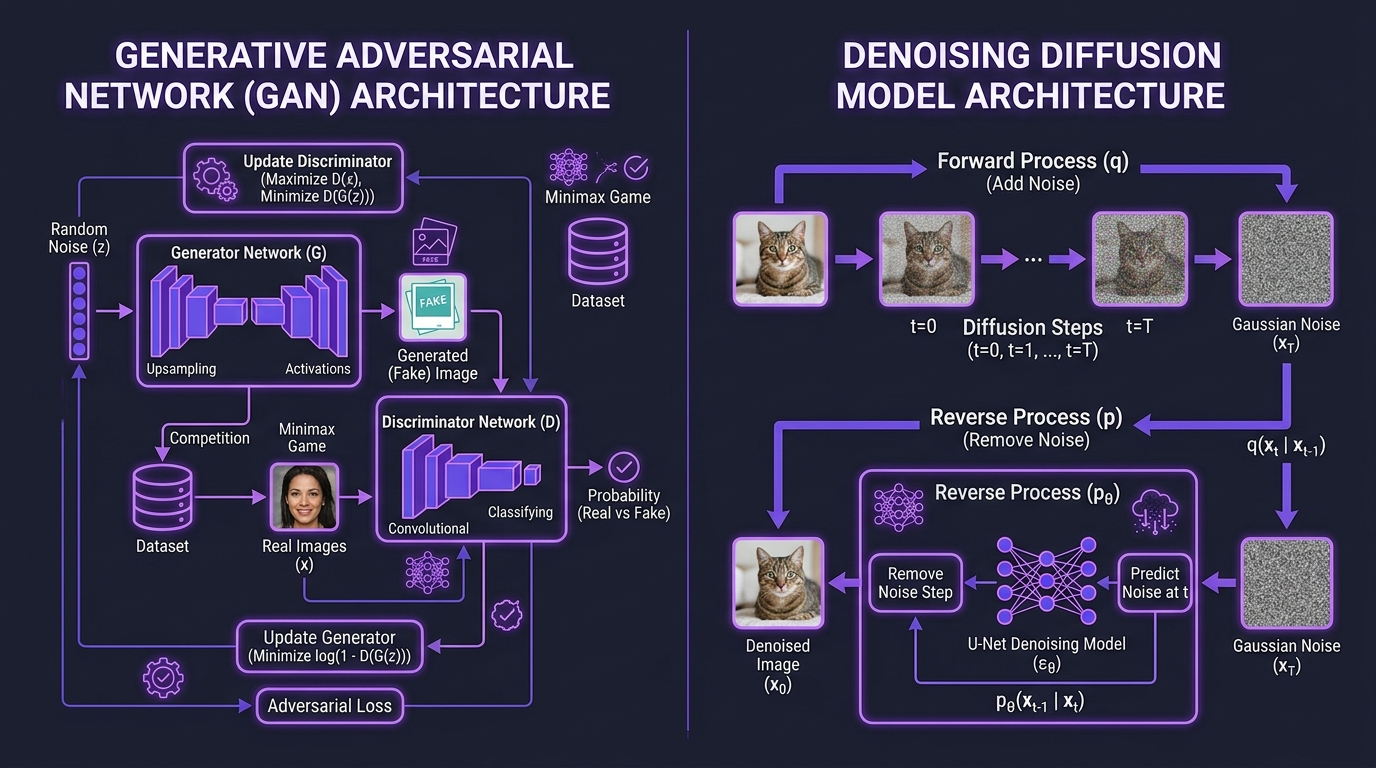
Every gramhir.pro article credits Generative Adversarial Networks (GANs) as the core engine. A GAN pairs two neural networks. The generator network produces images from random noise. The discriminator network compares those outputs against reference datasets and scores them as real or fake. Both networks improve through adversarial training until the discriminator can no longer separate generated images from authentic photographs.
That description is accurate as a description of GANs. It is out of date as a description of current text-to-image tools. The leading 2026 image generators — Midjourney V7, OpenAI’s GPT Image line, Flux 2, Imagen 4, Stable Diffusion — are diffusion models, not GANs. For a deeper technical breakdown of these architectures and how they contrast with statistical machine learning, see our guide to Generative AI vs Predictive AI. Meanwhile, emerging Bay Area visual AI leaders covered in our guide to the hottest AI startups in Silicon Valley (such as World Labs and Luma AI) are expanding into 3D spatial world models and generative video. Diffusion models start from noise and denoise iteratively toward a target, which is a different mechanism entirely.
A tool building a 2026 text-to-image product on GAN architecture would be an outlier worth documenting. No article documenting it provides evidence.
From Text Prompt to Final Image
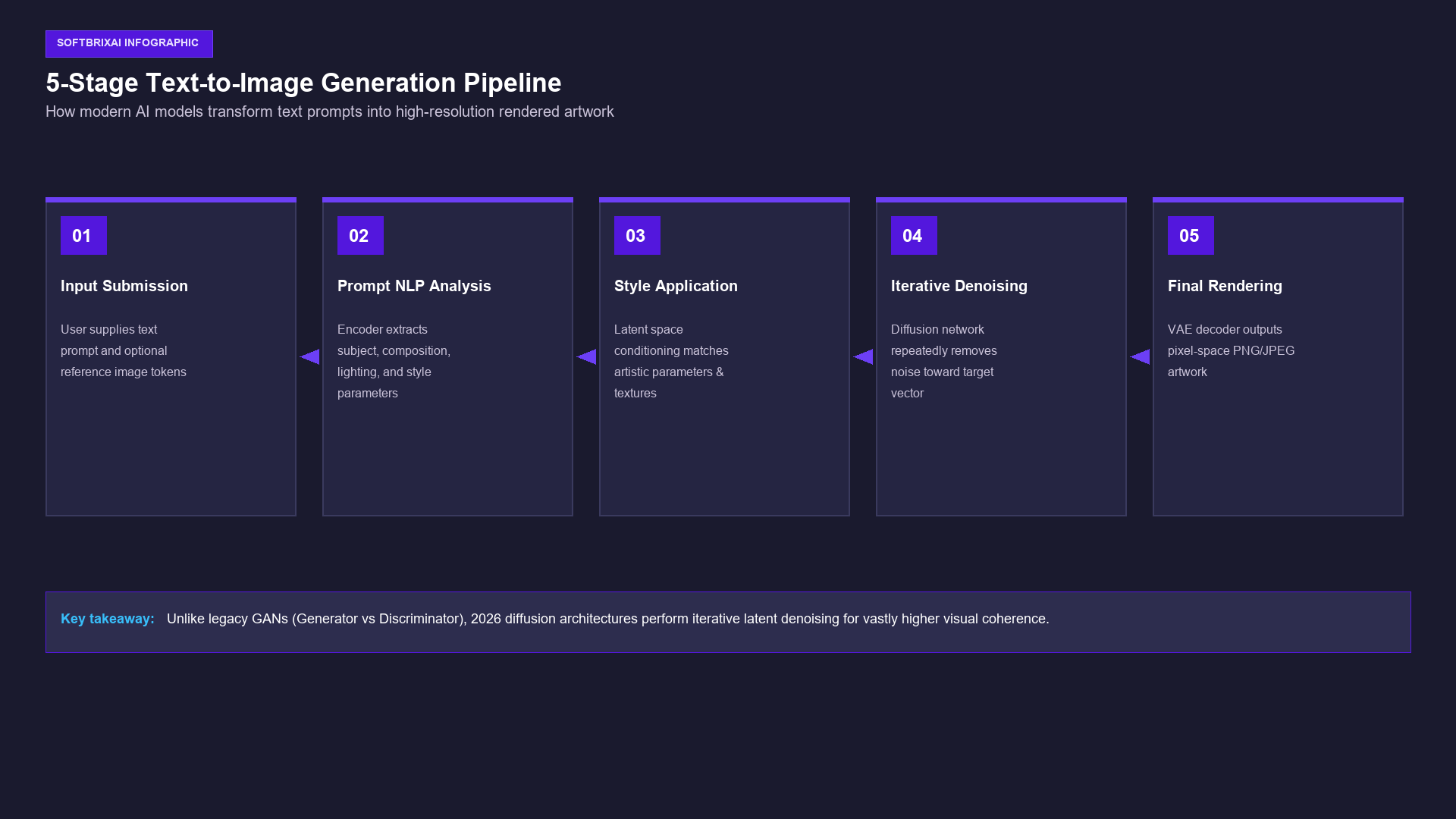
The five-step process described across these articles matches how text-to-image tools generally operate:
- Input submission. The user supplies a text prompt, optionally with a reference image.
- Prompt interpretation. Natural language processing extracts subject, style, lighting, mood, and composition from the prompt syntax.
- Style application. The engine applies selected artistic parameters and textures.
- Quality optimization. The model refines output across iterations.
- Final rendering. The system returns the completed image.
This sequence is correct for diffusion-based generators. It is generic enough to describe any of them, which is part of why the gramhir.pro articles read interchangeably.
Processing User Inputs and Prompts
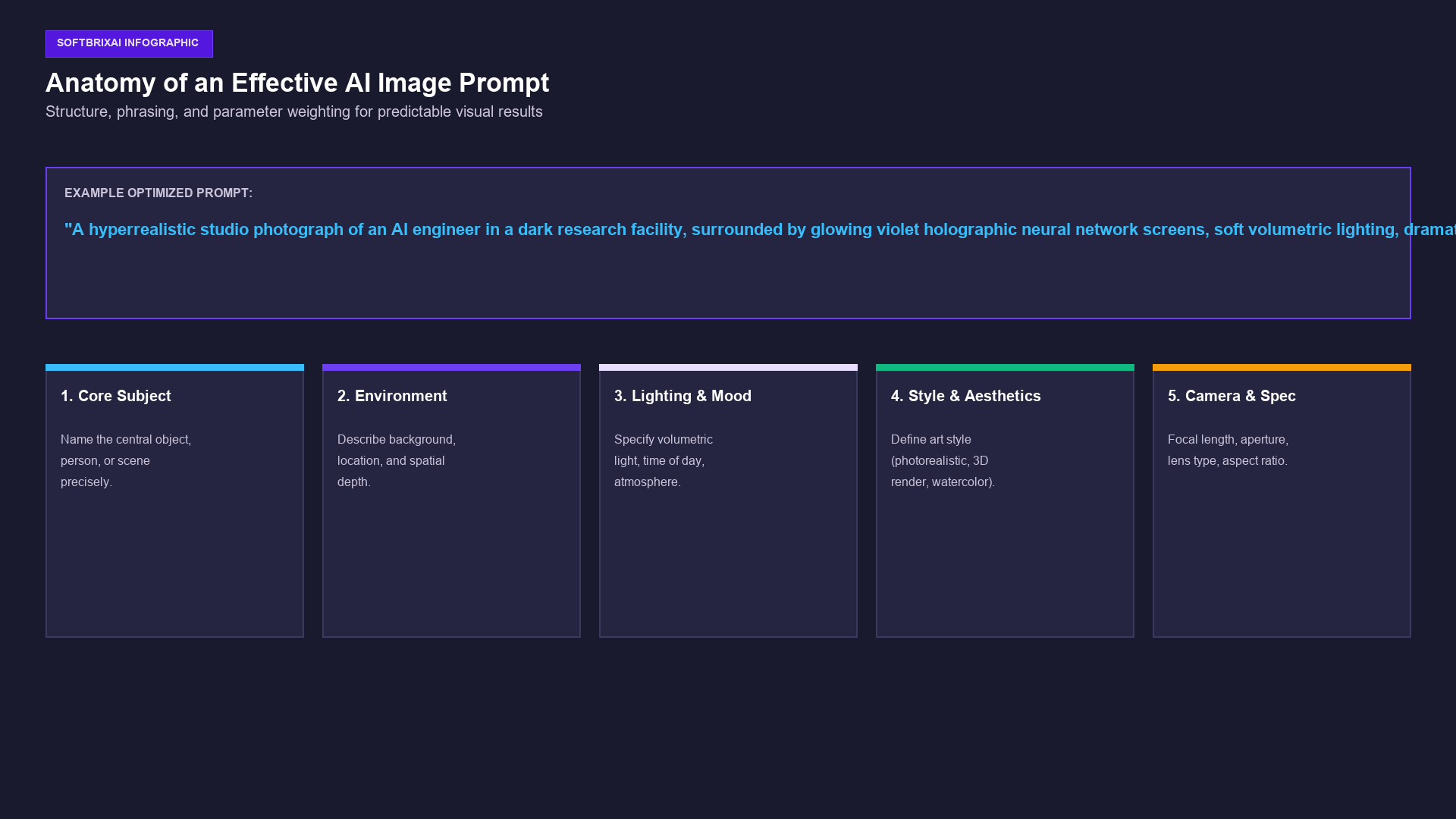
Prompt specificity drives output quality across every image generator. A prompt naming the subject, environment, lighting, mood, and style produces measurably better results than a two-word prompt. Small changes in phrasing shift the output, so testing several variations is standard practice.
This holds regardless of which tool you use. It is not a distinguishing feature of any platform. For a detailed technical look at visual feature extraction and how high-dimensional vectors encode visual concepts, explore our guide on Image Search Techniques.
Key Features Attributed to Gramhir.pro AI Image Generator
The feature list repeated across gramhir.pro coverage includes a user-friendly interface, multiple artistic style options, high-resolution output, fast processing speed, and customization of aspect ratio, colour palette, and dimensions.
Treat this list as a specification sheet nobody has checked. The claims are plausible for a modern generator and unverifiable for this one specifically. The recurring details — outputs in PNG and JPEG, five variations in under a minute, cloud processing that removes local GPU requirements — appear identically across sources with no supporting evidence in any of them.
Benefits of Using an AI Image Generator
The benefit claims made for gramhir.pro apply to AI image generation as a category, and those benefits are real when the tool works.
Speed. Manual image production takes hours. Generation takes seconds. A marketing team producing custom thumbnails for 50 blog posts a month replaces a scheduling bottleneck with a prompt-writing task.
Cost. A subscription between $10 and $60 monthly replaces per-project designer or photographer fees for routine visual work. That maths favours AI for high-volume, low-stakes assets like social graphics and blog headers.
Iteration. Generating five interpretations of one concept costs nothing beyond a minute. Traditional workflows make that comparison expensive enough that teams skip it.
These benefits are available from tools you can verify. They are not an argument for any one platform.
Verifiable Testing: What Actually Exists
No independent test of gramhir.pro image quality, speed, or output resolution exists. The “1,000 images tested” figure circulating in reviews traces to one article and is repeated without replication.
What can be verified about the category in 2026:
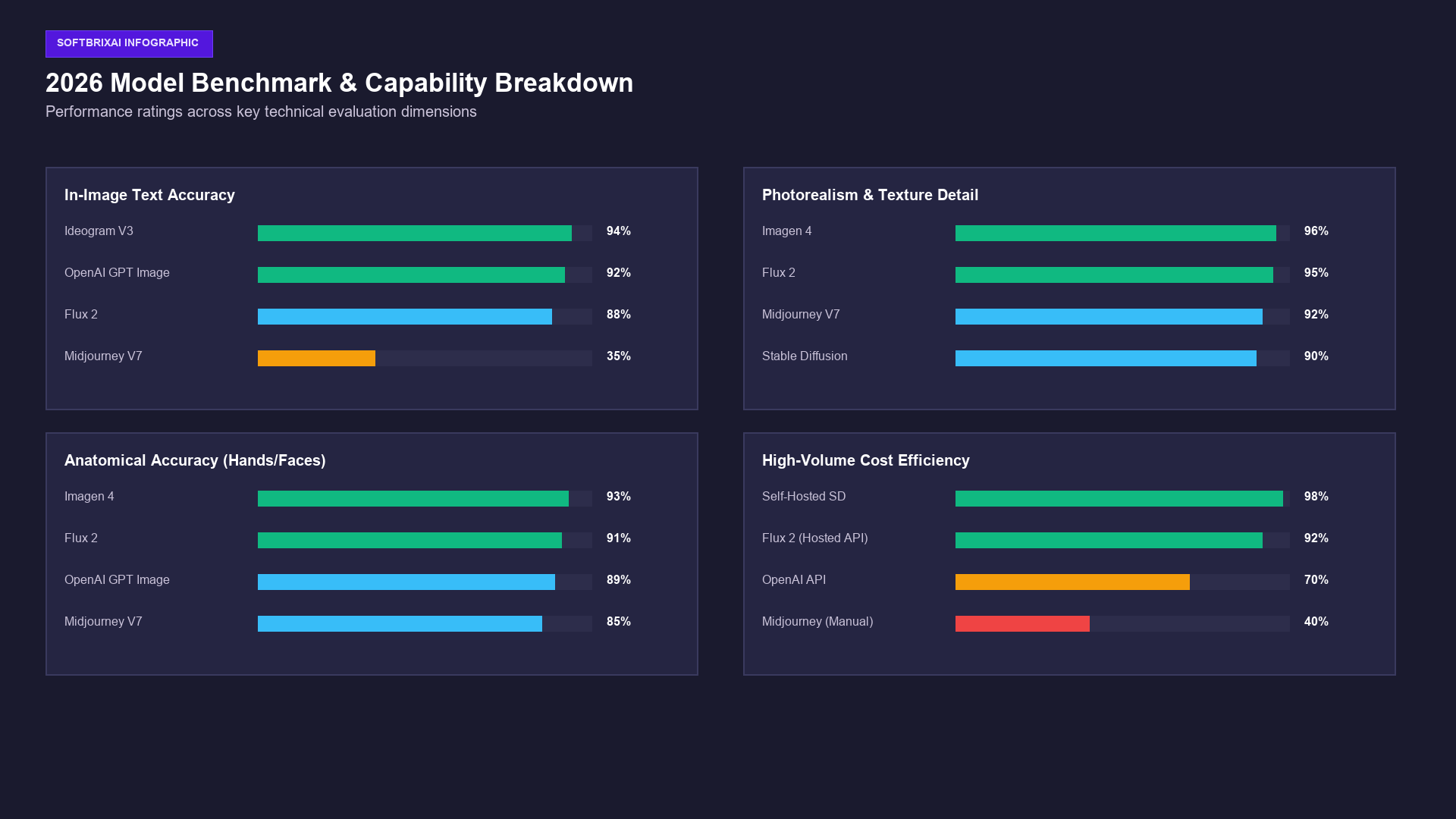
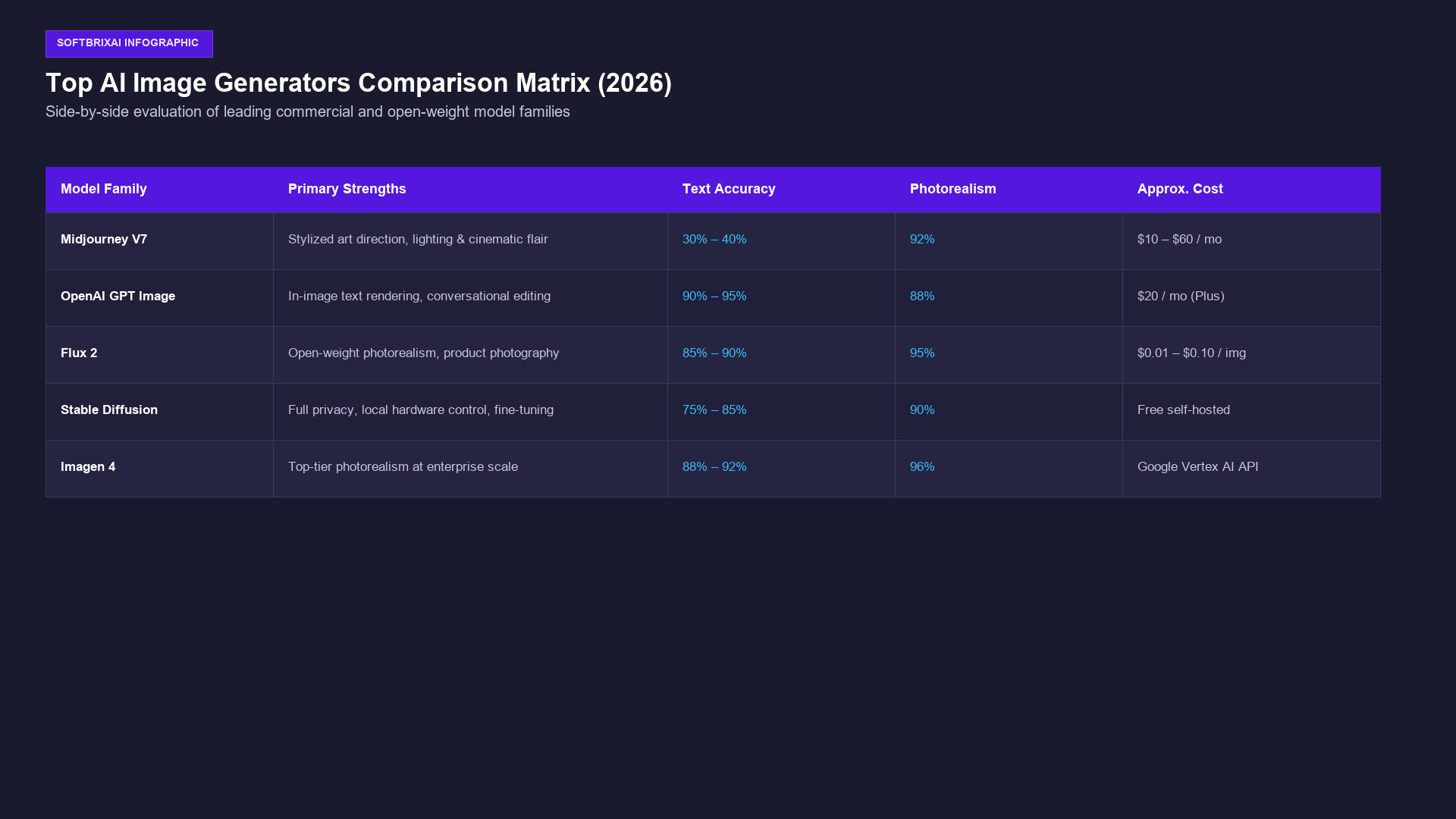
Text rendering remains the sharpest quality divide between models. Ideogram V3 leads at roughly 90 to 95 percent accuracy on text inside images. Midjourney sits around 30 to 40 percent. OpenAI’s GPT Image line is widely rated the strongest of the mainstream tools for legible in-image text, which makes it the practical choice for thumbnails, social graphics, and mockups carrying words.
Human anatomy has improved substantially. Coherent hands and accurate object rendering were the running joke of 2022 and 2023; by 2026 the leading models have largely resolved them, though fine anatomical detail still fails at a measurable rate.
Photorealism now passes casual human evaluation over 70 percent of the time across the top model families, with Imagen 4 reaching top-tier photorealism in its April 2026 release.
Speed varies by model and load rather than by any single architecture, and cloud-hosted generation removes local hardware from the equation for all major tools. For methodologies on conducting empirical latency testing and automated QA suites, read our article on Software Testing Basics.
Pricing and Limitations
The $15 monthly Pro plan attributed to gramhir.pro has no verifiable source. No pricing page, checkout flow, or plan comparison has been documented by anyone publishing that figure.
For context, verified pricing across the market in mid-2026:
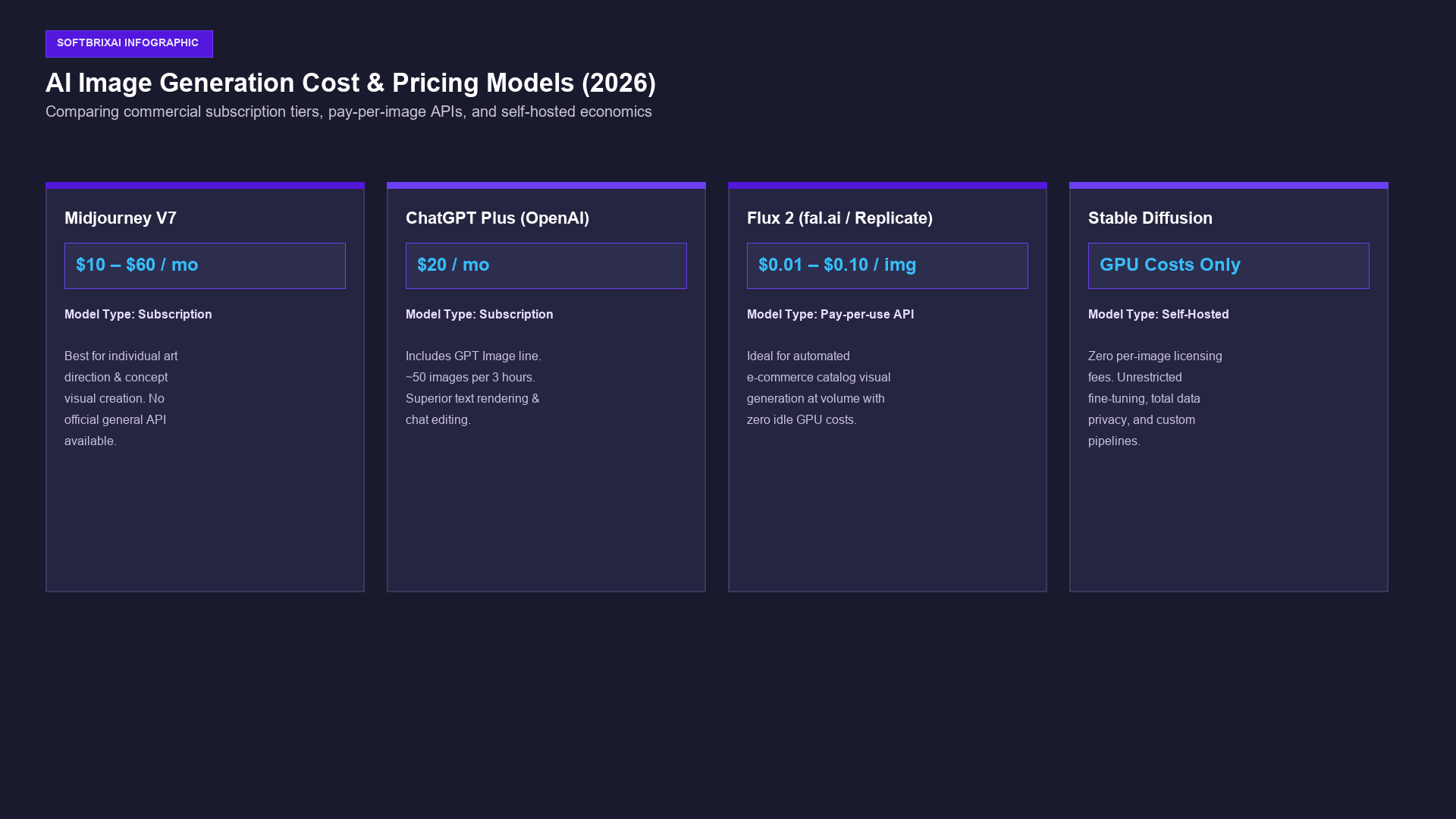
| Tool | Approximate cost | Strongest at |
|---|---|---|
| Midjourney V7 | $10–$60/month by tier | Stylised, art-directed imagery |
| OpenAI GPT Image (via ChatGPT Plus) | $20/month, ~50 images per 3 hours | Text rendering, conversational editing |
| OpenAI image API | ~$0.04–$0.12 per image | Volume and integration |
| Flux 2 | $0.01–$0.10 per image hosted; free self-hosted | Open-weight photorealism, product shots |
| Stable Diffusion | Free self-hosted; GPU costs only | Full control, privacy, custom training |
| Imagen 4 | Via Google Cloud Vertex AI | Photorealism at scale |
| Leonardo AI | Free tier and paid plans | Custom training, game assets |
| NightCafe | From ~$6/month | Breadth of model access |
Verify current pricing directly with each provider before publishing or budgeting. These figures move. For evaluating software vendor landing pages, speed claims, and transparent tier pricing, explore our assessment of the Best API Search Company’s Homepage in 2026.
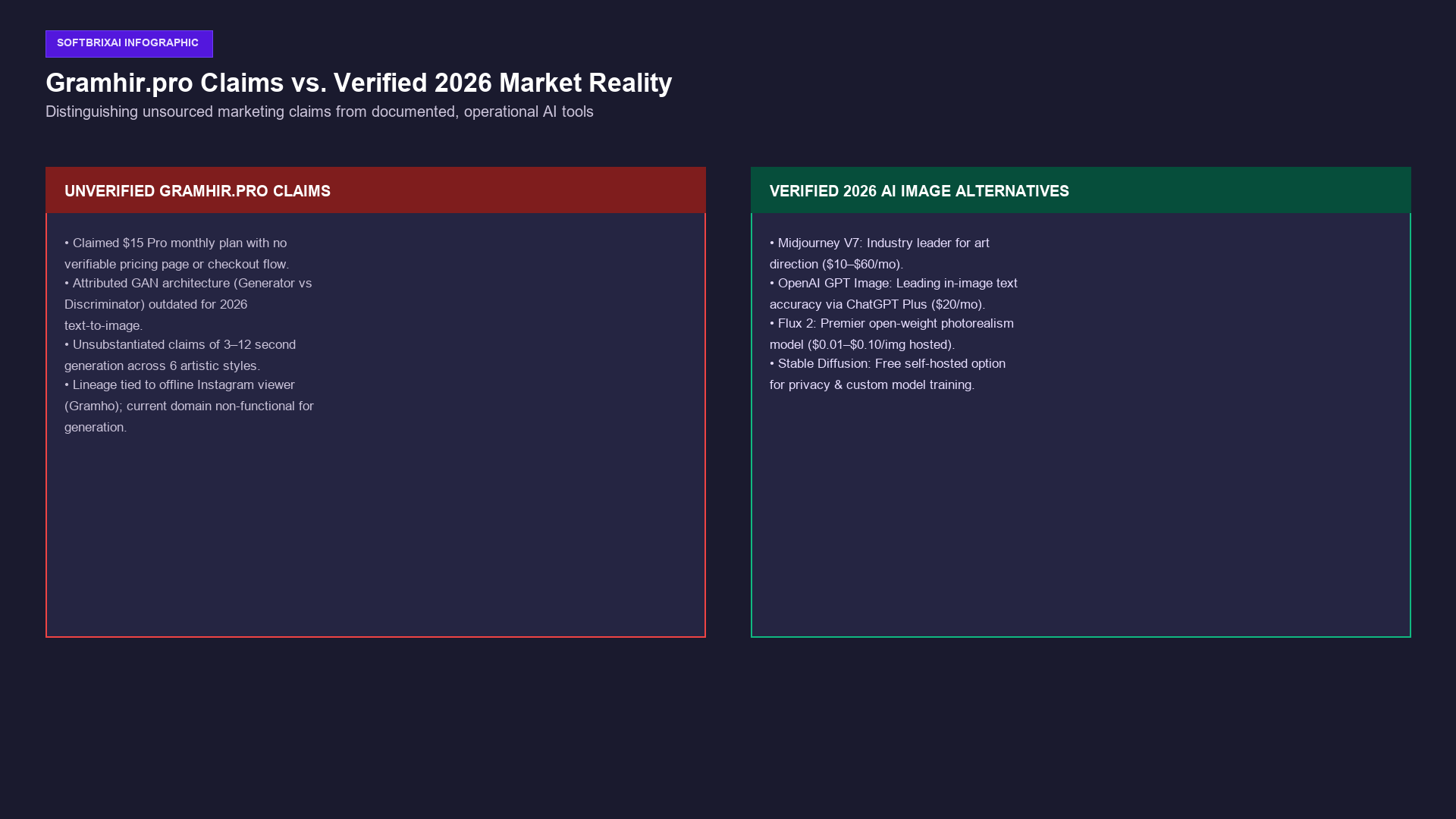
The limitation that matters most for gramhir.pro is not text rendering or anatomy. It is that the product cannot be confirmed to function. Reports through April 2026 describe non-operational image generation and a site that no longer serves its original purpose. That makes it unsuitable for any deadline-bound work regardless of what it costs.
Top Alternatives to Gramhir.pro AI Image Generator
Four model families lead in 2026, and each wins a different use case.
Midjourney V7
Midjourney produces the strongest default aesthetic of any generator. Lighting, composition, and colour grading arrive already art-directed, where competitors need explicit prompting to reach the same place. Concept art, mood boards, and campaign hero imagery are its territory.
Two trade-offs: text rendering is weak at roughly 30 to 40 percent accuracy, and Disney, Warner Bros. and major publishers have active copyright suits against the company as of mid-2026.
OpenAI GPT Image (formerly DALL·E 3)
OpenAI has folded image generation into the GPT line, retiring the DALL·E brand at API level. Its advantage is correctness rather than beauty. It follows complicated instructions faithfully, renders legible text better than any mainstream competitor, and supports conversational editing — asking for a warmer background or a repositioned logo and getting exactly that.
For marketing teams producing social graphics, thumbnails, and product mockups with text, this is the default choice. OpenAI also faces consolidated class-action claims from authors and news organisations.
Flux 2
Black Forest Labs’ open-weight model beats most closed competitors on photorealism and runs at $0.01 to $0.10 per image on hosted providers like fal.ai and Replicate. Self-hosting drops the marginal cost to GPU time. For e-commerce product shots at volume, this is usually the cheapest route to acceptable quality.
Stable Diffusion
Stable Diffusion runs on your own hardware. You control the model, the training data, and the output, with no platform restrictions and no per-image cost beyond electricity. Custom training and modification are supported. Developers and privacy-sensitive teams choose this when images are infrastructure rather than an occasional need. To understand how emerging hardware modalities are driving high-performance compute, see our deep-dive on the Latest Breakthroughs in Quantum Computing.
Which Tool Is Right for Your Needs
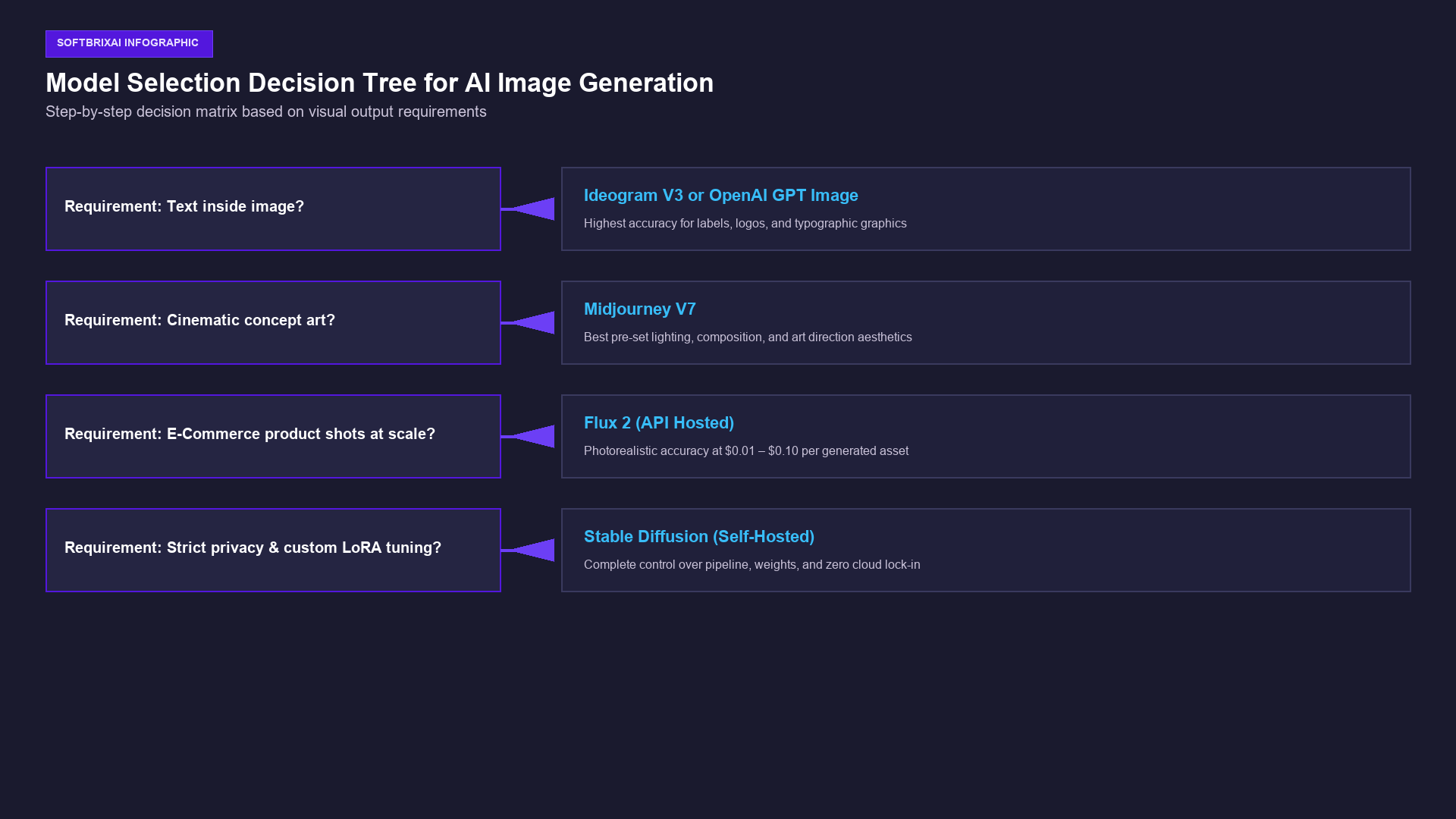
- Text inside the image: Ideogram V3 or OpenAI GPT Image.
- Artistic or stylised work: Midjourney V7.
- Product photography at volume: Flux 2.
- Photorealistic humans and faces: Imagen 4.
- Complete control and privacy: Stable Diffusion self-hosted.
- One subscription covering most needs: ChatGPT Plus at $20 monthly.
Most working teams end up using two tools rather than one, because no single model leads on aesthetics, text, and cost simultaneously. Keeping a backup also protects you when a service has an outage, the same lesson behind knowing how to check whether an AI tool like Janitor AI is down before assuming the fault is yours.
Expert Tips for Better Results From Any AI Image Generator
Prompt quality determines output quality more than model choice does at the margin. Four practices that work across every platform:
- Name the subject first, then the environment, lighting, mood, and style.
- Specify camera and rendering language for photorealism: focal length, time of day, film stock.
- Generate variations before committing, rather than refining one output repeatedly.
- Keep text out of the image where possible and add it in a layout tool afterwards.
Conclusion
Gramhir.pro is a name with search volume attached to a product nobody can demonstrate exists. The Instagram viewer that earned the traffic is offline. The AI image generator that replaced it in search results is described identically across dozens of articles, none of which cite a pricing page, a screenshot, or a company, and several independent reviews from 2026 report the tool does not function.
The underlying need is real. Marketing teams, e-commerce operators, and content creators do need fast, cheap, high-resolution visuals, and AI image generators deliver that. Midjourney, OpenAI’s GPT Image line, Flux 2, Imagen 4, and Stable Diffusion all have verifiable pricing, documented capabilities, and independent testing behind them.
Spend the $15 there instead.
FAQs
Is Gramhir Pro AI safe to use?
Treat it with caution. The original Gramhir Instagram viewer never requested user credentials, which made it safe from an account-security standpoint. That protection does not transfer to whatever occupies the domain now. No Instagram tool needs your password, and any site asking for one should be closed immediately. Avoid entering payment details on a site whose product cannot be confirmed to work.
Is Gramhir.pro AI image generator free or paid?
Unverified. The widely repeated answer — a free tier with watermarks and a $15 monthly Pro plan — has no traceable source. No pricing page has been documented.
Can you download images from Gramhir.pro?
Unverified. Reports through 2026 describe image generation as non-functional.
Does Gramhir.pro have a mobile app?
No dedicated iOS or Android application exists.
Is Gramhir Pro AI related to the Instagram viewer?
Yes. The name originated with the Gramhir Instagram Story Viewer, formerly Gramho. The AI image generator claim was attached to the same domain later, and the original viewer is no longer operating.
How accurate is Gramhir Pro AI?
No independent accuracy testing exists. Published accuracy claims trace back to unsourced articles rather than measurement.
Can beginners use it easily?
Unanswerable without a working product to test. Beginners looking for the lowest-friction entry point should start with ChatGPT’s image generation, which requires no prompt syntax and accepts plain conversational instructions.
What is Gramhir.pro and how does it work?
Gramhir.pro was an anonymous Instagram viewer that displayed public profiles, posts, stories, and engagement metrics without requiring a login. The AI image generator described in current search results is a separate claim attached to the same domain, and reviews from April 2026 report it as non-functional.
Which AI image generator produces the most realistic results in 2026?
Imagen 4 reached top-tier photorealism in its April 2026 release, matching or beating competitors on photorealism benchmarks. Flux 2 is the strongest open-weight option for realistic product imagery.
Are there completely free AI image generators?
Yes. Stable Diffusion is free to run on your own hardware. Most commercial tools offer limited free tiers with watermarks and daily generation caps, with full functionality behind a subscription.
What should I consider for high-volume image work?
Prioritise API access and per-image cost over aesthetic quality. Flux 2 at $0.01 to $0.10 per image or self-hosted Stable Diffusion handle volume most economically. Midjourney has no general API, which rules it out for automated pipelines.
What are the main limitations of AI image generators?
Text rendering remains the largest gap, ranging from roughly 30 percent accuracy on Midjourney to 90 percent-plus on Ideogram V3. Fine anatomical detail still fails at a measurable rate. Prompt writing carries a learning curve. Commercial usage rights and watermark removal usually require paid plans.
Can AI image generators replace photographers and designers?
No. They replace routine visual production — social graphics, blog headers, concept drafts, mockups. Work requiring art direction, brand judgement, or subjects that must be real still needs people.
Fact-check notes for editorial: pricing figures for all named tools should be verified against provider pages at publication date. The gramhir.pro functionality claims are sourced to independent reviews published April–June 2026; re-check before publishing in case the domain’s status has changed again.