
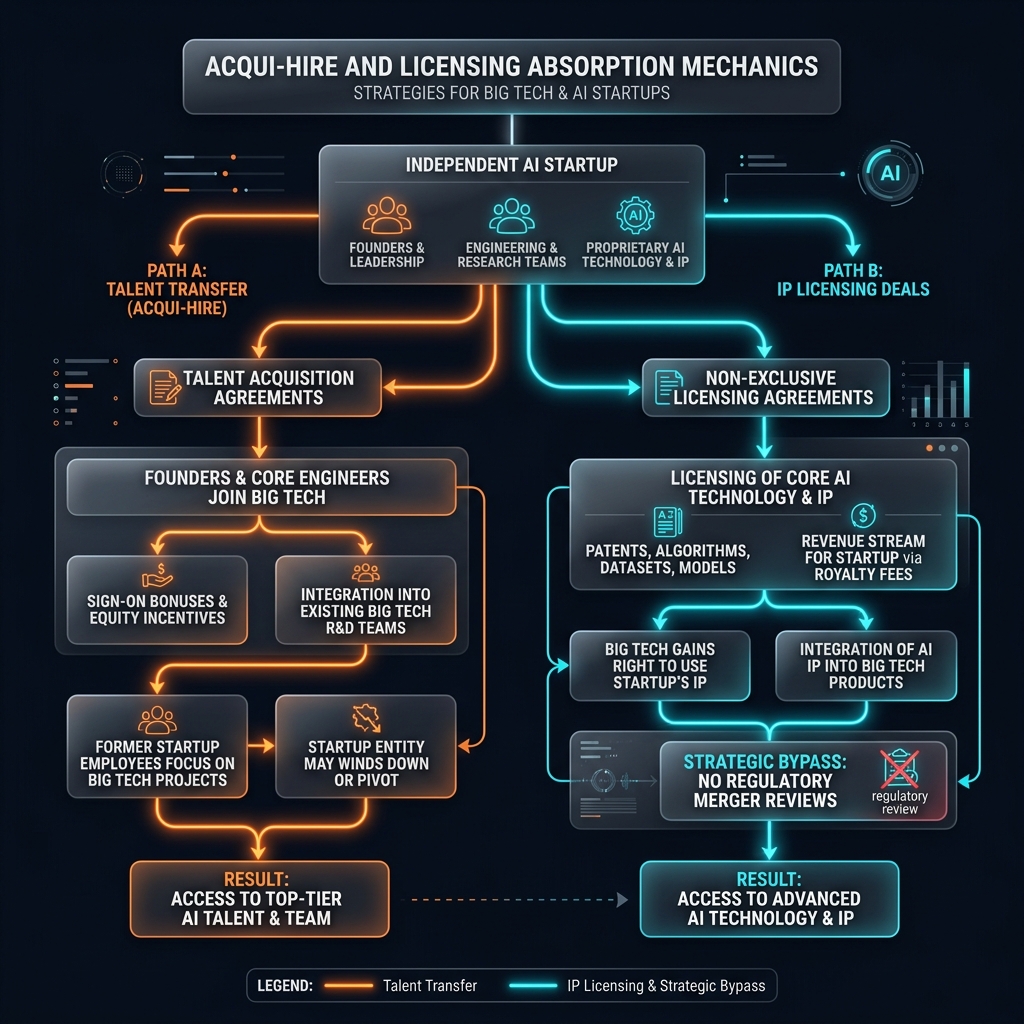
Pull up almost any “hottest AI startups” list from early 2025 and check it against who still exists as an independent company. A surprising number are gone. Adept was hired away by Amazon. Inflection’s team moved to Microsoft. Character AI’s founders went back to Google. These were not failures in the usual sense. They were absorbed through hiring and licensing deals that let the big platforms take the talent without triggering a merger review. Any 2026 list that still names them as companies to watch is quietly out of date.
So this is not that list. Every company below is privately held, still independent as of publication, and headquartered in the San Francisco Bay Area, which is what “Silicon Valley” means in practice: San Francisco, Palo Alto, Mountain View, Menlo Park, Sunnyvale, San Jose, and the towns between them. That geographic line matters more than most write-ups admit. Several of the AI companies people casually file under “Silicon Valley” are actually in New York, and a few of the most interesting ones are in Paris. Naming them accurately is part of the point.
What you should get out of this: a current, honest read on which Bay Area AI companies have real momentum in 2026, why, and how to tell the ones with a durable technical moat from the ones riding a demo. Numbers here are sourced and dated, because in this market a valuation from nine months ago can be off by a factor of two. For broader context on the AI industry shifts these companies are navigating, see our latest AI news September 2025 roundup.
Why the Bay Area still owns AI, despite predictions it wouldn’t
For years the confident forecast was that AI talent would scatter, that remote work and cheap compute would spread frontier research across the globe. It has not held up. The majority of the world’s most consequential privately held AI companies still sit within a short drive of each other in Northern California, and the concentration got tighter, not looser, as the stakes rose.
Three forces keep the flywheel spinning. The first is talent density: the founders raising the biggest rounds are overwhelmingly ex-OpenAI, ex-Google DeepMind, ex-Meta FAIR, or Stanford researchers, and they hire from the same pool. The second is capital: Sequoia, Andreessen Horowitz, Accel, Greenoaks, Founders Fund, and Thrive operate within miles of each other and can price a round in days. The third, and the one people underweight, is customers. The enterprises willing to be early reference accounts for an unproven agent are often other Bay Area companies, which shortens the loop from prototype to paying deployment.
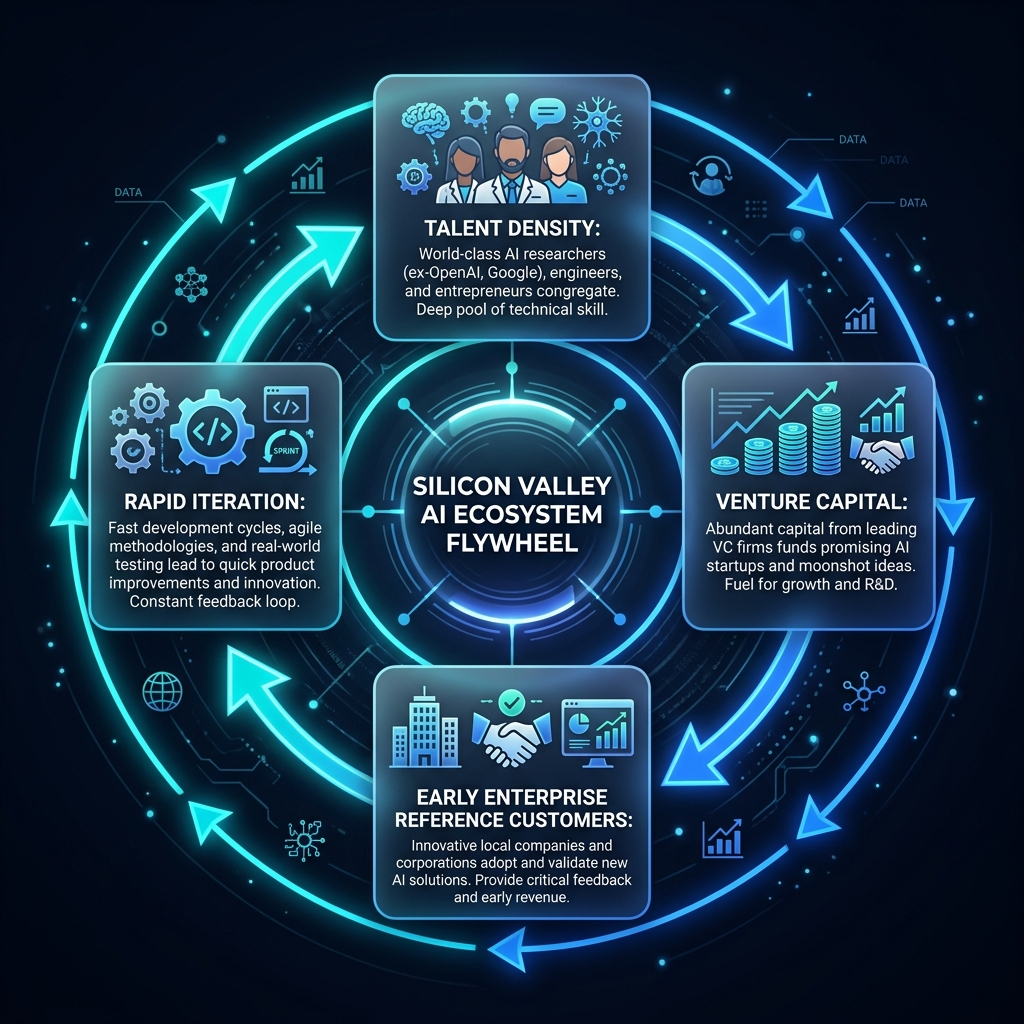
Here is the honest caveat. This concentration is a bet, not a law of nature. Mistral built a $14 billion business in Paris specifically by not being American, and open-source model leadership has repeatedly come from outside the Valley. The Bay Area’s edge is real and self-reinforcing today. It is not guaranteed, and the smartest founders here know it.
What “hot” actually means in 2026
Hot is not the same as highly valued, and this year made the gap obvious. Figure AI carries a $39 billion valuation on revenue most analysts estimate in the low tens of millions. That can be a reasonable bet on humanoid robots inheriting the labor market, or it can be froth. Either way, the price tag alone tells you almost nothing about whether the company is executing.
The signals that actually separate a breakout from the pack are less about the headline number and more about what sits underneath it. Revenue that compounds monthly, not media mentions. A technical moat that a competent team could not rebuild in a weekend, which rules out most thin wrappers over someone else’s model. Enterprise adoption that has crossed from pilot to production, measured in signed multi-year contracts rather than logos on a slide. And a founding team that keeps shipping through uncertainty instead of freezing when the model landscape shifts under them.
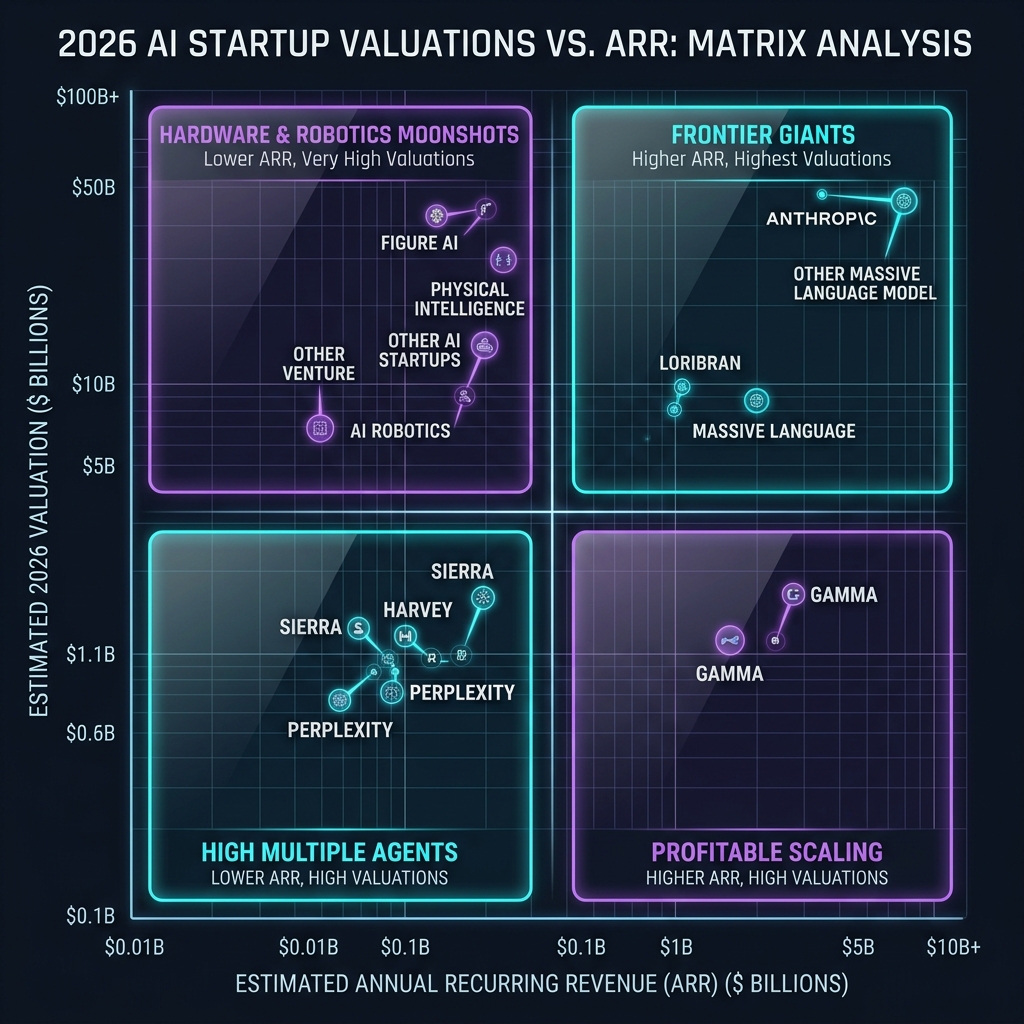
The revenue math is worth internalizing because it explains the valuations. The best application-layer companies are trading at roughly 20 to 45 times annual recurring revenue, and the standout agent companies command even more: customer-service agents have changed hands near 100 times ARR on the argument that they are replacing labor budgets, not software budgets. That premium is the whole thesis. It is also the whole risk, because it only holds if growth stays vertical for years. Telling a genuine moat from a temporary lead is the core judgment call here, and it is the same one I make when deciding whether a client’s “AI agent” idea needs real orchestration and evaluation infrastructure or just a good prompt.
The 25: Silicon Valley’s hottest AI startups to know
A note before the list. This is not a strict one to twenty-five ranking. Precisely ordering twenty-five private companies whose valuations move every quarter would be false precision. The rough order runs from the most established and highly valued toward the earlier and more speculative, grouped loosely by where they play. Every figure is dated so you can check whether it has moved by the time you read this.
1. Anthropic

Anthropic has arguably outgrown this list. The maker of Claude closed a $65 billion Series H at a $965 billion post-money valuation in May 2026, per its own announcement and TechCrunch, surpassing OpenAI as the most valuable AI company, and it filed confidentially for an IPO on June 1. Run-rate revenue crossed $47 billion, driven heavily by Claude Code, its agentic coding product. At near a trillion dollars and heading to public markets, it is less a startup to watch than the giant everyone else is measured against. Included here because no honest Bay Area list can omit it.
2. Replit

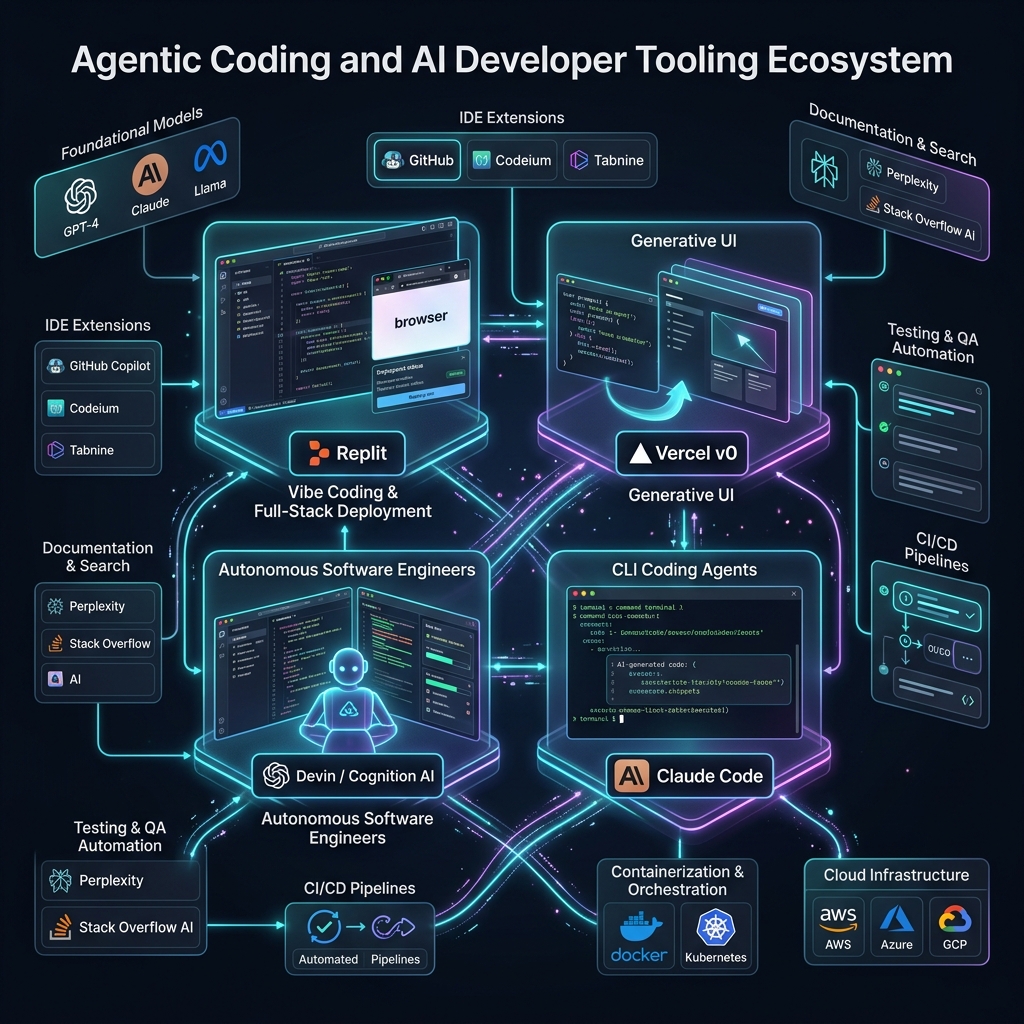
Type a sentence describing an app you want, and Replit’s agent will scaffold, write, and deploy it while you watch. That “vibe coding” pitch, led by founder Amjad Masad, has pushed the browser-based coding platform to a reported $9 billion valuation. Replit’s edge is owning the entire loop from idea to running URL inside one environment, which lowers the barrier for non-engineers more than any pure code-completion tool. The open question is durability: as coding agents commoditize, teams leveraging adaptive software development recognize that Replit’s moat is the integrated runtime and its education-to-prosumer user base, not the model itself.
3. Vercel

Every frontend team already knows Next.js, the framework Vercel maintains. Fewer clock how deliberately Vercel turned that developer mindshare into an AI position with v0, its generative-UI tool that turns prompts into production React components, and its AI SDK, which has become a default way to wire models into web apps. The company sits at the intersection of hosting, developer tooling, and AI, which is a strong place to stand. Its risk is that it competes on several fronts at once, against both infrastructure incumbents and a wave of AI-native app builders.
4. Deepgram

Voice is the interface AI still gets wrong most often, and Deepgram has spent years on the unglamorous parts: fast, accurate speech-to-text and, increasingly, the full voice-agent stack that lets software hold a real-time spoken conversation. The San Francisco company sells to contact centers, developers, and anyone building voice into a product. As voice agents become a mainstream way to deploy AI in 2026, Deepgram’s bet on owning the transcription and synthesis layer rather than the application looks well timed, though it now competes with a crowded field of voice-AI entrants.
5. Figure

A $39 billion valuation on close to zero disclosed revenue tells you exactly what kind of bet Figure is. The San Jose humanoid-robotics company raised over $1 billion in its September 2025 Series C, per Bloomberg, launched its Figure 03 robot in October, and runs a factory called BotQ that it says produces one robot roughly every ninety minutes. Its Helix system for on-robot intelligence is in-house, and it has a real deployment with BMW. The bear case is equally concrete: the price implies flawless execution across hardware, AI, and manufacturing at once, and BMW has since trialed a rival’s robot too. Highest risk, highest ceiling on the list.
6. Groq

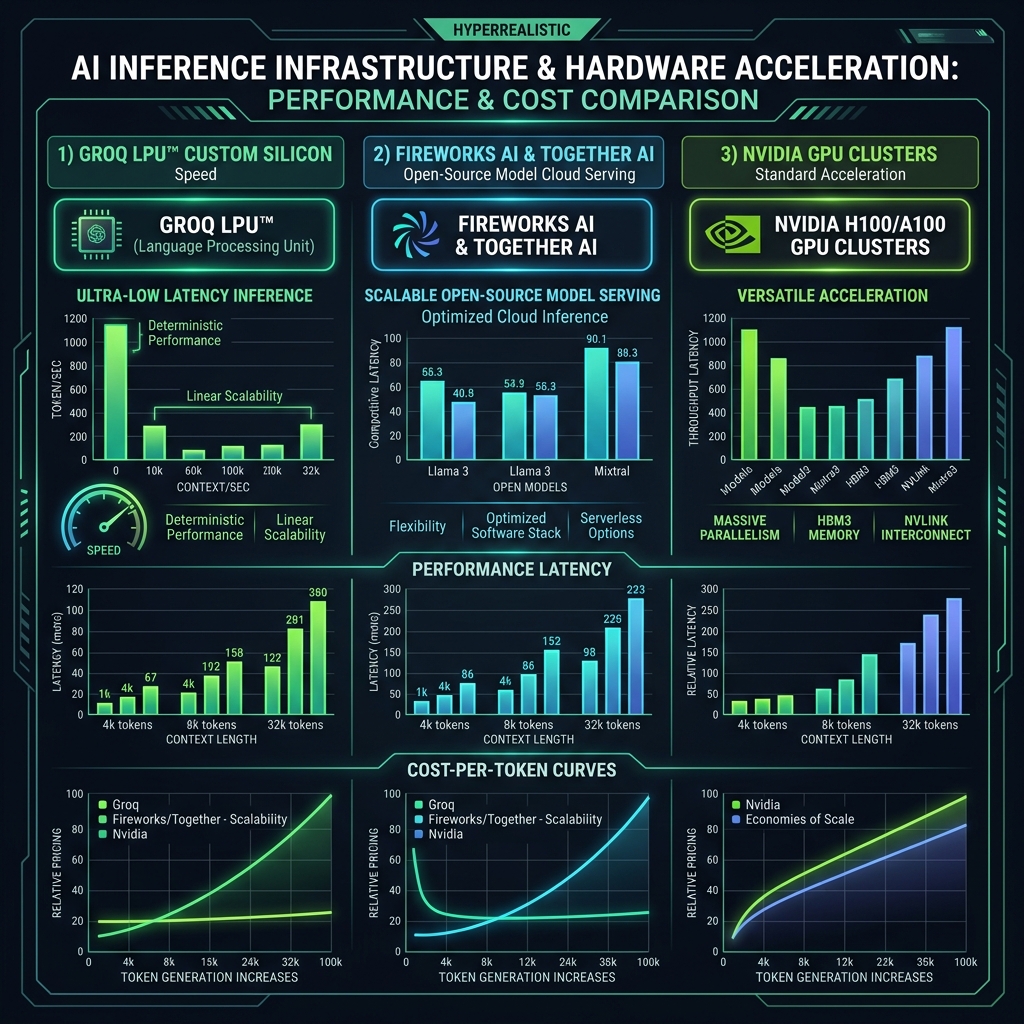
While much of the field argues about models, Groq bet on the chip underneath them. Its custom LPU inference hardware delivers dramatically faster token generation for certain workloads, and that specialization earned a roughly $6.9 billion valuation on a $750 million round in September 2025, per TechCrunch. Inference cost and latency have quietly become the constraint that decides which AI products are economically viable, which is exactly the layer Groq attacks. The challenge is that it competes with Nvidia’s gravitational pull and a handful of other custom-silicon startups, so distribution and developer adoption matter as much as raw speed.
7. Hippocratic AI

A phone call from your clinic that reminds you about a medication, checks how you are feeling, and flags anything worrying to a nurse: that is the product Hippocratic AI is building, and it is deliberately staying on the non-diagnostic side of the line. The Palo Alto company, valued around $3.5 billion, builds “AI staff” for healthcare and leans hard on safety testing with clinicians because the cost of a wrong answer here is measured in patient harm, not a bad chatbot reply. Its moat is regulatory trust and clinical validation, which is slow to build and hard to copy.
8. Harvey

Law firms are among the most conservative enterprise buyers alive, which makes Harvey’s traction the interesting part. The legal-AI company raised $200 million at an $11 billion valuation in March 2026, per CNBC, on reported annualized revenue above $200 million, selling contract analysis, due diligence, and research agents into Am Law firms and corporate legal teams. Its edge is deep customization for specific practice areas plus embedded engineers who make the tool fit real legal workflows. In a category where accuracy is non-negotiable, that last-mile investment is the moat, not the underlying model.
9. Perplexity

Can anything actually dent Google search? Perplexity is the most credible attempt, and the numbers show why people take it seriously: roughly a $23 billion valuation as of its January 2026 round, per Tracxn and multiple trackers, with annualized revenue estimated around $450 to $500 million by mid-year, up from under $100 million in 2024. The company ships an answer engine that cites its sources, a Chromium-based browser called Comet, and an agent product, and it routes across frontier models rather than betting on one. The bear case is the valuation itself: north of 40 times revenue only works if growth never slows and Google never fully responds.
10. Cognition AI

Devin was the first tool marketed as a genuine “AI software engineer” that plans, writes, tests, and ships code on its own. Its maker, Cognition, led by Scott Wu, was valued at $10.2 billion in a September 2025 round led by Founders Fund and was reported in talks for a new round near $25 billion in April 2026, per TechCrunch and follow-on coverage. The company became more strategically interesting after acquiring the Windsurf coding tool, which was generating roughly $82 million in ARR at the time. The competitive question is stark: it now faces Anthropic’s Claude Code and every other coding agent, in the most crowded category in AI.
11. Glean

The document you need is buried somewhere across Slack, Drive, Jira, and email, and Glean’s entire pitch is that its assistant finds it and acts on it. The Palo Alto enterprise-search company reached a $7.2 billion valuation in a December 2025 Series F, per Fortune’s reporting, after doubling ARR from roughly $100 million to $200 million in about nine months. Its moat is the permission-aware index that respects who is allowed to see what inside a company, which is genuinely hard to build and harder to retrofit. As Glean moves from search into agents that take actions, it is expanding from a feature into a platform.
12. Sierra

Bret Taylor’s second act is the clearest proof that founder credibility still moves markets. Sierra, which he co-founded with former Google VP Clay Bavor, builds enterprise customer-service agents and reached a $10 billion valuation on a $350 million round in September 2025 led by Greenoaks, per TechCrunch, after hitting $100 million in ARR in about seven quarters. The product handles regulated, high-stakes tasks like authentication and mortgage questions across phone, chat, and email, and it charges for completed outcomes rather than seats. That pricing model is the tell: Sierra is selling results, which is what lets it command an agent-tier multiple. The catch is that customer service is the most contested agent category anywhere.
13. Afresh

Grocers throw out billions of dollars in fresh food every year because a store manager cannot reliably guess how many cartons of strawberries will sell on a rainy Tuesday. Afresh sells AI that makes those ordering decisions, and it is scaling: $34 million in new funding in April 2026, deployment across more than 12,500 departments in 40 states, and 70 percent year-over-year revenue growth in 2025, per the company and PRNewswire. Customers including Albertsons and Meijer report shrink dropping by as much as 25 percent. This is vertical AI at its most defensible, because the hard part is fresh-food data and operational trust, not the model.
14. Hightouch

Calling Hightouch an “AI startup” is a stretch its older self would not recognize, and that is worth being honest about. The San Francisco company made its name in data activation, moving data out of the warehouse into the tools marketers use. Its newer “AI Decisioning” product is a real move up the stack: agents that decide, per customer, which message or offer to send, trained on warehouse data. Whether that reframes Hightouch as a genuine AI company or a data-infrastructure firm with an AI layer is a fair debate. I lean toward the latter for now, but the warehouse-native position is a strong base to build agents from.
15. Coactive AI

Most enterprise data is now images and video, and almost none of it is searchable in any useful way. Coactive, based in San Jose and at Series B, builds multimodal AI that pulls meaning directly from pixels and audio so teams can search and analyze visual content without manually tagging it. Its customers skew toward retailers and media companies drowning in visual assets. The company is smaller than the headliners here, but the problem it owns is large and mostly unaddressed, and multimodal understanding is exactly where a lot of 2026’s product value is moving.
16. Thinking Machines Lab

Few companies open their life at a valuation above $10 billion. Thinking Machines Lab did, on the strength of its founder: Mira Murati, OpenAI’s former chief technology officer, assembled a roster of senior researchers, and the market priced the lab in the same over-$10-billion tier as a small handful of frontier players, per CNBC’s reporting. There is no mass-market product to judge yet, which makes this a bet on people rather than traction. In a year when the model layer is consolidating, another serious independent frontier effort is notable precisely because it is swimming against that current.
17. World Labs

Fei-Fei Li spent her career on how machines see, and World Labs is her attempt to make them understand space. The San Francisco company raised $1 billion in February 2026, per its own announcement, to build “world models” that generate consistent, persistent 3D environments from an image, video, or text prompt. Its first product, Marble, turns a single image into an explorable 3D world. Much like our evaluation of next-generation AI image generators, 3D world models operate upstream of gaming, simulation, and robotics.

18. Physical Intelligence

Figure builds the body; Physical Intelligence is building the brain that could run many bodies. The San Francisco company, valued around $5.6 billion, develops foundation models for robots, general-purpose control software meant to work across different hardware rather than one proprietary machine. Its founders include leading robotics researchers, and its backers read like the Valley’s A-list. The strategic bet is that the winning layer in robotics is the model, not the metal, which would put Physical Intelligence in a picks-and-shovels position under the entire humanoid boom. It is early, and generalizable robot control remains an unsolved research problem, which is the whole risk.
19. Mercor

The least glamorous company on this list may be the most strategically placed. Mercor runs a marketplace that connects AI labs with the human experts they need to train and evaluate frontier models, doctors, lawyers, PhDs who supply the high-quality judgment that reinforcement learning and evaluation depend on. As every lab races to improve models, the bottleneck has quietly shifted from compute to expert data, and Mercor sits on that bottleneck. The company has grown revenue exceptionally fast for its age. If proprietary training and evaluation data is the durable moat many investors now believe it is, Mercor is selling the shovels.
20. Decagon

Sierra gets the headlines; Decagon is quietly signing enterprise customer-service deals of its own. The San Francisco company builds AI agents that resolve support conversations end to end across channels, competing directly in the most crowded agent category in the enterprise. Its pitch is resolution quality and deep integration into a company’s existing systems rather than a thin chat layer. Being the less-hyped name in a hot category can be an advantage if the product is genuinely better, because it keeps acquisition costs down while incumbents spend to defend. The risk is the same one every support-agent company faces: durable differentiation is hard when Salesforce, Zendesk, and a dozen startups all ship agents.
21. Gamma

One hundred million people have made a deck, a webpage, or a social graphic with Gamma at least once, and more than 600,000 pay for it, per Forbes. Founder Grant Lee’s company reached a $2.1 billion valuation and, unusually for this list, has been profitable since 2023. You type a prompt, Gamma designs the slides. Its moat is less technical than behavioral: it turned an annoying, universal chore into something fast, built a habit, and reached real scale without burning capital. In a cohort full of pre-revenue moonshots, a profitable consumer AI product with a hundred million touches is its own kind of rare.
22. Fireworks AI

Open-source models are only useful if someone runs them cheaply and quickly, and Fireworks AI is one of the companies making that practical. The San Francisco firm offers fast, low-cost inference and fine-tuning for open models, competing on price and flexibility so that teams can deploy Llama, Mixtral, and their successors without standing up their own GPU fleet. As more applications move from prototype to production, optimizing latency and API throughput matches the core performance goals seen in company homepage search APIs and application acceleration managers.
23. Together AI

Where Fireworks optimizes for speed on specific models, Together AI positions itself as a broader cloud for open-source and custom AI, training, fine-tuning, and inference in one place. The San Francisco company is a bet that many enterprises will want an alternative to running everything through the closed frontier labs, keeping their models and data under their own control. That thesis has weight in 2026 as open models close the quality gap and buyers get cost-conscious. The same forces that help Together, cheap open models and price-sensitive buyers, also compress what any single infrastructure provider can charge, so scale and reliability are the game.
24. Luma AI

Describe a shot and Luma renders it as video. The Bay Area company, valued around $4 billion, builds generative video and 3D models, with its Dream Machine product among the most-used consumer video generators. Generative video is widely expected to be one of 2026’s breakout categories, and Luma is one of a small set of credible players in it. The competitive field is brutal, spanning better-funded rivals and the video efforts of the frontier labs themselves, so Luma’s path depends on staying at the quality frontier and finding the creative and enterprise use cases where its output is good enough to pay for.
25. Chroma

Every retrieval-augmented system needs somewhere to store and search its vectors, and Chroma is the open-source answer many developers reach for first. The San Francisco company builds an embeddings database that has become a default in a lot of RAG prototypes because it is easy to start with and open by design. Its commercial challenge is the classic open-source one: converting widespread free usage into managed-service revenue against well-funded proprietary competitors. Its opportunity is that as more teams move RAG from demo to production, the ones who standardized on Chroma early are a natural upgrade path. Winning developer defaults is how infrastructure companies get built. For teams weighing that jump, how retrieval pipelines are built for production is where the real engineering decisions live.
A note on who is not here. A few companies people expect on a “Silicon Valley” list are elsewhere and were left off on geography, not merit: Runway (generative video, New York), Pinecone (vector databases, New York), and Viam (robotics software, New York). Reflection, a well-funded open-model challenger, is in Brooklyn. They are excellent companies. They are just not in the Bay Area.
Five shifts driving the 2026 startup boom
Five changes explain why this year’s list looks nothing like 2023’s, when nearly every hot startup was building a foundation model.

The first is verticalization. The generic chatbot is a commodity now, so the money moved to companies that take a foundation model and wrap it in the data, workflow, and compliance of a single industry: Harvey in law, Hippocratic in health, Afresh in grocery. The second is agents. The center of gravity shifted from tools that answer questions to systems that complete tasks, and the engineering behind production-grade AI agents, orchestration, tool use, evaluation, and guardrails, is now where a lot of the hard work sits. The third is AI-native developer tooling, from Cursor and Replit to Vercel, because the people building everything else need better tools first.
The fourth is the fusion of robotics and AI. Foundation models and cheap simulation made general-purpose robots suddenly plausible, which is why Figure, Physical Intelligence, and World Labs are all pulling nine and ten-figure rounds. The fifth is inference economics. Every 10x drop in the cost of running a model makes viable a set of products that were previously too expensive to serve, which is the entire reason Groq, Fireworks, and Together exist, and it depends on the kind of MLOps work that keeps inference cheap and reliable at scale. Running underneath all five is a sharper focus on AI safety and governance, less because everyone suddenly turned virtuous and more because enterprise buyers now demand it before they sign.
The headwinds nobody puts on the highlight reel
The biggest threat to a hot AI startup in 2026 is not a competitor. It is getting absorbed. The acqui-hire wave that took Adept, Inflection, and Character AI is the defining risk of the category: a big platform hires your founders and licenses your technology, your investors get made roughly whole, and the independent company you were watching quietly stops mattering. Cursor’s maker, Anysphere, agreed to a roughly $60 billion acquisition by SpaceX in mid-2026, per multiple reports, showing the pattern now reaches even the fastest-growing names. Any list of “startups to watch” is really a list of “companies that have not yet been absorbed,” and that framing should change how you read all of them.
The other pressures are more familiar but no less real. Talent is savagely expensive, with the same few hundred researchers bid up across every lab. Compute costs remain brutal: training and serving large models is a capital sink, and the pre-revenue robotics bets are burning fastest of all. There are unresolved ethical fault lines around data, bias, and, in Anthropic’s case, a public fight with the U.S. government over autonomous weapons and surveillance that got it blacklisted by the Pentagon. And there is the froth question. When a pre-revenue company is worth $39 billion and support agents trade near 100 times revenue, some of these prices assume a future that has to arrive on schedule. If it does not, the correction will be sharp and it will not be evenly distributed.
How to evaluate an AI startup like a Bay Area VC
If you are sizing one of these companies up, whether to join it, buy from it, or invest, five questions cut through the noise faster than any pitch deck.
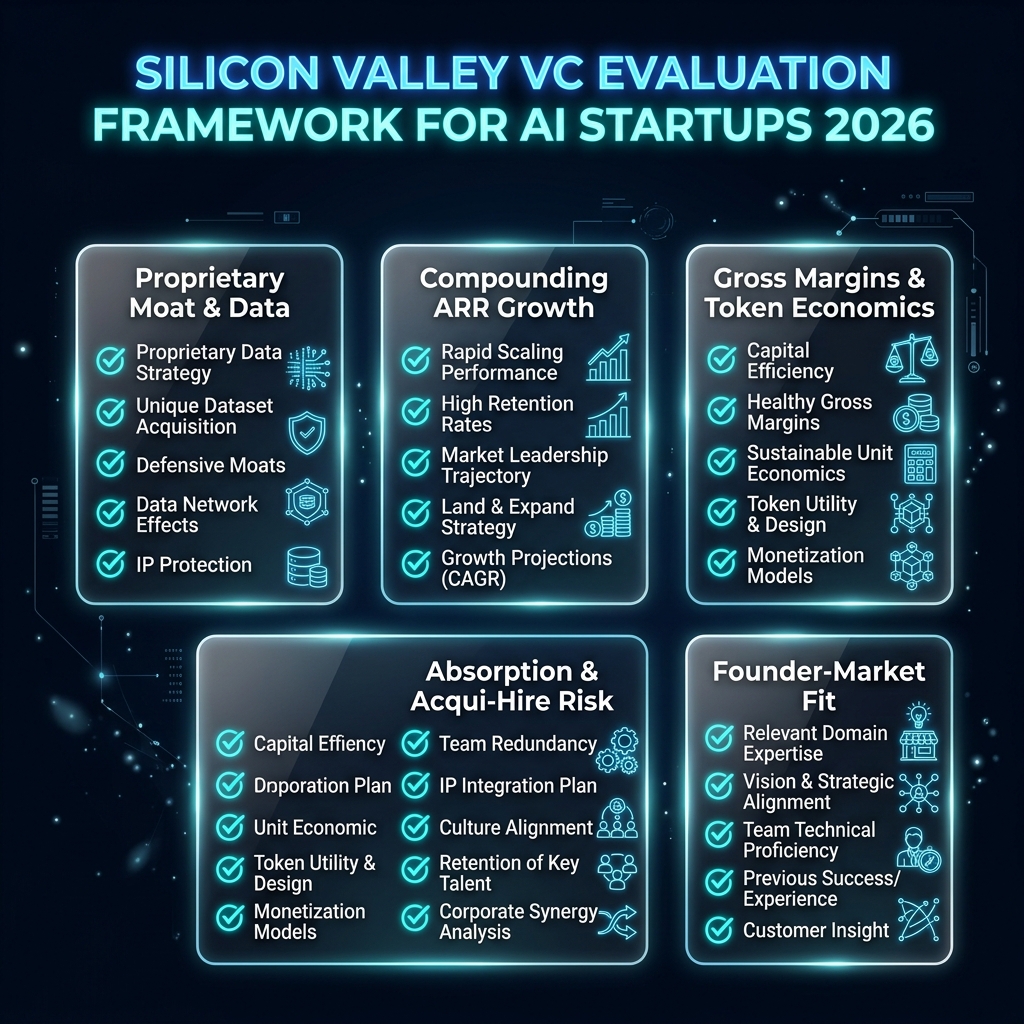
- Where is the moat, specifically? Name it: proprietary data, a genuine algorithmic edge, distribution, or a workflow lock-in. If the honest answer is “a good prompt over someone else’s model,” you are looking at a wrapper, and wrappers get squeezed the moment the model provider ships the same feature.
- Is the revenue real and compounding? Ask for ARR and its growth rate, not total funding. A company growing ARR at 10 percent a month is a different animal from one with a big round and a flat top line. Watch for the demo-to-production gap: getting an agent to 99 percent reliability is exponentially harder than the impressive demo.
- Do the unit economics point anywhere good? Inference costs are falling, which helps, but a company paying more to serve a query than it charges for one is not a business yet. Ask where gross margin goes as they scale.
- What is the acquisition and absorption risk? Given the acqui-hire pattern, ask how dependent the company is on a handful of founders a platform could hire away, and how much of its technology is licensed rather than owned. This is a 2026-specific question the older playbooks skip.
- Is there founder-market fit? The strongest companies here are led by people who lived the problem: a former front-desk worker in property management, a former Salesforce co-CEO in enterprise software, career researchers in robotics. Credentials help raise money. Fit is what makes them build the right thing.
My honest take
If I had to compress all of this into one sentence: the model layer is consolidating toward a few giants, and the value is moving up the stack into vertical workflows and agents that actually complete work. That is where I would spend my attention if I were a builder, a buyer, or a candidate. The safest technical bets on this list are the ones whose moat is data and workflow rather than a model anyone can rent, because the model is the part most likely to be commoditized or absorbed.
One concrete next step if you are trying to keep up with this space: pick two or three companies here whose category you actually work in, and track their ARR and their round cadence over the next two quarters rather than their valuations. Revenue tells you who is real. Valuations tell you what the market is hoping.
The same concentration has a flip side for everyday users: leaning your whole routine on one AI product means one outage stops everything, which is why it helps to know how to tell whether a consumer platform is genuinely down, as with our guide on checking if Janitor AI is down.
Frequently asked questions
What actually makes an AI startup “hot” in 2026? Momentum you can measure, not buzz. In practice that means fast-compounding annual recurring revenue, a technical or data moat competitors cannot quickly copy, enterprise customers in production rather than pilots, and oversubscribed rounds from top-tier investors. Valuation alone does not qualify a company, as Figure’s $39 billion price on minimal revenue shows. Hot means the business is compounding, not that a headline number is large.
Which of these startups could become the next tech giant? The strongest cases are companies already at real revenue scale with defensible positions: Anthropic (though it has effectively graduated to giant status and filed to go public), Perplexity in search, Harvey in legal, Glean in enterprise knowledge, and Sierra in customer service. Physical infrastructure bets like Figure could be enormous if humanoid robots work at scale, but that outcome is far less certain than the software companies with proven demand.
Why does the Bay Area still dominate when people predicted AI would decentralize? Because talent, capital, and early customers still concentrate there in a way nowhere else matches. Founders hire from the same research labs, investors price rounds within days, and reference customers are often neighbors. That said, the dominance is a strong bet rather than a certainty. Mistral built a $14 billion company in Paris precisely by being non-American, and open-source leadership has repeatedly come from outside the Valley.
What is the difference between a real AI company and an “API wrapper”? A wrapper adds a prompt and a UI on top of a model like GPT or Claude and owns nothing underneath, so it gets squeezed the moment the model provider ships the same feature. A real company owns something durable: proprietary data, deep workflow integration, a permission-aware index, custom silicon, or a fine-tuned model plus the evaluation infrastructure around it. The test is simple: could a competent team rebuild it in a weekend? If yes, it is a wrapper.
How real is the risk that these startups get acquired or absorbed? Very real, and it is the defining risk of the category in 2026. Adept, Inflection, and Character AI were all effectively absorbed by Amazon, Microsoft, and Google through hiring-and-licensing deals that avoided formal mergers, and even Cursor’s parent agreed to a roughly $60 billion acquisition by SpaceX. When you evaluate a company, ask how dependent it is on a few founders a platform could poach and how much of its core technology it actually owns.
Which industries will see the most disruption from these companies? The clearest near-term targets are software engineering (coding agents), enterprise knowledge work and customer service (search and support agents), legal, healthcare operations, and any workflow currently run on repetitive human judgment. Vertical AI, meaning models wrapped in one industry’s data and compliance, overtook horizontal tools in funding for the first time this cycle, which tells you where investors expect the disruption to land.
How can I engage with these companies as a job seeker or customer? Most publish careers pages and enterprise contact routes directly on their sites, and many of the developer-facing ones (Vercel, Replit, Together, Fireworks, Chroma, Deepgram) offer free tiers or open-source projects you can start using today without a sales call. For enterprise products like Harvey, Glean, or Sierra, expect a pilot-first sales motion. As a job seeker, note that founder-market fit matters to these teams, so relevant domain experience often counts as much as raw AI credentials.
Last updated: August 2026
Umar Abbas is the Principal AI Architect and Operator of SoftBrixAI. With years of experience in distributed systems, security-first architectures, and high-performance computing, Umar leads the engineering team in designing production-ready, security-hardened AI solutions.
LinkedIn · X · Facebook · Instagram