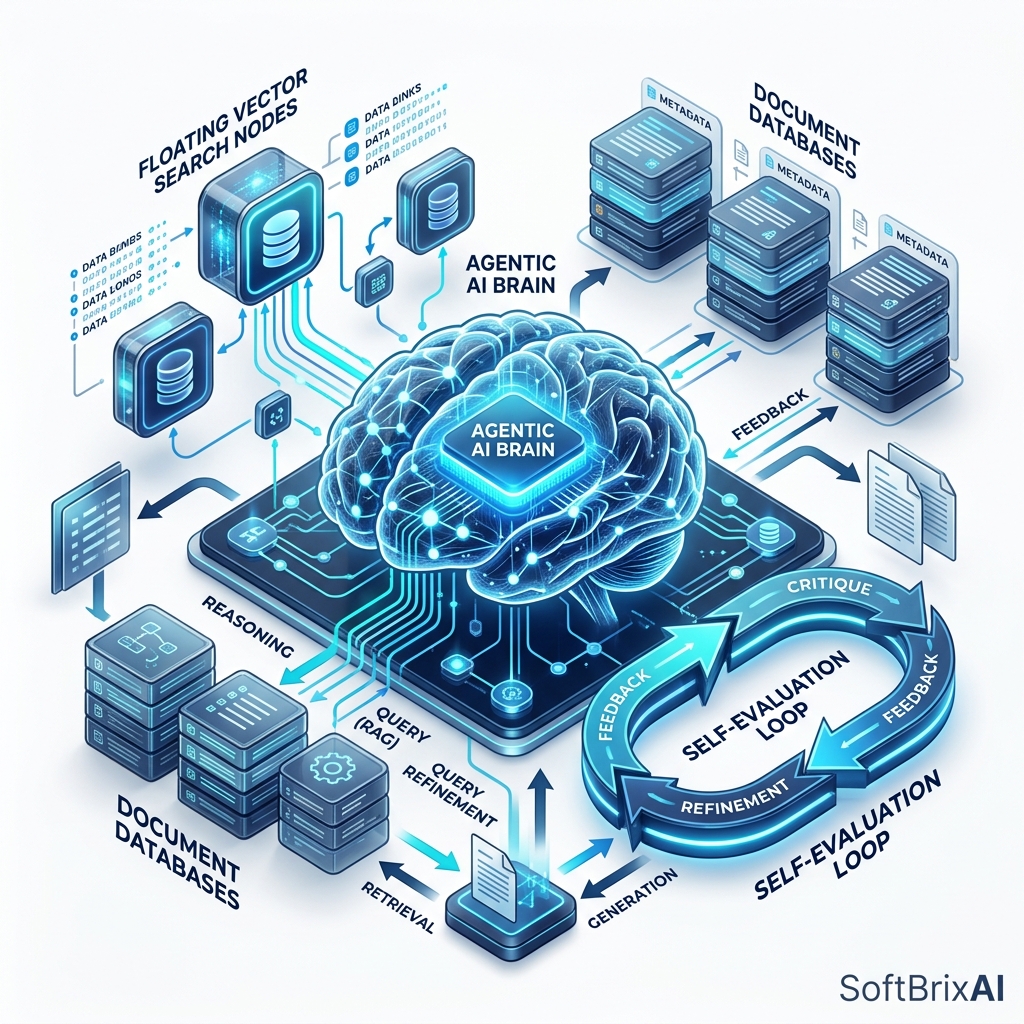
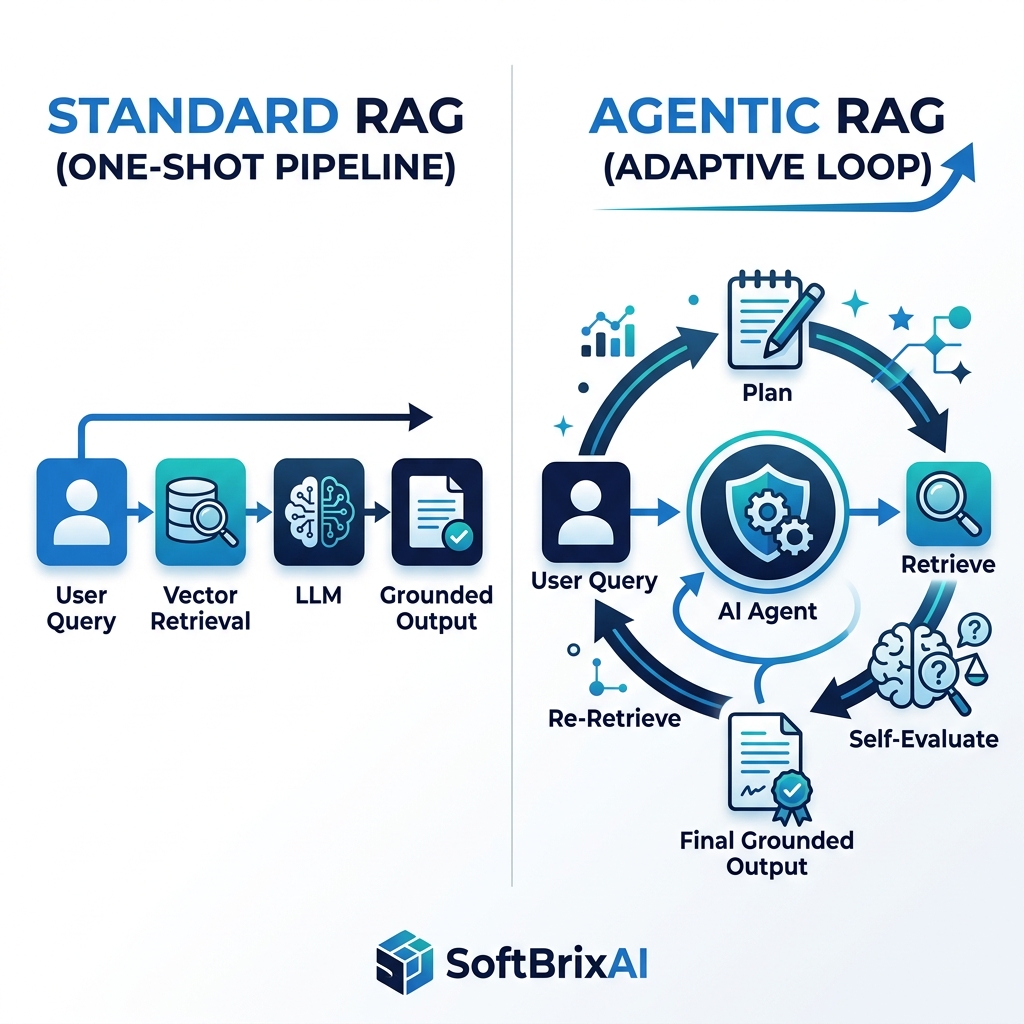
Agentic RAG is a form of retrieval-augmented generation (RAG) where an AI agent controls the retrieval process instead of running a single fixed pipeline. The agent reads the question, plans how to answer it, decides which source to query, checks whether the retrieved context is good enough, and loops back to retrieve again when it falls short. Standard RAG runs one pass: query, retrieve, generate. Agentic RAG runs an adaptive loop: query, retrieve, evaluate, and re-retrieve until the evidence supports a grounded answer.
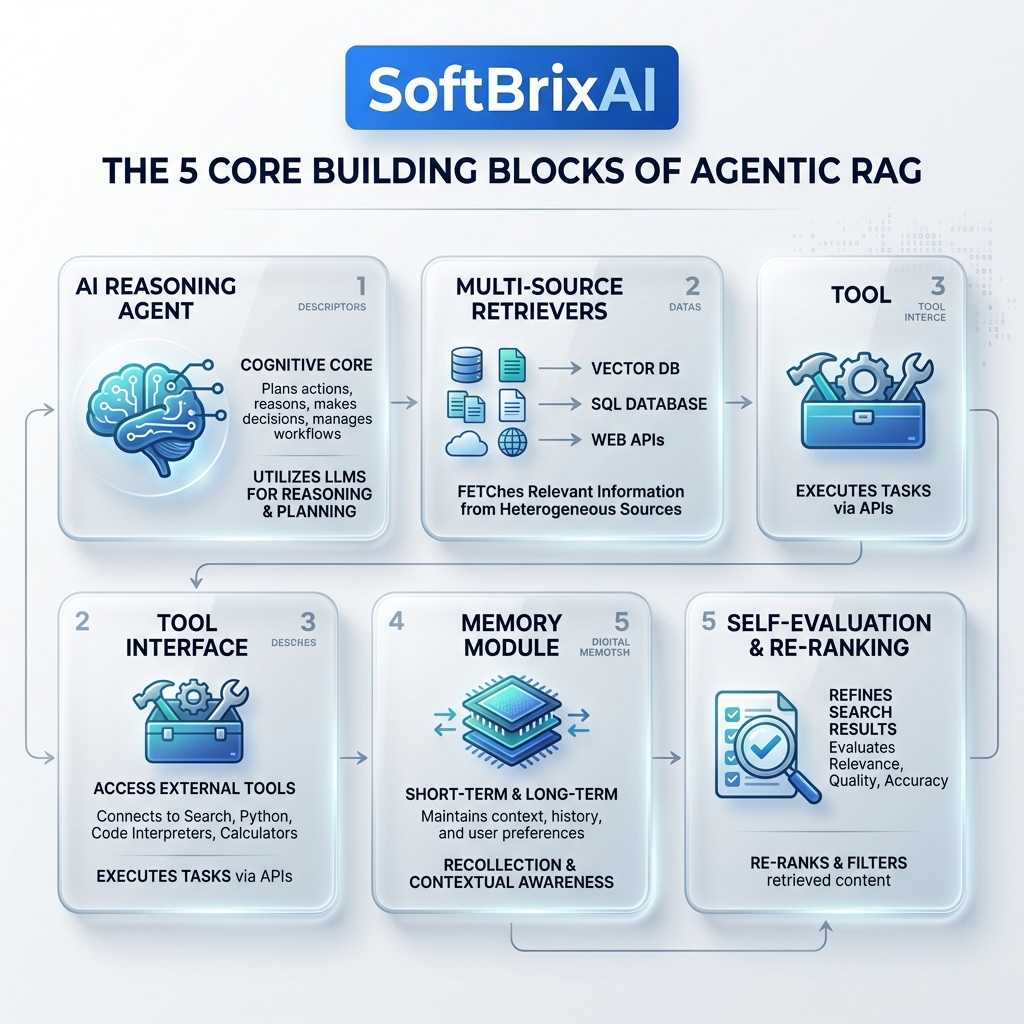
The main benefit is accuracy on hard questions. An agentic RAG system handles multi-step questions, resolves conflicts across sources, and catches weak retrieval before it becomes a wrong answer. The main uses are enterprise knowledge management, financial and fraud investigation, legal and contract review, healthcare decision support, and automated customer support. The main components are an AI agent that plans and reasons, one or more retrievers connected to knowledge bases, a tool interface for external calls, a memory module for short-term and long-term state, and a self-evaluation step that judges retrieval quality.
This guide covers the problem agentic RAG solves, how it works step by step, the design patterns that matter, the real trade-offs, and how to build and evaluate a system that earns the extra cost.
1. The Problem That Agentic RAG Was Built to Solve
Standard RAG fails when the answer needs more than one lookup. The core problem is that nothing sits between retrieval and generation to check whether the retrieved context was good enough. Information flows one direction: query to retrieval to response. There is no checkpoint and no second attempt.
Why Standard RAG Fails on Complex, Multi-Step Questions
Standard RAG fails on complex questions because it retrieves once and cannot adapt. A query like “compare the termination clauses in our 2023 contracts with our 2024 contracts and summarize the liability differences” needs several retrieval steps. A one-shot pipeline retrieves for the first part of the query, misses the rest, and returns an incomplete answer. The quality of the final output depends entirely on that first retrieval. If the first pass is weak, the system has no way to recover.
Large language models (LLMs) run on parametric knowledge, which is the information fixed inside their weights during training. That knowledge goes stale and cannot cover private or fast-changing data. RAG grounds the model in an external knowledge base to fix this. The grounding works well for direct questions. It breaks down when questions require reasoning across steps.
The “One-Shot Pipeline” Problem: Retrieve Once, Hope for the Best
The one-shot pipeline retrieves the top matching chunks by similarity score and passes them straight to the LLM. The system takes the query as written, retrieves whatever scores highest, and generates an answer with no chance to verify the results. A weak or incomplete first retrieval produces a weak answer, and the pipeline never notices. This static flow suits simple lookups. It cannot express the sequence of decisions that complex retrieval needs.
Three Core Failure Modes: Ambiguous Queries, Scattered Evidence, and False Confidence
Standard RAG has 3 core failure modes.
- Ambiguous queries. A user asks “how do I handle taxes?” without specifying personal, business, or nonprofit tax. Standard RAG cannot rewrite or clarify the query. It retrieves whatever matches and hopes the match fits.
- Scattered evidence. A question like “what is the remote work policy for contractors?” needs content from the remote work policy and the contractor agreement. Standard RAG pulls from one pool of chunks and has no mechanism to check a second source.
- False confidence. Retrieval returns a chunk that looks relevant by similarity score but comes from an outdated document version. The system cannot tell the difference between relevant and correct. It generates a confident response either way.
These 3 failure modes share one root cause: the system does not reflect on what it retrieved.
2. What is Agentic RAG? A Clear, Jargon-Free Definition
Agentic RAG is retrieval-augmented generation controlled by an AI agent that decides how to retrieve. The agent chooses when to retrieve, which tool or source to query, and whether the results are sufficient to answer, then iterates until it has enough grounded context or reaches a stopping point.
Agentic RAG in Simple Terms: When an AI Agent Controls the Retrieval Process
In simple terms, agentic RAG puts a decision-maker between the query and the answer. Instead of retrieve-then-generate, the flow becomes retrieve, evaluate what came back, decide whether to answer or try again, and retrieve differently if needed. The agent acts on the query both before retrieval, by rewriting it, and after retrieval, by judging the results. This loop is the entire value add. It turns a fixed pipeline into a control loop with decision points.
How Agentic RAG Differs from Standard RAG at Its Core
Agentic RAG differs from standard RAG in one core way: it owns its reasoning process. Standard RAG follows a path a developer defined in advance. An agentic system decides the sequence of steps at run time based on the quality of the information it finds. It is not executing a script. It determines what to retrieve, when to retrieve, and when to stop, on its own, within the tools and policies its developers set.
The Role of the AI Agent: From Passive Pipeline to Active Decision-Maker
In the broader landscape of artificial intelligence (and its underlying hierarchy of AI, machine learning, and deep learning), an AI agent is a software system that perceives its context, makes decisions, and takes actions to reach a goal with some independence. In this setting, an agent is an LLM given the ability to call tools and make decisions. Rather than only generating text, the agent can run a search, query a database, call an API, or decide it needs more information before responding. This shift from passive pipeline to active decision-maker is what separates agentic RAG from every static retrieval system that came before it.
3. Understanding the Building Blocks: RAG and Agentic AI Explained
Agentic RAG combines 2 technologies: retrieval-augmented generation and agentic AI. Each solves a different problem, and together they cover for each other’s gaps.
What is Retrieval-Augmented Generation (RAG)? A Quick Refresher
Retrieval-augmented generation (RAG) is an AI technique that connects a generative model to an external knowledge base so the model answers from real data instead of memory alone. A standard RAG pipeline has 2 parts: an information retrieval component, usually an embedding model paired with a vector database, and a generative component, usually an LLM. The embedding model converts a natural language query into a vector embedding, then retrieves similar chunks from the knowledge base. The system combines those chunks with the query so the LLM can generate a grounded response. Strong retrieval and grounding against curated knowledge bases set the ceiling for how accurate any RAG system can be.
What is Agentic AI? Perceive, Reason, Plan, and Act
Agentic AI is a type of AI that can decide and carry out a course of action by itself. Most agents today are LLMs with function-calling, which means they can call tools to perform tasks. As explored in our breakdown of Generative AI vs Predictive AI, agentic systems bridge the gap between creative language generation and analytical forecasting models. An AI agent has 4 core capabilities: perceiving its context, reasoning through a problem, planning step-by-step actions, and acting by using digital tools. Agents also hold memory, both short-term and long-term, which lets them plan multi-step tasks and refer back to earlier steps. Query routing, planning, and tool calling through APIs complete the picture.
Why These Two Technologies Were Always Meant to Combine
RAG gives an agent dynamic knowledge grounding. Agentic AI gives RAG the ability to plan, route, and self-correct. A retriever without an agent retrieves once and stops. An agent without retrieval reasons well but has no fresh facts to reason over. Put together, the agent uses retrieval as a tool inside its reasoning process, and the retriever gains a controller that knows when one pass is not enough. That pairing is why agentic retrieval-augmented generation now anchors so many production AI systems.
4. How Agentic RAG Works: The Step-by-Step Workflow
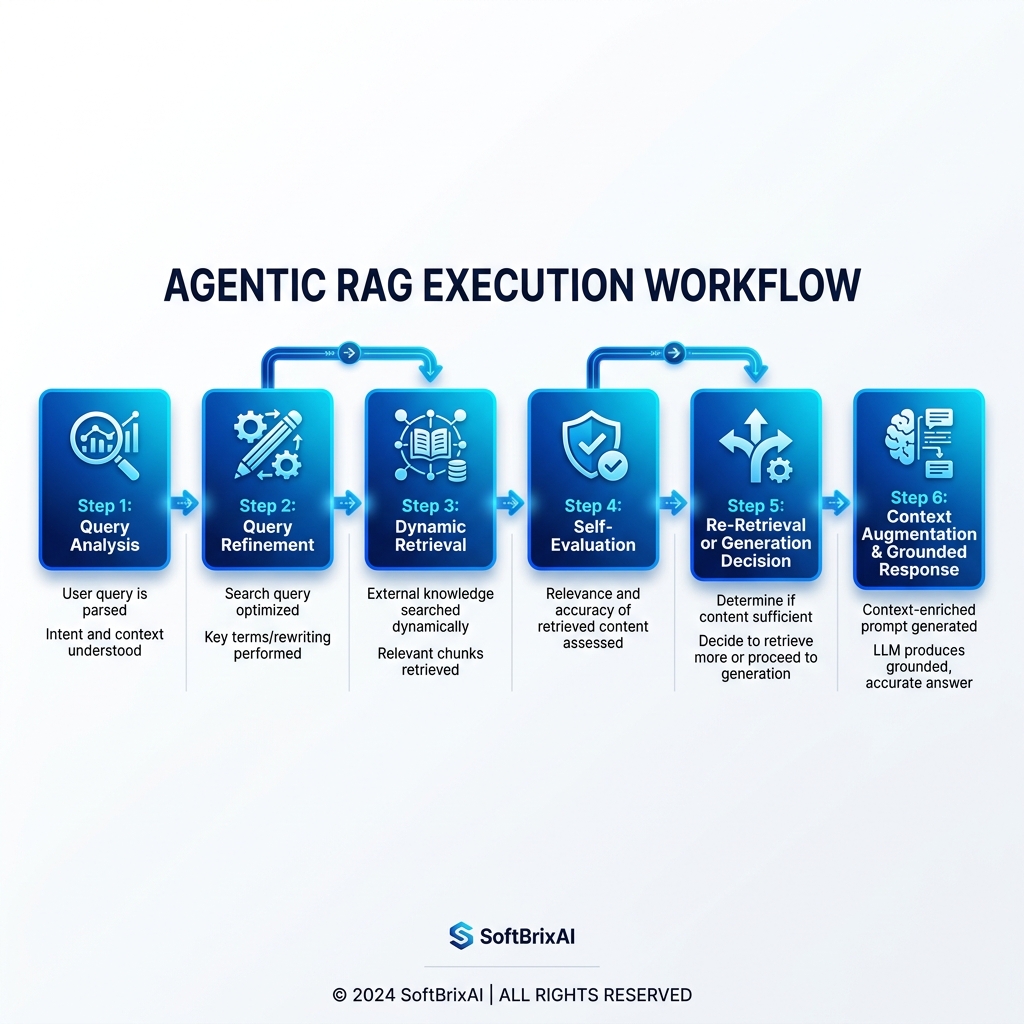
Agentic RAG works through a loop of 6 steps that repeats until the agent has enough context. Each step is a decision point the agent controls.
Step 1 — Query Analysis: The Agent Understands What You’re Really Asking
The agent first reads the query and identifies the real intent. It decides whether the question is simple enough for a single retrieval or complex enough to need a multi-step plan. A query analysis step clears up ambiguity before any retrieval happens, which prevents the system from chasing the wrong interpretation.
Step 2 — Query Refinement: Rewriting Ambiguous Questions Before Retrieval Begins
The agent rewrites vague or broad queries into targeted ones before searching. To refine a query, the agent decomposes it into sub-questions or restates it with the missing context added. A rewritten query retrieves sharper chunks than the raw input would. This step directly answers the ambiguity failure mode.
Step 3 — Dynamic Retrieval: Choosing the Right Source, Not Just the First Source
The agent selects which source to query based on the question. A financial question routes to a SQL database. A policy question routes to a document store. A product question may need both. Dynamic retrieval means the agent picks the right place, or searches several places, rather than defaulting to a single knowledge base.
Step 4 — Self-Evaluation: Does the Retrieved Context Actually Answer the Question?
The agent inspects the retrieved context and asks whether it is relevant, complete, and consistent. The self-evaluation step is what lets agentic RAG catch bad retrieval before it becomes a bad answer. If the context conflicts with itself or fails to address the question, the agent flags it. This step answers the false-confidence failure mode, because the system stops trusting similarity scores blindly.
Step 5 — Re-Retrieval or Generation: The Agent Decides Whether to Loop or Respond
Based on the evaluation, the agent decides its next move. If the context is sufficient, it moves to generation. If not, it re-retrieves with a new query, a different source, or both. This decision is the fork that separates a control loop from a pipeline. The agent loops only when looping closes a real gap.
Step 6 — Context Augmentation and Final Answer Generation
The agent combines the retrieved context with the original query and passes the package to the LLM. The model generates a final answer grounded in verified evidence. Context augmentation at this stage gives the LLM a richer prompt than the raw question alone, which improves faithfulness and reduces made-up content.
5. The Core Capabilities That Make Agentic RAG Smarter Than Traditional RAG
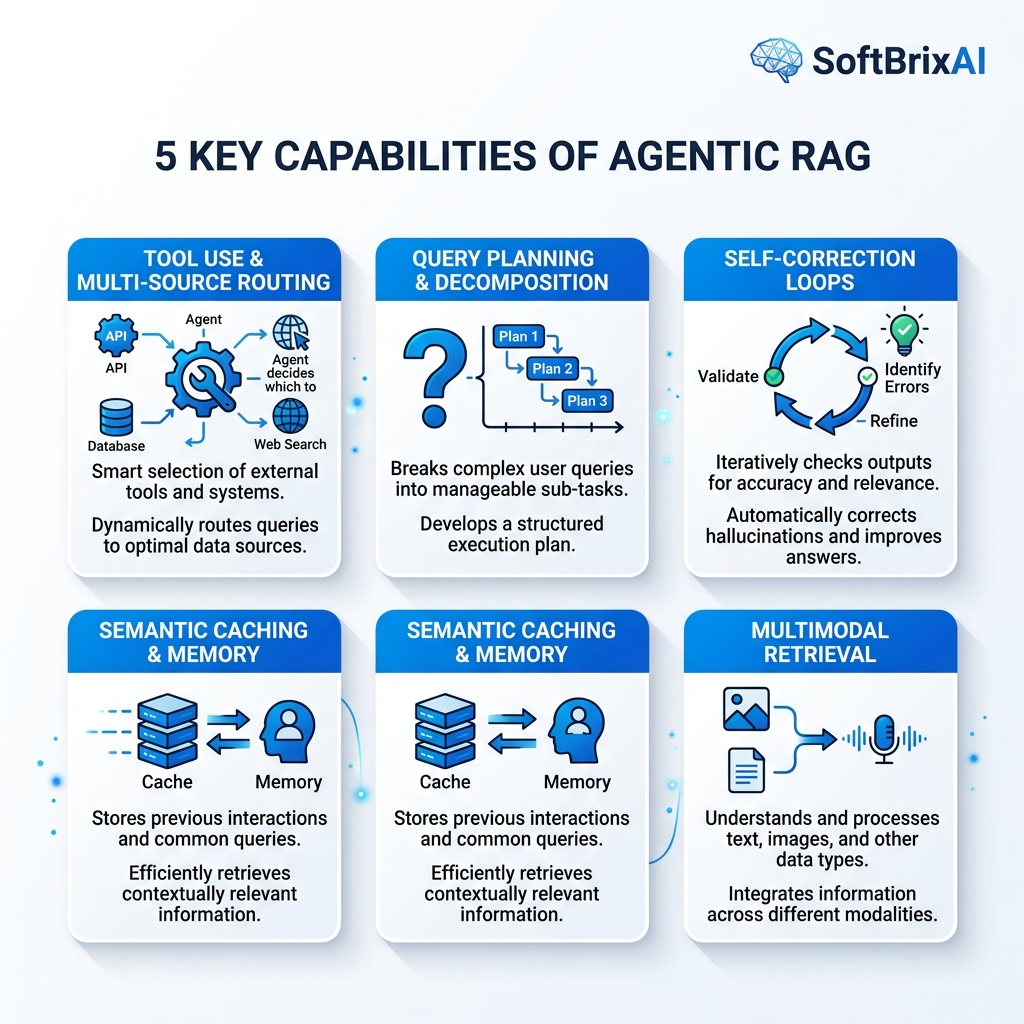
Agentic RAG adds 5 capabilities that traditional RAG lacks. Each capability maps to a limitation of the one-shot pipeline.
Tool Use and Multi-Source Routing: Querying the Right Database Every Time
The agent calls tools and routes each query to the source most likely to hold the answer. Tool use covers vector search, keyword search, SQL queries, web search, and custom API calls. Multi-source routing sends a billing question to account data and a technical question to product docs, without querying every source for every request.
Query Planning: Breaking Complex Questions into Manageable Sub-Queries
The agent breaks a complex question into a sequence of sub-queries and solves them in order. Query planning turns “find every contract with unlimited liability and no matching insurance” into 3 steps: find the contracts, retrieve the clauses, verify the insurance condition. The agent then combines the results into one coherent answer.
Self-Correction Loops: Catching Bad Retrieval Before It Becomes a Bad Answer
The agent runs a maker-checker loop that rewrites failed queries and retries. When retrieval returns irrelevant documents or a malformed database query, the agent reformulates and searches again instead of returning a low-value response. Self-correcting retrieval means the system learns from its own missteps within a single session.
Semantic Caching and Memory: Remembering What Was Already Retrieved
The agent stores previous queries, context, and results in a semantic cache so it does not re-retrieve the same source twice. Memory holds short-term state across loop iterations and long-term state across sessions. Task-oriented memory recall lets the agent pick up where it left off, which prevents redundant loops and cuts token cost.
Multimodal Retrieval: Working with Text, Images, Audio, and Structured Data
The agent retrieves and reasons over text, images, audio, and structured data using multimodal LLMs. Multimodal retrieval surfaces insight hidden in charts, tables, and images that a text-only system would miss. This widens the range of questions an agentic RAG system can answer.
6. Agentic RAG vs Traditional RAG: A Direct Side-by-Side Comparison
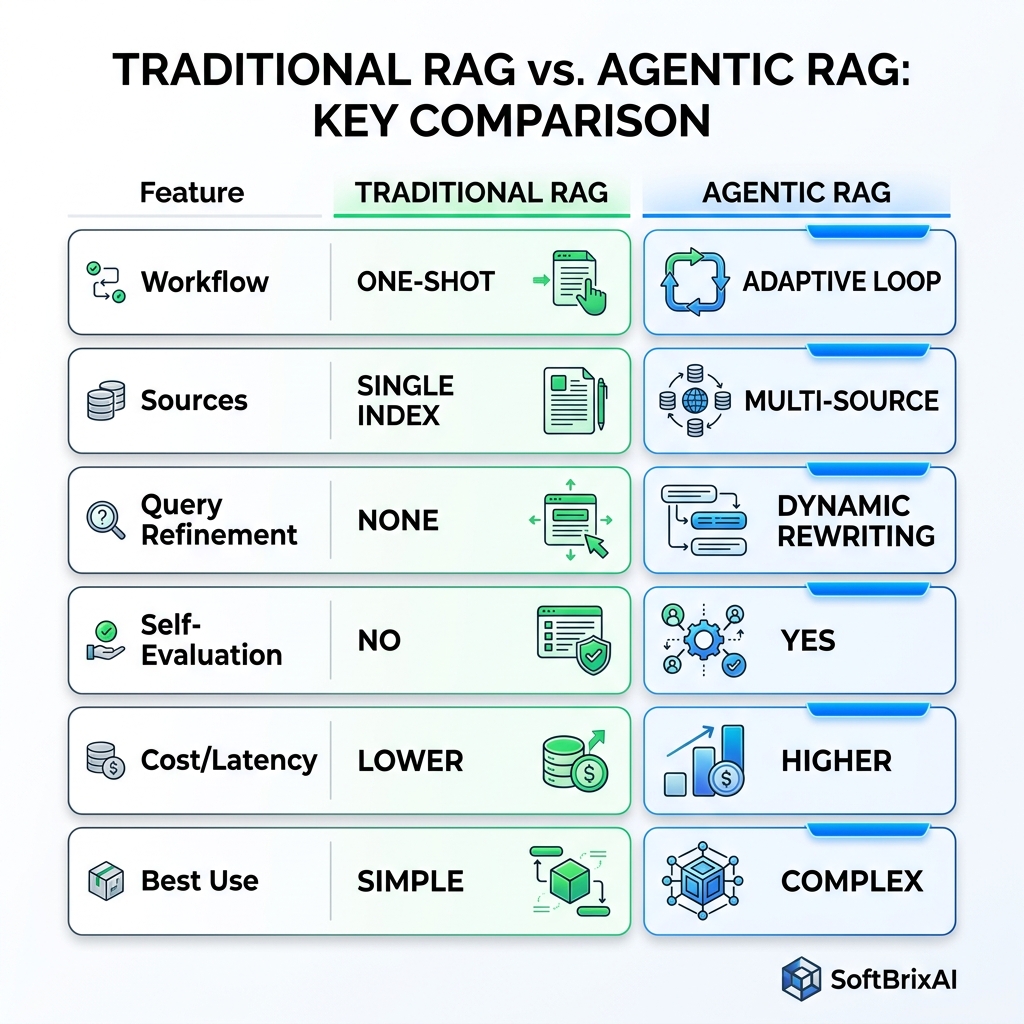
Agentic RAG and traditional RAG differ across workflow, source flexibility, query handling, self-evaluation, cost, and best use. The table below sets them side by side.
| Dimension | Traditional RAG | Agentic RAG |
|---|---|---|
| Workflow | One-shot pipeline | Adaptive loop |
| Source Flexibility | Single knowledge base | Multiple sources |
| Query Refinement | None | Dynamic rewriting |
| Self-Evaluation | No | Yes |
| Cost & Latency | Lower | Higher |
| Best For | Simple lookups | Complex, multi-step tasks |
Traditional RAG retrieves in one step from a fixed query and generates directly. Agentic RAG reasons, acts, observes, and repeats, routing across tools and validating evidence before it answers. The trade is speed and cost against accuracy and reach.
When Traditional RAG Is Still the Better Choice (Honest Answer)
Traditional RAG is the better choice for direct factual lookups against a clean, single-source knowledge base. A question like “what is our return policy?” against well-organized documentation gets a solid answer almost every time, faster and cheaper than any agent loop. High-volume, low-complexity query patterns also favor standard RAG, because latency and cost matter more than handling edge cases. When most failures in an existing RAG system come from retrieval quality, such as bad chunking or stale data, fixing those issues delivers more value than adding an agentic layer.
When Agentic RAG Justifies the Extra Cost and Complexity
Agentic RAG justifies its cost when your hardest questions depend on multi-step reasoning, cross-source synthesis, or validation before generation. If the system needs to query the right source, judge whether the retrieval was good enough, and try again when it was not, an agentic approach fits. The decision comes down to strategy: an assessment of build vs buy and query complexity tells you whether the accuracy gain is worth the extra latency and tokens. Add agentic behavior where a specific failure demands it, not as a default.
7. Types of AI Agents Inside an Agentic RAG System
An agentic RAG system runs 1 or more specialized agent types. Each type owns a distinct job in the pipeline.
Routing Agents: The Traffic Controllers of Your Knowledge Pipeline
Routing agents decide which knowledge sources and tools address a query. A routing agent reads the prompt, picks the retrieval path most likely to produce a good answer, and sends the query there. In a single-agent system, the routing agent chooses which data source to query. It prevents the system from searching every source for every request.
Query Planning Agents: The Task Managers That Break Down Complex Problems
Query planning agents break complex queries into step-by-step sub-queries. A planning agent submits each sub-query to other agents, then combines the responses into one cohesive answer. Using one agent to manage other models is a form of AI orchestration, and it keeps multi-part questions from collapsing into a single weak retrieval.
ReAct Agents: Reasoning and Acting in an Alternating Loop
ReAct (reasoning and acting) agents alternate between reasoning about what they know and acting to learn more. A ReAct agent produces a thought, takes an action such as a retrieval call, and reads the observation that feeds the next thought. Based on each result, the agent adjusts the next step of the workflow dynamically.
Plan-and-Execute Agents: Completing Multi-Step Workflows Without Constant Supervision
Plan-and-execute agents run multi-step workflows without calling back to the primary agent at every step. This agent type is a progression from ReAct that reduces cost and raises efficiency. Because the planning agent reasons through the full task before acting, completion rates and answer quality tend to be higher.
Corrective Agents: Switching Sources When Retrieval Falls Short
Corrective agents run an evaluation immediately after retrieval and switch sources when the primary index comes up short. If the retrieved context is irrelevant or ambiguous, the corrective agent falls back to an alternative source, often a web search, before generation. The difference from ReAct is where correction happens: corrective agents change the source rather than re-query the same one.
8. The Five Most Powerful Agentic RAG Design Patterns
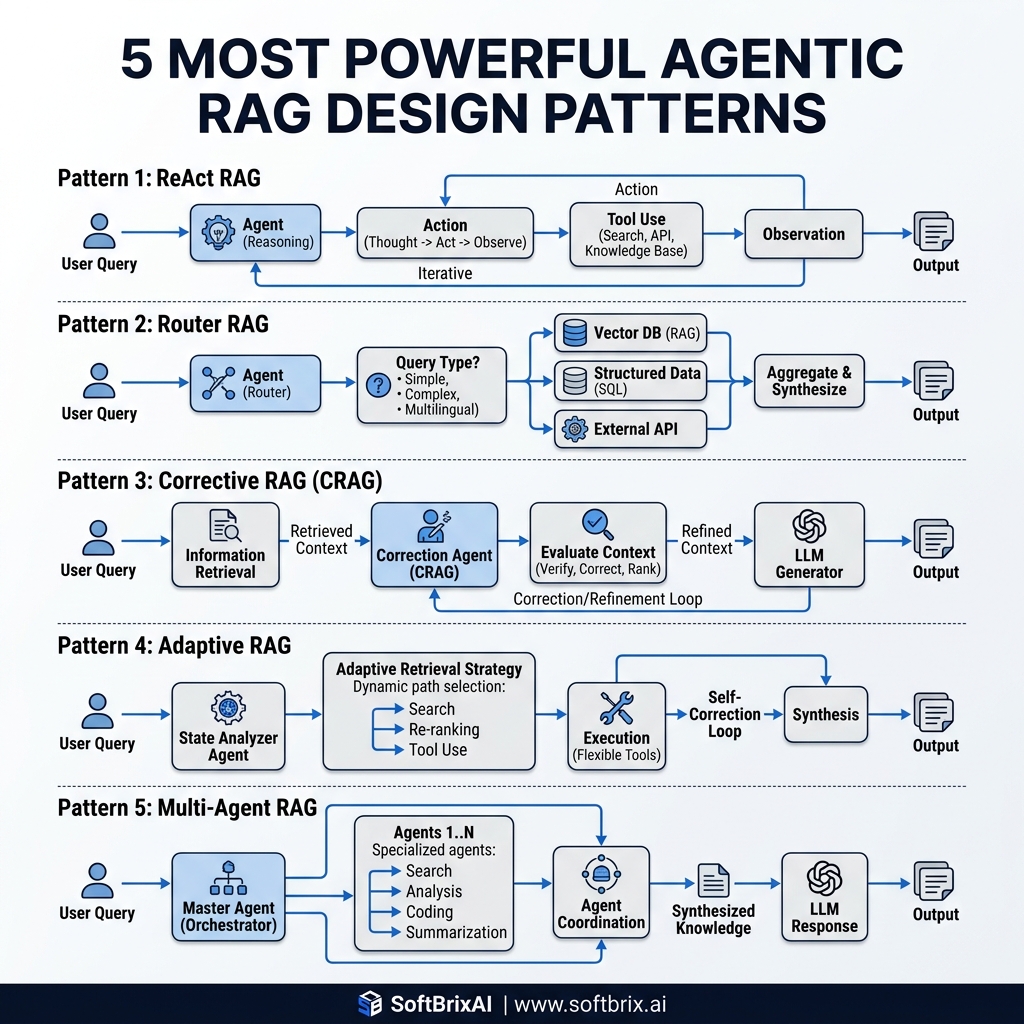
There are 5 agentic RAG design patterns that cover most real systems. Start with the simplest pattern that fixes your named failure, then add complexity only when you can point to the gap it closes.
ReAct RAG — The Foundational Pattern Most Systems Should Start With
ReAct RAG is the foundational pattern and the right starting point for most builds. The agent cycles through thought, action, and observation: it reasons about what it still needs, calls a retrieval tool, and reads the result that feeds the next reasoning step. The loop continues until the agent has enough grounded context or hits a stopping point. ReAct RAG solves most standard RAG issues before you layer in anything heavier.
Router RAG — Directing Each Query to the Most Relevant Data Source
Router RAG directs each query to the most relevant retrieval method before generation begins. Use it when queries vary enough that one retrieval method cannot serve all of them. A router agent sends semantic questions to vector search, connected-entity questions to a knowledge graph, and simple lookups to keyword or database search. Router RAG stops the system from querying every source for every request.
Corrective RAG — Building a Reliable Fallback When Primary Retrieval Fails
Corrective RAG adds an evaluation step right after retrieval and falls back to another source when the context is weak. Use it when your primary index has coverage gaps and you need a reliable backup path. If the retrieved context is relevant, generation proceeds. If it is not, the agent switches to an alternative source before passing context to the LLM.
Adaptive RAG — Matching Retrieval Complexity to Query Complexity
Adaptive RAG classifies query complexity before retrieval and matches the effort to the question. Use it for mixed traffic that spans simple lookups and questions that need the full pipeline. A classifier sends simple questions straight to the LLM, moderate questions through a single retrieval pass, and complex questions through a full agentic loop. Adaptive RAG avoids paying agent-loop cost on questions that do not need it.
Multi-Agent RAG — Parallel Retrieval for Enterprise-Scale Knowledge Tasks
Multi-agent RAG splits work across specialized agents for tasks a single agent cannot handle. An orchestrator agent delegates to a planning agent, which dispatches parallel retrieval agents. A synthesis agent combines the results, a validation agent checks quality, and a generation agent produces the response. Use this pattern only when the scope demands it, because latency, cost, and coordination overhead climb fast. Teams that need this level of coordination often bring in dedicated agent orchestration and multi-agent systems engineering to keep failures traceable across agent boundaries.
9. Real-World Use Cases: Where Agentic RAG Delivers Measurable Value
Agentic RAG delivers value wherever a single retrieval pass consistently falls short. Here are 6 settings where the loop earns its cost.
Enterprise Knowledge Management: Resolving Conflicts Across Policies, Wikis, and Docs
Enterprise questions cut across policies, ticket history, internal docs, and system data, and conflicts surface fast. A policy document says one thing, last month’s all-hands says another, and the wiki has not been updated in a year. A flat retrieval returns all of it and leaves the reader to sort it out. An agent compares sources, reasons about which one takes precedence, and flags the disagreement when there is no clear winner.
Financial Services and Fraud Investigation: Sequential Evidence-Building at Scale
Fraud investigation does not follow a fixed retrieval path. A flagged transaction surfaces an unknown counterparty. Before judging the transaction, the agent pulls the counterparty’s know-your-customer (KYC) file rather than more transaction history. If that file ties to a sanctioned entity, the question shifts to sanctions and policy documents move ahead in the queue. The agent decides its next step from what it just found and stops when the evidence is strong enough. The same sequential reasoning supports forecasting and modeling on business data for risk scoring.
Legal and Contract Review: Multi-Step Clause Verification Across Hundreds of Documents
Contract review needs sequential retrieval and evaluation. Finding every agreement with an unlimited liability clause and no matching insurance provision is not a one-pass job. One retrieval returns contracts with similar language, but similarity does not confirm the right clauses or both conditions together. The agent identifies the relevant contracts, retrieves clause-level content, and verifies the insurance condition. A second agent evaluates the findings and generates a response only when all 3 checks pass.
Healthcare and Clinical Decision Support: Interdependent Retrieval That Catches Errors
Clinical decisions are interdependent. You cannot recommend a medication without checking the patient’s history and drug interactions first, so each retrieval depends on the last. An agentic RAG system retrieves patient context, then uses it to decide what to look up next. In a high-stakes setting, the validation loop catches errors before the system produces an output.
Automated Customer Support: Routing Billing, Technical, and Account Queries Intelligently
Customer support pulls from product docs, account data, order history, and open tickets, but which sources and in what order depends on the question. A billing issue needs a different retrieval than a technical one. A router agent sends each request to the right sources without querying every source for every ticket, then hands harder cases to a human when confidence is low.
Real-Time Research and Summarization: Synthesizing Answers Across Live Data Sources
Research and summarization pull current facts from live sources and combine them into one answer. An agent retrieves market reports, competitor data, and internal metrics, then synthesizes them into a briefing. Because the agent can re-query when new information changes the picture, the summary reflects the latest data rather than a single stale snapshot.
10. The Real Trade-Offs of Agentic RAG Nobody Talks About
Agentic RAG is not a straight upgrade. Every loop iteration carries a cost, and those costs are large enough that many systems should not use it. Here are 5 trade-offs to weigh.
Latency: Why a 10-Second Response Can Kill a Real-Time Application
Every loop iteration adds another LLM call, retrieval, and evaluation. A standard RAG query takes 1 to 2 seconds. An agentic query with 3 or 4 loops can take 10 seconds or more. For real-time chat, that delay is usually unacceptable, so latency alone can rule out an agentic design.
Token Cost: How Agentic Loops Multiply Your API Bill 3–10x
Each agent decision consumes tokens. A system handling thousands of queries per day can see costs rise 3 to 10 times over standard RAG. If 80 percent of those queries are simple lookups, most of that spend goes to reasoning the query never needed. Cost control starts with sending only the hard questions into the loop.
The Evaluator Paradox: Asking the Same LLM to Judge Its Own Retrieval
The self-evaluation step uses an LLM to judge whether retrieval was good enough. The system’s ability to self-correct is only as strong as that judge. A weak evaluator rejects good results and sends the system chasing something better, or accepts poor results and generates a bad answer anyway. You are trusting one LLM call to oversee another, and that trust needs testing.
Debugging and Predictability: Why Agentic Systems Are Harder to Test
Standard RAG is close to deterministic. Agentic RAG introduces variability, because the agent makes different decisions based on what it finds at each step. That variability makes issues harder to reproduce, tests harder to write, and answers harder to explain when the same question produces different results. Governance suffers too, so compliance, risk, and auditability controls belong in the design from the start, not bolted on later.
Overcorrection Risk: When the Agent Discards Good Results Chasing Better Ones
Sometimes the loop is smarter than it needs to be. The agent discards useful retrieved information during evaluation, keeps searching for something better, and lands on a worse answer than the first result would have given. Overcorrection is a real failure mode, and a hard iteration cap is the main defense against it.
11. How to Build and Implement an Agentic RAG System: A Practical Roadmap
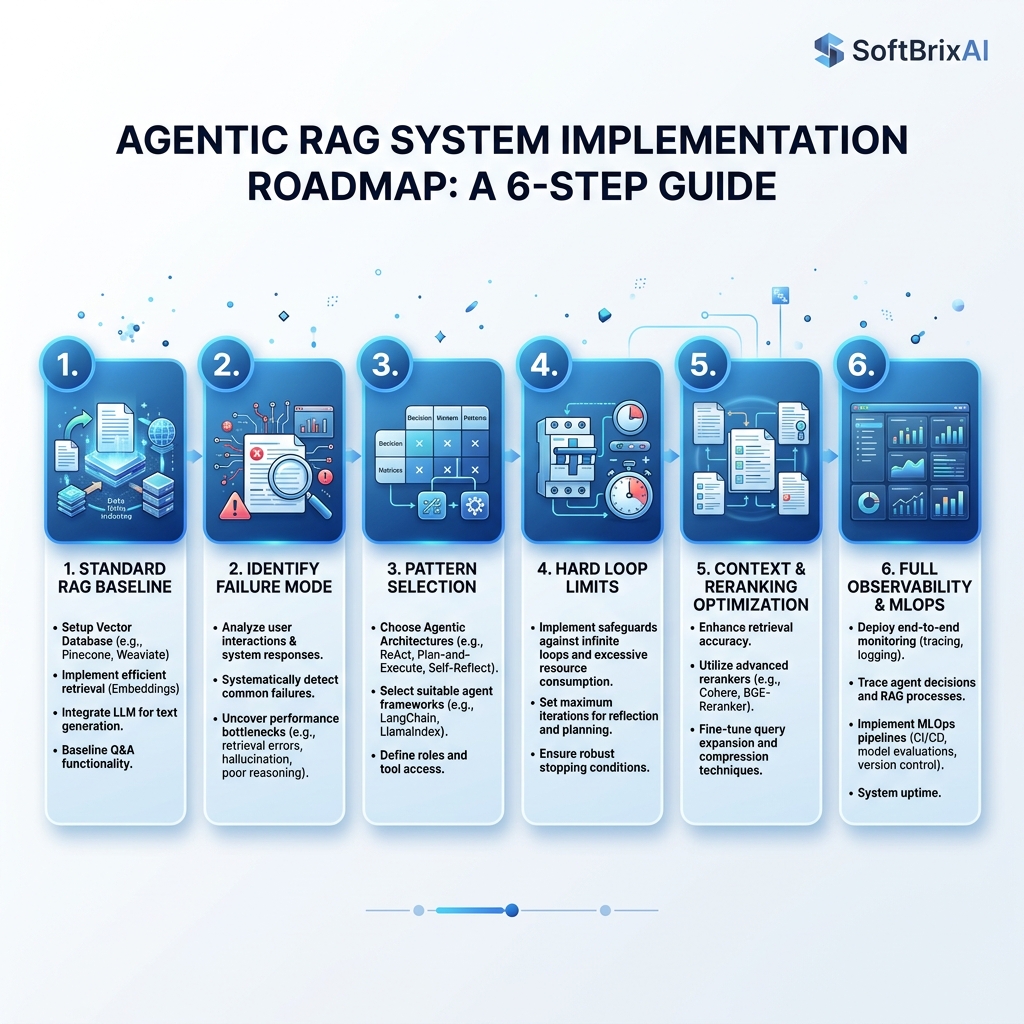
Build agentic RAG as an upgrade to standard RAG, not a rewrite. Start with a baseline, then add patterns where the pipeline falls short. These 6 steps keep complexity earning its place.
Step 1 — Start with a Standard RAG Baseline and Measure It First
Begin with a straightforward pipeline: a data store, a retriever, and an LLM. Use vector retrieval as the baseline and measure answer quality, latency, and empty-context rate before adding any agent loop. Those numbers become the benchmark every later change gets measured against. Clean data pipelines, ingestion, and streaming feed that baseline, and their quality sets the ceiling for everything downstream.
Step 2 — Identify the Exact Failure Mode Before Changing the Architecture
Name the specific failure before you touch the architecture. Poor routing, missing multi-hop context, weak explainability, and answers that need verification each call for a different fix. Trying to solve all of them at once makes each one harder to trace. One named failure at a time keeps the work measurable.
Step 3 — Choose the Right Agentic Pattern for Your Specific Problem
Match the pattern to the failure. Add a review step where the pipeline fails most often, and start with the ReAct loop as the common baseline. Define explicit pass and fail criteria upfront, such as a minimum faithfulness score or a required entity match. If ReAct alone does not close the gap, add router, corrective, or adaptive layers, or specialized agents for heavy workloads.
Step 4 — Set Hard Loop Iteration Limits to Prevent Runaway Costs
Put a hard cap on loop iterations as a stop criterion. A cap prevents the system from spiraling into expensive, hard-to-trace retries. Tuning the cap is one of the harder problems in agentic RAG: too strict and the loop exits before it has enough context, too loose and it adds cost without improving answers.
Step 5 — Optimize Context: Filter, Rerank, and Manage Short-Term Memory
Optimize the context you pass at each step. Filter retrieved chunks by relevance score and rerank before sending them to the LLM, because irrelevant context degrades answers even when the right facts were retrieved. Track short-term memory so the agent does not re-query the same source, and store intermediate reasoning so it resumes rather than restarts. Good context engineering often beats another loop iteration.
Step 6 — Instrument Everything Before You Scale
Return the retrieved context alongside each answer during development so you can see exactly what fed each query. Define a fallback for empty-context cases so the system fails gracefully. Trace tool calls, loop depth, retry counts, stop reasons, and stage-level latency. A custom build with production engineering discipline, with deployment, monitoring, and drift detection handled through solid MLOps pipelines, is what keeps an agentic system reliable once real traffic hits it.
12. How to Evaluate an Agentic RAG System: Metrics That Actually Matter
Agentic RAG needs a broader scorecard than standard RAG, because the system can take several paths to an answer. A single end-to-end score tells you whether the answer was right. It does not tell you where things broke when the answer was wrong. Build an evaluation set that mirrors real usage, with clean and noisy questions, single-hop and multi-hop tasks, and inputs with typos and vague intent.
Retrieval Metrics: Context Precision, Context Recall, and Re-Retrieval Rate
Track context precision, which is the fraction of retrieved chunks that were relevant, and context recall, which is the fraction of needed evidence that was retrieved. Watch the re-retrieval rate too. A high re-retrieval rate usually points to routing logic, chunk size, or query formulation, because answer generation is rarely the bottleneck.
Answer Quality Metrics: Faithfulness, Answer Relevance, and Hallucination Rate
Measure faithfulness, which asks whether the answer contradicts the retrieved context, answer relevance, which asks whether it addresses the question, and the hallucination rate. An LLM-as-judge setup works well here, because multiple valid retrieval paths can reach the same correct answer and rigid string matching undercounts accuracy.
System-Level Metrics: Loop Depth, Tool Call Success Rate, and Stage Latency
Track loop depth per query, tool call success rate, stop reasons, and stage-level latency. These metrics tell you whether the system is improving answers or just spending more tokens to reach the same result. If average loop depth keeps climbing without a matching gain in faithfulness, tighten the stopping criteria.
Evaluation Tools: Ragas, LangSmith, and TruLens Compared
Three tools cover different parts of the stack. Ragas provides RAG-specific retrieval and answer metrics, including faithfulness, context precision, and context recall, that wire into a test suite with a few lines of Python. LangSmith provides request-level tracing, useful for seeing which tool was called, what it returned, and why the agent stopped. TruLens instruments across retrieved context, tool calls, plans, and full agent execution, useful when you want one dashboard across the whole loop.
13. Agentic RAG Frameworks and Tools Available in 2025–2026
Several open frameworks let you build agentic pipelines at low cost. Here are 5 you will meet most often.
LangChain and LangGraph: Building Agentic Pipelines with Granular Control
LangChain provides the building blocks for chaining LLM calls, retrieval, and tool use. LangGraph, its orchestration layer, models agent workflows as graphs so you control loops, branches, and state with precision. Together they suit teams that want granular control over how the agent moves through retrieval and evaluation.
LlamaIndex: Connecting Agents to Complex, Multi-Modal Knowledge Bases
LlamaIndex focuses on connecting agents to data. It handles ingestion, indexing, and retrieval across complex and multi-modal knowledge bases, which makes it a strong fit when the hard part of your system is the data layer rather than the agent logic.
Microsoft AutoGen and CrewAI: Multi-Agent Collaboration at Scale
AutoGen and CrewAI target multi-agent collaboration. Both let you define specialized agents that talk to each other and split work, which fits tasks that span domains or benefit from parallel retrieval. They trade simplicity for coordination power, so reserve them for scope a single agent cannot handle.
NVIDIA NeMo Agent Toolkit: High-Performance RAG for Production Environments
The NeMo Agent Toolkit is an open library that connects different agent frameworks and adds performance tracking to find bottlenecks and cut costs. It acts as a universal connector across LangChain, CrewAI, and custom code, which suits production environments that mix frameworks and need detailed observability.
GraphRAG with Neo4j: When Relationships Between Entities Matter More Than Similarity
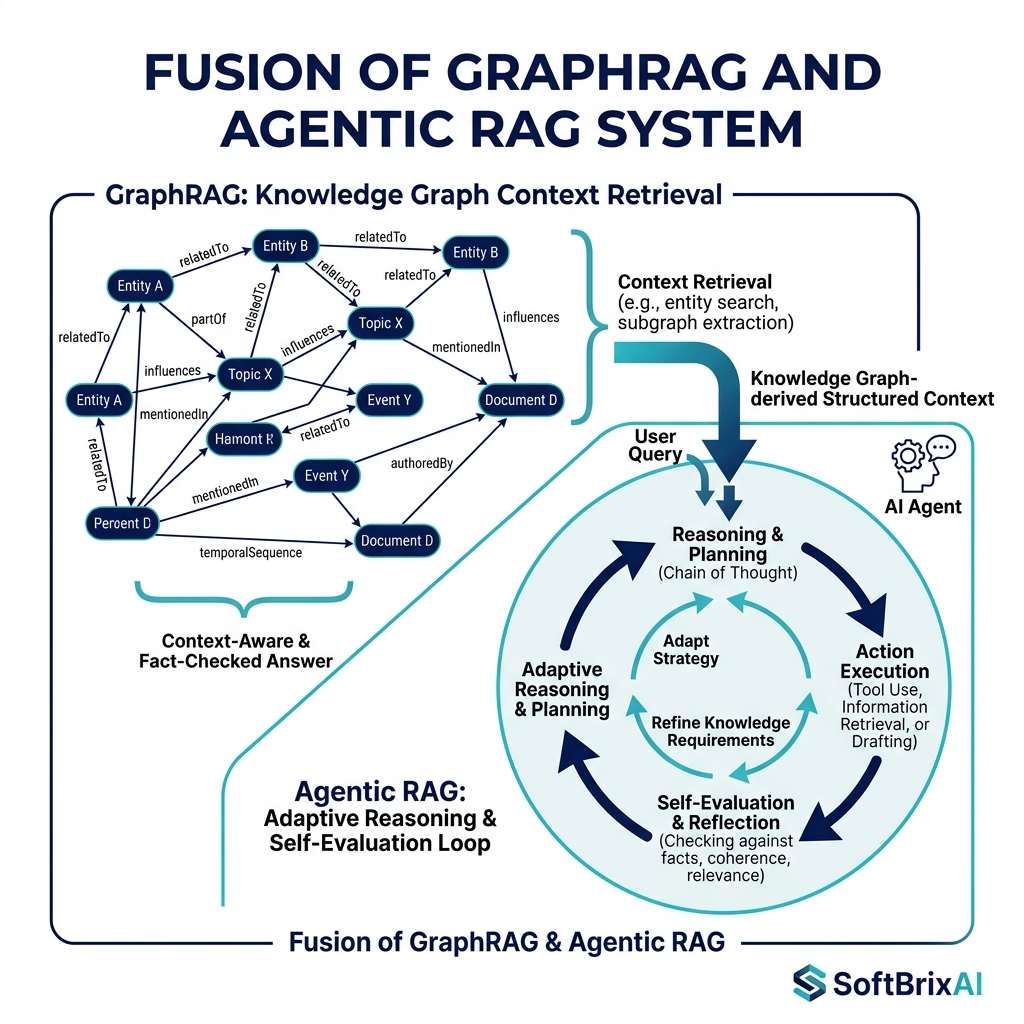
GraphRAG pairs retrieval with a knowledge graph so the system returns connected context instead of isolated passages. A Neo4j knowledge graph preserves relationships between entities, so agents traverse those connections at query time rather than rebuilding them from flat text. Use GraphRAG when the relationships between entities change the answer.
14. GraphRAG — The Next Evolution After Agentic RAG
GraphRAG improves the retrieval foundation that agentic RAG loops over. Retrieval sets the ceiling on answer quality, and vector search alone hits a limit that a knowledge graph clears.
Why Vector Search Alone Misses Relationships That Change the Answer
Vector search returns chunks that look similar in meaning while missing the relationship that makes the answer useful. Two documents can score as similar and still leave out how their entities connect. When the answer depends on that connection, semantic similarity is not enough, and the system returns a plausible but incomplete response.
How Knowledge Graphs Give Agents Structured, Multi-Hop Reasoning Context
A knowledge graph stores entities and the relationships between them as structured data. Agents traverse those relationships at query time, which supports multi-hop fact validation and returns connected context rather than loose passages. That structure improves relevance and makes answers easier to trace back to a source.
When to Combine GraphRAG with Agentic RAG for Maximum Retrieval Accuracy
Combine GraphRAG with agentic RAG when your agent’s reasoning depends on how entities relate in your domain. The agent loops over a retrieval layer that already reflects real relationships, so its reasoning becomes more contextual and more traceable. Agentic RAG shifts where failures hide, and a graph-grounded retrieval layer makes those failures easier to find.
15. Frequently Asked Questions About Agentic RAG
Is Agentic RAG Better Than Traditional RAG?
Agentic RAG is better than traditional RAG for complex, multi-step questions, but not for simple lookups. It handles multi-hop reasoning, cross-source synthesis, and validation that a one-shot pipeline cannot. It also costs more tokens, adds latency, and is harder to debug. For direct questions against a clean, single source, traditional RAG is faster, cheaper, and easier to maintain.
What is the Difference Between RAG and Agentic RAG?
The difference is that RAG retrieves once and generates, while agentic RAG runs an adaptive loop controlled by an AI agent. Standard RAG follows a fixed retrieve-then-generate path. Agentic RAG plans the task, chooses tools, reasons over results, re-queries when the first pass falls short, and validates evidence before answering.
What Agents Are Used in Agentic RAG?
Agentic RAG uses routing agents, query planning agents, ReAct agents, plan-and-execute agents, and corrective agents. Routing agents pick the source. Planning agents break down complex queries. ReAct agents alternate reasoning and action. Plan-and-execute agents run multi-step workflows without constant supervision. Corrective agents switch sources when retrieval falls short.
Does Agentic RAG Eliminate Hallucinations Completely?
No, agentic RAG reduces hallucinations but does not eliminate them. Grounding answers in retrieved, verifiable data and adding a self-evaluation step lowers the hallucination rate compared to a one-shot pipeline. No RAG system removes the risk entirely, and a weak evaluator can still let a wrong answer through, so validation and human oversight stay important for high-stakes tasks.
How Much Does It Cost to Run an Agentic RAG System?
An agentic RAG system typically costs 3 to 10 times more than standard RAG per query, driven by extra LLM calls in the loop. Each agent decision, retrieval, and evaluation consumes tokens. You control the cost by classifying query complexity, sending only hard questions into the loop, and setting a hard cap on loop iterations.
Can I Use Agentic RAG Without a Multi-Agent System?
Yes, you can run agentic RAG with a single agent. A single-agent setup, such as a router that picks between a few knowledge bases or a ReAct loop that retrieves and evaluates in cycles, is a meaningful upgrade over standard RAG. Multi-agent systems add parallelism and specialization, but they also add cost and coordination overhead, so reserve them for scope a single agent cannot cover.
Final Word
Agentic RAG turns retrieval from a one-shot pipeline into a loop with decision points, and those decision points are the entire value add. An agentic RAG system plans the query, routes to the right source, evaluates what it retrieved, and re-retrieves until the evidence supports a grounded answer. The benefits are accuracy on multi-step questions, cross-source synthesis, and self-correction. The uses run from enterprise knowledge and fraud investigation to legal review, healthcare, and customer support. The components are an AI agent, retrievers over knowledge bases, a tool interface, memory, and a self-evaluation step.
The honest guidance is simple. Use standard RAG for clean, single-source lookups. Reach for agentic RAG when the accuracy gain is worth the extra latency, tokens, and complexity, and ground it on a strong retrieval layer such as GraphRAG. For teams building these systems in production, SoftBrixAI works on the retrieval, orchestration, and evaluation that keep an agentic RAG system reliable at scale.
For a closer look at governing autonomous AI systems as they evolve, read AI Contextual Governance: Business Evolution and Adaptation.