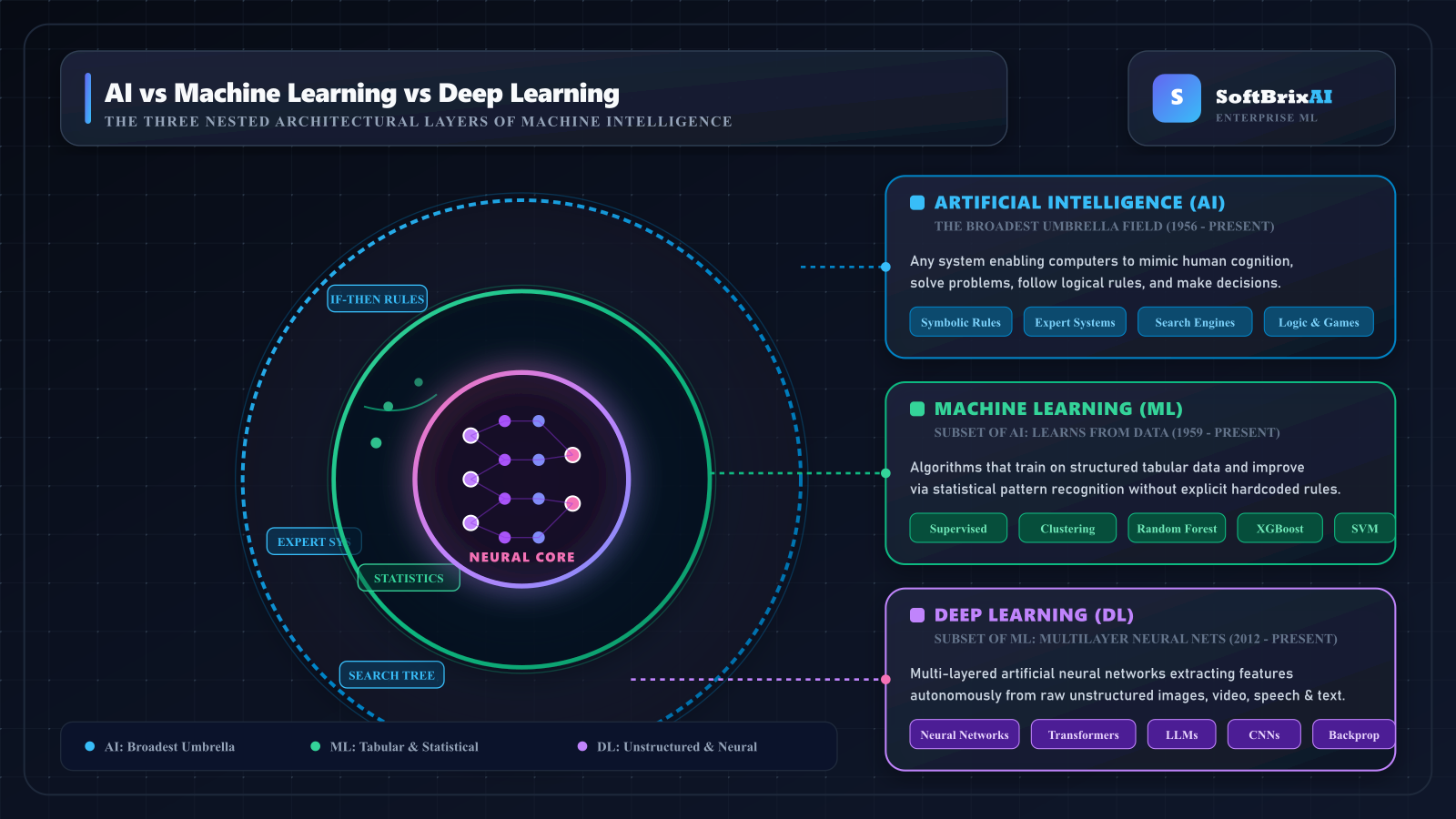
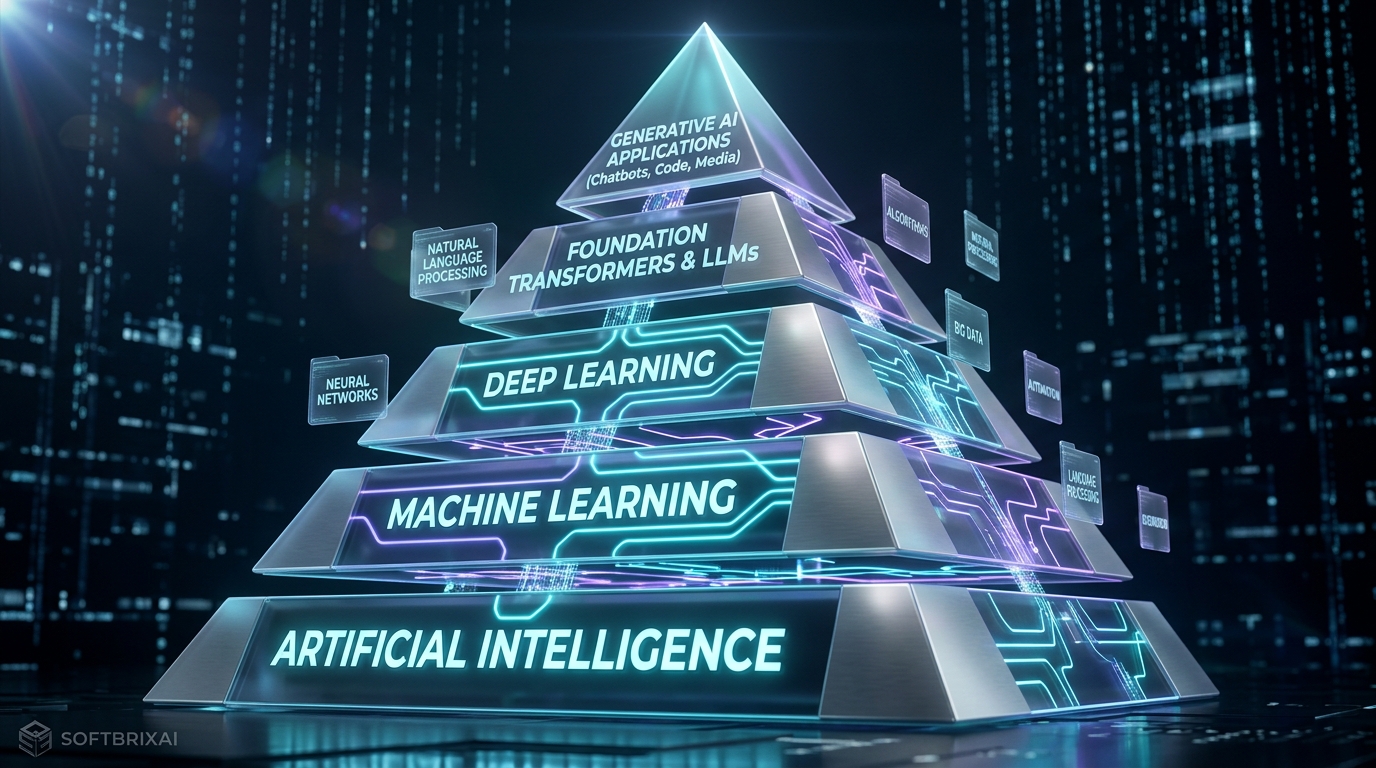
Artificial intelligence (AI), machine learning (ML), and deep learning (DL) represent three nested layers of a single computational hierarchy. AI represents the broad discipline of building intelligent systems. Machine learning is the subset of what artificial intelligence is that learns statistical patterns from data rather than following static rules. Deep learning is the subset of machine learning utilizing multi-layered artificial neural networks to extract hierarchical representations directly from raw inputs.
For an in-depth breakdown of mathematical optimization, model training, and gradient descent, read our comprehensive guide on how does AI work. Below, we explore the core boundaries separating these layers, examine where neural networks and large language models fit, trace a real-world spam detection problem across all three approaches, and provide an engineering decision matrix for architectural selection.
Key Takeaways
- Nested Hierarchy: Deep learning is a subset of machine learning, which is a subset of artificial intelligence. Significant AI applications (such as symbolic expert systems) involve no statistical learning.
- Feature Extraction: Classic ML relies on human domain experts to engineer structured features; deep learning discovers hierarchical representations autonomously from raw unstructured data.
- Compute and Data Footprint: Deep learning demands vast training volumes and specialized GPU acceleration, whereas classic ML executes efficiently on standard CPU infrastructure.
- Interpretability Trade-offs: Classic algorithms (decision trees, linear models) offer high transparency; deep neural networks operate primarily as high-parameter black boxes.
- Tabular Superiority: On structured tabular enterprise data, gradient-boosted decision trees frequently outperform deep neural networks in accuracy and efficiency.
AI vs Machine Learning vs Deep Learning: The Short Answer
Artificial intelligence, machine learning, and deep learning operate as concentric layers of machine intelligence, analogous to Russian nesting dolls:
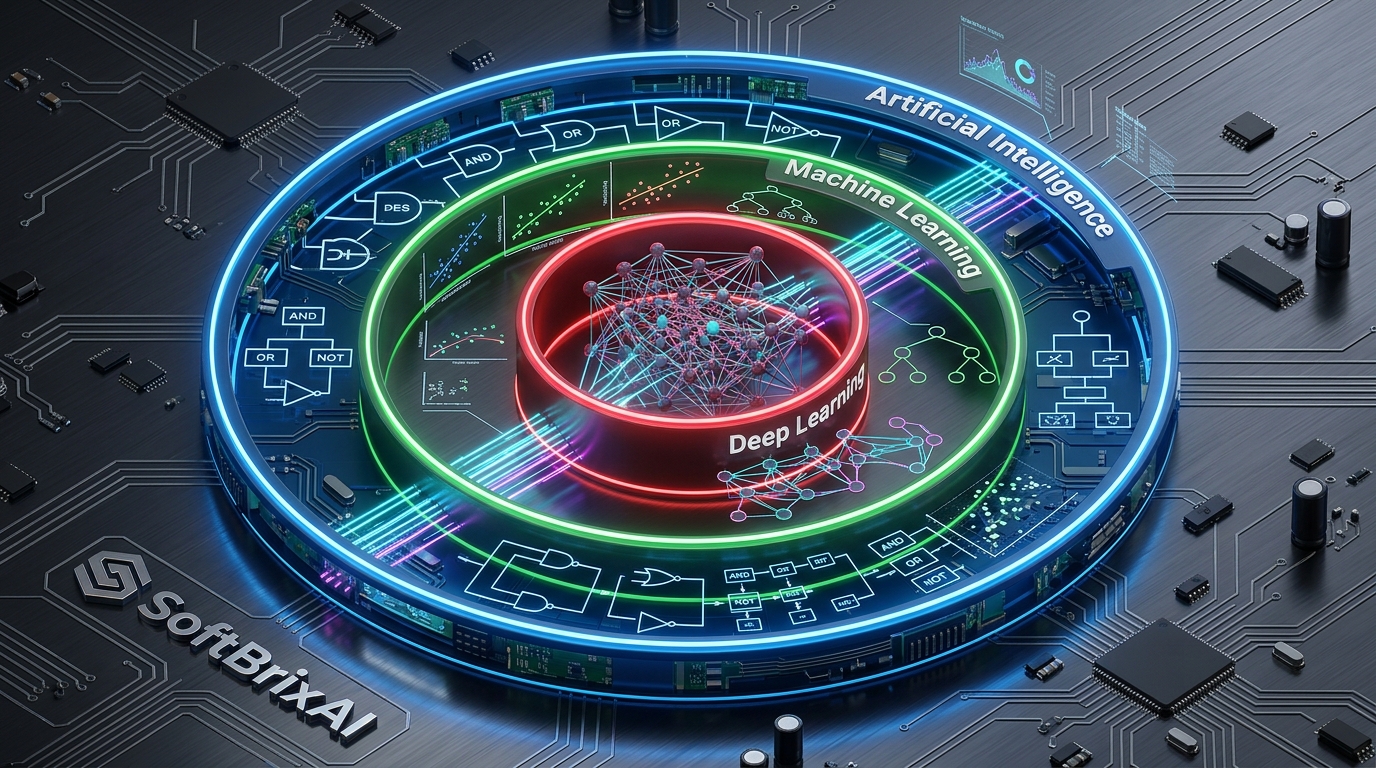
- Artificial Intelligence (Outer Layer): Encompasses all techniques enabling computers to emulate cognitive functions, including symbolic logic, heuristic search, and statistical learning.
- Machine Learning (Middle Layer): Algorithms that infer statistical decision boundaries from data examples without manual programming.
- Deep Learning (Inner Core): Multi-layered neural network architectures that automatically extract abstract representations from raw unstructured data.
Comparing AI with deep learning is equivalent to comparing “transportation vehicles” with “electric sports cars”—deep learning is a specialized, high-performance manifestation of the broader field.
What Is Artificial Intelligence?
Artificial intelligence encompasses the entire field of computer science dedicated to building systems capable of performing cognitive tasks typically requiring human intellect—including natural language processing, visual recognition, automated reasoning, and decision-making. Coined at the 1956 Dartmouth Workshop, AI describes a destination rather than a single technical mechanism. For a comprehensive historical breakdown and foundational concepts, see our guide on what artificial intelligence is.
Rule-Based AI and Expert Systems
Before data-driven approaches dominated, artificial intelligence relied on symbolic reasoning and hand-coded heuristics. Expert systems in the 1970s and 1980s chained together thousands of deterministic if-then rules to diagnose infections, configure machinery, and authorize transactions.

IBM’s Deep Blue, which defeated world chess champion Garry Kasparov in 1997, exemplifies this rule-and-search paradigm: it evaluated up to 200 million board positions per second using heuristic evaluation functions rather than learning from gameplay data. Rule-based AI remains essential across deterministic enterprise software—including tax engines and compliance validation—where absolute auditability is mandatory. However, rule-based systems break down when faced with complex, non-linear real-world tasks like computer vision or speech parsing.
Narrow AI vs Artificial General Intelligence (AGI)
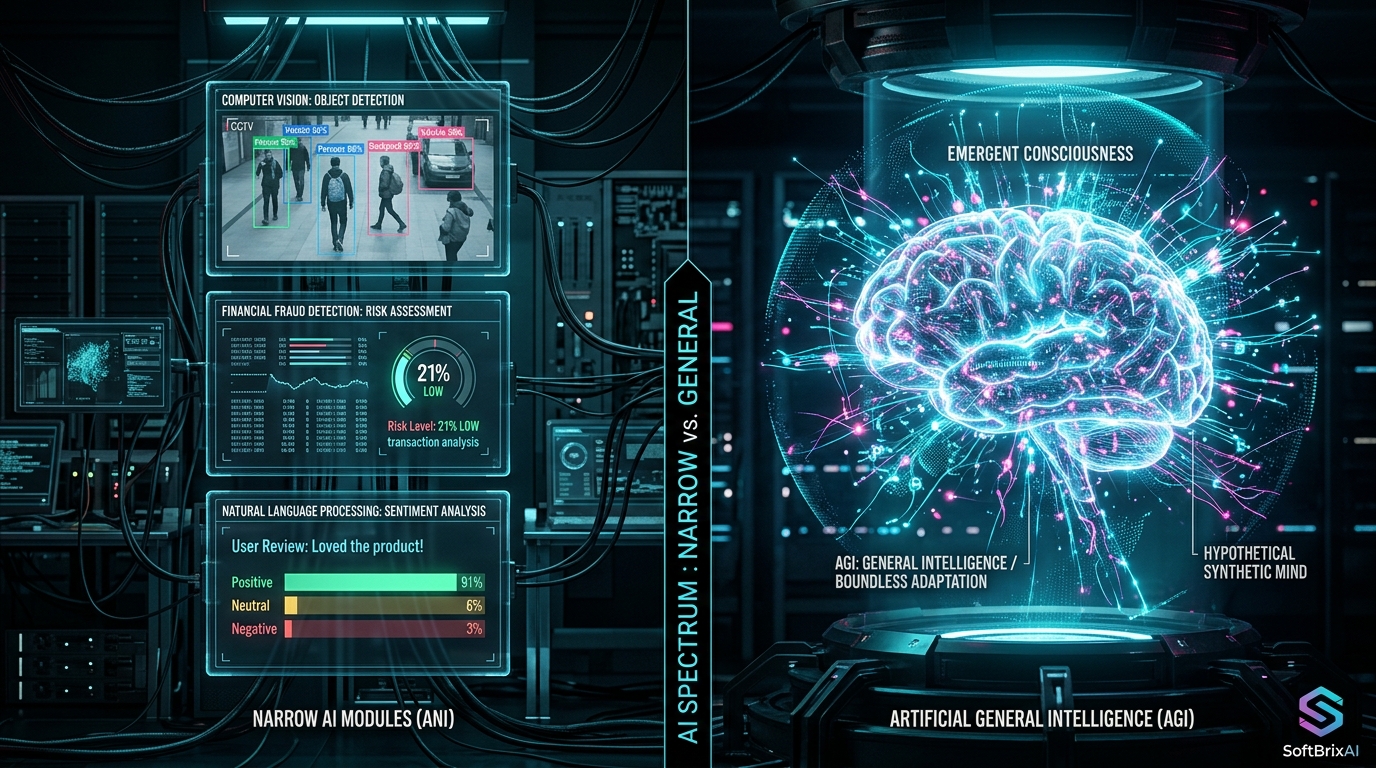
All contemporary systems operate strictly as narrow AI (specialized for bounded problem sets), while Artificial General Intelligence (AGI) remains a theoretical research horizon. For a comprehensive analysis of capability tiers and functional models, see our complete guide on the types of artificial intelligence.
What Is Machine Learning?
Machine learning is the subset of AI in which a program gets better at a task through pattern recognition, learning regularities from data instead of following rules a programmer wrote by hand. Arthur Samuel popularized the term in 1959 through his research on a checkers program that improved the more games it played.
Instead of telling a program to “flag any transaction above $5,000 from a new country,” a machine learning engineer feeds it thousands of past transactions labeled “fraud” or “legitimate” and lets an algorithm work out which combinations of signals predict fraud. The result, called a model, can then score new transactions it has never seen before.
How Machine Learning Works
A standard machine learning workflow progresses through data collection, preprocessing, model training, validation, and production deployment:

During training, an algorithm optimizes mathematical parameters to minimize prediction error against ground-truth labels. For a detailed technical walkthrough of pipeline mechanics, backpropagation, and loss optimization, read our complete guide on how does AI work.
Types of Machine Learning
Machine learning encompasses three core learning paradigms based on feedback structure:
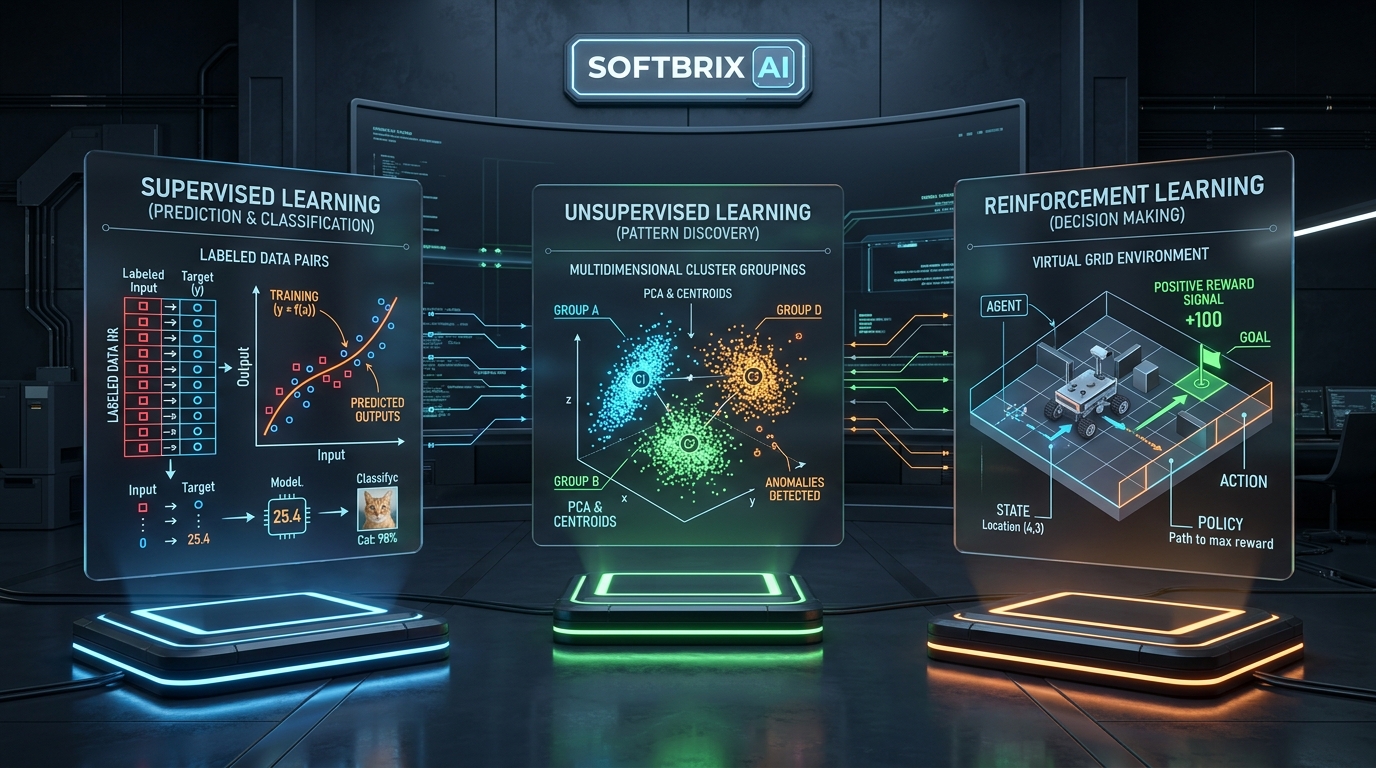
- Supervised Learning: Trains on labeled input-target pairs ($x \rightarrow y$) for classification (sorting categories) and regression (predicting continuous metrics).
- Unsupervised Learning: Discovers latent patterns, geometric clustering, or anomalies in unlabeled datasets ($x$).
- Reinforcement Learning: Optimizes an agent’s sequential decision policy through environmental rewards and penalties.
Additionally, self-supervised learning creates internal prediction targets by masking portions of raw data—the foundational technique used to pretrain foundation models and agentic RAG architectures.
Common Machine Learning Algorithms
Classic machine learning leverages proven mathematical models that execute efficiently on standard CPU hardware:
- Linear & Logistic Regression: Baseline models for continuous estimation and binary classification.
- Tree Ensembles (XGBoost, Random Forest, LightGBM): High-accuracy models optimized for structured tabular data.
- Support Vector Machines (SVM): Geometric boundary maximizers for classification.
- K-Means Clustering: Centroid-based grouping for exploratory segmentation.
- Naive Bayes: Probabilistic conditional classifiers frequently deployed in low-latency text filtering.
What Is Deep Learning?
Deep learning is the specialized subset of machine learning utilizing artificial neural networks with multiple hidden layers to extract hierarchical abstractions directly from raw sensory data. The term “deep” refers to the depth of stacked layers between input and output, enabling automated representation learning without manual feature engineering.
Early network layers detect simple primitives (such as edge orientations and pixel gradients), intermediate layers combine them into textures and contours, and deep layers assemble them into complex semantic concepts (such as objects, speech phonemes, or grammatical structures).
How a Neural Network Learns
Artificial neural networks organize computational units across three core layers:
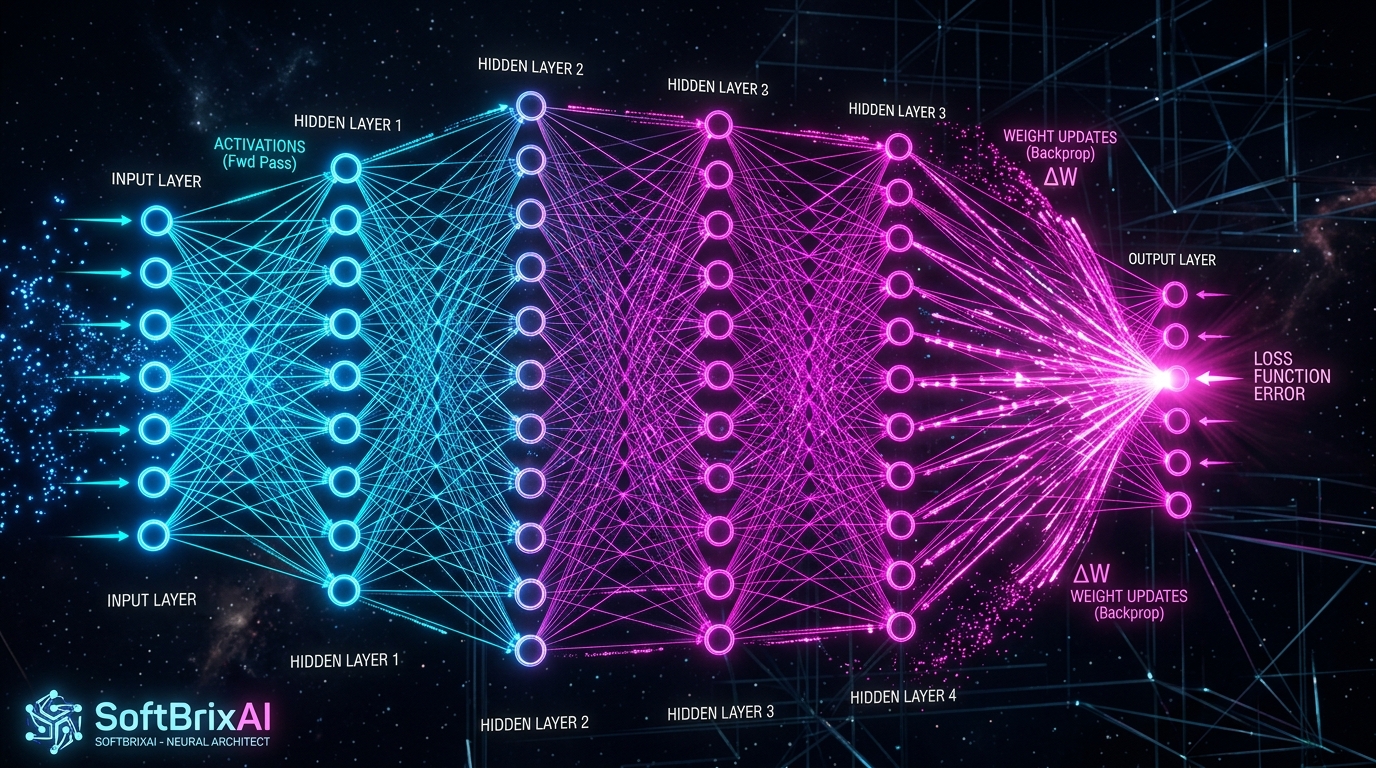
- Input Layer: Ingests raw numerical representations (pixel grids, audio spectrograms, token embeddings).
- Hidden Layers: Execute weighted summations, add bias terms, and apply non-linear activation functions (ReLU, Sigmoid, GELU) across successive layers.
- Output Layer: Generates target predictions (class probabilities, continuous scalars, next-token logits).
Training operates via closed-loop optimization: forward activations compute loss against ground truth, backpropagation applies the calculus chain rule to derive error gradients, and optimizers (AdamW, SGD) update weights iteratively. Formalized by Rumelhart, Hinton, and Williams in 1986 (Nature), backpropagation remains the universal training engine for deep neural networks.
Main Deep Learning Architectures
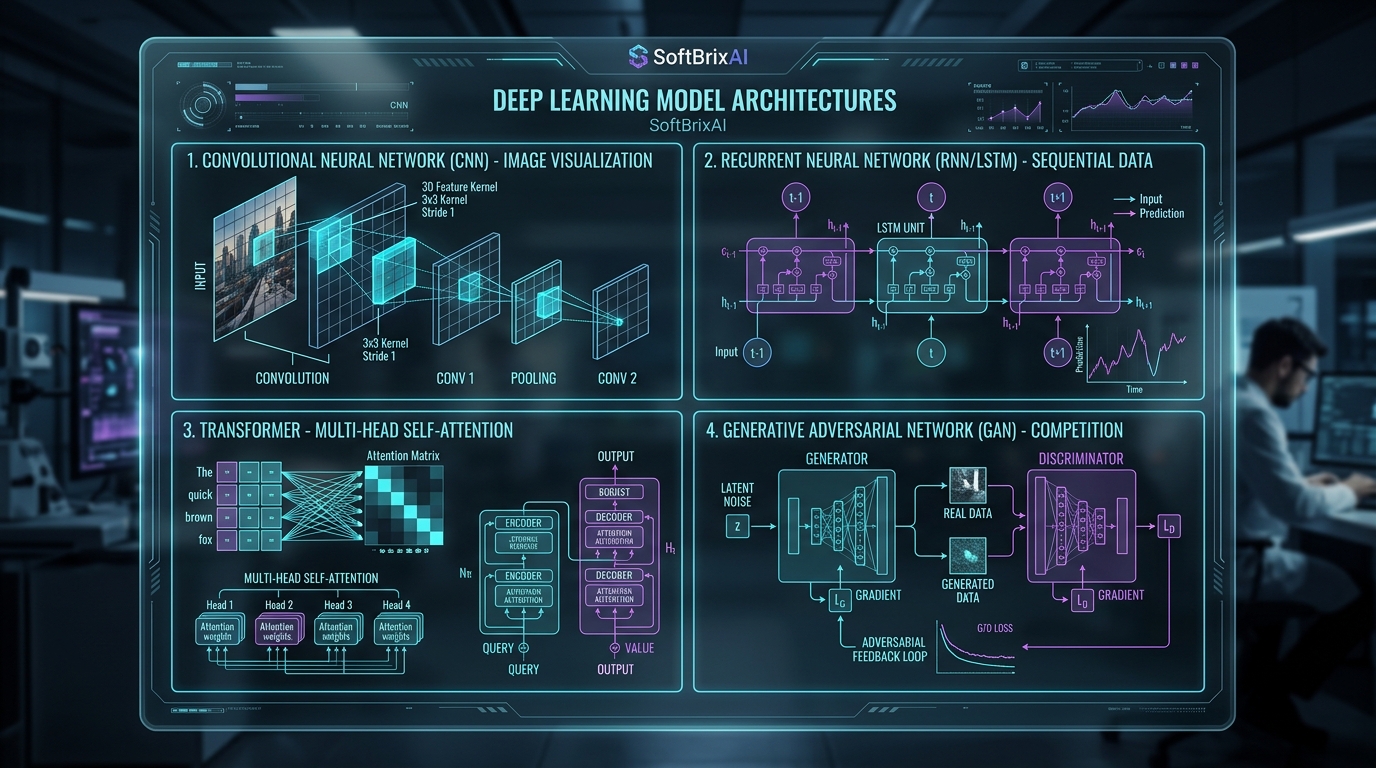
Deep learning employs specialized network topologies tailored to specific data structures:
| Architecture | Primary Data Modality | Operational Mechanism | Enterprise Application |
|---|---|---|---|
| Convolutional Neural Network (CNN) | Spatial grids (images, video) | Local receptive fields and parameter sharing | Medical image triage, autonomous driving perception, AI visual search |
| Recurrent Neural Network (RNN / LSTM) | Sequential time-series | Gated recurrence maintaining temporal state | Industrial telemetry forecasting, speech recognition |
| Transformer | Sequential and multimodal data | Multi-head self-attention modeling global dependencies | Conversational LLMs, code generation, machine translation |
| Generative Adversarial Network (GAN) | Synthetic continuous data | Adversarial minimax game between generator and discriminator | Photorealistic image synthesis, data augmentation |
Introduced by Vaswani et al. in 2017 (“Attention Is All You Need”), transformers have largely superseded recurrent architectures due to superior parallelization across high-performance GPU clusters.
Why Deep Learning Took Off After 2012
Neural networks existed theoretically for decades, but three computational catalysts converged in 2012: massive labeled benchmark datasets (ImageNet), parallel matrix compute on commodity GPUs, and architectural improvements (such as ReLU activations and dropout).
The breakthrough occurred in October 2012 when AlexNet won ImageNet with a top-5 error rate of 15.3% (compared to 26.2% for the nearest classical model), igniting the modern deep learning boom.

This architectural revolution earned Yoshua Bengio, Geoffrey Hinton, and Yann LeCun the 2018 ACM Turing Award, while John Hopfield and Geoffrey Hinton were awarded the 2024 Nobel Prize in Physics for foundational artificial neural network discoveries.
AI vs ML vs Deep Learning: Side-by-Side Comparison
The table below sums up how the three layers differ on the factors that matter most when you evaluate a product or plan a project.
| Factor | Artificial Intelligence (AI) | Machine Learning (ML) | Deep Learning (DL) |
|---|---|---|---|
| Scope | The broadest field, covering any technique that produces intelligent behavior | A subset of AI that learns from data | A subset of ML that uses many-layered neural networks |
| Source of “knowledge” | Hand-written rules, search, logic, or learning | Statistical patterns learned from examples | Layered representations learned from raw data |
| Human involvement | High for rule-based systems, where experts write every rule | Moderate, since people usually select and engineer features | Lower for features, though people still design architectures and curate data |
| Data requirements | Anywhere from none (pure rules) to massive | Often a few thousand to a few hundred thousand structured examples | Usually large volumes, often unstructured, unless you fine-tune a pretrained model |
| Best data type | Depends on the technique | Structured, tabular data in rows and columns | Unstructured data such as images, audio, video, and free text |
| Hardware | Standard CPUs for rule-based systems | Standard CPUs in most cases | GPUs or other AI accelerators for training, and often for inference |
| Training time | None for pure rules | Seconds to hours | Hours to months, depending on model size |
| Interpretability | High for rules, since you can read the logic | Moderate to high, especially for trees and linear models | Low, so many deep models behave like “black boxes” |
| Typical examples | Classic chess engines such as Deep Blue, scripted chatbots, route planners | Credit scoring, churn prediction, product recommendations | Facial recognition, voice assistants, self-driving perception, LLM chatbots |
How AI and Machine Learning Differ
The difference between AI and machine learning comes down to scope, since AI names the goal of making machines act intelligently and machine learning names one specific way to reach that goal by learning from data. Machine learning always counts as AI, but a great deal of AI involves no learning whatsoever.
Take a customer service bot as an example: if developers script every question and answer into a fixed flowchart, the bot is AI but not machine learning, because it never improves with experience. If the bot instead studies thousands of past support conversations to predict which answer resolves a ticket fastest, it becomes a machine learning system.
When people talk about machine learning and AI as one thing, they usually mean learning-based products, since most of the AI tools companies buy today rely on machine learning or deep learning to cope with messy, changing data. Adoption keeps climbing, too: Stanford’s 2026 AI Index Report found that 88% of surveyed organizations used AI in at least one business function in 2025, up from 78% the year before.
Deep Learning vs Machine Learning: Six Key Differences
The main difference between deep learning and machine learning is that deep learning uses many-layered neural networks to learn its own features from raw data, while classic machine learning relies on features that people engineer by hand. Since deep learning is itself a specialized form of machine learning (people sometimes loosely call it “deep machine learning”), the real comparison sets deep neural networks against classic algorithms such as decision trees, SVMs, and regression models, and six differences matter most when you choose between them.
1. Feature Engineering
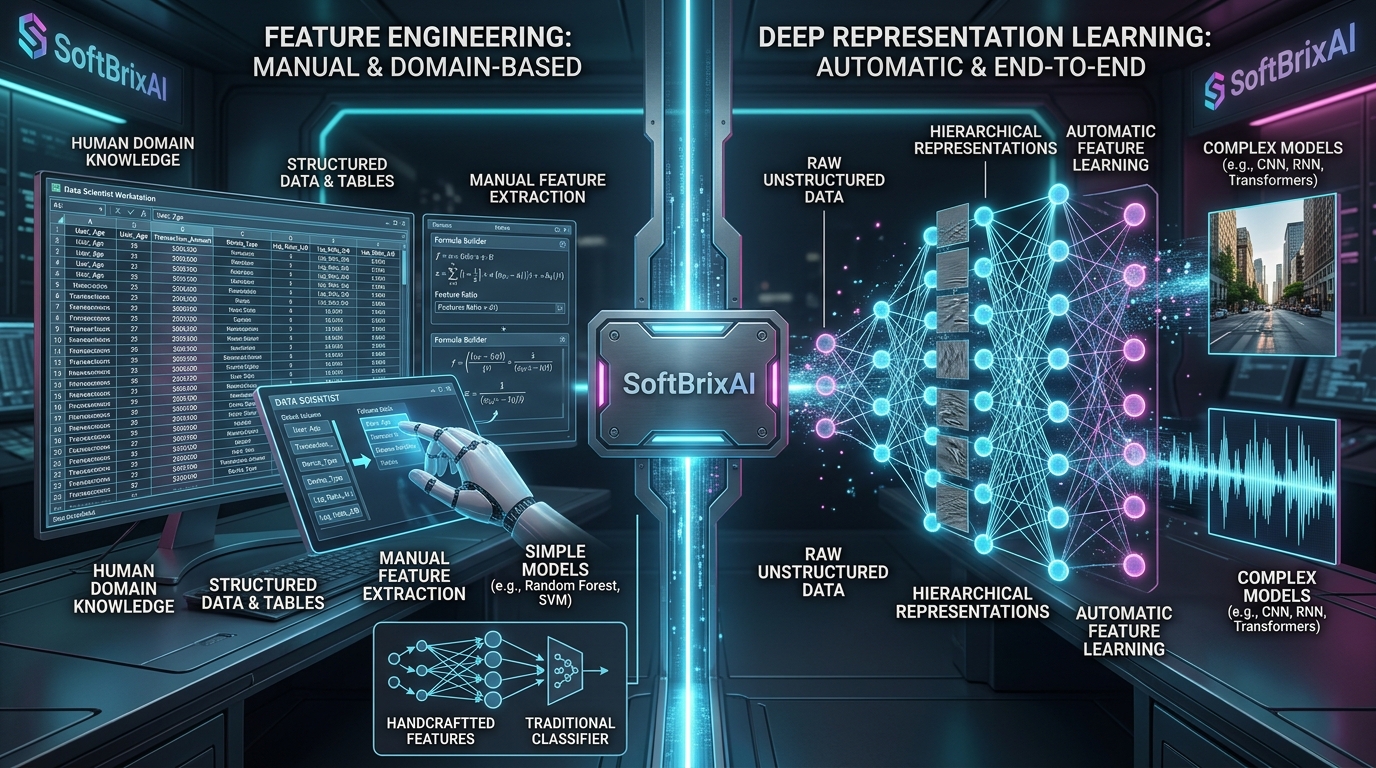
Classic ML requires manual feature engineering: domain experts extract mathematical attributes (such as link counts or income-to-debt ratios) before training. Deep learning eliminates manual feature engineering through end-to-end representation learning: hidden layers extract hierarchical abstractions directly from raw sensory data (pixels, audio spectrograms, text tokens).
2. Data Volume and Scaling
Classic ML achieves peak accuracy on small-to-medium datasets (thousands of records), plateauing as data scales. Deep learning models require massive datasets (hundreds of thousands to trillions of tokens) to prevent overfitting, but their performance scales continuously with compute and data volume.
3. Hardware Compute and Energy
Classic algorithms (Random Forests, Logistic Regression) train and serve in seconds on standard CPU cores. Deep neural networks require high-bandwidth GPU accelerator clusters (NVIDIA H100/B200) with liquid cooling and immense power infrastructure for training and low-latency inference.
4. Training and Iteration Latency
Classic ML models converge within seconds or minutes, enabling rapid experimental loops. Training deep foundation models requires weeks or months across distributed supercomputing clusters, substantially increasing development overhead.
5. Model Interpretability
Classic algorithms provide transparent feature attributions: decision tree branches and linear coefficients are directly auditable. Deep learning models distribute decision logic across billions of continuous weights, functioning as black-box approximators requiring post-hoc attribution tools (such as SHAP or Integrated Gradients).
6. Performance by Data Modality
Deep learning dominates unstructured modalities (vision, audio, natural language). However, on structured tabular enterprise data, tree-based models (XGBoost, LightGBM) routinely outperform deep neural networks on datasets under 50,000 samples, as documented by Grinsztajn et al. in their 45-dataset benchmark study (Why Do Tree-Based Models Still Outperform Deep Learning on Tabular Data?).
Deep Learning vs AI: The Narrowest and Broadest Layers
Deep learning sits two levels below AI in the hierarchy, so the relationship resembles the one between “science” and “quantum mechanics,” with physics as the level in between. AI takes in every approach to machine intelligence, from 1980s expert systems to modern robot planners, while deep learning covers only the approaches built on many-layered neural networks.
The two terms feel interchangeable today because deep learning drives most of the AI products that make headlines, including chatbots, image generators, voice assistants, and self-driving perception systems. Calling a rule-based tax calculator “deep learning” would still be wrong, even though calling it AI would be fair.
Where Do Neural Networks Fit?
Artificial neural networks (ANNs) serve as the computational backbone of deep learning and represent one of many model classes within the broader AI toolbox.
AI vs Neural Networks
Neural networks are a sub-technology within AI, alongside heuristic search, decision trees, and expert systems. A navigation app calculating optimal routes uses classic graph search (such as Dijkstra’s algorithm) without neural networks, while using a neural network in parallel to forecast congestion.
Deep Learning vs Neural Networks
All deep learning involves neural networks, but not all neural networks are deep learning. A single-layer perceptron constitutes classic machine learning. When multiple hidden layers are stacked to construct hierarchical representations, the architecture enters deep learning:
| Dimension | Neural Network (General) | Deep Learning |
|---|---|---|
| Definition | Interconnected computational graph of artificial neurons | Training neural networks with multiple stacked hidden layers |
| Layer Depth | Can contain a single hidden layer (shallow network) | Features multiple hidden layers (often dozens or hundreds) |
| Feature Extraction | Requires engineered inputs in shallow configurations | Learns hierarchical representations autonomously from raw data |
| Architectural Role | Foundational computational unit | The discipline of scaling neural networks deeply |
Where Do Generative AI and Large Language Models Fit?
Generative AI refers to algorithms that synthesize novel data—including text, code, imagery, audio, and video—rather than solely predicting or classifying existing data points. Modern generative systems operate almost exclusively on deep learning backbones, predominantly transformers and diffusion architectures.
A Large Language Model (LLM) is a deep neural network featuring tens or hundreds of billions of parameters trained autoregressively to predict sequential tokens. Foundation models are pretrained via self-supervised learning on web-scale text corpora and aligned through reinforcement learning from human feedback (RLHF).
LLM vs Neural Network Hierarchy
Every LLM is an artificial neural network, but only a fraction of neural networks are LLMs:
- A shallow perceptron or a CNN classifying radiology scans is an artificial neural network with zero natural language capability.
- An LLM (e.g., Claude 3.7, GPT-5.5) is a specialized deep neural network utilizing transformer self-attention to parse linguistic semantics.
In summary: LLMs are generative models built with deep learning, which is a subset of machine learning, which is a branch of artificial intelligence. Stanford’s 2026 AI Index documented that 70% of enterprise organizations deployed generative AI within production functions in 2025.
One Problem, Three Approaches: Building a Spam Filter
Examining how a single problem—email spam filtration—is solved across each architectural tier clarifies these engineering trade-offs:

- Approach 1: Rule-Based AI: Engineers author static regex rules (e.g., flagging “wire transfer” or >10 hyperlinks). The system deploys instantly with total auditability, but fails against adversarial misspellings (“w1re transf3r”), creating an endless manual maintenance burden.
- Approach 2: Classic Machine Learning: Engineers extract tabular features—link counts, domain reputation scores, capital-letter ratios—and train an XGBoost or Naive Bayes classifier on 50,000 labeled emails. The model adapts through periodic retraining and executes in sub-milliseconds on commodity CPUs, but remains blind to signals omitted during feature engineering.
- Approach 3: Deep Learning: Engineers fine-tune a pretrained transformer directly on raw text. The model detects semantic nuances (such as subtle phishing tones and multilingual evasion) without manual feature engineering. However, it requires GPU inference infrastructure and functions as an uninterpretable black box.
Production email gateways frequently deploy compound pipelines: deterministic rules reject known malicious IPs immediately, classic ML scores sender reputation, and deep models analyze ambiguous text.
Real-World Examples of Artificial Intelligence, Machine Learning, and Deep Learning
The examples below show which layer of the hierarchy does most of the work in familiar products.
| Application | Primary layer | Why that layer fits |
|---|---|---|
| Classic chess engine using search and hand-tuned scoring (Deep Blue, 1997) | AI (rule and search based) | The rules of chess are fixed and fully known |
| Scripted FAQ chatbot on a retail site | AI (rule based) | Answers follow a predictable flowchart |
| Credit scoring and loan approval | Machine learning | The data is structured, and regulators expect explainable decisions |
| Credit card fraud detection | Machine learning, often combined with deep learning | Tabular transaction data needs fast, high-volume scoring |
| Streaming and e-commerce recommendation systems | Machine learning and deep learning | Classic collaborative filtering works alongside deep models of user behavior |
| Demand forecasting and predictive analytics | Machine learning | Historical sales data lives in rows and columns |
| Customer segmentation | Machine learning (unsupervised clustering) | No labels exist, so the model finds natural groups on its own |
| Facial recognition and phone face unlock | Deep learning (CNNs) | Raw pixels vary enormously with lighting and angle |
| Voice assistants and speech-to-text | Deep learning | Raw audio needs layered feature learning |
| Real-time language translation | Deep learning (transformers) | Meaning depends on context across whole sentences |
| Self-driving car perception | Deep learning | Cameras and lidar produce huge volumes of unstructured data |
| Medical image analysis (X-rays, MRI scans) | Deep learning | Subtle visual patterns are hard for people to describe as features |
| Generative AI chatbots and coding assistants | Deep learning (LLMs) | Fluent language generation requires massive transformer models |
How to Choose Between Machine Learning and Deep Learning
If you’re planning a project, the AI vs machine learning vs deep learning question becomes a practical one, and working through these six questions in order will point you toward the right approach.

- Can clear rules solve the problem? If a domain expert can write down the full logic and the rules rarely change, start with a rule-based system, since it’ll be cheaper, faster, and easier to audit.
- What kind of data do you have? Rows and columns of structured business data point toward classic machine learning first, while images, audio, video, or free text point toward deep learning.
- How much labeled data can you get? With a few thousand labeled examples, classic machine learning or fine-tuning a pretrained deep model makes sense, whereas training a deep network from scratch usually takes far more.
- Do you need to explain each decision? In lending, insurance, hiring, and healthcare, interpretable models or strong explainability tooling often matter as much as raw accuracy.
- What are your compute budget and latency needs? When the model has to run on a phone, a sensor, or another edge device, a small classic model or a compressed deep model may be your only option.
- Does a pretrained model already exist? For language and vision tasks, calling or fine-tuning an existing foundation model often beats building anything from scratch on both cost and accuracy.
A sensible default for most teams is to build a simple machine learning baseline first and move to deep learning only when that baseline clearly falls short and the data type justifies the extra cost.
A Short History of AI, Machine Learning, and Deep Learning
The architectural evolution from symbolic AI to deep neural networks spans several key computational breakthroughs:
| Year | Milestone | Architectural Significance |
|---|---|---|
| 1943 | McCulloch-Pitts Neuron | Formulated the first mathematical abstraction of an artificial neuron |
| 1959 | Samuel’s Checkers Program | Arthur Samuel coined “machine learning,” demonstrating algorithmic self-improvement |
| 1986 | Backpropagation Formalization | Rumelhart, Hinton, and Williams established gradient descent optimization for multi-layer networks |
| 2012 | AlexNet ImageNet Victory | Deep convolutional neural networks trained on GPUs decisively outperformed hand-crafted features |
| 2017 | Transformer Architecture | Vaswani et al. introduced self-attention (“Attention Is All You Need”), superseding recurrent networks |
| 2024 | Nobel Recognition | Hopfield and Hinton awarded the Nobel Prize in Physics for foundational artificial neural network discoveries |
Common Misconceptions About AI, ML, and Deep Learning
“AI and machine learning mean the same thing.” Machine learning is only one route to AI, and many dependable AI systems, from route planners to rule-based fraud checks, never learn from data.
“Deep learning always wins on accuracy.” It leads on large volumes of unstructured data, but classic algorithms regularly hold their own on small datasets and on problems where people need to see the reasoning.
“Neural networks work like the human brain.” Artificial neurons borrow a loose idea from biology, yet they’re simple mathematical functions, and no current network learns or reasons the way a person does.
“Deep learning needs no human input.” Deep models remove most manual feature engineering, but people still collect and label data, design architectures, tune hyperparameters, test for algorithmic bias, and monitor models after launch.
“LLMs sit outside machine learning.” Large language models are deep neural networks trained on data, so they belong inside machine learning just like any image classifier does.
Summary: Which Term Fits Which System
When it comes to AI vs machine learning vs deep learning, the three terms describe nested levels of one idea, moving from the broad goal of machine intelligence to systems that learn from data and then to many-layered neural networks that learn their own features. Once you understand that hierarchy, you can judge AI marketing claims more carefully and ask vendors sharper questions. You’ll also be able to pick the approach that fits your data, whether that turns out to be a simple rule, a gradient-boosted tree, or a fine-tuned transformer.
Frequently Asked Questions
What is the primary difference between AI, machine learning, and deep learning?
AI is the overarching field of creating machines that perform cognitive tasks. Machine learning is the subset that learns statistical patterns from data. Deep learning is the subset of machine learning using multi-layered artificial neural networks to learn representations from raw data.
What is the core difference between machine learning and deep learning?
Classic machine learning requires data scientists to manually engineer input features, running efficiently on tabular datasets using CPU compute. Deep learning extracts features autonomously from raw sensory inputs (images, audio, text) using multi-layered neural networks accelerated by GPUs.
Is deep learning always superior to classic machine learning?
No. On structured tabular business data, tree-based models (such as XGBoost and LightGBM) routinely match or outperform deep neural networks while requiring significantly less compute, smaller training datasets, and offering superior interpretability.
Is ChatGPT considered AI, machine learning, or deep learning?
ChatGPT belongs to all three layers simultaneously: it is an artificial intelligence product powered by a large language model, which is a deep neural network (deep learning), trained via statistical pattern learning (machine learning).
Can artificial intelligence exist without machine learning?
Yes. Symbolic AI, expert systems, heuristic search algorithms (such as A* search), and rule-based systems execute intelligent tasks through explicit programmer-defined logic without learning from data.
Are neural networks synonymous with deep learning?
Not necessarily. A neural network is an architectural unit consisting of connected artificial neurons. While deep learning requires neural networks with multiple hidden layers, shallow neural networks containing a single hidden layer are classified as classic machine learning.
Does deep learning strictly require GPU acceleration?
Training production deep learning models requires GPUs or TPUs to parallelize billions of matrix multiplications. While small pretrained networks can execute inference on CPUs or mobile edge chips, training deep networks from scratch on CPUs is computationally impractical.
Should data practitioners learn machine learning or deep learning first?
Practitioners should master classic machine learning first—including loss functions, bias-variance trade-offs, regularization, and evaluation metrics—because deep learning builds directly upon these mathematical foundations.
How does an LLM differ from an artificial neural network?
An artificial neural network is a general architectural framework. A Large Language Model (LLM) is a specialized, multi-billion-parameter transformer neural network specifically trained to predict and generate sequential linguistic tokens.