Every AI system you use learned its skills from examples before it ever answered a question for you. A spam filter studied thousands of emails that people had already marked as junk, while a voice assistant listened to hours of recorded speech paired with written transcripts. Those examples have a name, and they decide how well a model performs long after the engineers stop tuning it.
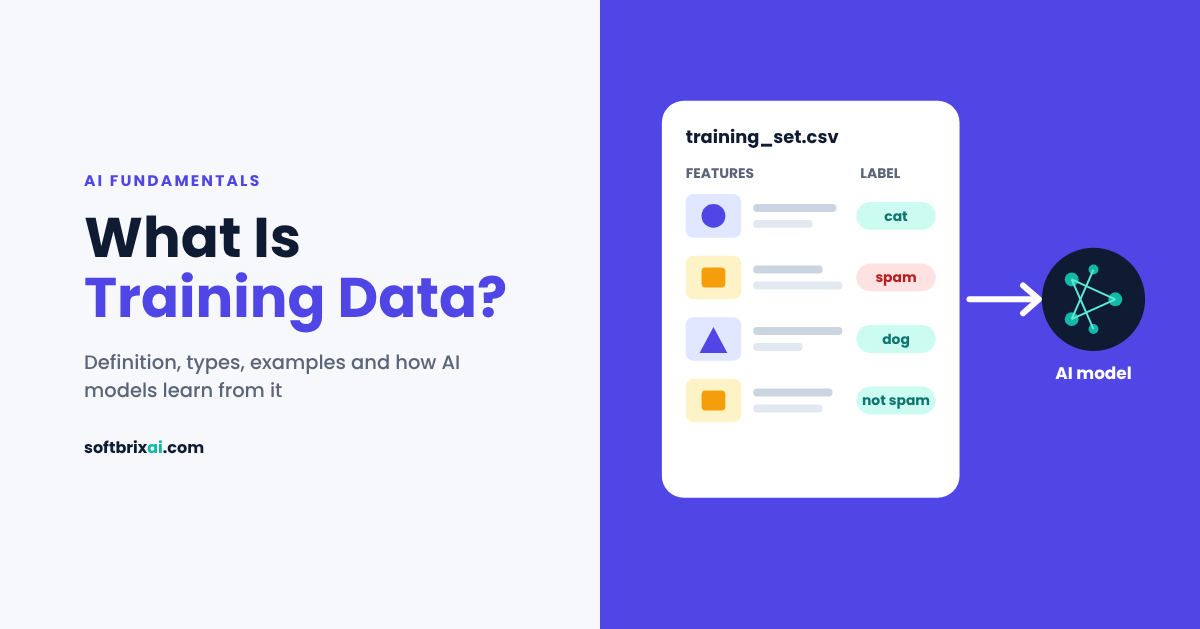
Training data is the collection of examples a machine learning model studies to learn patterns before it makes predictions on new information. Each example contains input features, such as the words in an email, and often a label that shows the correct answer, such as “spam.” The model adjusts its internal parameters until its guesses match those answers.
This guide explains what training data is, how AI training data shapes a model, and the main types of training data you will meet. It also covers where data for AI training comes from and how teams prepare it. Finally, it looks at the quality, bias and privacy issues that decide whether a model holds up in the real world.
What Is Training Data?
Training data is the set of examples a machine learning algorithm uses to learn a task. The algorithm looks for relationships between inputs and outputs inside that set, then stores what it learns as numbers called model parameters, or weights. Once training finishes, the resulting machine learning model applies those learned patterns to data it has never seen.
The role of training data in machine learning is easy to state but hard to get right: the examples define the limits of what the model can know. Machine learning training data that covers only sunny-day photos, for instance, will produce a vision model that struggles the first time it rains. For a full exploration of training and validation loops, see our guide on what is machine learning.
Think of training data as the worked examples in a textbook. A student who solves 500 practice problems with an answer key at the back starts to recognize the patterns behind each type of question. A model works the same way, except it can process millions of examples and it has no understanding beyond the patterns it finds in them.
If you are new to the wider field, our guide on what artificial intelligence is covers the basics. Our explainer on what an AI model is then shows where AI model training data fits among the other parts of a model.
Training Data Definition in Simple Words
In simple words, training data means “the examples a computer learns from.” People phrase the question in many ways, from “what is train data” and “what is data training” to “what is training dataset” or “what is training data in AI.” The training data meaning stays the same across every version.
The terms training dataset, training set and AI training data set are interchangeable in everyday use. You will also see the plural forms AI training datasets or AI training sets, while formal reports sometimes prefer the longer phrase artificial intelligence training data.
A training dataset can contain almost anything a computer can store. It might hold house prices in a spreadsheet, chest X-rays in a folder, or bank transactions in a log. Other common forms include product reviews and streams of sensor readings from factory machines.
Features, Labels and Ground Truth: Inside a Training Dataset
Most training datasets share the same building blocks, and knowing them makes the rest of this guide easier to follow.
- Examples (samples): Each row, image, document or recording is one example the model will study.
- Features (attributes): These are the input variables the model reads, such as the sender address, subject line and word count of an email.
- Labels (tags or targets): A label is the correct output for an example, such as “spam” or “not spam.” In a regression task, the label is a number, like a sale price. Data scientists also call it the target variable.
- Ground truth: This is the set of labels a team trusts as correct. Ground truth data acts as the reference point that every prediction gets compared against.
- Metadata: Extra information about each example, such as where it came from, when someone collected it, and who labeled it.
Features describe the question, while the label holds the answer. A model learns by finding which features best predict the label across thousands of examples.
How Is Training Data Used? The Training Loop
Training data feeds a repeating cycle called the training loop. The model sees an example, makes a guess, checks that guess against the label, then nudges its parameters to shrink the error. Here is how that cycle works in plain steps:
- Input: The algorithm receives one example, or a small batch of examples, from the training set.
- Predict: The model produces an output using its current weights. At the start, those weights are random, so the first guesses are poor.
- Compare: A loss function measures how far the prediction landed from the ground truth label, and that gap becomes the error signal.
- Adjust: In a neural network, a method called backpropagation sends the error signal backward through the layers. An optimizer inside frameworks like PyTorch or TensorFlow then updates each weight slightly so the next prediction lands closer.
- Repeat: The model cycles through the full training dataset many times, and engineers call each full pass an epoch.

The goal is generalization, which means the model should perform well on unseen data rather than simply memorizing the training examples. Engineers also set hyperparameters before training starts, such as the learning rate or the number of epochs. The model learns its parameters from the training data, whereas people choose the hyperparameters and tune them with a separate validation set.
Our article on how AI works walks through this loop with a single neuron learning to spot spam, if you want to see the math behind it.
Why Training Data Matters More Than the Algorithm
Engineers have a blunt phrase for poor data: garbage in, garbage out. A model can only learn the patterns that exist in its training data, so flawed examples produce a flawed model no matter how advanced the algorithm looks.
Label mistakes are more common than most people expect. The MIT-led study Pervasive Label Errors in Test Sets Destabilize Machine Learning Benchmarks found an average error rate of at least 3.3% across ten popular datasets. Label errors made up at least 6% of the ImageNet validation set alone. If widely studied benchmark datasets contain that many mistakes, private datasets built under deadline pressure often contain more.
That is why good training data for AI is rarely an accident. It comes from deliberate collection plans, careful labeling and repeated checks.
This realization drives a movement called data-centric AI. Instead of holding the data fixed while swapping algorithms, data-centric teams hold the model fixed and improve the dataset itself. The MIT course Introduction to Data-Centric AI describes it as “an emerging science that studies techniques to improve datasets.” In practice, cleaning labels, removing duplicates and filling coverage gaps often lifts model performance more than another month of model tuning would.
Types of Training Data
Training data comes in several forms, and most real projects mix more than one. The types of training data below cover the distinctions you will meet most often.
Labeled vs Unlabeled Data
What is labeled data? Labeled data pairs each example with the correct answer. A photo tagged “cat,” a transaction marked “fraudulent,” and a customer review scored “negative” all count as labeled data. People often call it annotated data or human-labeled data. Supervised learning depends on it, and creating it takes time because a person or a trusted process has to supply every label.
What is unlabeled data? Unlabeled data is raw data with no answer attached, such as a folder of untagged images or a database of website clicks. It is cheap to collect in large volumes. Unsupervised learning uses it to find hidden structure on its own, for example grouping shoppers into segments based on how they browse.
| Aspect | Labeled data | Unlabeled data |
|---|---|---|
| What it contains | Inputs plus correct answers | Inputs only |
| Common learning approach | Supervised learning | Unsupervised or self-supervised learning |
| Cost to create | High, since people or systems must add labels | Low, since it is collected as-is |
| Typical tasks | Classification, regression | Clustering, anomaly detection, pretraining |
| Example | Emails marked spam or not spam | A raw archive of customer emails |
Semi-supervised learning sits between these two approaches. A team labels a small slice of the data, then lets the model learn from a much larger pool of unlabeled examples to stretch its labeling budget further.
Structured vs Unstructured Training Data
Structured training data fits into rows and columns with clear field types. Spreadsheets of sales figures, tables of patient vitals and bank transaction records are all structured, so traditional algorithms can read them with little transformation. A typical machine learning training dataset for credit scoring, for example, holds one row per applicant with columns for income, loan amount and repayment history.
Unstructured training data has no fixed format. Emails, photos, audio clips, videos, PDFs and social media posts fall into this group, which makes up most of the data organizations hold. Deep learning models handle unstructured data well, but it usually needs more preprocessing and more careful labeling before it becomes useful. Semi-structured data, such as JSON files or server logs, sits in the middle because it carries tags without forcing every record into the same shape.
Real-World vs Synthetic Training Data
Real-world data comes from actual events, people and devices. It captures the messy detail of reality, which is exactly what a model needs to perform outside the lab.
Synthetic training data is generated by software rather than collected from the world. Teams create it with simulations, rule-based generators or other AI models. It helps when real examples are rare, expensive or sensitive. A fraud team, for instance, might generate extra examples of rare fraud patterns, while a self-driving project might simulate dangerous road scenes that nobody wants to stage in real life.
Synthetic data comes with real limits, though. It can only reflect the assumptions built into the generator, so it may miss the odd edge cases that real data contains. Most teams treat it as a supplement to real-world data, then confirm the final model on real examples before deployment.
Training Data by Modality
Modality describes the kind of signal a dataset holds, and each modality suits a different group of AI tasks.
| Modality | Typical examples | Common AI tasks |
|---|---|---|
| Text data | Emails, reviews, support tickets, web pages | Sentiment analysis, chatbots, spam detection |
| Image data | Product photos, medical scans, satellite images | Object detection, defect inspection, diagnosis support |
| Audio data | Call recordings, voice commands, podcasts | Speech recognition, speaker identification |
| Video data | Security footage, dashcam clips, sports broadcasts | Action recognition, tracking, autonomous driving |
| Tabular data | Transactions, customer records, sales logs | Fraud detection, predictive analytics, credit scoring |
| Time-series data | Stock prices, heart-rate readings, server metrics | Forecasting, anomaly detection |
| Sensor and IoT data | Temperature, vibration, GPS, LiDAR point clouds | Predictive maintenance, robotics, mapping (often streamed via Kafka) |
| Multimodal data | Images paired with captions, video with audio | Image captioning, visual question answering |
Training Data and Learning Approaches
The way a model learns depends on what its training data looks like.
- Supervised learning uses labeled data to learn a mapping from input to output. Classification and regression are its two main jobs.
- Unsupervised learning uses unlabeled data to find clusters, outliers or hidden structure.
- Semi-supervised learning combines a small labeled set with a large unlabeled one.
- Self-supervised learning creates its own labels from raw data, for instance by hiding a word in a sentence and asking the model to predict it. Large language models learn this way during pretraining.
- Reinforcement learning does not rely on a fixed dataset in the usual sense. An agent learns from rewards and penalties it receives while acting in an environment—a foundation for autonomous AI agent development—and its logged experiences become its training material.
- Transfer learning starts from a model already trained on a large general dataset, then fine-tunes it on a smaller task-specific one. This approach lets teams with only a few thousand examples still build accurate models.
For a fuller comparison of these approaches, see our breakdown of AI vs machine learning vs deep learning.
Training Data vs Validation Data vs Test Data
Teams never use all their data for training. They split it into three parts so they can check whether the model has actually learned something useful.
- Training data teaches the model, since the algorithm sees these examples repeatedly and adjusts its weights based on them.
- Validation data guides the decisions people make during development. Engineers use it to tune hyperparameters, compare model versions and spot overfitting early.
- Test data gives the final grade on the finished model. Also called holdout data, it stays locked away until the end so it can measure performance on truly unseen data.
| Dataset | Purpose | When the model sees it | Typical share |
|---|---|---|---|
| Training set | Learn patterns and fit parameters | Every epoch | 70% to 80% |
| Validation set | Tune hyperparameters, catch overfitting | During development | 10% to 15% |
| Test set | Final, unbiased evaluation | Once, at the end | 10% to 15% |
The key difference between training data vs test data is exposure. The model learns from training data, whereas test data must remain unseen until the final check. Training data vs validation data differs in a subtler way, because the model never learns directly from validation examples, yet the people building it make choices based on validation scores.
Train Validation Test Split
The most common train validation test split is 80/10/10, with 70/15/15 as a popular alternative for smaller datasets. Very large datasets can push the training share even higher, since 1% of ten million examples still gives a test set of 100,000.
When data is scarce, k-fold cross-validation in libraries like scikit-learn makes better use of every example. The data is divided into k equal parts, often five or ten. The model trains on all parts except one, tests on the part left out, and repeats until every part has served as the test fold once. Averaging the scores gives a steadier estimate than a single split would.
Time-ordered data needs special handling during the split. For a sales forecast, the training set should contain earlier months while the test set holds later ones, because random shuffling would let the model peek at the future.
Data Leakage
Data leakage happens when information from the test set, or from the future, slips into training. The model then scores brilliantly in testing but fails in production. Duplicate records that land in both the training and test sets are a common cause. Others include features that would not exist at prediction time, plus preprocessing steps fitted on the full dataset before splitting. A contaminated test set gives a false sense of confidence, which is why careful teams split their data first and only then clean, scale or encode it.
Training Data vs Big Data
People often confuse these terms, but they describe different things. Big data refers to any collection of information too large, fast-moving or varied for traditional tools to handle. Training data refers to a purpose: the examples chosen and prepared to teach a specific model.
A retailer might store petabytes of clickstream logs as big data in platforms like Snowflake or Databricks, yet only a carefully filtered and labeled slice of those logs becomes training data for a product recommendation model. Big data processing engines like Apache Spark can supply high-volume pipelines, but volume alone does not make data useful for training. Relevance, accuracy and labels matter far more than raw size.
Where AI Training Data Comes From
Teams source data for AI training from many places, and each source carries its own trade-offs in cost, quality and legal risk.
| Source | How it works | Strengths | Watch-outs |
|---|---|---|---|
| First-party data | Data your organization collects from its own products, customers or operations | Highly relevant, often exclusive | Needs consent and privacy controls |
| Public datasets | Open collections from universities and governments, such as the UCI Machine Learning Repository or Data.gov | Free, quick to start, well documented | May not match your domain, and competitors can use them too |
| Licensed data | Datasets bought or licensed from data owners | Ready to use, legally cleared | Ongoing cost, restricted reuse |
| Web scraping | Automated collection of publicly visible web pages | Huge volume and variety | Copyright, terms-of-service and personal data concerns |
| Crowdsourcing | Many remote workers collect or label small pieces of data | Scales labeling quickly | Quality varies, so it needs review layers |
| Sensors and IoT devices | Cameras, microphones and industrial sensors stream readings | Real-time, objective measurements | Noise, calibration drift, storage cost |
| Synthetic generation | Simulations or generative models create artificial examples | Covers rare events, avoids personal data | May miss real-world quirks |
| Partnerships | Organizations share data under formal agreements | Access to data you could not collect yourself | Contract terms, data sovereignty rules |
| User feedback | Ratings, corrections and clicks from people using a deployed model | Keeps the model current | Can reinforce existing bias |
When deciding how to collect training data, start with the question your model must answer, then work backward. If the model will run on photos taken by customers’ phones, a dataset of professional studio shots will not prepare it well, however large that dataset is.
How to Prepare Training Data: 7 Steps
Raw data almost never arrives ready for training. Here is how to prepare training data in a sequence most teams follow, from first collection to the final check.
1. Collect the Data
Gather examples that reflect the conditions the model will face in production. Cover the full range of cases, including rare ones, and record the source of every batch so you can trace problems later.
2. Clean the Data
Data cleaning, sometimes called data cleansing or data scrubbing, removes the noise that would confuse a model. Typical tasks include removing duplicates, fixing typos, handling missing values and filtering outliers caused by entry errors. Teams also standardize units and date formats so every record follows one convention. For missing values, teams either drop the affected rows or use imputation, which fills each gap with a reasonable estimate such as the column median. Our specialized AI data engineering workflows automate this pipeline to ensure repeatable data quality.
3. Label the Data
For supervised learning, every example needs an accurate label. This step often consumes the largest share of time and budget, so the next section covers it in detail.
4. Split the Data
Divide the dataset into training, validation and test sets before any further transformation. Splitting first protects you from data leakage.
5. Preprocess and Engineer Features
Training data preprocessing turns cleaned data into a form the algorithm can read efficiently, typically implemented using Python data stacks. Common techniques include:
- Normalization: Min-max normalization rescales values to a fixed range, usually 0 to 1.
- Standardization: Z-score standardization centers each feature at zero with a standard deviation of one, which helps many algorithms train faster.
- Encoding: One-hot encoding converts categories, such as “red,” “green” and “blue,” into separate binary columns.
- Feature engineering: Data scientists create new, more informative features from existing ones, for example turning a timestamp into “hour of day” and “weekday.”
- Data augmentation: Teams generate variations of existing examples, such as rotated or cropped images, to expand the training set without new collection.
- Balancing: When one class vastly outnumbers another, teams oversample the rare class, undersample the common one, or weight errors differently to fix class imbalance.
Fit every preprocessing step on the training set only, then apply the same fitted transformation to the validation and test sets.
6. Train the Model
Feed the prepared training set into the algorithm and run the training loop. Track the loss on both the training and validation sets after each epoch so you can see whether the model is still improving.
7. Validate and Iterate
Check the results against the validation set, study where the model fails, and trace those failures back to the data. Missing edge cases, mislabeled examples or underrepresented groups usually show up here. Fix the data, retrain, and only touch the test set once you are confident in the final version.

Data Labeling and Data Annotation
Data labeling and data annotation describe the same job: adding the tags, boxes, transcripts or scores that turn raw data into labeled data. Some teams use “annotation” for richer work, such as drawing outlines around tumors, and “labeling” for simple tags, but the terms overlap heavily. When people ask “what is data labeling in AI,” this is the answer.
Labeling methods range from simple to complex:
- Classification tags: One label per example, such as “positive review.”
- Bounding boxes and segmentation: Boxes or pixel-level outlines around objects in images.
- Transcription: Written text paired with audio recordings.
- Entity tagging: Highlighting names, dates or product codes inside documents.
- Ranking and rating: Scoring which of two AI responses is more helpful, a task central to training chatbots.
Human in the Loop Labeling
Human in the loop labeling keeps people involved at key points rather than handing the whole job to software. A common pattern lets a model pre-label data, then sends uncertain or high-stakes items to human annotators for review. Active learning takes this further by having the model pick the examples it finds most confusing, so people spend their time on the labels that teach the model the most.
Domain experts matter a great deal for specialized work. A radiologist labels medical scans more reliably than a generalist, and a lawyer spots contract clauses that a non-specialist would miss.
Keeping Labels Consistent
Three practices protect label quality:
- Annotation guidelines: A written rulebook with examples of edge cases, so every annotator handles a blurry photo or a sarcastic review the same way.
- Inter-annotator agreement: Teams assign the same examples to several annotators and measure how often they agree. Low agreement signals unclear guidelines or a genuinely ambiguous task.
- Review passes: A senior reviewer or adjudicator resolves disagreements and spot-checks samples, producing the final ground truth labels.
What Makes High Quality Training Data
High quality training data shares a handful of measurable traits, whether it feeds a small classifier or a large neural network. Machine learning training data that scores well on each dimension below gives a model its best chance in production. Use the table below as a checklist when you assess training data quality.
| Quality dimension | What it means | Quick test |
|---|---|---|
| Accuracy | Labels and values reflect reality | Spot-check a random sample against a trusted source |
| Completeness | Few missing values or empty fields | Count missing values per column |
| Consistency | The same thing is recorded the same way everywhere | Look for conflicting formats, units or labels |
| Relevance | Examples match the task and the production environment | Compare training inputs with real user inputs |
| Timeliness | Data is recent enough to reflect current conditions | Check collection dates for stale data |
| Diversity and coverage | All important groups, conditions and edge cases appear | Break performance down by subgroup |
| Balance | Classes appear in workable proportions | Count examples per class |
Quantity still matters, but quality sets the ceiling. A smaller, clean and representative dataset regularly beats a larger, noisy one.
Bias in Training Data
Bias in training data happens when the examples a model learns from misrepresent the people or situations it will serve. The model then repeats, and sometimes amplifies, those distortions in its predictions. The pattern always runs the same way: a skew in the data causes a skew in the model, which then causes unfair or inaccurate outcomes in the real world.
The best-known evidence comes from the Gender Shades study by Joy Buolamwini and Timnit Gebru. It found that commercial gender classification systems had error rates of up to 34.7% for darker-skinned women, while the maximum error rate for lighter-skinned men was 0.8%. The two benchmark datasets it examined were 79.6% and 86.2% lighter-skinned, which shows how unbalanced training and evaluation data can hide serious failures.
Common Types of Data Bias
- Historical bias: The data accurately records a past that was itself unfair, such as hiring records that favored one group.
- Selection and sampling bias: The collection method leaves out certain groups, for example a voice dataset recorded only in quiet offices.
- Representation bias: Some groups appear in such small numbers that the model never learns to handle them well.
- Measurement bias: The tools or proxies used to record data work better for some groups than others.
- Labeling bias: Annotators bring their own assumptions to subjective labels, such as what counts as “offensive.”
- Temporal bias: Data reflects conditions that no longer hold, such as shopping habits from before a major market shift.
The NIST report Towards a Standard for Identifying and Managing Bias in Artificial Intelligence (SP 1270) groups these into systemic, statistical and human biases. It argues that bias is a socio-technical problem rather than a purely statistical one.
A Practical Bias Checklist
Use these questions to reduce bias in AI training data before it reaches production:
- Who appears in this dataset, and who is missing compared with the people the model will serve?
- Does model accuracy hold steady across subgroups, or does it drop for some of them?
- Could any feature act as a proxy for a protected attribute, such as a postcode standing in for ethnicity?
- Do the labels rely on past human decisions that may have been unfair?
- Were annotators given clear guidelines for subjective calls, and did several of them review contested items?
- Can you rebalance the data, collect more examples from underrepresented groups, or add carefully checked synthetic data to fill gaps?
- Who will monitor fairness after launch, and how often?
Data quality and bias are closely linked. Many bias problems are, at heart, coverage problems that a better collection plan would have caught early.
Training Data and Overfitting
Overfitting occurs when a model memorizes its training data, including noise and quirks, instead of learning patterns that generalize. It shows up as very high accuracy on the training set paired with much lower accuracy on the validation set.
Training data and overfitting are directly connected. Small datasets, duplicated examples and narrow sources all make memorization easier. A model trained on receipts from a single store chain, for example, may learn that chain’s logo instead of learning to read totals. Underfitting is the opposite problem: the model is too simple, or the features too weak, to capture the real pattern, so it performs poorly on both sets.
Teams fight overfitting by collecting more diverse data, applying data augmentation, removing duplicates, simplifying the model, using regularization, and stopping training once validation loss starts to rise.
How Much Training Data Is Needed?
No single number answers how much training data is needed, because the right amount depends on several factors:
- Task complexity: Telling cats from dogs needs far fewer examples than reading handwritten prescriptions.
- Model size: Larger models with more parameters need more data to avoid overfitting.
- Number of classes: Each category needs enough examples of its own, so a 200-class problem needs more data than a two-class one.
- Data quality: Clean, accurately labeled data reduces the volume you need.
- Starting point: Fine-tuning a pretrained model can work with a few hundred or a few thousand examples, whereas training from scratch needs far more.
Rough ranges still help with early planning. Classic training data for machine learning on structured data often works with thousands to hundreds of thousands of rows. Deep learning on images or text from scratch usually needs hundreds of thousands of examples or more. Large language models sit at the far end of the scale, which the next section covers.
For language models, research on compute-optimal training found a useful rule. The paper Training Compute-Optimal Large Language Models concluded that “the model size and the number of training tokens should be scaled equally.” In practice, a bigger model needs proportionally more text as well as more computing power.
Signs You Need More Training Data
- Training accuracy is high, yet validation accuracy stays much lower.
- Performance keeps improving each time you add a batch of new examples, so the learning curve has not flattened.
- The model fails on specific groups, regions, accents or lighting conditions that appear rarely in the dataset.
- Rare but important classes, such as fraud cases, have only a few dozen examples.
- Results swing noticeably when you retrain with a different random split.
- Users report errors on inputs that look nothing like your training examples.
If adding data no longer moves your validation score, the bottleneck has shifted to label quality, features or model choice.
Training Data for LLMs
Training data for LLMs works in stages, and each stage uses a different kind of data.
- Pretraining data: Large language models first learn from enormous collections of text, including books, articles, code and filtered web pages. This stage uses self-supervised learning, so the model teaches itself by predicting the next word, or token, across trillions of tokens.
- Fine-tuning data: Next, the model learns from smaller, curated sets of example prompts paired with high-quality responses written or approved by people. This supervised fine-tuning teaches it to follow instructions.
- Preference data: Finally, human reviewers compare pairs of model answers and pick the better one. Reinforcement learning from human feedback (RLHF) uses these rankings to steer the model toward helpful, safe responses.
This scale creates a supply problem for the whole industry. A study from Epoch AI, Will We Run Out of Data? Limits of LLM Scaling Based on Human-Generated Data, estimates the stock of usable public human-written text at around 300 trillion tokens. It projects that AI developers will fully use that stock between 2026 and 2032 if current trends continue. That pressure explains the growing interest in synthetic training data, licensed archives and private, domain-specific datasets curated on platforms like Hugging Face.
Training data also shapes the way LLMs fail. When a model’s training data contains gaps, outdated facts or contradictions, the model may produce confident but false statements, which people call hallucinations. Grounding responses using RAG development and agentic RAG architectures directly alleviates this constraint. The hallucination section of our AI explainer covers why this happens in more detail. Our comparison of generative AI vs predictive AI shows how data needs differ between those two families, including how enterprises approach generative AI development.
AI Training Data Examples in Real Life
These AI training data examples show how different industries put the concept to work.
- Email spam filters: Millions of emails labeled spam or legitimate teach filters to recognize suspicious senders, phrases and links.
- Fraud detection: Banks train models on past transactions marked fraudulent or genuine, using features such as amount, location, merchant type and time of day.
- Medical imaging: X-rays, CT scans and skin photos labeled by specialists help models flag possible disease for a doctor to review.
- Voice assistants: Thousands of hours of recorded speech paired with transcripts teach speech recognition systems to handle different accents and background noise.
- Self-driving vehicles: Camera footage and LiDAR point clouds with labeled pedestrians, cyclists, lanes and traffic signs train perception systems.
- Product recommendations: Purchase histories, ratings and browsing sessions teach recommendation engines which items people tend to buy together.
- Customer segmentation: Unlabeled purchase data lets clustering algorithms group customers into segments, such as frequent high spenders or occasional bargain hunters.
- Sentiment analysis: Product reviews and social media posts tagged as positive, negative or neutral teach models to read customer mood at scale.
- Predictive maintenance: Vibration and temperature readings from machines, matched to records of past breakdowns, help factories fix equipment before it fails.
These training data examples in real life share one thing: each model is only as reliable as the examples behind it.
Worked Example: Building Training Data for a Spam Filter
A short walkthrough shows how the ideas above fit together. Imagine a small company that wants its own spam filter.
Step 1, collect. The team exports 12,000 past emails from shared inboxes, with consent covered by its privacy policy.
Step 2, clean. It removes 1,000 exact duplicates and strips out personal signatures to reduce exposure of personal data, which leaves 11,000 emails.
Step 3, label. Two staff members label each email as spam or not spam using a one-page guideline. They agree on 96% of emails, and a third person settles the rest. The final ground truth shows 2,200 spam emails (20%) and 8,800 legitimate ones.
Step 4, split. Using an 80/10/10 split, the team gets 8,800 training emails, 1,100 validation emails and 1,100 test emails. It keeps the 20% spam ratio in each set and ensures no duplicate email appears in more than one set.
Step 5, preprocess. The team converts each email into features such as word frequencies, the number of links, sender domain age and whether the subject line uses all capital letters. It fits these transformations on the training set only.
Step 6, train and validate. The first model reaches 99% accuracy on training data but only 91% on validation data, a clear sign of overfitting. Error analysis shows the model learned to flag every email containing “invoice,” because many spam examples used that word. The team adds 300 genuine invoice emails, retrains, and validation accuracy rises.
Step 7, test. Only after finishing development does the team run the model once on the 1,100 test emails, which gives an honest estimate of real-world performance.

Training Data Privacy, Consent and Regulation
Training data privacy matters because many datasets contain personal information, from names and emails to health records and voice recordings. Mishandling that data creates legal exposure and erodes user trust.
Several laws shape how teams collect and use AI training data:
- GDPR (EU): The General Data Protection Regulation requires a lawful basis for processing personal data and limits use to the original purpose. It also sets a principle of data minimization, which means collecting only what you need.
- CCPA (California): The California Consumer Privacy Act gives California residents the right to know what personal information businesses collect about them. Residents can also ask for deletion or opt out of the sale or sharing of their data.
- HIPAA (US health data): The HHS guidance on de-identification describes two approved methods, Expert Determination and Safe Harbor. Safe Harbor requires removing 18 types of identifiers before health data counts as de-identified.
- COPPA (children’s data): The FTC’s Children’s Online Privacy Protection Rule requires verifiable parental consent before collecting personal information from children under 13.
- EU AI Act: Article 10 of the EU AI Act sets data rules for high-risk AI systems. Their datasets must be “relevant, sufficiently representative” and, as far as possible, “free of errors and complete in view of the intended purpose.” Teams must also examine that data for possible biases.
Privacy Practices for Training Data
- Informed consent: Tell people clearly how their data may be used for model training, and record that consent.
- Data minimization: Drop fields the model does not need, such as full names when an ID number will do.
- Anonymization and de-identification: Remove or mask personally identifiable information (PII) before data enters the training pipeline.
- Privacy by design: Build privacy controls into the data pipeline from the start rather than adding them after launch.
- Access control and retention: Limit who can view raw data and delete it when it is no longer needed.
- Federated learning: When data cannot leave a device or hospital, train the model locally and share only the learned updates rather than the raw records.
The NIST AI Risk Management Framework offers a voluntary structure for managing these privacy and fairness risks across the full AI lifecycle, a core pillar of enterprise AI governance consulting.
Training Data Management
Training data management keeps datasets organized, traceable and current after the first model ships. It forms a core part of MLOps, the practice of running machine learning systems reliably in production.
- Dataset versioning: Save a snapshot of every dataset used to train a model—using tools like MLflow—so you can reproduce results or roll back after a bad update.
- Data lineage: Record where each example came from and every transformation it went through. Lineage makes audits and debugging far faster.
- Documentation: The paper Datasheets for Datasets proposes that every dataset ship with a datasheet describing its motivation, composition, collection process and recommended uses. Many research groups and companies now publish datasheets alongside their datasets.
- Data drift monitoring: Real-world inputs change over time. Data drift happens when incoming data stops resembling the training data, while concept drift happens when the relationship between inputs and outcomes shifts, such as fraudsters changing tactics.
- Training-inference skew: Make sure features are computed the same way during training and in production. A mismatch quietly degrades accuracy, and a shared feature store helps prevent it.
- Retraining schedule: Set triggers, such as a drop in accuracy or a fixed calendar interval, for refreshing the training data and retraining the model.
Teams deploying on cloud ecosystems like AWS or container platforms like Kubernetes manage these datasets systematically to ensure consistent retraining. Good training data management turns a one-off dataset into a living asset that improves with every model release.
Frequently Asked Questions
What is training data in simple words?
Training data is the set of examples a computer studies to learn a task. Each example shows an input, such as a photo, and often the correct answer, such as “dog.” By seeing thousands of these examples, the model learns patterns it can apply to new inputs it has never seen.
What is the difference between training data and test data?
Training data teaches the model, so the algorithm sees it repeatedly and adjusts its parameters based on it. Test data stays hidden until development ends, then measures how well the finished model handles unseen examples. Mixing the two produces misleading accuracy scores.
How much training data do you need?
It depends on the task, the model size and the data quality. Simple tabular problems may work with a few thousand rows, image models trained from scratch often need hundreds of thousands of examples, and large language models use trillions of tokens. Fine-tuning a pretrained model can cut the requirement sharply.
Is synthetic training data as good as real data?
Synthetic data works well for filling gaps, covering rare events and protecting privacy, but it only reflects the assumptions built into its generator. Most teams combine it with real-world data and always evaluate the final model on real examples before deployment.
What is the difference between training data and big data?
Big data describes any very large, fast or varied collection of information. Training data describes the specific examples selected and prepared to teach a model. Big data can supply training data, but only after teams filter, clean and often label the relevant portion.
Who owns AI training data?
Ownership depends on how the data was collected and the agreements involved. Organizations generally control first-party data they gather lawfully, licensed data comes with contract terms, and scraped web content may carry copyright and privacy restrictions. Rules differ by country, so legal review is wise for any commercial project.
How can you reduce bias in training data?
Start by auditing who appears in the dataset and comparing model accuracy across subgroups. Remove features that act as proxies for protected attributes, give annotators clear guidelines, and collect more examples from underrepresented groups. Continue monitoring fairness after launch, because bias can emerge as real-world data changes.
Can a model keep learning after training?
Most deployed models stay fixed until a team retrains them on updated training data. Some systems use scheduled retraining or online learning to absorb new examples over time, which helps them handle data drift. Each update still needs validation to avoid introducing new errors.
Conclusion
Training data is the foundation of machine learning. It defines what a model can learn, which situations it can handle, and where it will fail. The algorithm matters, yet the examples behind it decide most of the outcome. That is why the strongest AI teams invest as much in data labeling, cleaning, bias checks and privacy controls as they do in model design.
If you are planning an AI project, start by asking whether your training data truly represents the people and conditions your model will meet. Answer that question well, and every later step becomes easier. Our guide to the types of artificial intelligence and our look at the history of artificial intelligence add useful context. If you want help building datasets that hold up in production, explore how SoftBrixAI delivers enterprise-grade custom AI software development or talk to our team about AI consulting.