Machine learning is a branch of artificial intelligence that lets computers learn patterns from data so they can make predictions or decisions without a programmer writing every rule. Instead of following a fixed script, a machine learning system studies thousands of examples and measures how wrong its guesses are. It then adjusts itself until those guesses hold up on new data.
That idea now sits behind spam filters, fraud alerts, film recommendations, voice assistants and the chatbots people talk to every day. This guide answers the question “what is machine learning” from the ground up. You will find a clear ML definition, a worked numeric example of how a model learns, the main types of machine learning and the algorithms worth knowing. Later sections explain how to judge a model, where the technology fails and how to start learning it yourself.
Key Takeaways
- Machine learning (ML) is the part of AI that learns rules from data instead of receiving them from a programmer.
- Most modern models learn through the same loop: they make a prediction, measure the error, then nudge their internal settings to shrink that error.
- The core types of machine learning are supervised, unsupervised and reinforcement learning, while self-supervised learning powers today’s generative AI.
- A model is only as good as its data, so data quality, bias and drift matter as much as the choice of algorithm.
- All machine learning is AI, but not all AI is machine learning.
What Is Machine Learning? A Clear Definition
Short definition: ML is a method of building software that improves at a task by learning from examples rather than from hand-written instructions. The classic machine learning definition comes from Arthur Samuel, the computer scientist who popularized the term in 1959 while teaching a program to play checkers. He is widely credited with describing the field as giving computers the ability to learn without being explicitly programmed.
To define machine learning more precisely, the modern definition of machine learning adds three parts. There is a task, such as flagging fraudulent payments. There is experience, which arrives as training data. Finally, there is a performance measure that shows whether the system is getting better. When that score rises as the system sees more data, the system is learning.
ML Meaning and ML Definition in Plain Language
If you only need the ML meaning in one breath, picture a student revising with past exam papers. Nobody hands the student the marking scheme in advance, yet after enough practice questions they recognize the patterns and answer new questions correctly. A machine learning model does the same thing with numbers, finding the patterns in historical examples before applying them to fresh cases.
Anyone asking “what is ML?” usually gets the same two-word reply from people who define ML for a living: learning from data. The data replaces the instructions, which is the machine learning meaning most practitioners would recognize. For a closer look at what that data contains, how teams label it and why its quality decides almost everything, read our guide on what training data is.
Machine Learning vs Traditional Programming
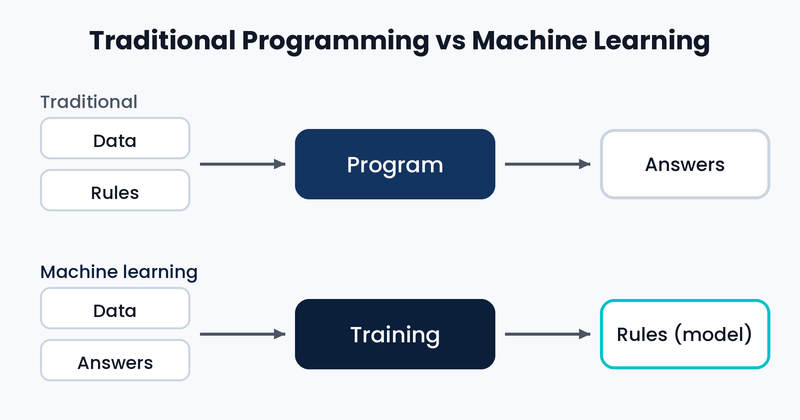
Traditional software follows rules that a developer writes by hand. A thermostat offers a simple example: if the temperature drops below 20°C, it switches on the heating. That rule never changes unless someone rewrites it, whereas machine learning reverses the relationship between rules and data.
| Traditional programming | Machine learning | |
|---|---|---|
| What goes in | Data plus hand-written rules | Data plus the expected answers |
| What comes out | Answers | Rules, stored as a trained model |
| Who writes the logic | A developer | The training algorithm |
| Handling new patterns | Someone must update the code | Retraining on fresh data updates the model |
| Best suited to | Stable logic with few exceptions | Messy patterns that are hard to describe |
| Everyday example | A tax calculator | A spam filter |
Spam filtering shows the difference between the two approaches clearly. A rules-based filter might block every email containing “free money”, but spammers simply change the wording. A machine learning filter studies millions of emails that people have marked as spam, weighs hundreds of subtle signals at once, then keeps adapting as tactics change.
Machine Learning vs Artificial Intelligence vs Deep Learning
People often use AI and machine learning as if they meant the same thing, which causes plenty of confusion. Artificial intelligence is the broad goal of building machines that handle tasks we link with human intelligence, such as understanding language, recognizing images or planning. Machine learning is one route to that goal, while deep learning is a specialized branch of machine learning.
The rule worth remembering is simple: all machine learning is AI, but not all AI is machine learning. Early expert systems and other rules-based AI encoded human knowledge as long chains of if-then statements. Those systems could diagnose equipment faults or approve routine claims, yet they never learned anything on their own. Within artificial intelligence, machine learning has since become the dominant approach because it scales with data instead of with human effort.
Our explainer on what artificial intelligence is covers the wider field, while our guide to how AI works walks through the mechanics behind it.
| Term | What it covers | Typical example |
|---|---|---|
| Artificial intelligence | Any technique that makes machines act intelligently, including fixed rules | A chess engine built on search rules |
| Machine learning | AI systems that learn patterns from data | A credit risk score |
| Deep learning | Machine learning built on multi-layer neural networks | Face unlock on a phone |
| Generative AI | Deep learning models that create new text, images, audio or code | A chatbot drafting an email |
Deep Learning vs Machine Learning
The deep learning vs machine learning question comes down to how much of the work the model does on its own. Classic machine learning algorithms usually need people to choose the useful inputs, a step called feature engineering. A loan model, for instance, might rely on income, debt ratio and payment history that an analyst picked by hand.
Deep learning uses artificial neural networks with many layers, which learn useful features straight from raw pixels, audio or text. Picture a classic model drawing one curve through the data, whereas a deep network joins thousands of tiny line segments that can bend around almost any shape. That flexibility explains why deep learning leads in computer vision and natural language processing, though it also demands far more data and computing power. For a side-by-side view, see our breakdown of AI vs machine learning vs deep learning.
How Does Machine Learning Work?
To answer “what is machine learning?” at a mechanical level, start with one idea. Most supervised models, from a simple regression to a deep neural network, learn through the same three-part loop.
- A decision process. The model takes input data and produces a prediction, such as a price, a label or a probability.
- An error function. Also called a loss function, it compares the prediction with the correct answer and turns the gap into a single number.
- An optimization process. The algorithm adjusts the model’s internal parameters, known as weights and biases, so the next prediction lands closer to the truth.
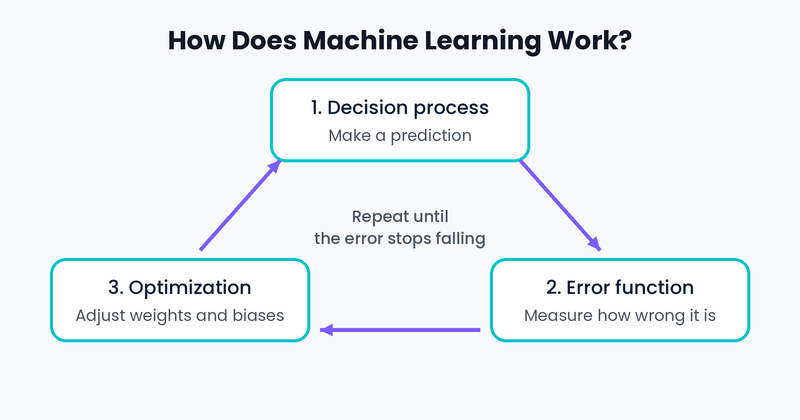
This loop repeats thousands or even millions of times. Each pass shaves a little off the error until the predictions stop improving in any meaningful way.
A Worked Example: Predicting a House Price
Suppose you want a model that estimates house prices. Each house becomes a list of numbers called a feature vector, so a 1,900-square-foot home with 4 bedrooms that is 30 years old becomes [1900, 4, 30].
A basic linear regression model multiplies each feature by a weight, adds the results together, then adds a constant called the bias:
price = (w1 × size) + (w2 × bedrooms) + (w3 × age) + bias
Before training, the weights are little more than guesses. Imagine the model starts with w1 = 100, w2 = 5,000, w3 = −1,000 and a bias of 20,000. Its prediction for our house would be (100 × 1,900) + (5,000 × 4) + (−1,000 × 30) + 20,000, which comes to $200,000.
The house actually sold for $350,000, leaving an error of $150,000. The optimization step works out which direction to move each weight to close that gap. Because size is by far the largest number in the vector, a small change to w1 has the biggest effect on the prediction. In practice, teams rescale features to similar ranges first, a step called normalization, so no single input dominates training. After thousands of houses and small corrections, the weights settle on values that predict prices well, even for homes the model has never seen.
How Does AI Learn From Its Mistakes?
When people ask “how does AI learn?”, the answer usually involves two ideas: gradient descent and backpropagation. Gradient descent treats the error like a hilly surface, then walks downhill one small step at a time toward the lowest point. The size of each step is a hyperparameter called the learning rate. Set it too high and the model overshoots the bottom, while a rate set too low makes training painfully slow.
Backpropagation is the bookkeeping that makes gradient descent work inside neural networks. It traces the final error backward through every layer, calculating how much each weight contributed to the mistake. Deep learning frameworks handle those derivatives automatically, so developers can spend their time on data and design.
Training, Validation and Test Data
Good practice splits the available data into three sets. The training set teaches the model, the validation set helps tune hyperparameters and compare versions, and the test set stays locked away until the very end. Only the test score gives an honest estimate of real-world performance, because it never influenced training. Many teams also use cross-validation, which rotates different slices of the data through the validation role to produce a steadier estimate.
Overfitting and Underfitting
The real goal of training is generalization, meaning strong performance on data the model has never seen. Overfitting happens when a model memorizes the training examples, noise included, so it scores brilliantly in training yet stumbles on anything new. Underfitting is the opposite problem, where the model is too simple to capture the real pattern in the first place.
Balancing these two failures is known as the bias-variance tradeoff. Teams fight overfitting with more data, simpler models, regularization that penalizes extreme weights or early stopping once validation scores begin to slide. When a model underfits, a richer model or better features usually solves it.
Types of Machine Learning
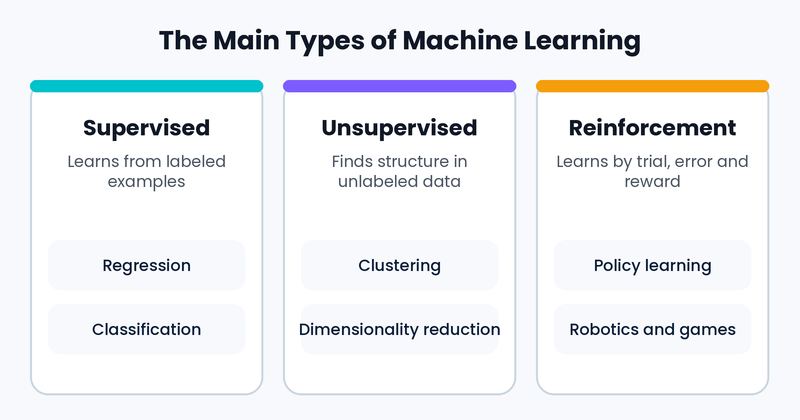
The main types of machine learning differ in one key respect: the kind of feedback a model receives while it learns.
Supervised Learning
Supervised learning trains on labeled data, where every example comes with the correct answer, often called the ground truth. Those labels act like an answer key that guides the model toward the right output. Supervised tasks fall into two groups:
- Regression predicts a continuous number, such as a house price, next month’s sales or tomorrow’s rainfall. Linear regression and polynomial regression are classic methods here.
- Classification predicts a category instead of a number. Binary classification chooses between two options, such as spam or not spam. Multiclass classification picks from many, such as naming which of 50 plant species appears in a photo.
The main drawback of supervised learning is cost. Labeling data takes human time, and in fields like medical imaging it requires expensive specialists.
Unsupervised Learning
Unsupervised learning works with unlabeled data and searches for structure on its own, a little like reading a book without a study guide and still noticing its recurring themes. Its main tasks include:
- Clustering, which groups similar items together. Feed a model years of daily weather readings, and groups resembling the four seasons appear without anyone naming them. Businesses use the same idea for market segmentation.
- Association rules, which find items that tend to occur together, such as products shoppers often place in the same basket.
- Dimensionality reduction, which compresses data with many variables into fewer while keeping the important information. Principal component analysis (PCA) is the best-known method.
- Anomaly detection, which flags data points that break the usual pattern, a core technique in fraud and cybersecurity monitoring.
Supervised vs Unsupervised Learning
| Supervised learning | Unsupervised learning | |
|---|---|---|
| Data | Labeled examples with known answers | Unlabeled raw data |
| Goal | Predict a known target | Discover hidden structure |
| Typical tasks | Regression, classification | Clustering, association, dimensionality reduction |
| Example | Predicting whether a loan will default | Grouping customers by buying behavior |
| Main cost | Labeling the data | Working out what the patterns mean |
Semi-Supervised and Self-Supervised Learning
Semi-supervised learning combines a small labeled dataset with a much larger pool of unlabeled data. One popular technique, self-training, lets the model label the easy unlabeled examples itself before retraining on the expanded set.
Self-supervised learning goes a step further by creating labels from the data itself. A language model, for example, learns by predicting the next word in a sentence, or a word that has been hidden from it. Because the internet offers an almost endless supply of text, this approach lets models pre-train on vast datasets without human annotation. This method sits underneath large language models and other foundation models.
Reinforcement Learning
Reinforcement learning trains an agent through trial and error inside an environment. The agent observes its current state, chooses an action, then receives a reward or a penalty. Over many attempts it learns a policy, which is a strategy for choosing actions that maximize long-term reward.
A maze makes this vocabulary easier to picture. A policy-based agent learns directly which way to turn at each junction, while a value-based agent learns how promising each position is before heading toward the best one. Q-learning is a classic value-based method, proximal policy optimization (PPO) is a widely used policy-based method, and actor-critic methods blend both. Reinforcement learning from human feedback (RLHF) applies the same principle to chatbots, using human ratings to train a reward model that steers answers toward ones people find helpful.
Common Machine Learning Algorithms
An algorithm is the procedure that learns from data, while the model is what you have once training ends. The table below covers the machine learning algorithms that turn up most often in real projects.
| Algorithm | Learning type | What it does | Typical use |
|---|---|---|---|
| Linear regression | Supervised | Fits a straight line through the data | Price and demand forecasting |
| Logistic regression | Supervised | Estimates the probability of a category | Credit approval, churn prediction |
| Decision trees | Supervised | Splits data with a series of yes/no questions | Readable business rules |
| Random forest | Supervised | Averages the votes of many decision trees | Fraud scoring, risk models |
| Gradient boosting (XGBoost) | Supervised | Builds trees that correct earlier mistakes | Tabular data, ranking |
| Support vector machines | Supervised | Finds the widest boundary between classes | Text and image classification |
| Naïve Bayes | Supervised | Applies probability to word counts and features | Spam filtering |
| k-nearest neighbors | Supervised | Predicts from the most similar past examples | Simple recommendations |
| K-means clustering | Unsupervised | Groups data around a set number of centers | Customer segmentation |
| DBSCAN | Unsupervised | Finds dense clusters while isolating outliers | Anomaly detection |
| Principal component analysis | Unsupervised | Reduces many variables to a few | Data compression, visualization |
| Q-learning, PPO | Reinforcement | Learns actions that maximize reward | Robotics, game playing |
Random forest and gradient boosting are examples of ensemble learning, which combines many models into one stronger predictor. On structured business data stored in rows and columns, these ensembles often beat deep learning while using a fraction of the compute.
Machine Learning Models: From Formulas to Neural Networks
Machine learning models range from a single equation to systems with hundreds of billions of parameters. Simple models like linear regression are easy to explain line by line. Neural networks sit at the other end, built from layers of connected nodes loosely inspired by neurons in the brain. Each node applies weights, a bias and an activation function before passing its output forward, moving from an input layer through hidden layers to an output layer.
Several neural network architectures matter in real projects today:
- Feedforward networks pass information in one direction and suit straightforward prediction tasks.
- Convolutional neural networks (CNNs) slide small filters across images to detect edges, textures and shapes, which makes them strong at object detection and image segmentation.
- Recurrent neural networks (RNNs) carry a hidden state from one step to the next, so they can handle sequences such as speech or time series analysis.
- Transformers use an attention mechanism to weigh how every word in a passage relates to every other word, the breakthrough behind modern large language models.
- Generative models such as variational autoencoders (VAEs), generative adversarial networks (GANs) and diffusion models learn to create new images, audio or video.
Our guide to what an AI model is explains how these architectures become working products.
Where Generative AI Fits
Generative AI is machine learning that produces new content rather than labels or scores. Think of a painter who studies thousands of canvases before developing a style that echoes them without copying any single one. A generative model learns the statistical patterns in its training data in a similar way, then produces fresh output that follows them.
| Input | Output | Example task |
|---|---|---|
| Text | Text | Answering a question or summarizing a report |
| Text | Image | Creating a product mockup from a description |
| Text | Code | Writing a function from a plain-English request |
| Text | Speech | Reading an article aloud |
| Image | Text | Describing a photo for screen-reader users |
| Text | Video | Producing a short clip from a script |
Our article on generative AI vs predictive AI explains how this kind of output differs from a forecast or a risk score. Teams that want to build on these models can explore our generative AI development services, which cover model selection, fine-tuning and deployment.
What Is Machine Learning Used For?
So what is machine learning used for in practice? Most ML systems perform one of three jobs. Descriptive systems explain what happened, such as grouping support tickets by topic. Predictive systems estimate what will happen, such as forecasting demand, while prescriptive systems recommend what to do next, such as rerouting a delivery truck around traffic.
Here are machine learning examples you have probably met this week, covering the most common machine learning applications across industries:
- Recommendation engines on streaming and shopping platforms compare your viewing or buying history with millions of other users to suggest the next film, song or product.
- Fraud detection in banking flags card transactions that break your normal spending pattern within milliseconds. Our fintech AI solutions cover systems built for exactly this.
- Medical imaging models help radiologists spot tumors in CT scans and X-rays. A model trained on thousands of labeled scans learns which pixel patterns accompany disease, then highlights suspicious regions for a specialist. Our healthcare AI work follows this approach.
- Natural language processing powers chatbots, virtual assistants like Siri and Alexa, machine translation, sentiment analysis, text summarization and the predictive text on your phone. Businesses usually build these through AI chatbot development or conversational AI development.
- Computer vision handles facial recognition, optical character recognition for scanned documents and quality inspection on factory lines.
- Forecasting predicts sales, energy use or stock levels. It forms a core part of predictive analytics as well as logistics and supply chain AI.
- Self-driving cars and robotics combine vision, sensor data and reinforcement learning to perceive the road before planning each movement.
- Speech recognition converts spoken words into text for captions, voice search and dictation.
Machine learning increasingly drives autonomous AI agents as well, which plan multi-step tasks and call software tools on a user’s behalf. That area is the daily focus of our AI agent development team.
How to Tell Whether a Machine Learning Model Is Any Good
Accuracy sounds like the obvious score, but it can mislead badly. Imagine a fraud model where only 1 in 1,000 transactions is fraudulent. A model that labels every transaction “legitimate” scores 99.9% accuracy while catching no fraud at all. Practitioners therefore rely on several metrics built from a confusion matrix, a table that counts correct and incorrect predictions for each class.
- Precision asks how much of what the model flagged was actually positive, so high precision means few false alarms.
- Recall asks how many of the real positives the model caught, so high recall means few missed cases.
- F1-score combines precision with recall in a single number, which helps when you need a balance between them.
- AUC-ROC measures how well the model separates the classes across every possible decision threshold.
The right target depends on the stakes. A cancer screening tool should favor recall, since missing a tumor costs far more than an extra follow-up scan. A spam filter should favor precision, because sending an important invoice to the junk folder frustrates users more than letting the occasional spam message through.
The Machine Learning Lifecycle and MLOps
Training a model is only one step in a longer cycle. A production machine learning project usually moves through these stages:
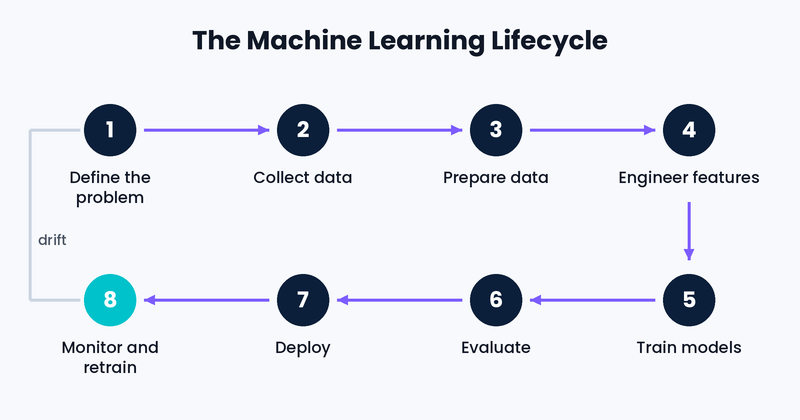
- Problem definition, where the team agrees on the business question and the metric that defines success.
- Data collection from databases, sensors, logs or third-party sources.
- Data preprocessing, which fixes errors, fills gaps, normalizes values and labels examples where needed.
- Feature engineering, including feature selection and feature extraction, to turn raw data into useful inputs.
- Model selection and training, often with hyperparameter tuning across several candidate algorithms.
- Model evaluation on held-out test data, using the metrics described above.
- Model deployment into an app, a website or an existing legacy system, where it runs inference on new data.
- Model monitoring and retraining, which catches model drift as real-world data moves away from the training data.
Drift is the stage teams most often underestimate. A demand forecast trained before a major price change will slowly lose accuracy unless someone notices it and retrains the model. Running AI machine learning systems in production therefore calls for machine learning operations, or MLOps, which brings DevOps habits to the problem. That means automated pipelines, version control for data and models, monitoring dashboards and clear model governance records.
Tools such as MLflow, Apache Airflow, Docker and Kubernetes form the backbone of many MLOps stacks. Our MLOps services help teams run them reliably, although clean pipelines always start with clean data, which is where AI data engineering comes in.
Benefits and Risks of Machine Learning
| Benefits | Risks |
|---|---|
| Automates repetitive decisions at scale | Learns and amplifies bias found in historical data |
| Finds patterns that people miss in large datasets | Black box models can be hard to explain |
| Improves as more data arrives | Needs large volumes of good-quality data |
| Personalizes products for each user | Raises data privacy and data security concerns |
| Speeds up research in medicine and science | Large models carry high compute and energy costs |
| Runs around the clock without fatigue | Can fail silently when real-world data changes |
Shortcut Learning and Spurious Correlations
Machine learning models optimize for whatever signal reduces their error fastest, which is not always the signal you intended. In a 2018 study published in PLOS Medicine, researchers showed that neural networks could tell which hospital system produced a chest X-ray with near-perfect accuracy. Because pneumonia rates differed between hospitals, the pneumonia models could lean on those hospital cues instead of the disease, and their performance dropped on scans from new sites.
Researchers call this shortcut learning, and a 2020 paper by Geirhos and colleagues showed how widespread it is across deep neural networks. Adversarial examples expose a related weakness in these systems. Work by Szegedy and colleagues showed that changes invisible to the human eye can push an image classifier into confident mistakes. In one case, the network labeled a photo of a dog as an ostrich.
Bias, Privacy and Explainability
Algorithmic bias appears when training data reflects past discrimination, such as hiring records or lending histories that disadvantaged certain groups. Data privacy matters because models often learn from personal information. Explainability matters whenever a model’s decision affects someone’s job, loan or health, which is why explainable AI (XAI) techniques try to show which inputs drove a given prediction.
The NIST AI Risk Management Framework gives organizations a voluntary structure for managing these issues through four functions: govern, map, measure and manage. Companies that need help putting such controls in place can turn to our AI governance consulting team or review our AI compliance standards.
When Is Machine Learning the Right Tool?
Machine learning is powerful, yet plenty of problems are better solved with plain rules. Before starting an ML project, check whether these conditions hold:
- You have enough historical examples, ideally with reliable labels, for a model to learn from.
- The pattern is too complex, or changes too often, to capture in hand-written rules.
- The business can tolerate some errors and has a plan for the cases the model gets wrong.
- The future will look roughly like the past, or you can retrain the model when it does not.
- You can measure success with a clear metric tied to a real business outcome.
- Someone will own the model after launch, including its monitoring and retraining.
If several of these conditions fail, a rules-based system or a simple dashboard may deliver more value at a lower cost. An independent AI consulting and technical audit can help you decide before you commit budget, and our AI development process shows how that assessment leads into a build.
Machine Learning Software and Tools
Most machine learning software is written in Python, thanks to its readable syntax and a deep ecosystem of free libraries:
- NumPy handles fast numerical arrays, while pandas cleans and reshapes tabular data.
- scikit-learn offers ready-made versions of most classic algorithms, from linear regression to random forests and k-means.
- Matplotlib and SciPy cover plotting along with scientific computing.
- PyTorch, TensorFlow, Keras and JAX are the main deep learning frameworks.
- Hugging Face hosts thousands of pre-trained transformer models that teams can fine-tune instead of training from scratch.
- Apache Spark, Databricks and Ray scale training across clusters, while cloud platforms such as AWS supply the GPUs that deep learning needs.
You can browse every framework we build with on our technology stack page.
A Short History of Machine Learning
Machine learning has a longer history than most people assume:
- 1950: Alan Turing publishes “Computing Machinery and Intelligence”, which proposes the imitation game now known as the Turing Test and discusses machines that could learn.
- 1957: Frank Rosenblatt designs the perceptron, an early artificial neural network that could learn simple visual patterns.
- 1959: Arthur Samuel popularizes the term “machine learning” after building a checkers program that improved by playing against itself.
- 1981: Gerald DeJong introduces explanation-based learning, in which a computer generalizes a rule from a single worked example.
- 1997: The chess computer Deep Blue beats world champion Garry Kasparov, largely through brute-force search rather than learning.
- 2012: A deep convolutional network wins the ImageNet image-recognition challenge by a wide margin, sparking the deep learning boom.
- 2016: AlphaGo defeats Go champion Lee Sedol four games to one, using deep reinforcement learning.
- 2017: Researchers introduce the transformer architecture, which underpins today’s large language models.
- 2022: ChatGPT launches publicly, bringing generative AI to a mass audience almost overnight.
For the complete story, read our history of artificial intelligence timeline.
Machine Learning Basics: How to Start Learning
You do not need a PhD to grasp machine learning basics, though a structured path will save you months of frustration:
- Refresh the maths. Focus on probability, statistics, linear algebra and enough calculus to follow derivatives, since intuition matters more than proofs at this stage.
- Learn Python. Get comfortable with NumPy and pandas, because most real ML work involves wrangling data.
- Train classic models. Use scikit-learn to build regression and classification models on public datasets, then evaluate them with a proper train/test split.
- Move on to deep learning. Pick one framework, such as PyTorch, and train a small image classifier or text model.
- Build a project end to end. Collect data, train a model, deploy it behind a simple API and monitor it, since this step teaches more than any course.
- Study responsible AI. Learn about bias, privacy and explainability before your models ever touch real users.
With some coding background, a few months of steady part-time practice is usually enough to build and evaluate classic models with confidence.
Where Machine Learning Is Heading
Business adoption of machine learning has moved quickly. Stanford HAI’s 2025 AI Index reports that 78% of organizations used AI in 2024, up from 55% the year before. The same report found that the cost of running a model at GPT-3.5 level fell more than 280-fold between November 2022 and October 2024. That drop puts capable machine learning within reach of far smaller teams. It also counted 233 reported AI incidents in 2024, a 56.4% jump that shows why governance has to keep pace with deployment.
Demand for skills follows the same curve. The U.S. Bureau of Labor Statistics projects 35% employment growth for data scientists between 2025 and 2035, much faster than the average for all occupations. It also puts their median annual wage at $120,230 as of May 2025.
Several trends are likely to shape the next few years:
- Multimodal AI that works across text, images and audio within one model.
- Smaller, cheaper models that run directly on phones and laptops.
- Physics-informed machine learning that blends scientific equations with data in engineering and climate research.
- Stronger transparency rules that push teams toward human-centered AI design.
Artificial general intelligence remains a research goal rather than a product. For most businesses, the practical frontier is narrow, well-governed machine learning that solves one specific problem well. Our overview of the types of artificial intelligence explains how narrow AI, general AI and superintelligence differ.
Check Your Understanding
1. A bank trains a model on past loans labeled “repaid” or “defaulted”. Which type of machine learning is this? Supervised learning, specifically binary classification.
2. A retailer groups customers by purchase history without any predefined categories. Which type is this? Unsupervised learning, using clustering.
3. A model scores 99% on its training data but only 70% on new data. What went wrong? The model is overfitting, because it memorized the training set instead of learning patterns that generalize.
Frequently Asked Questions
What is ML in AI, in simple terms?
ML in AI stands for machine learning, the subset of artificial intelligence in which systems learn from examples instead of following hand-coded rules. Most modern AI products, from recommendation engines to chatbots, run on machine learning models.
Is ChatGPT AI or machine learning?
It counts as both, since one sits inside the other. ChatGPT is an AI application built on a large language model, a deep learning model trained with self-supervised learning on huge text datasets. Its developers then refined its answers with reinforcement learning from human feedback. That makes it a machine learning system inside the broader field of AI.
Does machine learning require coding?
Building custom models usually requires coding, most often in Python. However, no-code platforms now let analysts train simple models through a visual interface. Many business users also rely on machine learning inside everyday software without writing any code.
What is the difference between machine learning and data science?
Data science is the broader discipline of extracting insight from data, drawing on statistics, visualization, domain knowledge and machine learning. Machine learning is one of its tools, focused specifically on building models that learn to make predictions or decisions.
What are the stages of machine learning?
A typical project moves through eight stages, from problem definition and data collection to deployment and monitoring. The lifecycle section above explains each one, including why retraining never really stops.
What jobs use machine learning?
Machine learning engineers, data scientists, research scientists, MLOps engineers, data analysts and AI product managers all use ML daily. It also plays a growing part in roles across finance, healthcare, marketing and logistics.
Final Thoughts
So, what is machine learning? It is the practice of letting data write the rules, then testing carefully that those rules hold up in the real world. The algorithms grab the headlines, yet the projects that succeed usually win on clean data, honest evaluation and steady monitoring after launch.
If you are planning a machine learning project, the SoftBrixAI team builds production-grade systems through our AI software development services. We cover everything from the first data audit to a monitored model in production, as our machine learning case studies show. Talk to our team about the problem you want to solve.