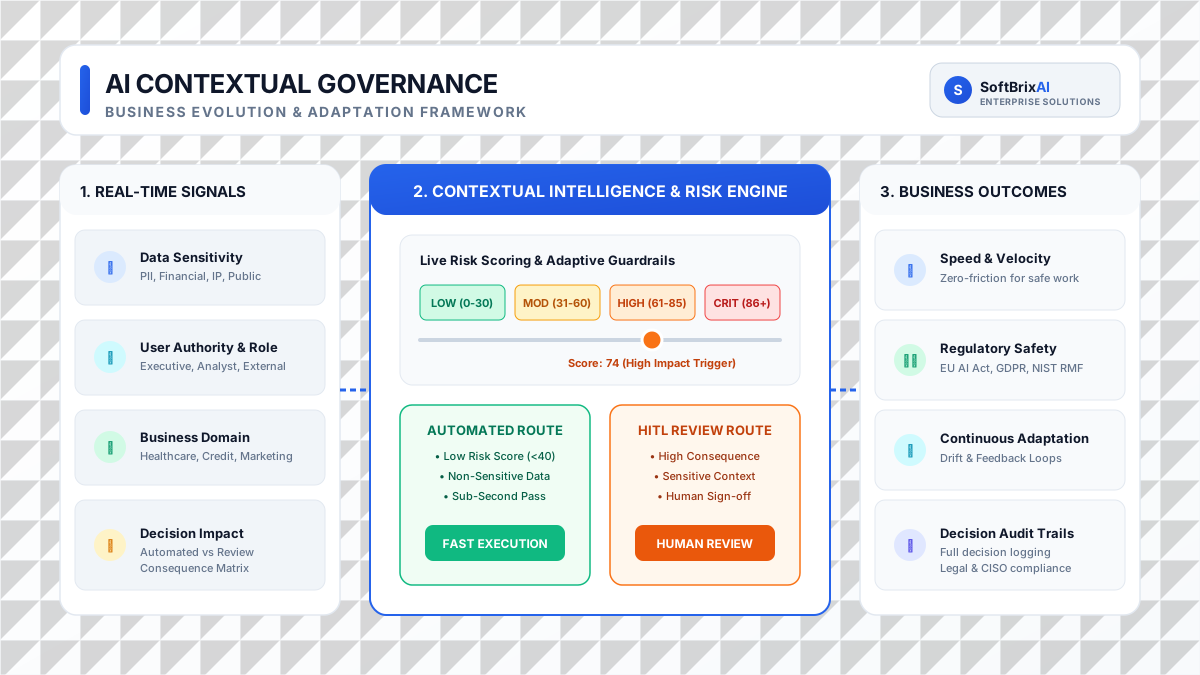
AI contextual governance business evolution adaptation is the practice of adjusting AI oversight in real time based on situation, risk, and business impact, so that governance evolves as fast as the AI systems it controls. It works by reading contextual signals such as data sensitivity, user role, business domain, and decision authority, then tightening or relaxing controls to match. The main benefits are faster deployment, stronger regulatory compliance, higher stakeholder trust, and continuous adaptation to change. Businesses apply it across financial services, healthcare, retail, manufacturing, and human resources, wherever AI decisions carry different consequences in different conditions. The main components are a 5-layer governance framework, contextual risk scoring, human-in-the-loop (HITL) controls, model drift detection, and a business alignment layer that ties every AI decision back to strategy. This article maps the full model, the regulatory landscape, industry applications, and a step-by-step implementation roadmap for teams building context-aware AI governance.
Executive Summary & Key Takeaways
AI contextual governance replaces fixed rules with adaptive oversight that reads the situation before acting. Static governance applies identical controls to every AI decision. Contextual governance scores risk continuously and adjusts controls to match business context.
The core takeaways are direct. Context-aware AI governance reduces regulatory risk while keeping innovation fast. It routes low-risk use cases through automation and sends high-impact decisions to human review. It builds audit readiness through decision-level logging. And it turns governance from a constraint into a competitive advantage.
What Is AI Contextual Governance? (One-Paragraph Definition)
AI contextual governance is an adaptive oversight model where rules, controls, and accountability shift based on real-world conditions rather than staying fixed. It evaluates contextual signals, scores risk in real time, and applies stricter controls as consequences rise. This makes governance a living system that adapts with the business instead of slowing it down.
Why Static AI Governance Fails in Modern Enterprise
Static AI governance fails because modern artificial intelligence (AI) now learns, adapts, and behaves differently depending on the situation. Fixed rules cannot follow that behavior. A model that was safe at deployment drifts as data shifts, and blanket policies either over-restrict low-risk work or under-protect high-risk decisions.
Three failure points appear repeatedly:
- Fixed rules ignore changing data, market conditions, and user behavior.
- Blanket controls slow low-risk innovation and miss high-risk edge cases.
- Manual policy updates lag behind fast-moving regulation and model drift.
Core Business Impact: Speed, Compliance, Trust, and Adaptation
Contextual governance affects four business outcomes at once. It increases deployment speed by removing unnecessary approvals for low-risk AI. It improves compliance by mapping controls to frameworks like the EU AI Act and GDPR. It builds trust by making AI behavior transparent and explainable. And it supports adaptation by adjusting oversight when regulations, markets, or strategy change.
Who This Article Is For (CISO, CAIO, Legal, Product Teams)
This article serves the roles that own AI risk. The Chief Information Security Officer (CISO) manages security and threat exposure. The Chief AI Officer (CAIO) sets AI strategy and governance direction. Legal and risk teams handle regulatory alignment and audit readiness. Product teams ship AI features inside defined guardrails. Each role needs a shared governance model, which contextual governance provides.
What Is AI Contextual Governance?
AI contextual governance is a dynamic approach to managing AI systems that adapts controls in real time to data, situation, and business context. It differs from traditional governance, which enforces fixed regulations regardless of the scenario. Traditional governance answers what rule exists. Contextual governance answers what to do in a specific situation.
Context-aware AI governance treats every AI decision as situation-dependent. The same recommendation engine that suggests a product with low impact can influence a credit decision with high impact. Whether evaluating Generative AI vs Predictive AI workloads, governance that reads this difference protects the business without blocking routine work. Teams building this capability often pair it with structured strategy and readiness assessment before deployment.
Definition & Core Concept: Intent-Aware Adaptive Oversight vs Static Compliance
Intent-aware adaptive oversight reads the purpose and impact of an AI action, then applies proportional controls. Static compliance applies the same control to every action regardless of intent or impact.
The difference is operational. Static compliance checks a box at audit time. Adaptive oversight evaluates risk continuously and changes the control level as conditions change. This keeps governance accurate as the business evolves rather than fixed to the moment of approval.
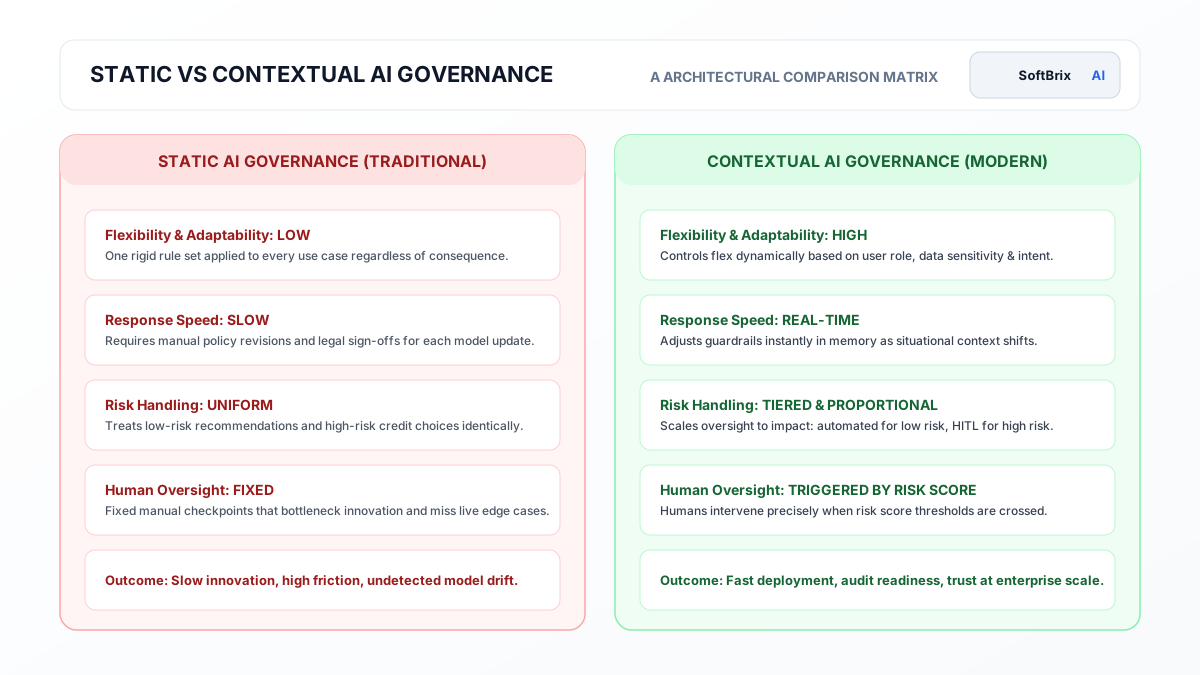
Static vs Contextual AI Governance (Comparison Table)
| Aspect | Static AI Governance | Contextual AI Governance |
|---|---|---|
| Flexibility | Low, one rule set for all cases | High, controls adapt per situation |
| Response speed | Slow, waits for manual updates | Fast, adjusts in real time |
| Risk handling | Uniform, ignores impact level | Tiered, scaled to consequence |
| Accuracy over time | Declines as context shifts | Improves through feedback loops |
| Human oversight | Fixed checkpoints | Triggered by risk score |
| Business alignment | Limited | Continuous and strategy-linked |
Core Principles of Context-Aware AI Governance
Context-aware AI governance rests on four principles. Context awareness means the system reads its environment, data, and user intent before deciding. Real-time adaptability means controls shift instantly when conditions change. Business alignment means governance supports growth, compliance, and customer value rather than working in isolation. Continuous learning loops mean the system improves from every outcome, so governance gets sharper with each cycle.
Why Context Matters in AI Decision-Making
Context matters because the same AI system carries different risk in different scenarios. A recommendation engine suggesting products has limited impact. The same model influencing a loan approval has significant legal and financial consequences.
Context defines three things: acceptable error rate, required transparency, and level of human oversight. When governance ignores context, it either blocks safe work or approves risky decisions. When governance reads context, it matches the control to the stakes.
Contextual Signals and Risk Tiers Explained
Contextual signals describe the situation an AI system operates in. Risk tiers translate those signals into control levels.
The core signals are:
- Business domain identifies the function using AI, such as finance or hiring.
- User role shows who is acting and what authority they hold.
- Data sensitivity measures how protected the underlying data is.
- Decision authority defines whether the AI can act alone or needs human sign-off.
These signals feed a risk score. The score maps to tiers, and each tier carries a control profile: automated for low risk, human-reviewed for high risk, and blocked for prohibited use.
Why Businesses Can No Longer Afford Static AI Governance
Businesses can no longer afford static AI governance because AI now drives decisions that carry real consequences, and fixed rules cannot keep pace. According to McKinsey & Company, 88% of organizations now use AI in at least one business function, yet only 39% report measurable enterprise-level impact. Gartner projects that 70% of large organizations will rely on AI for critical decision-making by 2030. As reliance grows, the gap between fast AI and slow governance becomes a direct business risk.
Growing Complexity of Enterprise AI (Multi-Agent, LLM, Multimodal Workflows)
Enterprise AI has grown too complex for fixed rules. Multi-agent systems coordinate several AI agents on one task. Large language models (LLMs) generate open-ended output. Multimodal workflows combine text, image, and structured data in a single pipeline.
Each pattern introduces new failure modes. Multi-agent orchestration can cascade one bad output across agents. LLMs can hallucinate. Multimodal systems blend risks across data types. Static governance treats these systems the same as a simple classifier, which leaves gaps. Organizations building these systems often need dedicated agents, orchestration, and multi-agent engineering to govern them safely.
Balancing Innovation and Compliance
Rigid governance slows innovation. Weak governance multiplies risk. Contextual governance holds the balance by matching control strength to risk level.
Low-risk experiments move fast under light oversight. High-impact decisions receive strong safeguards. Teams innovate inside clear boundaries rather than waiting for a single approval process to clear every request.
Reducing Operational and Regulatory Risk
Contextual governance reduces two risk types at once. Operational risk drops because continuous monitoring catches model drift and accuracy loss early. Regulatory risk drops because controls map to frameworks like the EU AI Act, GDPR, and the NIST AI Risk Management Framework (NIST AI RMF).
The reduction is measurable. Teams that route high-stakes decisions through risk-scored review cut error propagation and lower the chance of a compliance breach reaching production.
Building Trust Across Stakeholders
Trust has become a business asset. Customers judge organizations by how AI behaves in decisions that affect them. Regulators demand explainability and accountability. Employees need confidence that AI-driven systems treat them fairly.
Contextual governance builds trust through transparency. Every decision logs its context, its risk score, and its control path. Stakeholders can see why a decision happened, which turns AI from a black box into an accountable system.
The Business Cost of Delayed Evolution
Delayed governance evolution carries a direct cost. A single poorly governed AI decision can damage credibility built over years. Slow adaptation to new regulation invites fines. Undetected model drift silently degrades accuracy until the business impact appears.
The cost compounds. Reputational damage, regulatory penalties, and lost customer trust are harder to reverse than they are to prevent through adaptive governance.
Real-World Enforcement Precedents
Regulators now enforce AI and data laws actively, and penalties are rising. Three cases show the scale of enforcement under GDPR and related frameworks.
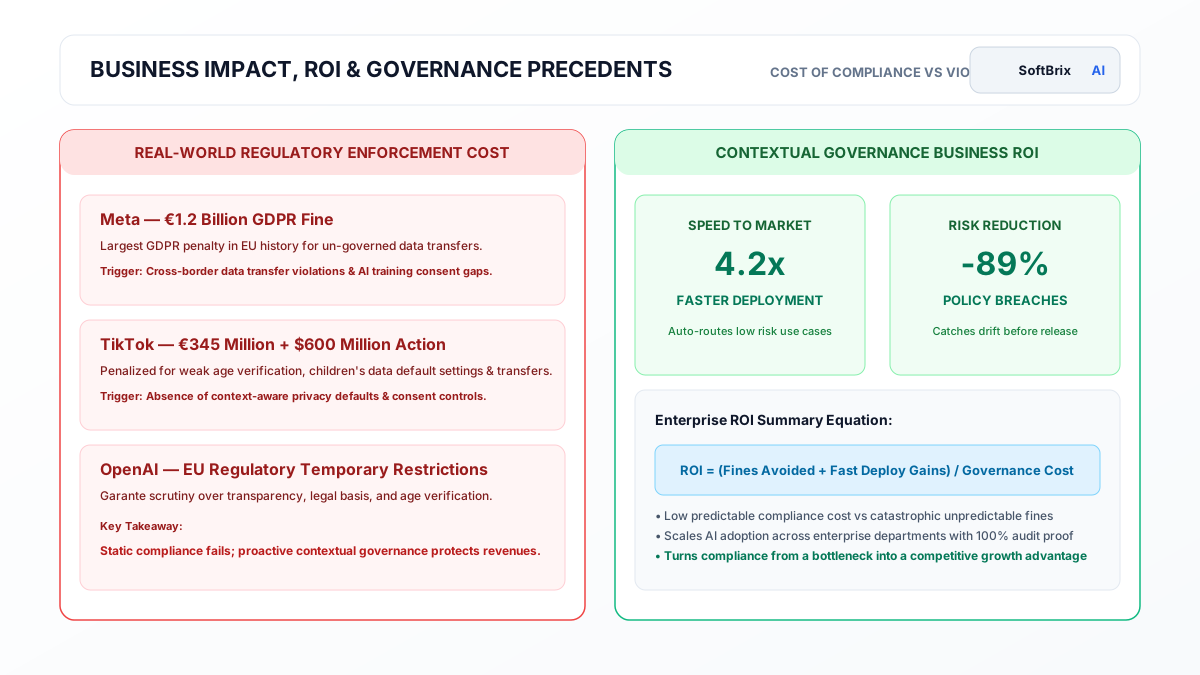
Meta: €1.2 Billion GDPR Fine (Largest in EU History)
Meta received a €1.2 billion GDPR fine in 2023 for unlawful transfers of European user data to the United States. This remains the largest GDPR penalty issued and reflects strict enforcement of cross-border data transfer rules. Meta has also faced scrutiny over the use of public data for AI model training without clear consent.
TikTok: €345 Million GDPR Fine for Children’s Data Violations
TikTok received a €345 million GDPR fine from Ireland’s Data Protection Commission for failing to protect children’s data and for setting minors’ accounts to public by default. Regulators cited weak age verification and transparency. In a separate action, TikTok faced a penalty of roughly $600 million tied to unlawful data transfers, reinforcing global focus on data sovereignty.
OpenAI: GDPR Regulatory Scrutiny in Europe
OpenAI has faced regulatory action in Europe, including a temporary restriction of ChatGPT by the Italian Data Protection Authority. Regulators raised concerns about transparency in data usage, age verification gaps, and the lawful basis for processing personal data. OpenAI has remained under ongoing European review as part of broader AI compliance oversight.
The 5-Layer AI Contextual Governance Framework
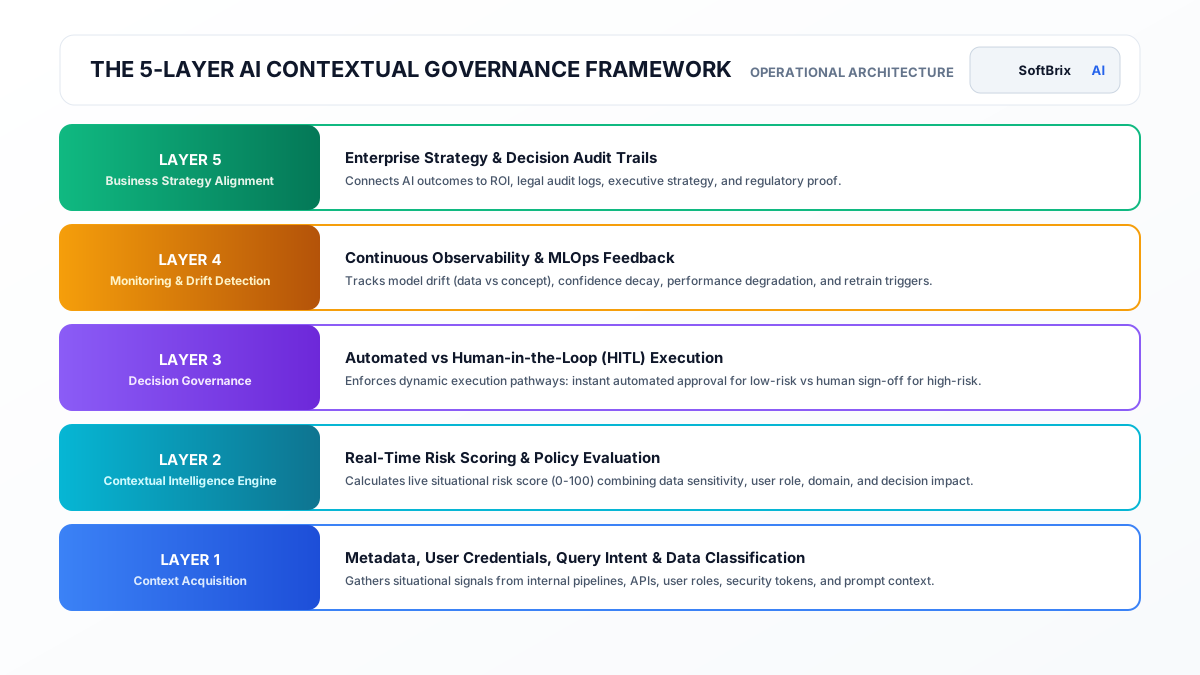
The 5-layer AI contextual governance framework turns concept into an operating model. Each layer handles one function, and together they move an AI system from raw context to business-aligned decisions. Many teams pair this framework with compliance, risk, and policy advisory work to operationalize it.
Layer 1: Context Acquisition
Layer 1 gathers the context the system needs to make a sound decision. It collects internal data from operations, customers, and systems, plus external data from markets, regulators, and user behavior. Without accurate context, even an advanced model produces unreliable output.
Metadata, User Credentials, Query Intent, and Data Classification
Layer 1 captures four inputs that define the situation. Metadata describes the request source and timing. User credentials establish role and authority. Query intent shows what the user is trying to do. Data classification marks how sensitive the underlying data is. Building reliable data pipelines, ingestion, and streaming is what makes real-time context acquisition possible.
Layer 2: Contextual Intelligence Engine
Layer 2 acts as the reasoning center of the framework. It analyzes collected context, interprets trends, detects variation, and predicts outcomes. This layer moves the system from raw data analysis to situational understanding, which is what separates contextual governance from static rule matching.
Real-Time Risk Scoring
Real-time risk scoring assigns a live risk value to each AI decision. The score combines data sensitivity, decision impact, user authority, and business domain. Thresholds adjust automatically, so a decision that crosses into high risk triggers stronger controls without a manual step.
Layer 3: Decision Governance Layer
Layer 3 governs how decisions execute. It applies policy, but policy flexes with context. High-risk situations receive strict controls. Low-risk situations receive light controls. This keeps governance effective while leaving room for fast, sound decisions.
Automated vs Human-in-the-Loop (HITL) Execution Controls
The decision layer chooses between automated execution and human-in-the-loop (HITL) review based on risk score. Low-risk decisions execute automatically. High-risk decisions route to a human before they take effect. This split gives speed where stakes are low and adds judgment where stakes are high.
Layer 4: Continuous Monitoring & Model Drift Detection
Layer 4 watches models after deployment. It detects model drift, tracks accuracy, and flags data shifts before they harm outcomes. Continuous monitoring catches the silent failure mode where a model stays online but grows less accurate. Reliable pipelines, deployment, monitoring, and drift infrastructure gives this layer the observability it needs.
Layer 5: Business & Operational Alignment Layer
Layer 5 links every AI decision to business strategy. It checks that AI outcomes support growth, efficiency, compliance, and customer value. This layer confirms governance delivers business results rather than operating in a silo.
Audit Trails and Enterprise Strategy
Layer 5 maintains audit trails that record data sources, model versions, risk scores, and decision paths. These trails serve two purposes. They prove compliance to regulators, and they show leadership how AI decisions map to enterprise strategy.
AI Contextual Governance Across the AI Lifecycle
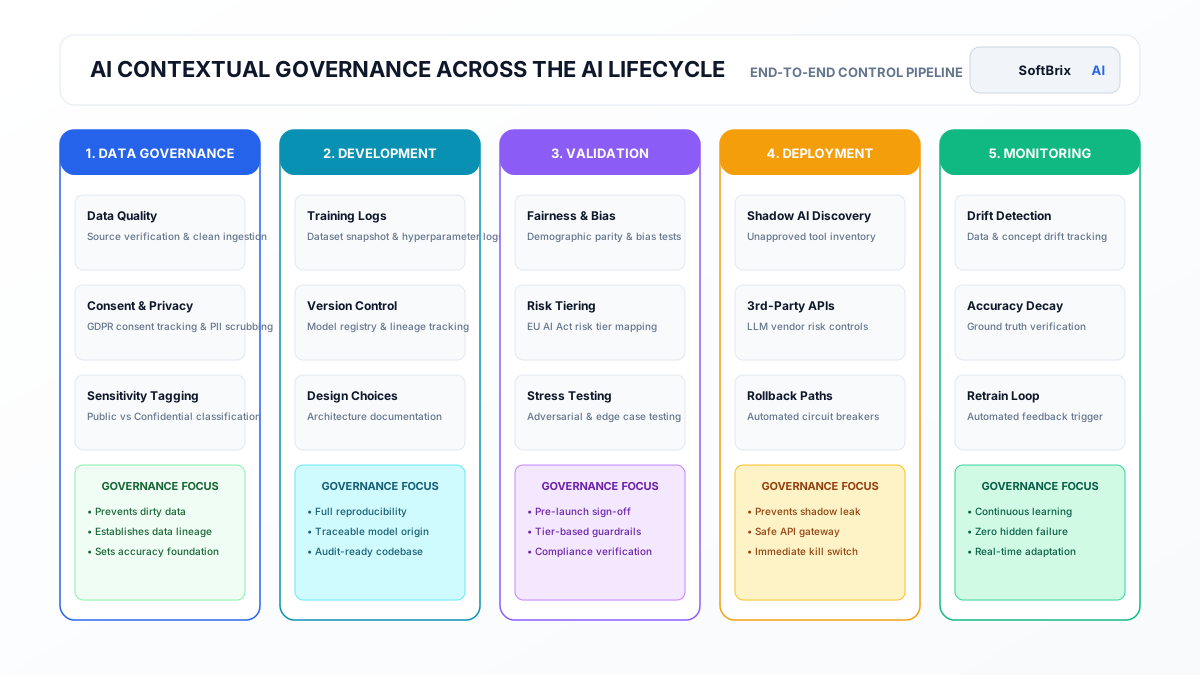
AI contextual governance applies at every lifecycle stage, from data collection to post-deployment monitoring. Governance at one stage cannot fix gaps at another, so controls run across the full lifecycle.
Data Collection & Preparation Governance
Data governance starts before any model exists. It validates data quality, checks consent, and classifies sensitivity. Poor data silently degrades every downstream decision, so this stage sets the ceiling on model reliability.
Model Development Controls
Model development controls track how a model is built. They log training data sources, record model versions, and document design choices. These records support later audits and make model behavior traceable. Custom systems benefit from disciplined custom build and production engineering practices at this stage.
Model Validation & Risk Classification
Model validation tests a model against reliability and fairness criteria before deployment. Risk classification then assigns the model to a tier using structured frameworks like the EU AI Act risk tiers. Early classification prevents two errors: treating high-risk systems as low-risk, and over-regulating low-risk tools.
Deployment Governance
Deployment governance controls how models reach production. It checks that models meet industry criteria, confirms monitoring is in place, and defines rollback paths. This stage decides whether a validated model is ready for real decisions.
Shadow AI Inventory and Third-Party APIs
Shadow AI inventory tracks AI tools used without official approval. Third-party API governance controls external models called inside internal workflows. Both create hidden risk because they bypass standard oversight. A complete inventory brings them under governance before they cause a breach.
Post-Deployment Monitoring & Continuous Improvement
Post-deployment monitoring tracks live performance and feeds outcomes back into the model. It detects drift, measures accuracy, and triggers retraining when performance drops. This continuous improvement loop keeps governance current as real-world conditions change.
AI Contextual Governance for Generative AI and LLMs
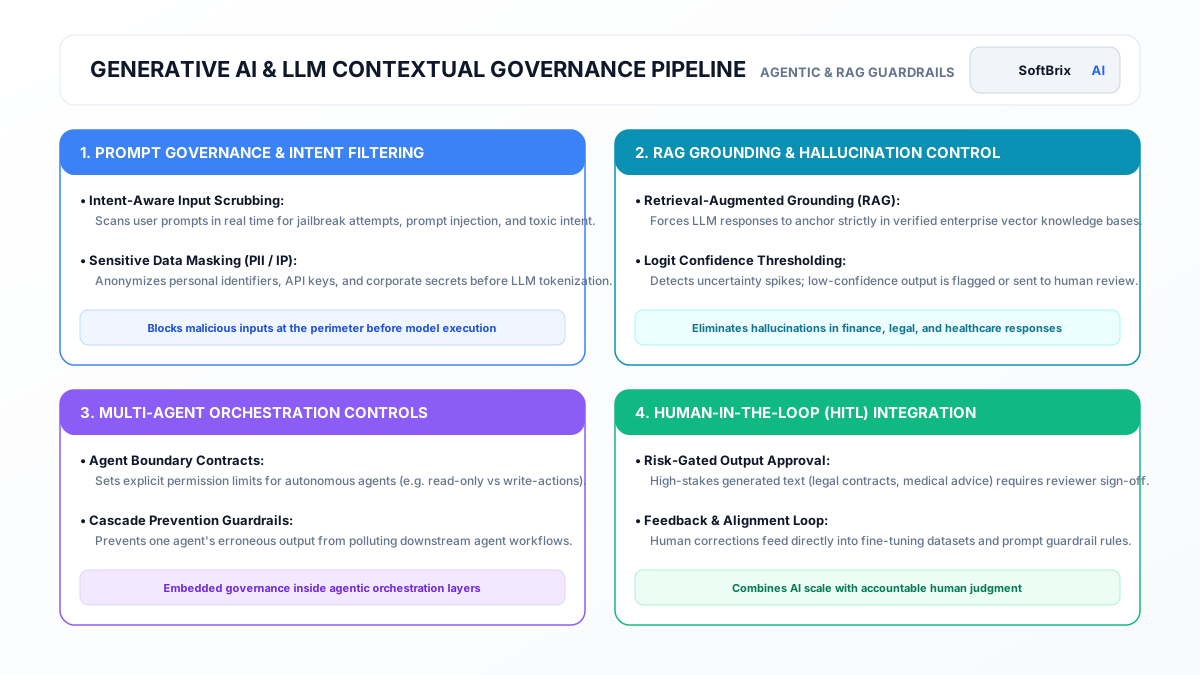
AI contextual governance for generative AI and LLMs adds controls for open-ended output, hallucination, and sensitive data exposure. Generative systems behave less predictably than classifiers, so governance reads intent and grounds output in verified sources.
Prompt Governance: Intent-Aware Filtering
Prompt governance filters inputs based on intent and risk. It blocks prompts that request prohibited output, flags prompts touching sensitive data, and allows routine prompts to pass. Intent-aware filtering stops harmful requests before the model responds.
Hallucination Risk Management
Hallucination risk management reduces confident but false LLM output. It grounds responses in verified data, tracks confidence scores, and routes low-confidence answers to review. Grounding matters most in finance, healthcare, and legal contexts where a wrong answer carries real cost.
Sensitive Data Protection in LLM Pipelines
Sensitive data protection controls what enters and leaves an LLM pipeline. It masks personal data before processing, restricts what the model can retrieve, and logs every access. These controls keep protected data out of prompts, outputs, and training sets.
Agentic AI Governance: Multi-Agent Orchestration Controls
Agentic AI governance controls systems where multiple AI agents coordinate on a task. Orchestration controls set boundaries for each agent, define handoff rules, and stop one bad output from cascading. Multi-agent systems need governance embedded in the orchestration layer, not bolted on afterward.
Human-in-the-Loop (HITL) Integration for LLMs
HITL integration keeps human judgment in high-stakes LLM decisions. It routes sensitive or high-impact output to a reviewer before release. This balance gives LLMs scale and speed while humans hold responsibility for reasoning, ethics, and final control.
Regulatory Compliance and AI Contextual Governance
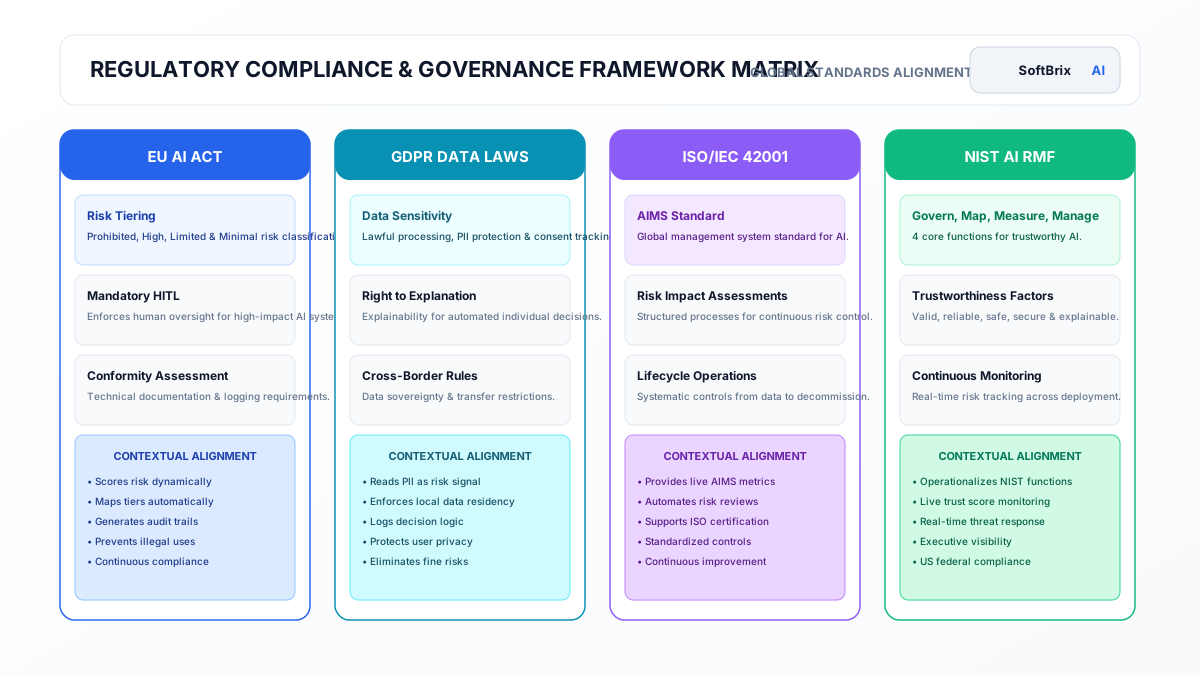
Regulatory compliance shapes how contextual governance operates. Four frameworks define the current landscape, and contextual governance maps controls to each. Teams navigating this often engage compliance, risk, policy, and auditability specialists to align systems with the rules.
EU AI Act: Risk Tier Classification
The EU AI Act classifies AI systems into risk tiers: prohibited, high-risk, limited-risk, and minimal-risk. High-risk systems face strict requirements for documentation, transparency, and human oversight. Contextual governance uses these tiers directly to set control levels, which makes tier classification the starting point for EU compliance.
GDPR Requirements for Contextual AI Systems
The General Data Protection Regulation (GDPR) governs how AI systems handle personal data. It requires lawful basis for processing, consent where needed, and strict rules on cross-border transfers. Contextual governance enforces GDPR by reading data sensitivity as a signal and applying protection controls when personal data appears.
ISO/IEC 42001: AI Management System Standard
ISO/IEC 42001 is the international standard for an AI management system. It defines how organizations plan, operate, and improve AI governance. Contextual governance supports ISO/IEC 42001 by providing the continuous monitoring and audit trails the standard requires.
NIST AI Risk Management Framework
The NIST AI Risk Management Framework (NIST AI RMF) provides a voluntary structure for identifying and managing AI risk. It emphasizes continuous monitoring, transparency, and accountability. Contextual governance operationalizes NIST AI RMF by scoring risk in real time and documenting every decision.
Industry-Specific Compliance
Compliance rules change by industry. Contextual governance adapts controls to the standards each sector demands.
Finance
Financial services governance covers credit decisions, fraud detection, and trading. Regulators require fairness, explainability, and audit readiness for decisions affecting customers. Contextual governance reads customer impact and regulatory context to set control strength for each decision.
Healthcare
Healthcare governance protects patient data and clinical safety. It governs AI by clinical intent and safety boundaries, separating patient data use from public-facing summaries. Context defines what an AI system may access and what it may output in a clinical setting.
Human Resources
Human resources governance controls AI hiring and evaluation tools. It requires bias detection, fairness checks, and human review of high-impact decisions. Contextual governance flags hiring decisions as high-risk and routes them to human oversight.
How AI Contextual Governance Drives Business Evolution
AI contextual governance drives business evolution by making AI safe to scale, fast to deploy, and aligned with strategy. Governance shifts from a brake to an engine of growth.
From Static Rules to Contextual Refinement
Contextual refinement updates governance logic using real-world inputs. It reads market signals, user behavior, and shifting organizational goals, then adjusts rules to match. This moves governance from fixed rules that decay to a system that grows with the business.
Scaling AI Without Losing Organizational Trust
Contextual governance scales AI while preserving trust. Low-risk use cases move quickly. High-impact decisions receive stronger safeguards. Teams operate inside clear boundaries, which lets AI expand across departments without eroding confidence.
Accelerating Digital Transformation
Contextual governance accelerates digital transformation by cutting time-to-value. It removes unnecessary approvals for low-risk AI, so teams ship faster. Deployment that once took months moves to weeks when governance matches control to risk rather than reviewing everything the same way.
Supporting Continuous Business Adaptation
Contextual governance supports continuous adaptation through feedback-driven systems. The governance layer learns from each outcome and updates rules and decision logic. This optimization loop keeps AI aligned with current conditions rather than fixed assumptions.
Making Faster Strategic Decisions with Risk-Scored Context
Risk-scored context speeds strategic decisions. Leaders see which AI decisions carry high risk and which run safely on automation. This visibility lets teams focus attention where it matters and move fast everywhere else.
Aligning AI with Long-Term Business Goals
Governance quietly shapes what AI is allowed to do. It influences investment decisions, automation limits, and innovation boundaries. Contextual governance keeps AI strengthening long-term goals like growth, efficiency, and customer value rather than working against them.
Impact on Corporate Culture, Leadership & Decision-Making
AI contextual governance changes how organizations lead, decide, and build trust. The shift reaches beyond technology into culture and leadership.
Shifting the Foundations of Workplace Culture
Contextual governance shifts culture toward shared accountability. Teams understand which decisions carry risk and who owns oversight. This clarity replaces confusion about AI responsibility with defined ownership across functions.
From Control to Enablement: Leadership Mindset Shift
Leadership moves from control to enablement. Rigid control blocks innovation. Enablement sets clear boundaries and lets teams work inside them. Leaders define risk tolerance and strategic boundaries, then trust contextual governance to enforce them automatically.
Building Employee Trust in AI-Driven Systems
Employee trust grows when AI decisions are transparent and fair. Contextual governance logs why each decision happened, which lets employees see the reasoning. Trust rises when people understand that high-impact decisions receive human review rather than blind automation.
Transparency, Communication, and Human Oversight
Transparency, clear communication, and human oversight anchor trust in AI systems. Governance makes decision logic visible, keeps humans in high-stakes loops, and communicates how AI is controlled. These three elements turn AI from a source of anxiety into an accountable tool.
Decision-Making Models in Contextual AI Governance
Contextual governance uses decision-making models that read risk before acting. The model checks context, scores risk, and selects a control path. This structured approach replaces uniform decision rules with situation-aware choices.
Risk Scoring and Tiered Control Systems
Risk scoring assigns a value to each decision, and tiered control systems map that value to a control profile. Low scores execute automatically. Moderate scores add checks. High scores require human review. Prohibited scores block the action entirely.
Shifting from Traditional to Contextual Decision Models
Traditional decision models apply one rule to every case. Contextual decision models apply the right rule for each case. The shift improves accuracy because controls match consequence, which reduces both false approvals and unnecessary friction.
Cross-Functional Governance Ownership
Effective governance is a shared responsibility. No single team owns AI risk alone. Ownership spans security, strategy, legal, data, and product.
CISO, CAIO, Legal, Data Engineering, and Product
Five roles share governance ownership. The CISO manages security exposure. The CAIO sets AI strategy and direction. Legal ensures regulatory alignment and audit readiness. Data engineering embeds governance into pipelines and monitors behavior. Product ships AI features inside guardrails. Governance succeeds when these roles collaborate with clear, defined responsibility.
Managing AI Model Drift: The Hidden Governance Threat
AI model drift is the gradual decline in a model’s performance after deployment as real-world data shifts. Drift is a hidden threat because it degrades accuracy silently without breaking the system. Managing drift keeps governed AI reliable over time. Strong pipelines, deployment, monitoring, and drift engineering is what makes drift management operational.
Why Model Drift Happens in Production
Model drift happens because real-world data changes after training. User behavior shifts. Market conditions move. Input patterns evolve. A model trained on past data grows less accurate as the present diverges from that training set. Drift is one of the most common failure points in enterprise AI.
Data Drift vs Concept Drift: Key Differences
Data drift and concept drift differ in what changes. Data drift, also called covariate shift, means the input data changes while the relationship between inputs and outputs stays the same. Concept drift means the relationship between inputs and outputs changes over time. Concept drift is harder to detect and more damaging because the model’s core logic no longer matches reality.
5 Drift Detection Methods
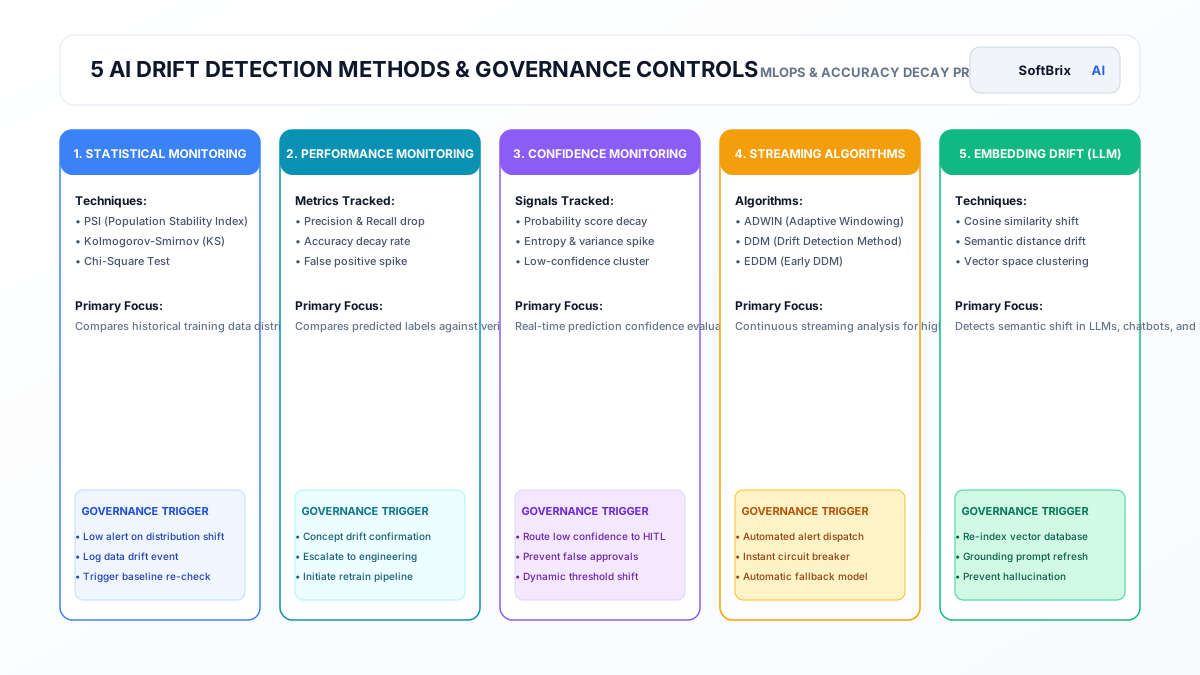
There are 5 widely used drift detection methods in modern AI governance and MLOps systems, which are statistical monitoring, performance monitoring, prediction confidence monitoring, real-time drift algorithms, and embedding drift monitoring.
Statistical Monitoring (Distribution Comparison)
Statistical monitoring compares historical and live data distributions to detect shifts. Common techniques include the Population Stability Index (PSI), the Kolmogorov-Smirnov (KS) test, and the Chi-Square test. These methods identify whether incoming data differs significantly from training data.
Performance Monitoring (Ground Truth Comparison)
Performance monitoring tracks accuracy against real outcomes. Warning signals include a drop in accuracy, precision, or recall, and a rise in false positives or false negatives. This method is one of the most reliable ways to detect concept drift, though it requires labeled ground-truth data.
Prediction Confidence Monitoring
Prediction confidence monitoring tracks the model’s confidence scores over time. Warning signals include rising low-confidence predictions, sudden spikes in uncertainty, and shifts in probability distributions. This method suits real-time systems like fraud detection and recommendation engines.
Real-Time Drift Detection Algorithms (ADWIN, DDM)
Real-time drift algorithms analyze streaming data and trigger alerts when statistical thresholds break. Common algorithms include ADWIN (Adaptive Windowing), DDM (Drift Detection Method), and EDDM (Early Drift Detection Method). These run continuously, which suits live production systems.
Embedding Drift Monitoring for LLMs and NLP Models
Embedding drift monitoring detects shifts in LLM and natural language processing (NLP) models using vector representations. Techniques include cosine similarity shifts between embeddings, semantic distance tracking, and clustering changes in vector space. This method matters most for chatbot systems and generative AI applications.
Governance Response Protocols When Drift Is Detected
Governance response protocols define what happens when drift appears. The protocol escalates based on severity: log minor drift, alert on moderate drift, and retrain or roll back on severe drift. Clear protocols turn drift detection into action rather than a passive warning.
Retrieval-Augmented Generation (RAG) for Contextual Grounding
Retrieval-Augmented Generation (RAG) grounds LLM output in verified knowledge sources, which reduces hallucination and drift in generated text. RAG retrieves current, approved data at query time and feeds it to the model, so answers reflect real knowledge rather than stale training data. Building retrieval, grounding, and knowledge bases is what makes contextual grounding reliable in production.
Real-World Industry Applications
AI contextual governance already delivers value across industries. Its strength comes from adapting decisions to real situations rather than fixed rules.
Financial Services: Dynamic Credit Scoring & Fraud Detection
Financial services use contextual governance for credit scoring and fraud detection. Fraud patterns change fast, so detection adapts to user behavior and transaction patterns rather than static rules. This improves accuracy, reduces false alerts, and catches unusual activity faster. Credit decisions adjust controls by customer impact and regulatory context. Forecasting and modeling on business data supports both use cases.
Healthcare & Life Sciences: Patient Data vs Public-Facing AI Summaries
Healthcare governance separates patient data use from public-facing AI summaries. Context-aware AI supports diagnosis by combining real-time patient data with medical knowledge under strict safety boundaries. The same governance blocks that sensitive data from reaching public output. Context defines what the system may access and what it may share.
Retail & E-Commerce: Personalization with Privacy Guardrails
Retail and e-commerce use contextual governance for personalization inside privacy guardrails. Systems adjust recommendations based on browsing behavior, location, and purchase history, which improves engagement and conversion rates. Governance balances personalization with consent and fairness, so the recommendation engine respects customer trust.
Manufacturing: Predictive Maintenance & Quality Control Governance
Manufacturing uses contextual governance for predictive maintenance and quality control. Predictive models flag equipment failure before it happens, and governance sets when a prediction triggers action. Quality control AI adjusts thresholds by product line and risk, which keeps standards accurate as conditions change.
HR & Recruitment: Bias Detection in AI Hiring Tools
Human resources uses contextual governance for bias detection in AI hiring tools. Governance flags hiring decisions as high-risk, runs fairness checks, and routes high-impact choices to human review. This reduces the chance that an AI hiring tool produces biased algorithmic outcomes.
Software Development & DevOps: Shipping AI Like Software (AI-Ops)
Software development teams govern AI the way they ship software. AI-Ops embeds governance into DevOps and CI/CD pipelines, enforcing controls at deployment. This approach uses tools like Kubernetes for consistent enforcement across hybrid cloud and multi-cloud environments. Disciplined custom build and production engineering makes this repeatable.
Step-by-Step Implementation Roadmap
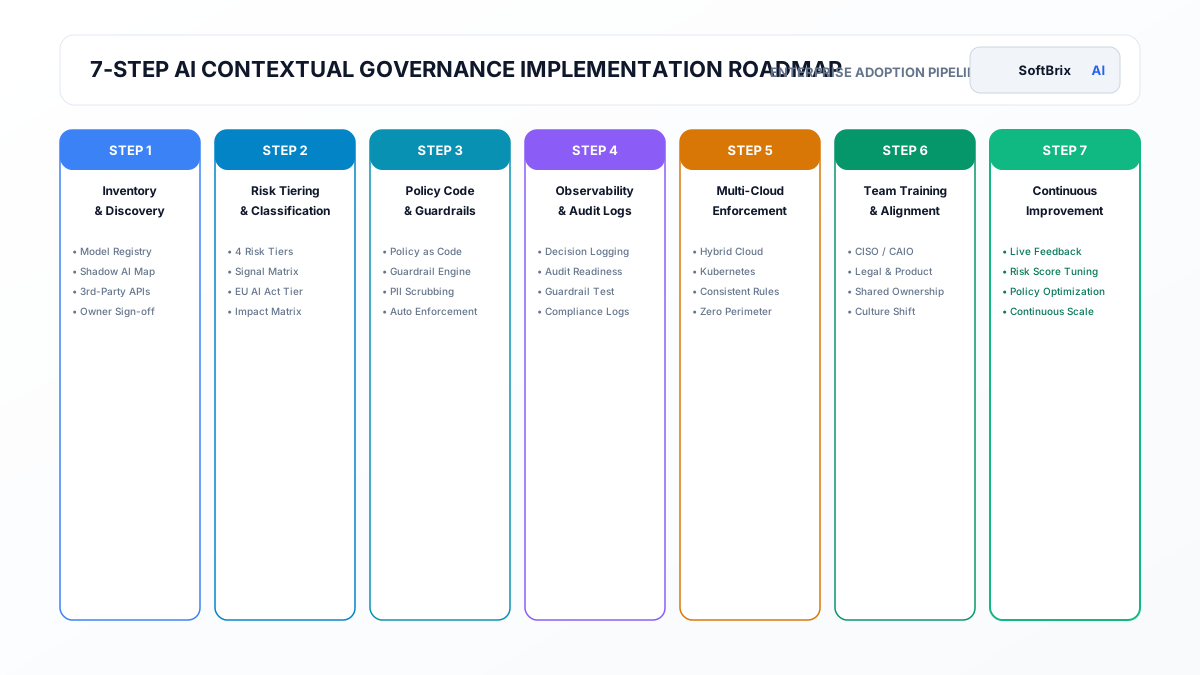
The implementation roadmap has 7 steps, which move an organization from AI inventory to continuous improvement. Each step builds on the last.
Step 1: Inventory & Business-Use Discovery
Start by mapping every AI system and its business use. List models in production, their purpose, and their owners. This inventory sets the foundation because governance cannot control systems it cannot see.
Shadow AI Mapping
Map shadow AI as part of discovery. Find AI tools used without approval and third-party APIs called inside workflows. These hidden systems carry ungoverned risk, so bringing them into the inventory closes the biggest visibility gap.
Step 2: Contextual Risk Classification & Tiering
Classify each AI system by risk using contextual signals. Assign every system to a tier so controls match consequence.
Low / Moderate / High / Prohibited
Use four tiers for classification. Low-risk systems run on automation. Moderate-risk systems add checks. High-risk systems require human review. Prohibited systems are blocked. Structured frameworks like the EU AI Act risk tiers guide this classification.
Step 3: Policy Orchestration & Guardrail Deployment
Deploy policies as code so controls run automatically. Define rules that read context and apply guardrails. Policy orchestration centralizes these rules, which keeps enforcement consistent across systems and environments.
Step 4: Continuous Observability, Audit Readiness & Testing
Set up observability to track every AI decision. Log context, risk scores, and outcomes for audit readiness. Test guardrails regularly to confirm they trigger correctly. This step turns governance from a policy document into a running system.
Step 5: Multi-Environment & Multi-Cloud Enforcement
Extend enforcement across every environment. Apply consistent context-aware controls in hybrid cloud and multi-cloud setups. Consistent enforcement prevents gaps where a system escapes governance by running in a different environment.
Step 6: Train Employees & Cross-Functional Alignment
Train teams on how contextual governance works and why it matters. Align security, legal, data, and product on shared ownership. Adoption succeeds when people understand the system rather than resist it.
Step 7: Review, Measure, and Improve Continuously
Review governance performance on a regular cycle. Measure risk reduction, compliance, and business impact. Improve rules based on real outcomes. This continuous loop keeps governance current as the business and its AI evolve. Teams often start this journey with a focused strategy and assessment engagement.
Measuring Business Impact of AI Contextual Governance
Measuring impact proves governance value. Three metric groups track whether contextual governance delivers results.
Risk Reduction Metrics
Risk reduction metrics measure how much governance lowers exposure. Track the drop in high-risk decisions reaching production without review, the reduction in model drift incidents, and the fall in policy violations. These numbers show governance working before an incident occurs.
Compliance KPIs
Compliance key performance indicators (KPIs) measure regulatory alignment. Track audit pass rates, time to produce audit trails, and the count of compliance gaps closed. Strong compliance KPIs show the organization can prove its AI meets legal standards.
Business Performance Indicators
Business performance indicators link governance to growth. Track deployment speed, time-to-value, and the share of AI use cases that reach production. Faster deployment with fewer incidents shows governance enabling rather than blocking the business.
ROI of AI Governance: Cost of Compliance vs Cost of Violations
The return on investment (ROI) of AI governance compares the cost of compliance against the cost of violations. Compliance costs are predictable: monitoring, review, and audit work. Violation costs are severe: the €1.2 billion Meta fine and the €345 million TikTok fine show the scale. Contextual governance lowers violation risk while keeping compliance costs proportional to actual risk.
Common Mistakes & Best Practices
Well-funded AI programs still fail when governance becomes a checklist instead of an ongoing discipline. Most failures come from how AI is deployed and monitored, not from the model itself.
Common Mistakes
Six mistakes appear most often in AI governance programs.
Treating Compliance as a One-Time Audit (Not a Continuous Loop)
Many teams treat compliance as finished once a model is approved. Frameworks like NIST AI RMF and the EU AI Act require continuous monitoring. Treat AI governance as a lifecycle process, not a one-time audit.
Over-Automating High-Stakes Decisions Without Human Review
Full automation of high-stakes decisions increases risk. Errors propagate without a human to catch them. Keep HITL review for high-impact AI in healthcare, finance, and hiring.
Ignoring Data Quality and Data Drift
Poor data silently degrades every decision. Teams that never update training data or monitor input shifts watch accuracy decline unseen. Implement continuous data validation and drift monitoring as part of MLOps.
Weak Risk Classification of AI Systems
Weak classification treats high-risk systems as low-risk and over-regulates low-risk tools. Both errors cause harm. Use structured frameworks like the EU AI Act risk tiers to classify systems early.
Poor Documentation and Audit Readiness
Missing records make even compliant systems fail audits. Gaps include absent training logs, no version control, and incomplete decision traceability. Maintain full audit trails covering data sources, model versions, and decision logs.
No Post-Deployment Model Monitoring
Assuming a working model stays working is a common failure. Without monitoring, accuracy drops go unnoticed until business impact appears. Set up real-time monitoring for drift, accuracy, and data shifts.
Best Practices
Three practices separate resilient AI programs from fragile ones.
Aligning Governance to Business Strategy
Align governance with business strategy so controls support growth rather than block it. Governance tied to strategy earns leadership support and delivers measurable value.
Implementing Continuous Improvement Cycles
Run continuous improvement cycles that feed outcomes back into governance rules. Each cycle sharpens accuracy and keeps controls current as conditions change.
Adopting Explainable AI (XAI) Principles
Adopt Explainable AI (XAI) principles so decisions are clear and traceable. Explainability builds trust with stakeholders and meets the transparency that regulators require.
Future Trends in AI Contextual Governance
AI contextual governance is moving toward intelligent systems that govern themselves with contextual awareness. Six trends define the next phase.
Adaptive Governance & Autonomous Policy Enforcement
Adaptive governance systems will adjust rules automatically without heavy manual updates. Autonomous policy enforcement will monitor performance, detect risk, and update controls in real time. This gives businesses more control with less manual effort.
Multi-Agent Orchestration with Embedded Governance
Future multi-agent systems will carry governance inside the orchestration layer. Agents will negotiate context, coordinate tasks, and enforce controls as they act. Embedded governance stops one agent’s error from cascading across the system. For complex multi-step reasoning and dynamic tool routing, see our complete guide on What is Agentic RAG.
Privacy-Preserving Contextual Governance
Privacy-preserving governance will protect data while still reading context. It applies techniques that let systems learn and decide without exposing raw personal data.
Federated Learning and Zero-Knowledge Proofs
Federated learning trains models across decentralized data without moving that data to one place. Zero-knowledge proofs verify facts without revealing the underlying information. Both techniques let governance read context while keeping sensitive data protected.
AI Trust Scoring Inside DevOps & Deployment Pipelines
AI trust scoring will move into DevOps and deployment pipelines. Each model will carry a trust score that gates deployment, so only sufficiently governed models reach production. This makes governance part of shipping rather than a separate step.
Global Regulatory Divergence & Cross-Border Compliance
Global regulation is diverging, which raises cross-border compliance complexity. Different regions set different rules on data sovereignty and AI risk. Contextual governance will read region as a signal and apply the right rules for each jurisdiction automatically.
Responsible AI Evolution as Competitive Advantage
Responsible AI evolution is becoming a competitive advantage. Organizations that govern AI well scale it with confidence and credibility. Early adopters of contextual governance capture more of the value from AI, which McKinsey estimates as part of a projected $13 trillion AI economy by 2030.
Conclusion
AI contextual governance business evolution adaptation is not about controlling AI for the sake of control. It is about letting AI operate responsibly in complex, changing environments. Governance that reads context lets businesses evolve faster, adapt smarter, and earn trust naturally.
The model is clear. Contextual governance replaces static rules with real-time risk scoring, routes decisions through automated or human-in-the-loop controls, detects model drift before it causes harm, and ties every decision back to business strategy. It maps controls to the EU AI Act, GDPR, ISO/IEC 42001, and the NIST AI RMF, and it adapts them across finance, healthcare, retail, manufacturing, and hiring.
Organizations that invest in context-aware AI governance build stronger foundations for the future. They stay flexible, compliant, and competitive in fast-changing markets. The next step is direct: start with one AI use case, build the framework, and expand toward adaptive governance systems. For teams building this capability, SoftbrixAI provides the engineering and advisory support to make contextual governance real, and the blog covers more on adaptive AI governance and business evolution.
Frequently Asked Questions (FAQs)
What is the difference between static AI governance and contextual AI governance?
Static AI governance applies one fixed rule set to every AI decision regardless of situation. Contextual AI governance adjusts controls in real time based on data sensitivity, user role, business domain, and decision impact. Static governance declines in accuracy as conditions change, while contextual governance improves through feedback loops and stays aligned with business reality.
What is contextual intelligence in AI governance?
Contextual intelligence in AI governance is the system’s ability to understand a situation before deciding. It evaluates environment, timing, and user behavior rather than raw data alone. This lets AI respond in a smarter, more relevant way that matches the real conditions of each decision.
Why is contextual accuracy important in AI systems?
Contextual accuracy is important because it ensures AI decisions match real-world conditions. High-quality data alone does not guarantee accuracy, since consumer behavior and market conditions shift over time. When systems use proper context, they produce reliable decisions and avoid errors that correct data alone would still cause.
How does HITL fit into a contextual governance engine?
Human-in-the-loop (HITL) fits into a contextual governance engine by handling high-risk decisions that the risk score flags. Low-risk decisions execute automatically, while high-impact decisions route to a human before they take effect. HITL keeps AI fast and scalable while humans hold responsibility for reasoning, ethics, and final control.
Is contextual AI governance only relevant for large enterprises?
No. Contextual AI governance benefits small and mid-sized companies whenever AI influences pricing, approvals, or customer interactions. The model scales with the size and maturity of the business, so smaller organizations apply lighter versions of the same framework.
When should a business start implementing contextual AI governance?
A business should start as soon as AI moves beyond experiments into decisions that affect customers, employees, or finances. Waiting until problems appear usually means reacting too late. Early adoption adds context signals, risk tiers, and monitoring to systems before an incident occurs.
What is AI context drift and how is it different from model drift?
AI context drift is a change in the business situation that makes existing governance rules no longer match reality. Model drift is a decline in a model’s predictive accuracy as input data shifts after deployment. Context drift affects whether the rules still fit, while model drift affects whether the model still performs.
How does contextual governance support faster decision-making?
Contextual governance supports faster decision-making by matching controls to risk. It removes unnecessary approvals for low-risk use cases and focuses human attention on decisions that carry real consequences. This keeps teams moving quickly without losing oversight where it matters.
Can existing AI systems be adapted to contextual governance frameworks?
Yes. Most organizations adopt contextual governance gradually by adding context signals, risk tiers, and monitoring layers to systems already in production. This incremental approach avoids a full rebuild and lets teams introduce governance one use case at a time.
What happens when business context changes over time?
When business context changes, contextual governance adjusts its rules instead of requiring a rewrite. As regulations, markets, or strategic priorities shift, the governance layer updates controls through contextual refinement. This keeps AI aligned with current conditions rather than outdated assumptions.