
Every time your inbox moves a scam email to the spam folder, an AI model has made a decision on your behalf. The same thing happens when a photo app groups pictures by face or a chatbot drafts a reply in a few seconds. So what is an AI model, and why does it sit behind so many everyday tools?
An AI model is a computer program trained on data to recognize patterns, so it can make predictions or decisions about information it has never seen before. That training step is what separates an AI model from traditional software, which only follows the fixed rules a programmer writes.
This guide explains how AI models work and how they learn from data. You will also find the main types of AI models, a list of well-known examples and the limits worth knowing before you rely on one. If you are new to the wider field, our guide on what artificial intelligence is gives useful background first.
Key Takeaways
- An AI model is a trained program that turns new inputs into predictions, decisions or generated content by applying patterns it learned from data.
- An algorithm is the learning method, while the model is the trained result you get after that method studies a specific dataset.
- AI models learn in four main ways: supervised, unsupervised, reinforcement and self-supervised learning, which powers today’s large language models.
- There is no fixed number of AI models, since public hubs now host over 3.1 million of them, yet they belong to roughly a dozen core types.
- The right model depends on your problem, your data, the accuracy you need and how clearly you must explain each decision.
What Is an AI Model?

Picture a new insurance claims adjuster on their very first day at work. Nobody hands them a rulebook that covers every possible claim. Instead, they study thousands of past files, noticing which details tended to signal fraud and which ones pointed to an honest mistake. After enough cases, they can judge a brand-new claim with reasonable confidence.
An artificial intelligence model works in much the same way as that adjuster. It reviews a large set of examples during training, adjusts its internal settings each time it gets something wrong, then applies what it learned to new cases. Engineers also call it a machine learning model, a trained model or a predictive model, depending on the context.
Three quick examples show the input and output pattern that every AI model follows:
- Text in, answer out: a language model reads your question, then writes a reply in plain language.
- Photo in, label out: a vision model looks at an X-ray, then flags a possible fracture for a doctor to review.
- Numbers in, forecast out: a regression model reads last year’s sales figures, then predicts next month’s demand.
The idea is older than most people assume. In the 1950s, Arthur Samuel built a checkers program that improved by playing thousands of games against itself, and he popularized the term “machine learning” in 1959. You can trace that thread forward through our history of artificial intelligence timeline.
AI Model vs Algorithm
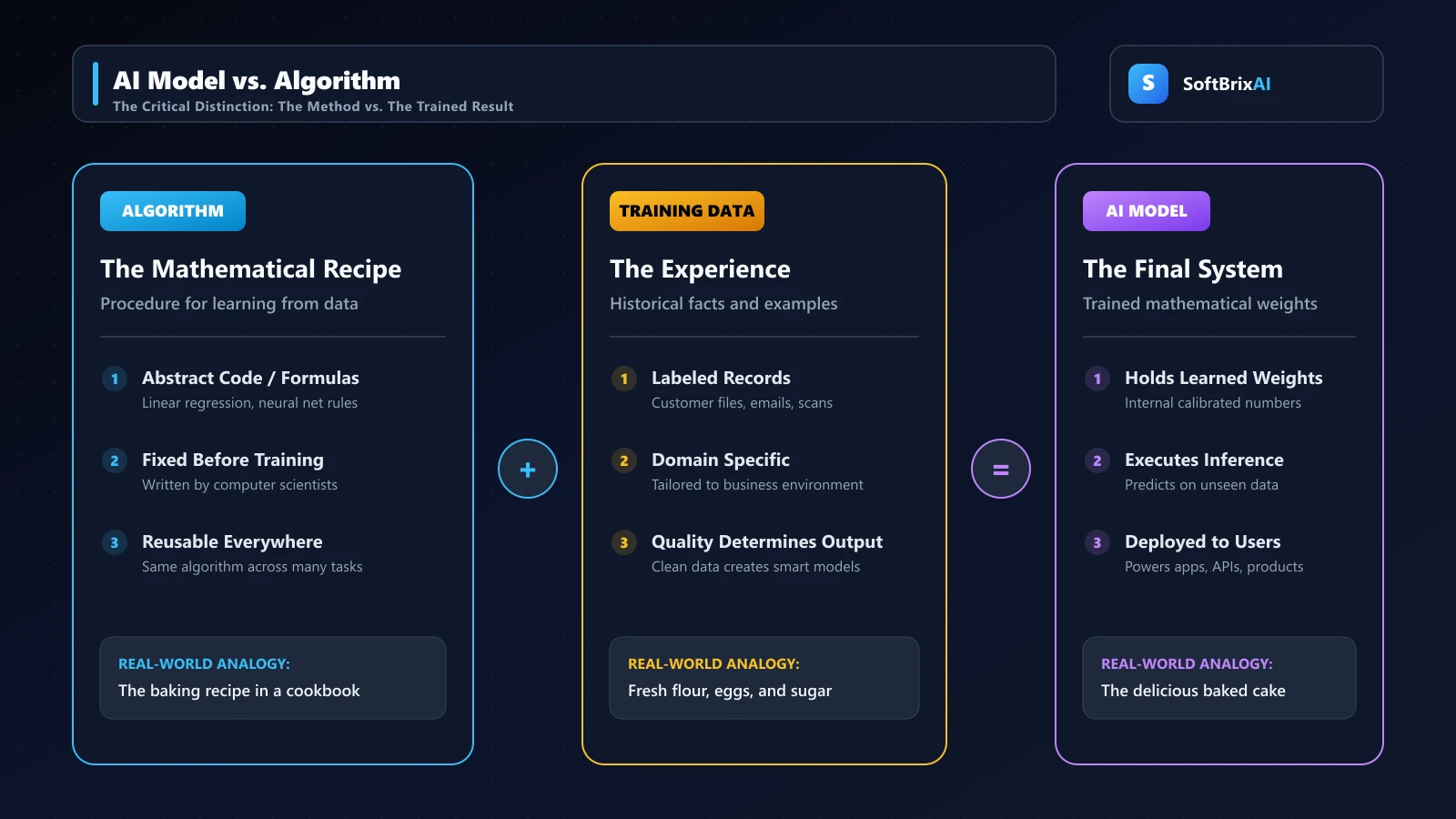
People often use these two words as if they were interchangeable, yet they describe different things. An algorithm is the recipe, meaning a mathematical procedure such as linear regression or a decision tree that describes how to learn from data. The AI model is what you get after that recipe has been trained on a specific dataset.
Returning to the claims adjuster, the algorithm is their method of studying files, while the model is the judgment they carry away once the studying is done. Two teams can run the same algorithm on different data and end up with very different models. That is why data quality matters just as much as the choice of method.
AI Models vs Machine Learning vs Deep Learning
The easiest way to picture the relationship is as four nested circles, with artificial intelligence forming the outer ring. Machine learning sits inside it, deep learning sits inside machine learning, while generative AI forms the smallest circle within deep learning.
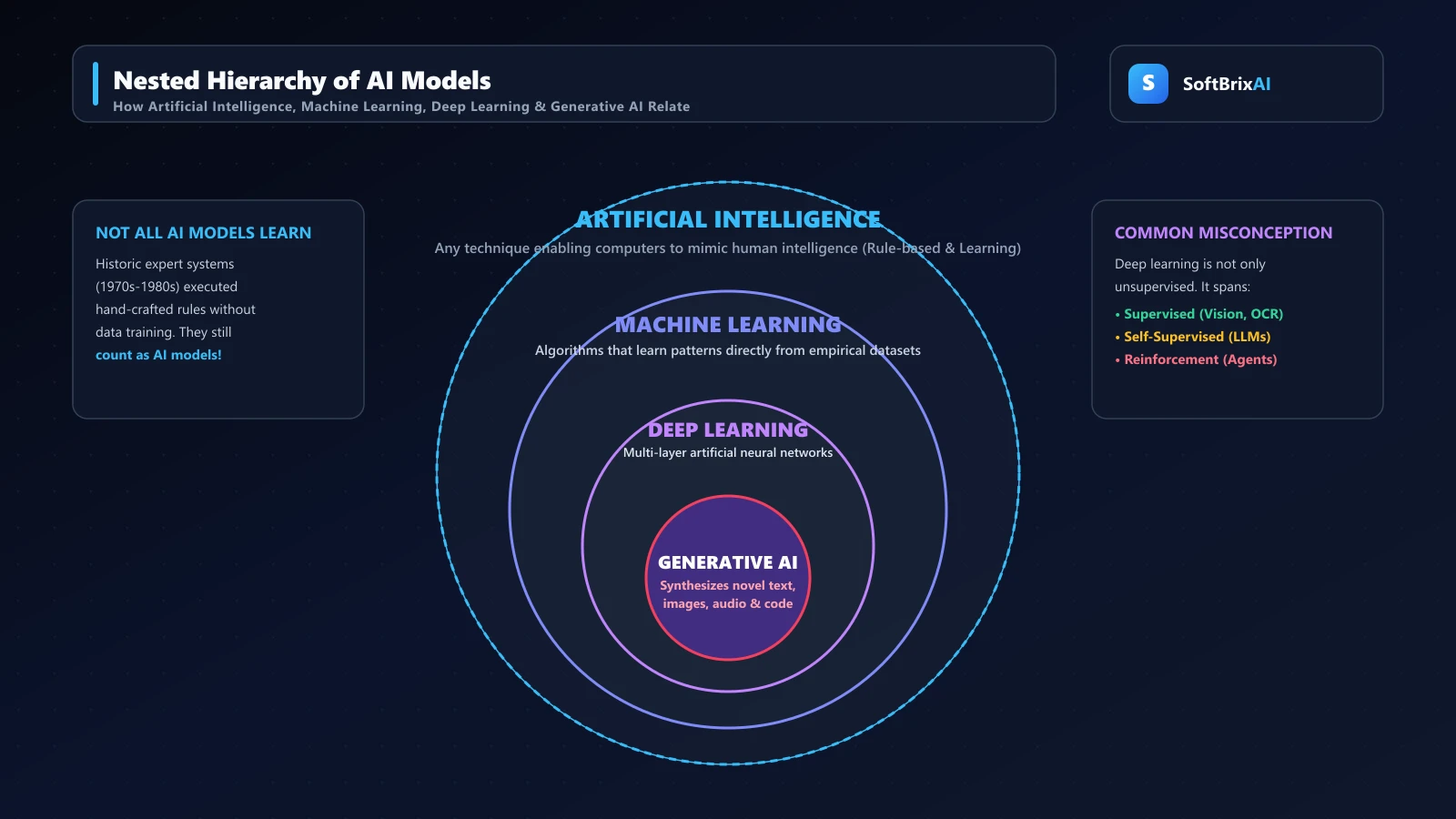
Every machine learning model is an AI model, but not every AI model learns. Rule-based expert systems from the 1970s and 1980s followed hand-written if-then rules, so they count as AI models even though they never improve from data. When people talk about AI ML models today, they usually mean the kind that learns.
Some explainers describe deep learning as a branch of unsupervised learning, which is a common mistake worth correcting. Deep learning can be supervised, unsupervised or self-supervised, depending on how the training data is prepared. For a fuller breakdown of where each field begins and ends, read our comparison of AI vs machine learning vs deep learning.
How Do AI Models Work?
At the simplest level, every AI model follows the same four-step loop. Data goes in, it passes through the model’s learned parameters, a prediction comes out, then feedback improves the next round.
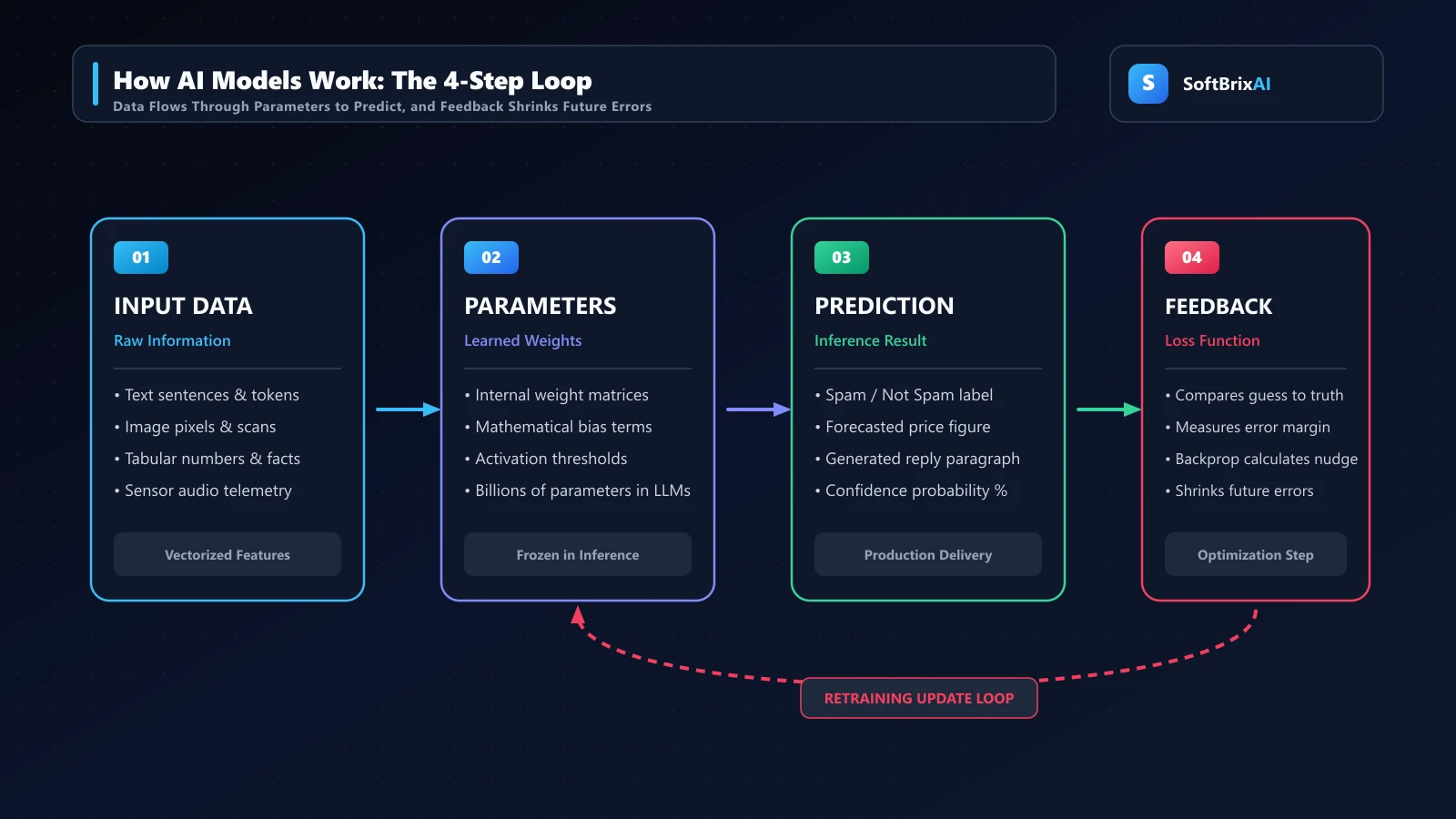
Parameters, sometimes called weights, are the numbers inside the model that decide how much each piece of input matters. A small spam filter might hold a few thousand of them, while large language models hold billions.
During training, the model sees an example, makes a guess, compares that guess with the right answer, then nudges its parameters so the next guess lands closer. Once training ends, the parameters are usually frozen, so the model can be put to work on fresh data in a stage known as inference.
Inference is the part you actually experience as a user, because it is what happens when a chatbot answers you or a bank flags an odd card payment. Our guide on how AI works walks through this pipeline in more technical detail, including the math behind a single neuron.
The Core Parts of an AI Model
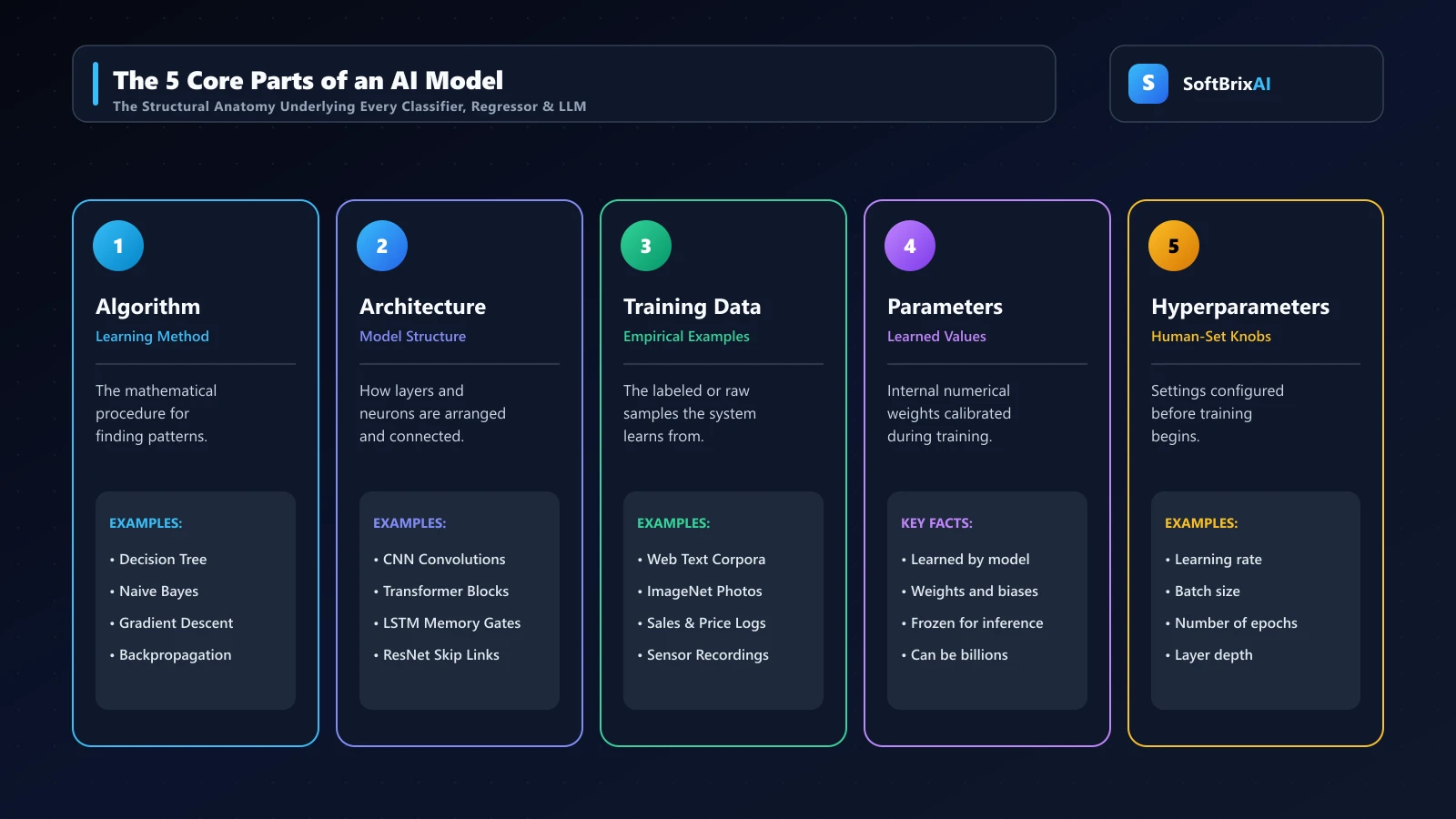
Every artificial intelligence model, from the smallest classifier to the largest language model, is built from the same five parts:
- Algorithm: the learning method, such as a decision tree or a neural network, that defines how patterns are found.
- Architecture: the structure of the model, for example how many layers a neural network has and how those layers connect.
- Training data: the examples the model learns from, which can be text, images, audio, numbers or a mix of these.
- Parameters: the internal values the model adjusts during training, also known as weights and biases.
- Hyperparameters: the settings a person chooses before training starts, such as the learning rate or the number of layers.
The difference between the last two trips up many beginners. The model learns its parameters by itself, whereas a data scientist sets the hyperparameters before training begins. Testing different hyperparameter values to find the best combination is known as hyperparameter tuning.
A Simple Example: How a Spam Filter Model Works
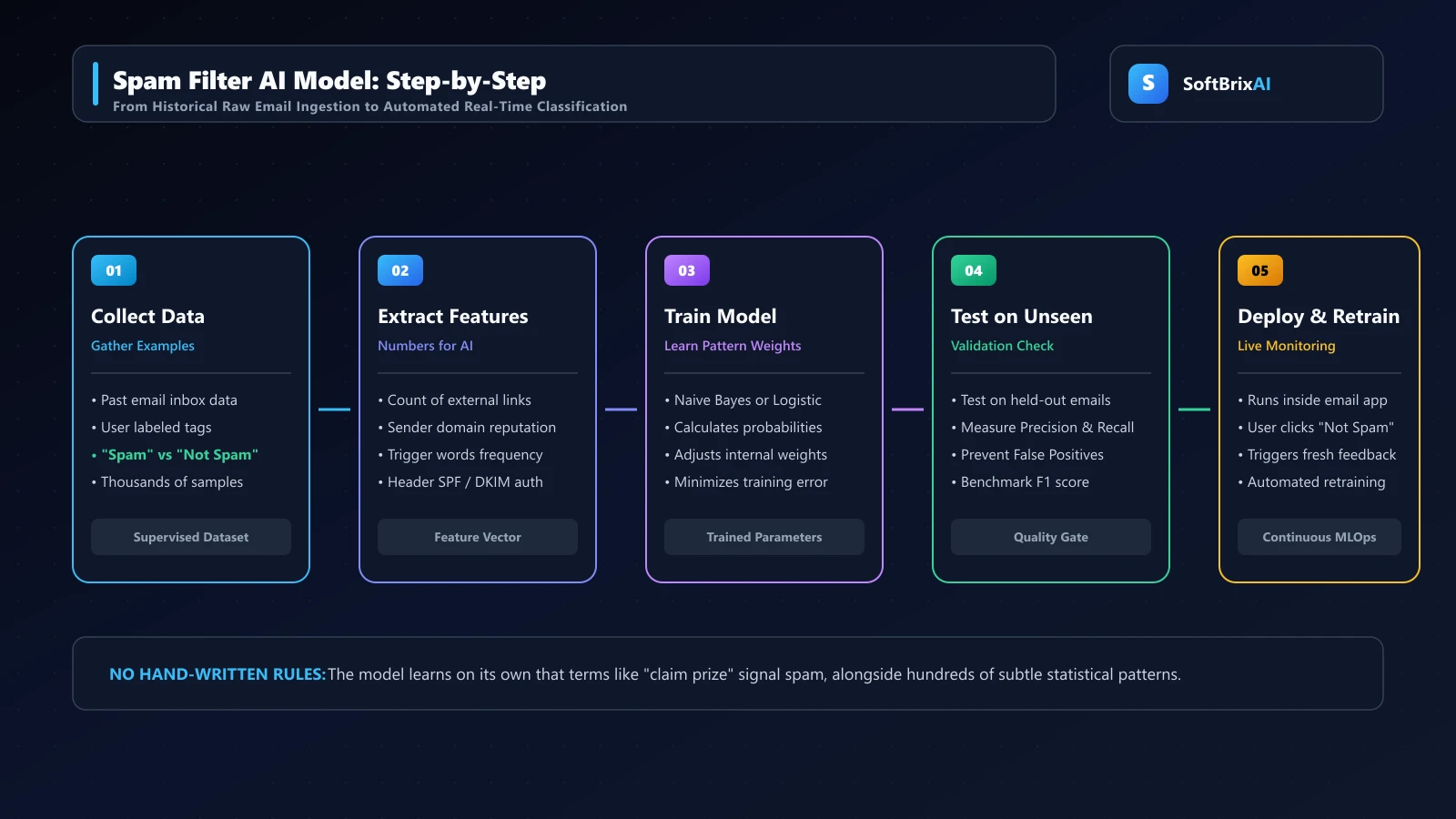
Spam detection is one of the oldest everyday uses of machine learning, so it makes a clear example of the whole process from start to finish.
- Collect labeled examples: The team gathers thousands of past emails that people have already marked as spam or not spam.
- Turn emails into features: Each message becomes numbers the model can read, such as how many links it contains, whether the sender is known or which words appear.
- Train the model: A classification algorithm, often Naive Bayes or logistic regression, studies the examples to learn which feature combinations tend to mean spam.
- Test on unseen emails: The team checks the model against a held-back set of emails it never saw, measuring how often it assigns the right label.
- Deploy, then keep learning: The filter starts sorting real mail, while every “not spam” click from a user becomes fresh labeled data for the next round of retraining.
Notice that nobody wrote a rule saying an email containing “claim your prize” is spam. The model found that pattern itself, along with hundreds of subtler signals a person would struggle to spot.
How Do AI Models Learn?
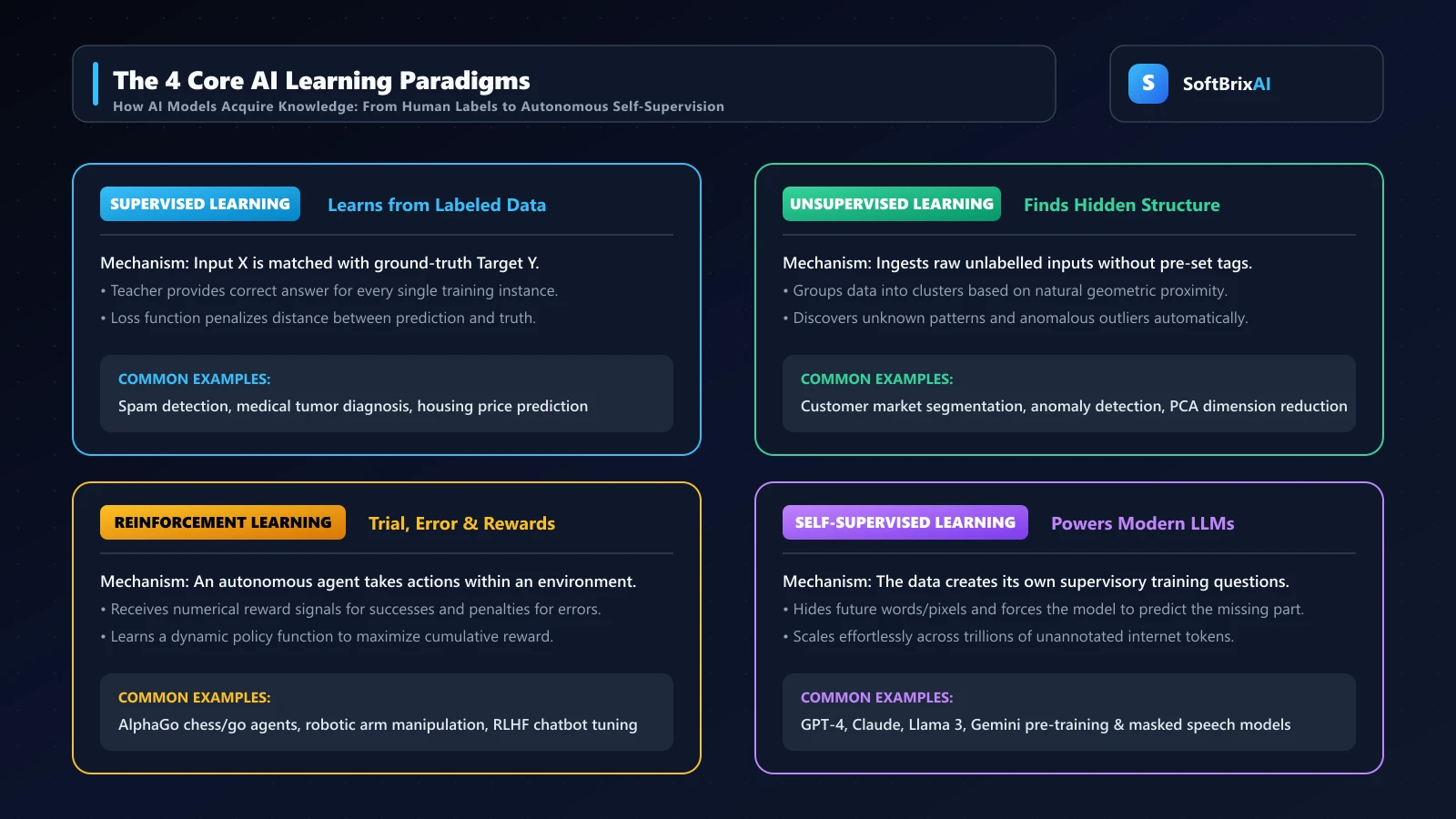
AI models learn through a repeating cycle of guessing, checking and adjusting. The model makes a prediction on a training example, then a loss function measures how far that guess was from the correct answer. Next, the model shifts its parameters slightly to shrink the error.
Repeat that cycle millions of times, and the parameters settle into values that work well across the whole dataset. In neural networks, the method that works out which parameters to adjust, and by how much, is called backpropagation.
What changes from one model to the next is the kind of feedback it receives, which gives us four main learning styles. Our step-by-step explainer on how machines learn covers each style with worked examples, so the summaries below stay brief.
Supervised Learning
Supervised learning trains a model on labeled data, meaning every example comes with the correct answer attached. A spam filter learning from emails tagged “spam” or “not spam” uses supervised learning. So does a model that predicts house prices from past sales where the final price is known. It remains the most common approach in business, because its results are easy to measure.
Unsupervised Learning
Unsupervised learning works with data that has no labels at all, so the model has to find structure on its own. A retailer might feed in purchase histories and let the model sort customers into clusters, such as bargain hunters, seasonal shoppers or loyal regulars. Nobody defines those groups in advance, since the model discovers them from the data.
Reinforcement Learning
Reinforcement learning teaches a model through a long process of trial and error. The model, often called an agent, takes an action, receives a reward or a penalty, then adjusts its strategy to collect more reward over time. This approach powers game-playing systems, robot arms that learn to grip objects and the fine-tuning step that makes chatbots more helpful.
Self-Supervised Learning
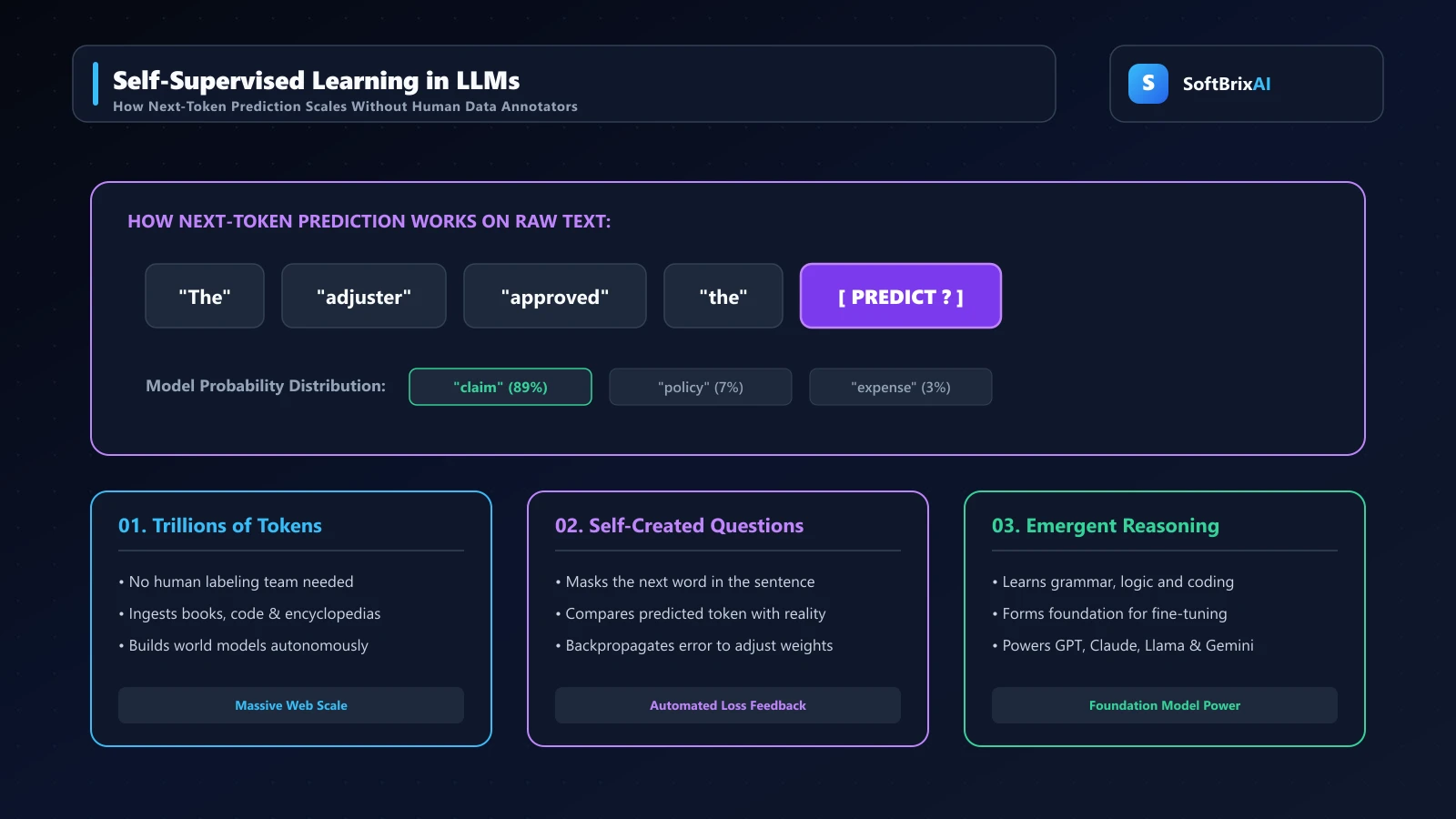
Self-supervised learning is the method behind modern large language models, yet most explainers skip it entirely. Instead of relying on people to label data, the model creates its own practice questions from raw text by hiding the next word and trying to predict it. Given the phrase “The adjuster approved the,” for instance, the model guesses the missing word, checks the real one, then adjusts.
Because the labels come from the data itself, this approach scales to trillions of words without an army of human annotators. That is how models in the GPT family, Claude and Llama build their broad grasp of language before any fine-tuning happens.
Training, Testing, Deployment and Monitoring
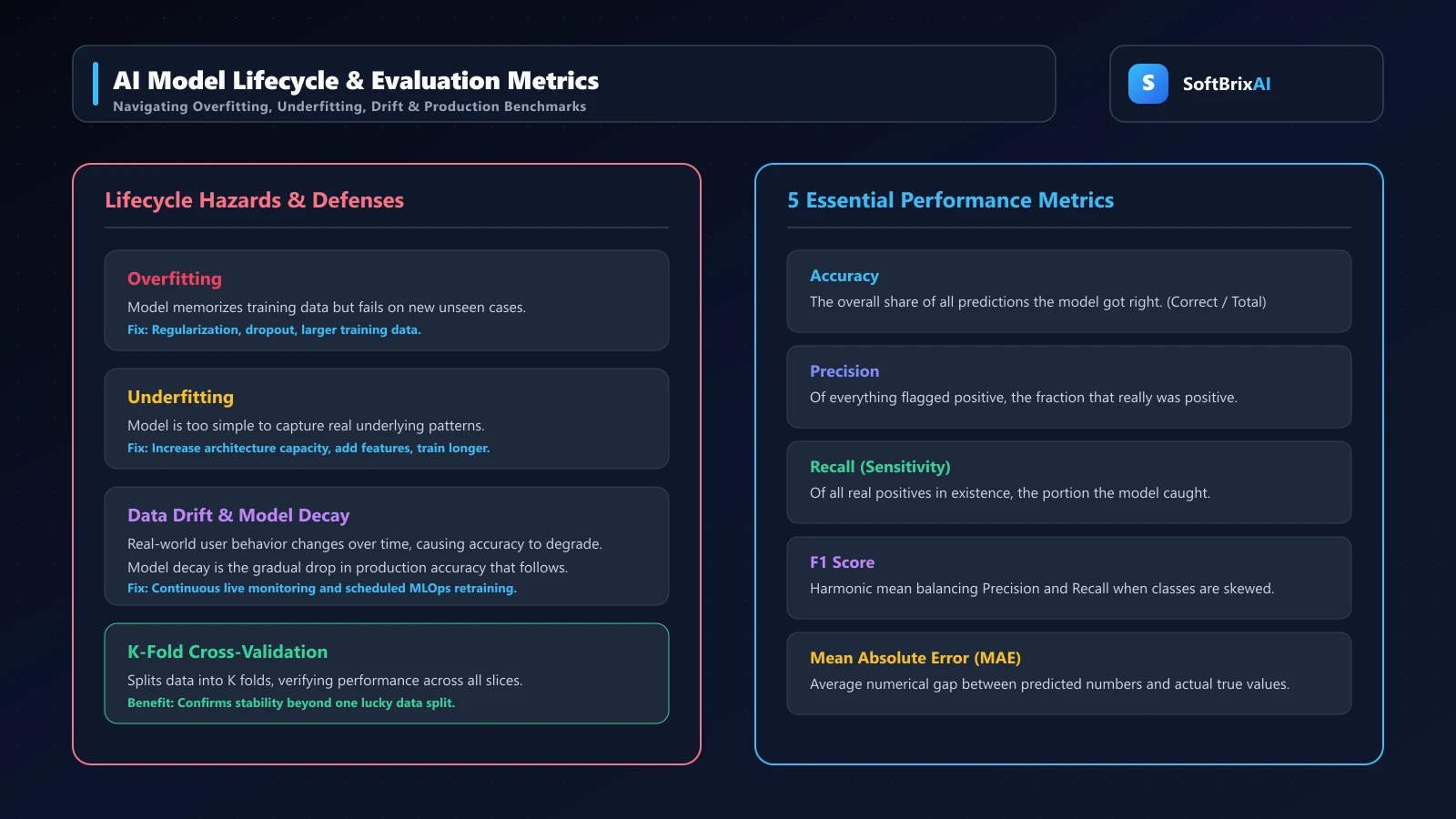
Learning is only one stage in a model’s life cycle, while each later stage brings its own common problems:
- Overfitting happens when a model memorizes its training data so closely that it fails on new examples, like a student who memorized past exam answers.
- Underfitting is the opposite problem, where the model is too simple to capture the real pattern at all.
- Cross-validation tests the model on several slices of held-back data, as in k-fold testing, to confirm it performs well beyond one lucky split.
- Data drift occurs when real-world inputs start to look different from the training data, for instance when shopping habits change after a price rise.
- Model decay is the gradual drop in accuracy that follows drift, which is why production teams monitor live models and retrain them on a schedule.
Teams that run many models in production usually formalize this cycle through MLOps practices. To judge performance along the way, they rely on a handful of plain metrics:
- Accuracy: the share of all predictions the model got right.
- Precision: of everything the model flagged as positive, the portion that really was positive.
- Recall: of all the real positives in the data, the portion the model managed to catch.
- F1 score: a single number that balances precision against recall.
- Mean absolute error (MAE): the average gap between a predicted number and the real one, used for regression models.
Types of AI Models
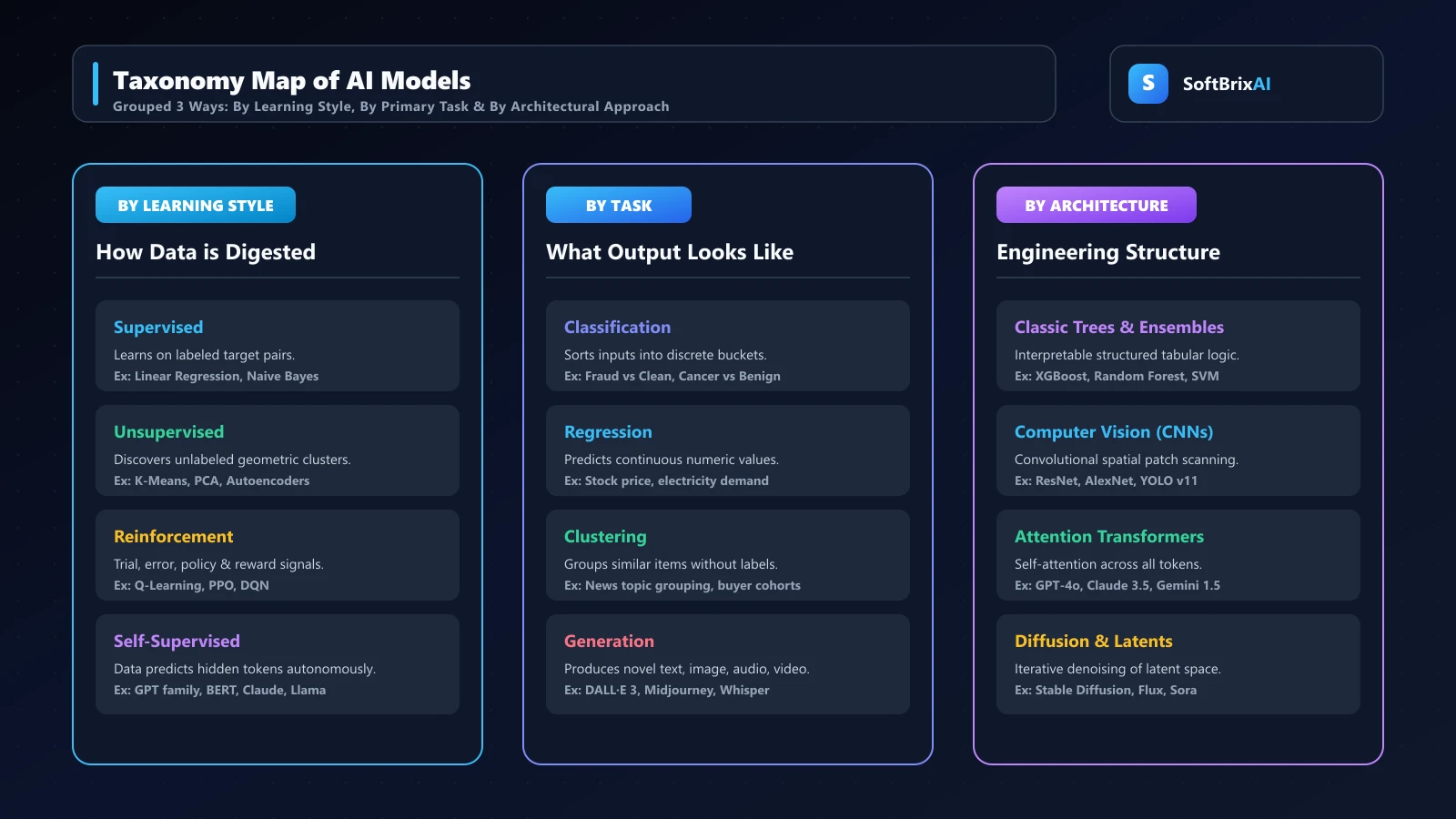
There is no single official list of AI model types, because the answer depends on how you group them. Experts usually sort different AI models in three ways: by learning style, by the task they perform or by the approach they take to data. Learning style was covered above, so this section focuses on tasks, approaches and the main model families you will meet.
Classification, Regression and Clustering Models
These three AI model types are defined by what their output looks like:
- Classification models sort inputs into categories, for example deciding whether a loan application is high risk or low risk.
- Regression models predict continuous values, such as tomorrow’s electricity demand or the price a house will sell for.
- Clustering models group similar items together without predefined labels, such as organizing news articles by topic.
Some names cause confusion here, since logistic regression is actually a classification model despite the word “regression” in its title. It estimates the probability that an input belongs to a class, then uses that probability to pick a label.
Generative vs Discriminative Models
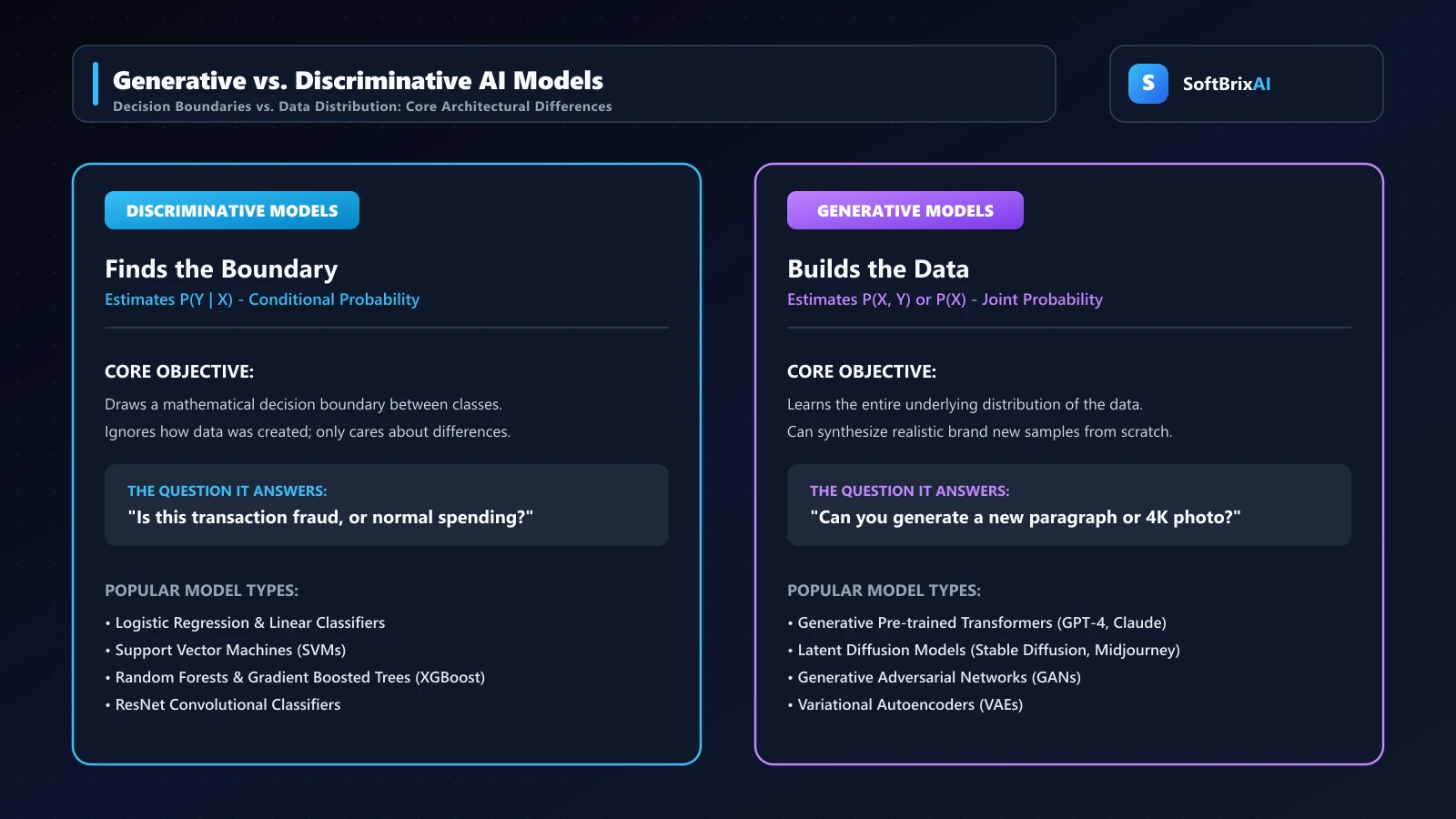
A discriminative model learns the boundary between categories. Shown a card transaction, it answers a narrow question, such as whether the payment looks fraudulent, by focusing only on the features that separate fraud from normal spending.
A generative model instead learns how the data itself is built. As a result, it can produce new examples that resemble its training data, such as a fresh paragraph of text or a photo of a room that never existed.
The two approaches can also work as a team. In a generative adversarial network (GAN), a generator creates fake samples while a discriminator tries to spot them, so each side improves by competing with the other. If you are weighing which family suits a business problem, our breakdown of generative AI vs predictive AI goes deeper.
Types of Machine Learning Models
Classic machine learning models still handle a large share of real business work, especially with structured data such as spreadsheets or transaction logs. The types of machine learning models you will see most often include:
- Linear regression: draws the best-fitting straight line through data to predict a number, such as sales from advertising spend.
- Logistic regression: predicts the probability of a yes-or-no outcome, such as whether a customer will cancel a subscription.
- Decision trees: split data through a series of simple questions, which makes their reasoning easy to follow.
- Random forests: combine hundreds of decision trees and average their votes, a technique known as ensemble learning.
- Support vector machines (SVMs): find the widest possible margin that separates two classes of data.
- K-means: a clustering method that groups data points around a chosen number of centers.
- Naive Bayes: applies Bayes’ theorem to estimate probabilities quickly, which is why spam filters have long relied on it.
Open libraries such as scikit-learn make all of these available in a few lines of code, which is one reason they remain so popular.
Deep Learning Models
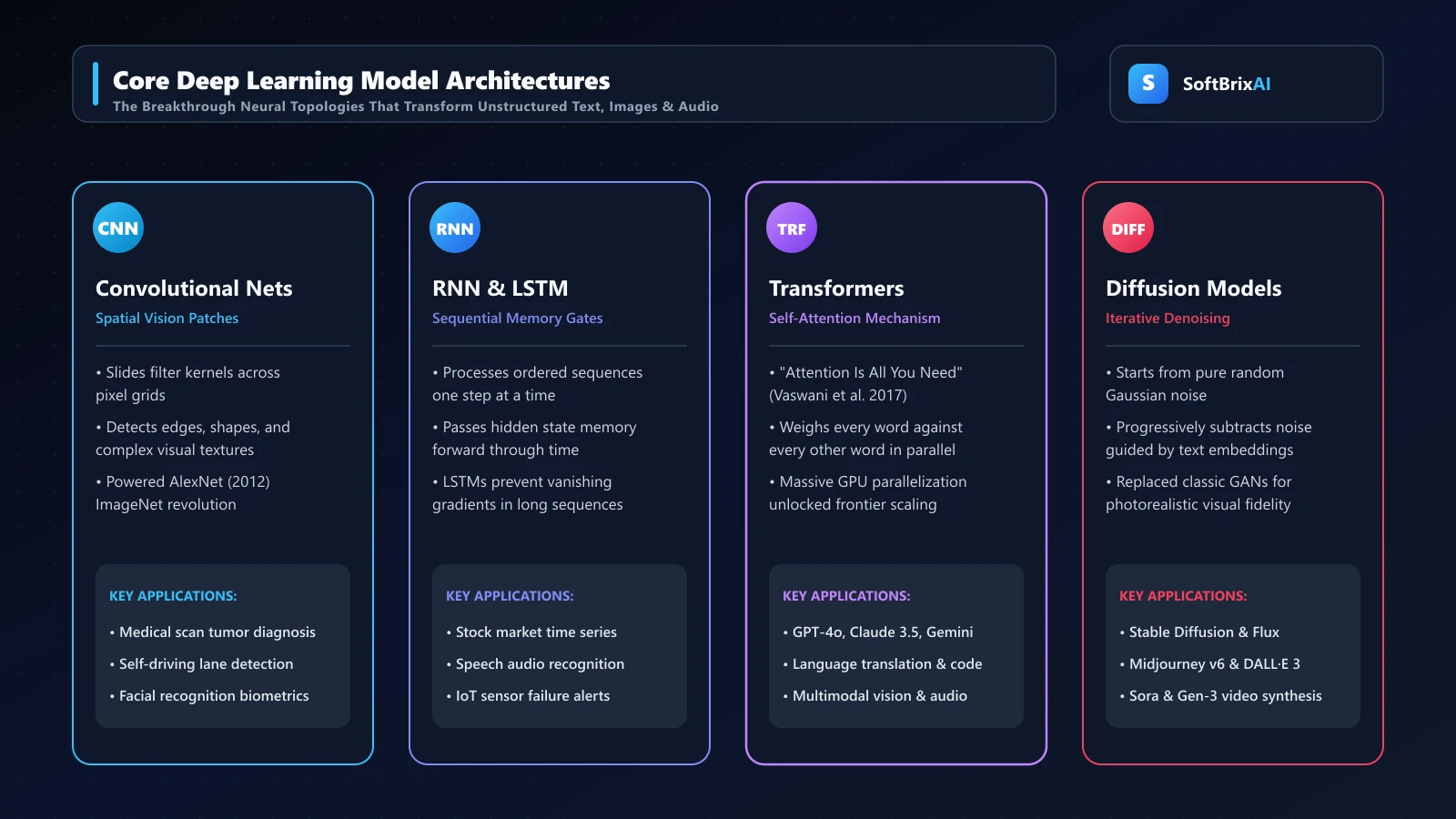
Deep learning models are neural networks with many hidden layers, the in-between layers that transform raw input step by step into a useful output. They excel on unstructured data such as images, audio or free-flowing text.
- Convolutional neural networks (CNNs): scan images in small patches to detect edges, shapes and objects. They powered the 2012 AlexNet breakthrough on the ImageNet benchmark, which kicked off the modern deep learning era.
- Recurrent neural networks (RNNs) and LSTMs: process sequences one step at a time while carrying a memory of earlier steps. Long short-term memory (LSTM) networks handle longer sequences, which suits speech and time-series data.
- Transformers: use a mechanism called self-attention to weigh how every word in a passage relates to every other word. The idea comes from the 2017 paper “Attention Is All You Need” by Vaswani and colleagues.
- Diffusion models: learn to turn random noise into a clear image step by step, which is how Stable Diffusion creates pictures from text prompts.
Most of these networks are built with open frameworks such as PyTorch, which handle the heavy math on GPUs.
Foundation Models and Large Language Models
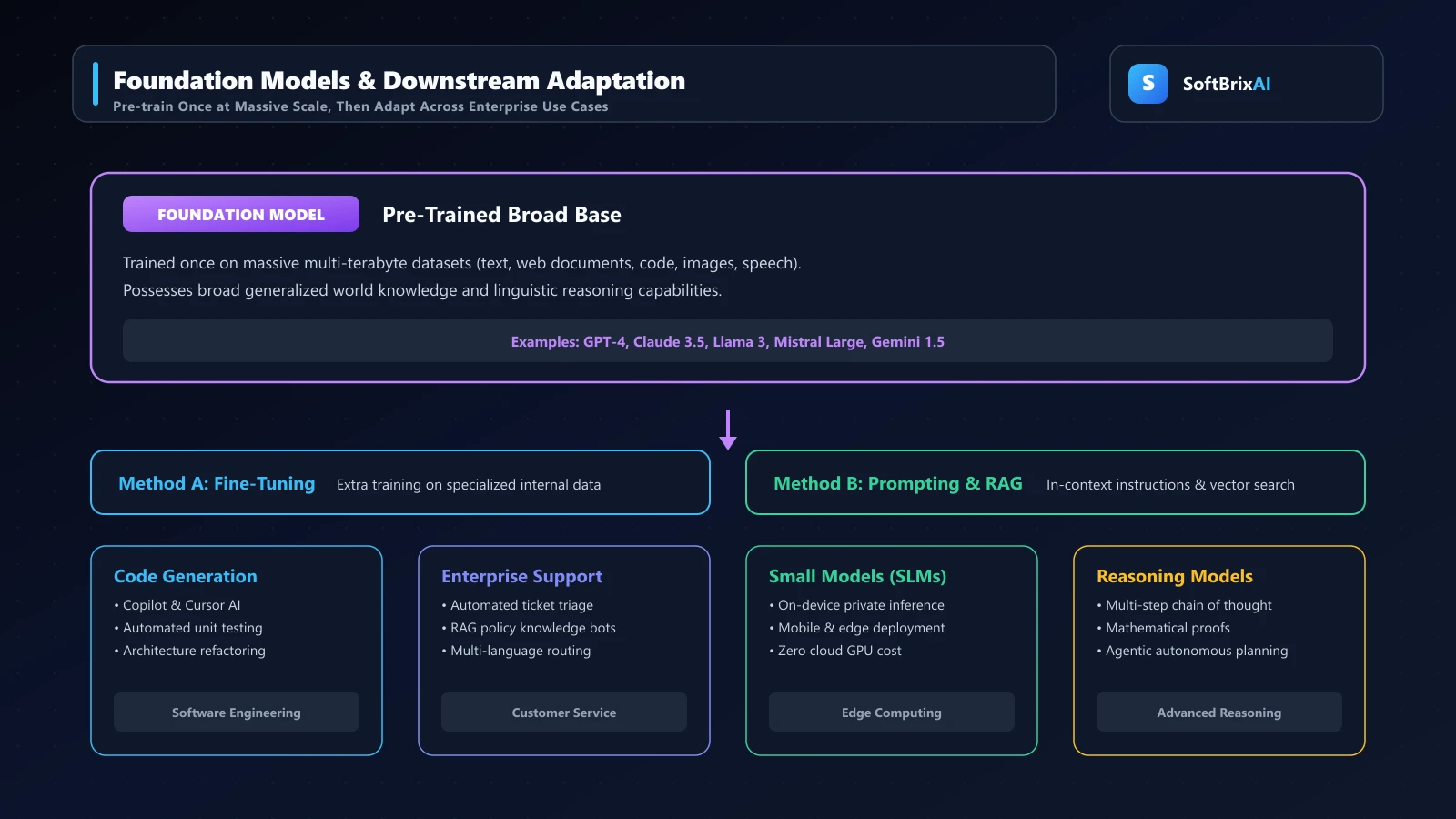
A foundation model is a large model pre-trained once on a broad dataset, then adapted many times for specific jobs. Teams adapt it either through fine-tuning, which means extra training on a smaller task-specific dataset, or through prompting, which means giving the model clear instructions.
Large language models (LLMs) are the best-known foundation models, trained on huge volumes of text to understand and generate language. Small language models (SLMs) follow the same design with far fewer parameters, so they run cheaply on laptops, phones or other edge devices at the cost of some breadth.
Many newer foundation models are multimodal, meaning a single model can read text, interpret images or process audio. A newer group called reasoning models works through a problem in several internal steps before answering, which helps with math, coding and planning tasks.
Narrow vs General-Purpose AI Models
Most AI models are narrow, which means each one is built for a single job, such as reading license plates or forecasting inventory. A general AI model, in everyday usage, usually refers to a general-purpose foundation model that can write, summarize, translate, code or answer questions without being rebuilt for each task.
That is not the same as artificial general intelligence (AGI), a hypothetical system that could match human ability across virtually any intellectual task. AGI does not exist yet, so even the most capable general-purpose models still lack common sense, lasting memory or a real understanding of the world. Our guide to the types of artificial intelligence explains how narrow AI, AGI and superintelligence differ.
With every different type of AI model now mapped out, the next step is to put real names to them.
AI Models Examples (List of AI Models)
Use this artificial intelligence models list as a quick reference. It mixes famous named models with everyday model types, since both help you picture what AI models actually do.
One distinction is worth keeping in mind with these artificial intelligence models examples. ChatGPT is an application, while the GPT models underneath it are the actual AI models, much as a website runs on the server behind it.
| AI model | Type | What it does |
|---|---|---|
| GPT family (powers ChatGPT) | Large language model | Writes, answers questions and holds conversations in text |
| Claude | Large language model | Handles writing, analysis and coding tasks |
| Llama | Open large language model | Gives developers a downloadable model they can run or fine-tune |
| Mistral | Open large language model | Offers efficient open models that are popular for self-hosting |
| BLOOM | Open multilingual language model | Generates text in dozens of languages from a community research project |
| DALL·E | Image generation model | Creates images from written descriptions |
| Stable Diffusion | Open diffusion model | Generates or edits images from text prompts |
| Whisper | Speech recognition model | Transcribes and translates spoken audio |
| YOLO | Computer vision model | Detects and labels objects in images in real time |
| Recommendation engine | Ranking and classification model | Suggests products, songs or shows based on past behavior |
| Spam filter | Classification model | Labels incoming email as spam or not spam |
How Many AI Models Are There?
There is no fixed number of AI models, and the count grows every single day. Hugging Face, the largest public hub for open models, listed more than 3.1 million models in October 2026, up from about one million in 2024.
That figure counts every uploaded version, so a single popular model may appear hundreds of times as fine-tuned copies, compressed variants or personal experiments. Proprietary models add to the total as well, since companies train private models for fraud checks, demand planning and search that never appear on any public hub.
Counting by type gives a much smaller answer. Most of those millions fall into roughly a dozen core designs, such as classification, regression, clustering, CNNs, transformers or diffusion models. So when someone asks how many AI models there are, the honest reply is millions of individual models built on a small family of designs.
Where Are AI Models Used?

AI models already run inside most industries, usually in places customers never see. A few concrete uses show how wide their reach has become:
- Healthcare: imaging models highlight possible tumors on scans, so radiologists can review the riskiest cases first.
- Finance: classification models score each card payment within milliseconds, blocking those that look fraudulent.
- Retail: recommendation models suggest products based on what similar shoppers bought, while forecasting models plan stock levels.
- Manufacturing: vision models inspect parts on the production line, catching defects that tired human eyes might miss.
- Transport: route models predict traffic delays, while computer vision helps driver-assistance systems recognize lanes and pedestrians.
- Customer service: language models answer routine questions, draft replies for human agents or sort incoming tickets by urgency.
Most real products combine several artificial intelligence models at once. A single shopping app might use a language model for its chat assistant, a recommendation model for its home page and a fraud model at checkout.
How to Choose the Right AI Model
Picking among different AI models starts with the problem, not with the technology. Work through these six questions before committing to any AI model:
- What kind of problem is it? Predicting a number points to regression, while sorting items points to classification, whereas creating content points to a generative model.
- What data do you have? Labeled data opens the door to supervised learning, whereas a pile of unlabeled data suggests clustering or a pre-trained foundation model.
- How accurate does it need to be? A product recommendation can afford a few mistakes, but a medical or credit decision needs far higher accuracy, plus human review.
- Do you need to explain each decision? Regulated decisions often favor simpler models like decision trees, whose reasoning is easy to show an auditor.
- What can you afford to run? Large models need powerful GPUs, which raises inference cost, so a smaller model may deliver better value for routine tasks.
- Where will the data live? Privacy laws such as GDPR in Europe or CCPA in California may require a model you can host on your own servers.
In many cases the best starting point is an existing pre-trained model fine-tuned on your own data, rather than a model trained from scratch. If you want a second opinion on that trade-off, our team offers AI consulting to help match the right model to the problem.
Limitations of AI Models
AI models are powerful tools, yet they come with limits that every buyer or builder should understand before relying on them:
- Bias: a model trained on skewed historical data can repeat that unfairness, for example by rating some job applicants lower for reasons unrelated to skill.
- Hallucination: generative models sometimes produce fluent answers that are simply false, because they predict likely words rather than check facts. Techniques such as retrieval-augmented generation reduce the problem by grounding answers in trusted documents.
- Black-box decisions: deep learning models can hold billions of parameters, which makes it hard to explain why they reached a specific answer.
- Data drift: accuracy fades when the world changes but the model does not get retrained on newer data.
- Compute cost: training and running large models requires expensive hardware along with a significant amount of electricity.
- Privacy risk: models trained on personal data can leak sensitive details when that data is not handled carefully.
For a structured way to manage these risks, the AI Risk Management Framework from NIST offers a voluntary playbook built around four functions: govern, map, measure and manage. In the European Union, the European Commission has set binding obligations for high-risk AI systems under the EU AI Act.
Common Misconceptions About AI Models
A few myths about AI models refuse to go away, so they are worth clearing up directly:
- “AI models are sentient.” No AI model has feelings, intentions or awareness, because it processes numbers and patterns, however human its replies may sound.
- “AI models get smarter on their own.” Most deployed models stay fixed until a team retrains them on new data, so they do not quietly improve in the background.
- “One model can do everything.” Even large general-purpose models struggle with specialized tasks, which is why many companies still pair them with smaller models built for a single job.
Frequently Asked Questions
What is an AI model in simple words?
An AI model is a program that learns patterns from examples so it can make predictions or decisions about new information. Think of it as a trained specialist who studies thousands of past cases, then applies that experience to a case it has never seen before.
What is the difference between an AI model and an algorithm?
An algorithm is the method, a step-by-step mathematical procedure for learning from data. An AI model is the trained result you get after running that algorithm on a specific dataset. The same algorithm trained on two different datasets will produce two different models, each with its own strengths and blind spots.
How do AI models learn?
AI models learn by making guesses on training data, measuring how wrong each guess was with a loss function, then adjusting their internal parameters to reduce the error. This cycle repeats over many rounds until predictions become reliable. The feedback can come from labels, rewards, hidden patterns or the raw data itself.
How many AI models are there?
There is no fixed number, since new models are published every day. The Hugging Face hub alone listed more than 3.1 million public models in October 2026, while companies run countless private ones. Most of these models, however, belong to about a dozen core types, such as classification, regression, transformers or diffusion models.
What are the main types of AI models?
By learning style, the main types are supervised, unsupervised, reinforcement and self-supervised models. By task, the main groups are classification, regression, clustering and generative models. You will also hear models grouped by architecture, such as decision trees, CNNs or transformers, or by scale, such as large and small language models.
Is ChatGPT an AI model?
Strictly speaking, ChatGPT is an application rather than a model. It runs on OpenAI’s GPT large language models, which are the actual AI models doing the work. The app adds a chat interface, memory features and safety layers on top, in the same way a website runs on top of the server behind it.
What is a general AI model?
A general AI model usually means a general-purpose foundation model that can handle many tasks, from writing to coding to translation, without being rebuilt for each one. It is not the same as artificial general intelligence (AGI), a hypothetical system with human-level ability across all tasks that does not exist today.
Are AI models the same as machine learning models?
Not quite, because every machine learning model is an AI model, while some AI models do not use machine learning at all. Rule-based expert systems, for example, follow hand-written if-then rules instead of learning from data. In everyday conversation, though, most people use the two terms to mean the same thing.
Conclusion
An AI model is a program trained on data to spot patterns, which lets it make predictions, decisions or new content from information it has never seen. From a simple spam filter to a large language model, every AI model follows the same loop of learning from examples, measuring its mistakes and adjusting its parameters.
AI models differ by how they learn, the task they perform or the data they handle, ranging from simple regression models to transformers and diffusion models. Choosing well comes down to your problem, your data and the level of risk you can accept. For the bigger picture of where AI models fit, continue with our pillar guide on what artificial intelligence is.