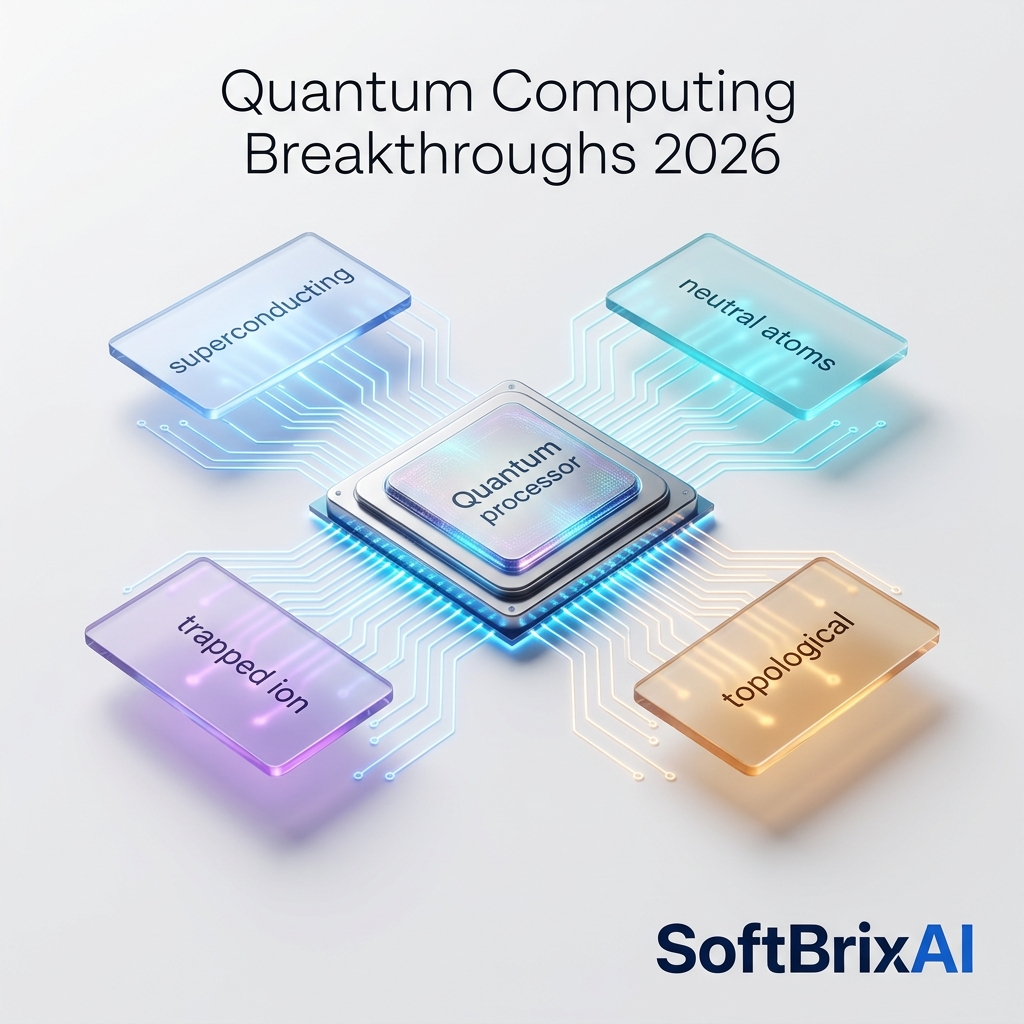
The latest quantum computing breakthroughs fall into 4 groups: stronger error correction, a sharp drop in the qubits needed to break encryption, a hardware race between competing qubit types, and the first useful quantum advantage on a real physics problem. Together these advances moved quantum computing from a long-term research idea to a technology with real machines, cloud access, and near-term risks.
A quantum computer processes information with qubits instead of classical bits. A qubit holds 0, 1, or a mix of both through superposition, and groups of qubits link through entanglement. This lets a quantum computer test many possibilities at once and beat a classical supercomputer on a few specific problems. The main components that matter are physical qubits, logical qubits, error-correction codes, and the algorithms that run on top of them.
The main benefits show up in chemistry, drug discovery, materials, energy, finance, and cryptography. The main risk shows up in security, because the same power that models a molecule can also break the encryption that protects websites, bank accounts, and cryptocurrency. This article covers each breakthrough, what it means in practice, and which quantum computing problems still slow the field down.
Quantum Computing Explained: Why Logical Qubits Are the Number That Actually Matters
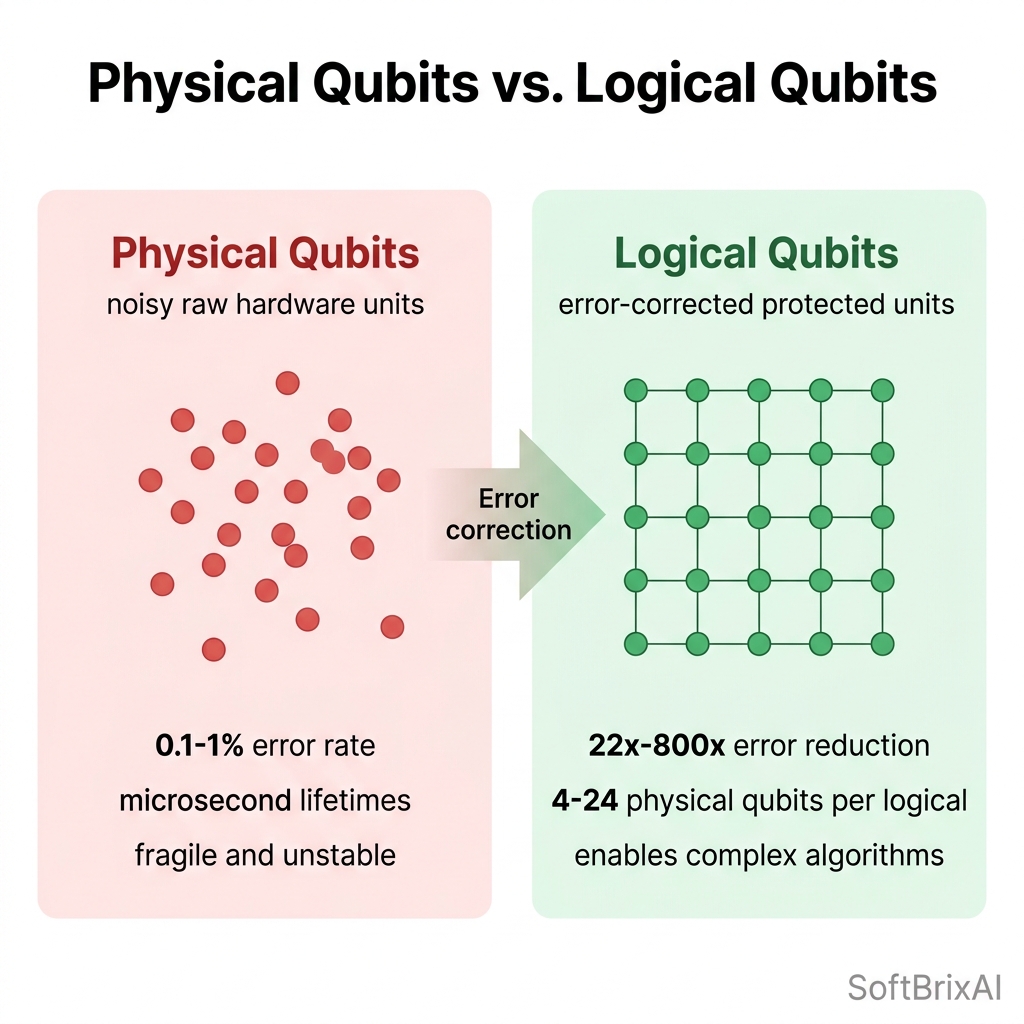
A logical qubit is the number that matters because it measures usable, error-protected computing power, not raw hardware count. Companies report chips with tens to a few hundred physical qubits, but those units are fragile and lose information in microseconds. A logical qubit combines many physical qubits under a quantum error correction (QEC) code so the encoded information survives long enough to run a program.
There are 3 core units inside a quantum computer:
- Physical qubits are the hardware units on the chip.
- Logical qubits are error-protected units built from many physical qubits.
- Fault-tolerant qubits are logical qubits stable enough to run long programs without errors taking over.
Most machines today sit in the noisy intermediate-scale quantum (NISQ) era, with tens to a few hundred noisy qubits. NISQ devices handle narrow experiments and pilots, and they cannot yet run large general-purpose algorithms such as breaking standard encryption. The shift from counting physical qubits to counting logical qubits explains why 2024 and 2026 produced the breakthroughs below.
Breakthrough 1: Google’s Willow Chip Cut Error Rates as Qubits Increased (Late 2024)
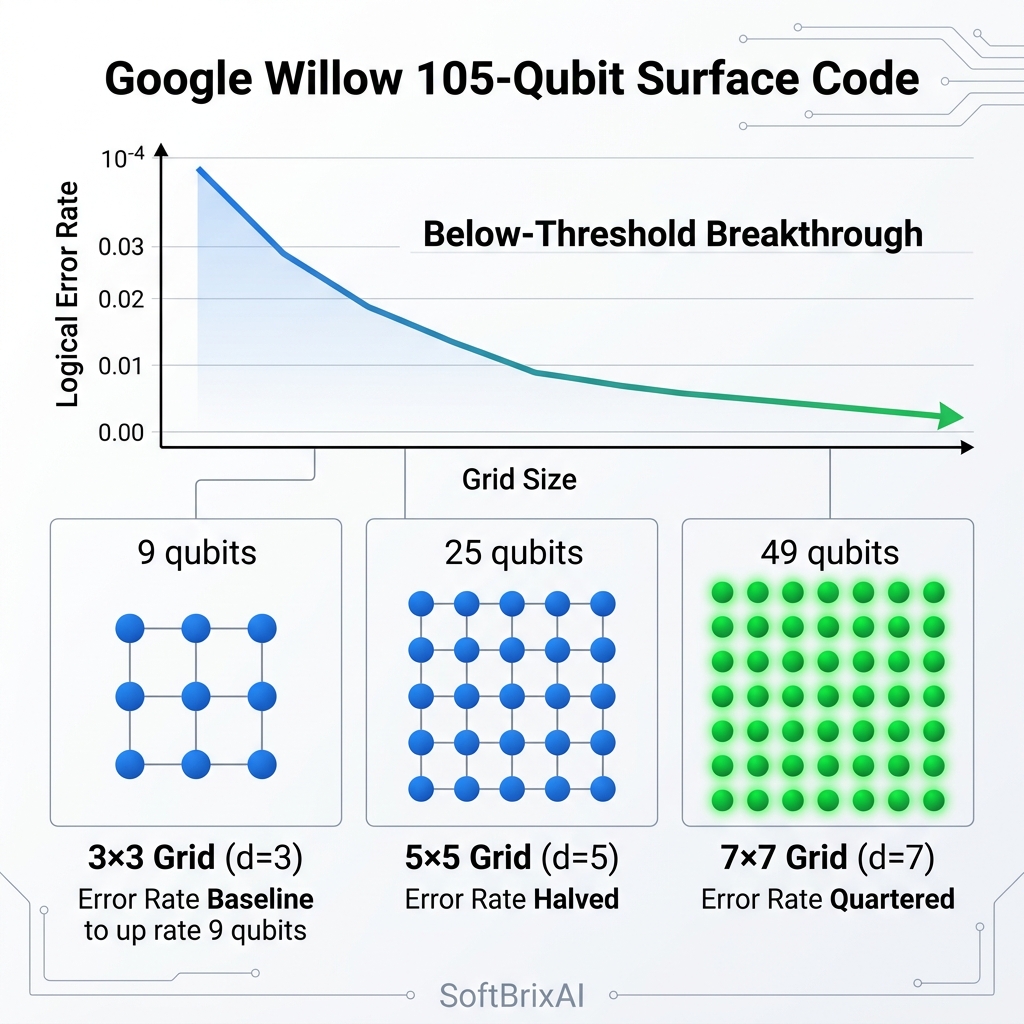
Google’s Willow chip cut logical error rates as the number of qubits increased, which reversed the field’s oldest problem. Google Quantum AI introduced Willow in December 2024 as a 105-qubit superconducting processor that achieved below-threshold quantum error correction. This result marked the first clear sign that a larger quantum processor can store information more safely, not less.
How Below-Threshold Error Correction Works on Willow’s 105 Qubits
Below-threshold error correction works when a code fixes errors faster than the hardware creates them. Google arranged Willow’s qubits in surface-code grids of 3×3, 5×5, and 7×7, which represent growing code distances. Each time the team increased the grid size, the logical error rate dropped by about half. The encoded qubit kept its information longer than any single physical qubit in the array.
Why “Errors Falling as Qubits Grow” Is the Real Fault-Tolerance Milestone
Falling errors as qubits grow is the real fault-tolerance milestone because it proves scale improves reliability. This result shows 3 things: scaling a processor can reduce errors, encoded qubits outlast single physical qubits, and large fault-tolerant machines are physically possible at enough scale. A study in Nature confirmed that Willow crossed the surface-code threshold, correcting errors faster than new ones appeared.
Random Circuit Sampling: The Benchmark Willow Finished in Minutes
Willow finished a random circuit sampling (RCS) benchmark in under 5 minutes. The same task would take one of today’s fastest classical supercomputers about 10 septillion (10^25) years. RCS solves no direct business problem, yet it gives strong evidence that quantum hardware can beat classical machines on carefully chosen tasks. For Google’s subsequent 2025 quantum hardware achievement with Quantum Echoes (running 13,000x faster than classical baselines), read our overview of Google AI News Today October 2025.
Breakthrough 2: The 2026 Shock — Breaking RSA and Bitcoin May Need ~30,000 Qubits, Not Millions
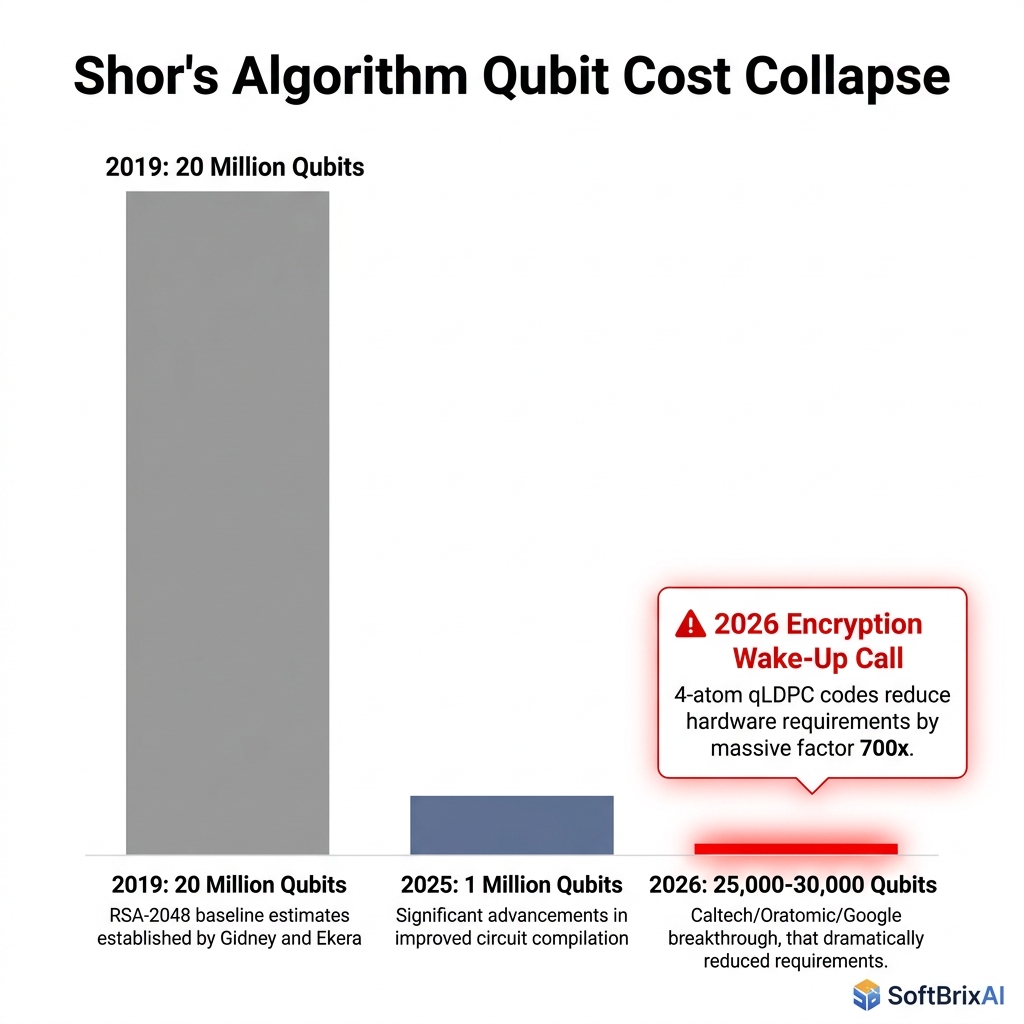
The 2026 shock is that breaking common encryption may need tens of thousands of qubits, not millions. In early 2026, 2 research groups cut the estimated cost of running Shor’s algorithm by about 2 orders of magnitude. Peter Shor first described this algorithm in 1995 as a way for a quantum computer to factor large numbers and break public-key encryption. For 30 years the threat stayed theoretical, because early estimates demanded billions and later a million qubits. The 2026 results moved that number close to real hardware.
Caltech and Oratomic’s Design to Run Shor’s Algorithm on ~10,000 Atomic Qubits
A Caltech team and the startup Oratomic published a design to run Shor’s algorithm on about 10,000 reconfigurable atomic qubits. Dolev Bluvstein leads Oratomic as chief executive, with Madelyn Cain, Qian Xu, and Robert Huang on the design, and John Preskill advising. The team simulated different neutral-atom arrays against 2 encryption schemes:
- Rivest-Shamir-Adleman (RSA): about a century with 10,000 atoms, or 3 months with 100,000 atoms.
- Elliptic curve cryptography (ECC): about 3 years with 10,000 atoms, or a few days with 26,000 atoms.
How qLDPC Codes Made One Logical Qubit From Just Four Atoms
Quantum low-density parity-check (qLDPC) codes made 1 logical qubit from just 4 atoms. Neutral atoms suit these codes, because a physicist can move 1 atom across the array to meet a distant atom. Huang’s group used a large language model (LLM) to search the code space. The LLM returned a code that builds 1 logical qubit from 4 atoms and survives 20 to 24 simultaneous errors. An earlier high-performing qLDPC code needed 12 physical qubits per logical qubit and handled 12 errors, so the new code roughly tripled efficiency.
Google’s 10x-More-Efficient Shor’s Algorithm for Elliptic-Curve Encryption
Google built a Shor’s algorithm implementation for ECC that runs at least 10 times more efficiently than earlier methods. Craig Gidney led the work. In 2019, Gidney’s program needed 20 million qubits and 8 hours to break RSA. A 2025 method dropped that below 1 million qubits. The 2026 ECC procedure estimates that most cryptocurrencies fall in minutes to a machine with fewer than 500,000 qubits. Combine the Google efficiency gain with the Caltech design, and Bitcoin (BTC) could be vulnerable to a quantum computer with about 25,000 to 30,000 qubits.
Why Google Published the Result as a Zero-Knowledge Proof
Google published the ECC result as a zero-knowledge proof to prove the method works without revealing how to build it. This choice marks a turning point where researchers now hide details that competitors or attackers could reuse. The zero-knowledge format confirms feasibility while withholding the operational steps.
Breakthrough 3: The Hardware Race Between Four Competing Qubit Types
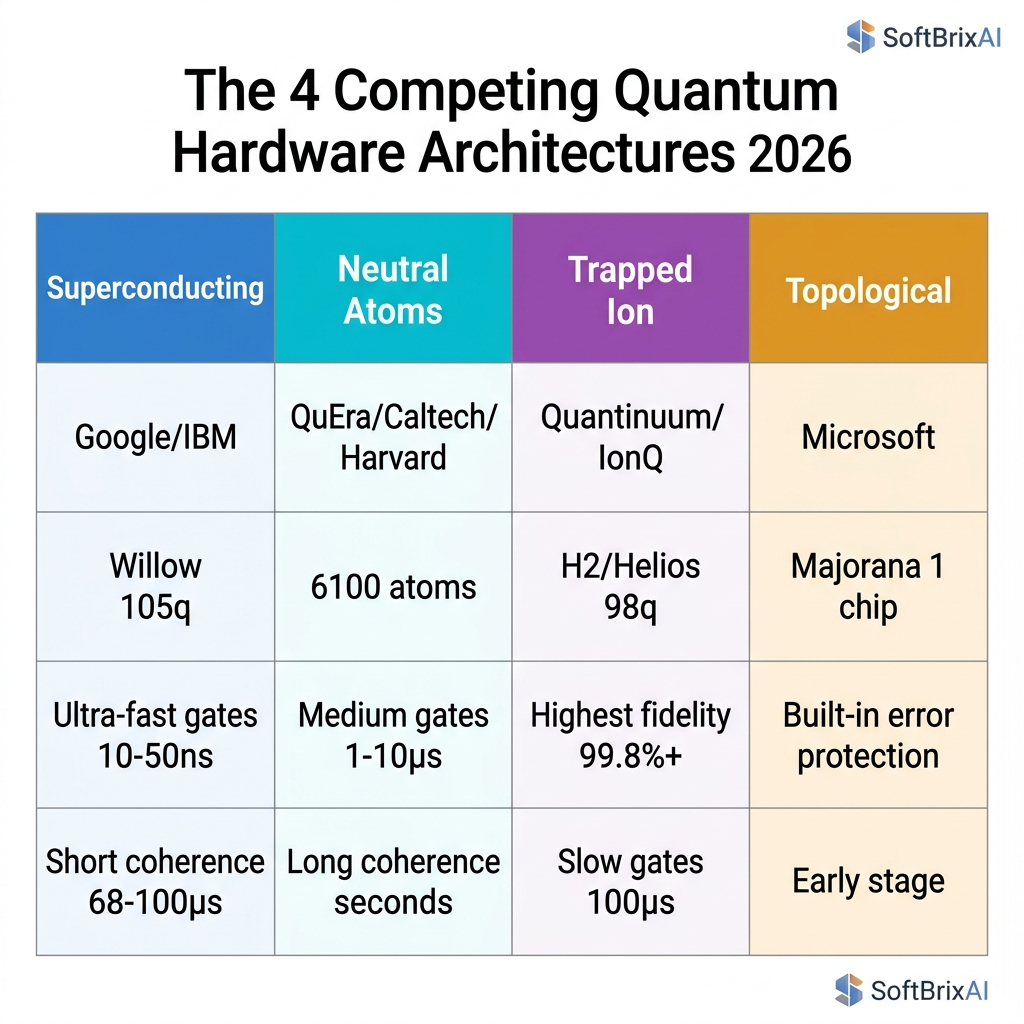
Four qubit types now compete for large-scale, fault-tolerant quantum computing: superconducting, trapped-ion, neutral-atom, and topological. Each design improves in parallel, which raises the odds that at least 1 reaches practical scale.
Superconducting Chips: Google and IBM’s Fast-but-Fragile Approach
Superconducting chips run fast but stay fragile. Google and IBM lead this approach, which uses circuits cooled near absolute zero (−273.15 °C / −459.67 °F / 0 K). Willow proved that superconducting qubits can cross the error-correction threshold. The trade-off is deep cooling and coherence times measured in microseconds, so the hardware demands heavy control and shielding.
Trapped-Ion Systems: Quantinuum’s High-Fidelity 56- and 98-Qubit Machines
Trapped-ion systems run slower but reach higher accuracy. Quantinuum’s H2-1 system reached 56 fully connected qubits with very high gate quality. The follow-on Helios system reached 98 trapped-ion qubits. These machines use charged atoms suspended in electromagnetic fields, and they post some of the field’s best gate fidelity numbers.
Neutral Atoms: How QuEra, Harvard and Caltech Scaled to 6,100 Atoms
Neutral-atom systems scaled to 6,100 atoms in a single array. QuEra, Harvard, and Caltech drive this approach, which traps atoms in laser beams and rearranges them freely. Mikhail Lukin’s Harvard lab ran algorithms on 280 neutral atoms in 2023. A Caltech group led by Manuel Endres then manipulated 6,100 atoms at once, though it ran no calculation on them. This flexibility makes neutral atoms the natural fit for qLDPC codes.
Topological Qubits: Where Microsoft’s Majorana 1 Chip Actually Stands
Topological qubits aim for built-in error resistance, and Microsoft’s Majorana 1 chip is the leading example. Microsoft unveiled Majorana 1 in February 2025 as a processor built on a topological architecture, with a roadmap toward 1 million qubits on a single chip. A topological qubit stores information in global patterns of the system, so small local disturbances rarely change it. The approach sits at the earliest stage of the 4, and parts of the underlying physics evidence remain under active debate among researchers. Note that this correctly attributes topological qubit work to Microsoft, not to trapped-ion qutrit experiments that some articles confuse it with.
Breakthrough 4: Quantum Advantage That Solves a Real Physics Problem
The clearest useful quantum advantage of the period solved a real condensed-matter physics problem. Quantum advantage means a quantum computer completes a task that a classical computer cannot match in a reasonable time.
Quantinuum’s Fermi-Hubbard Simulation and the Search for Room-Temperature Superconductors
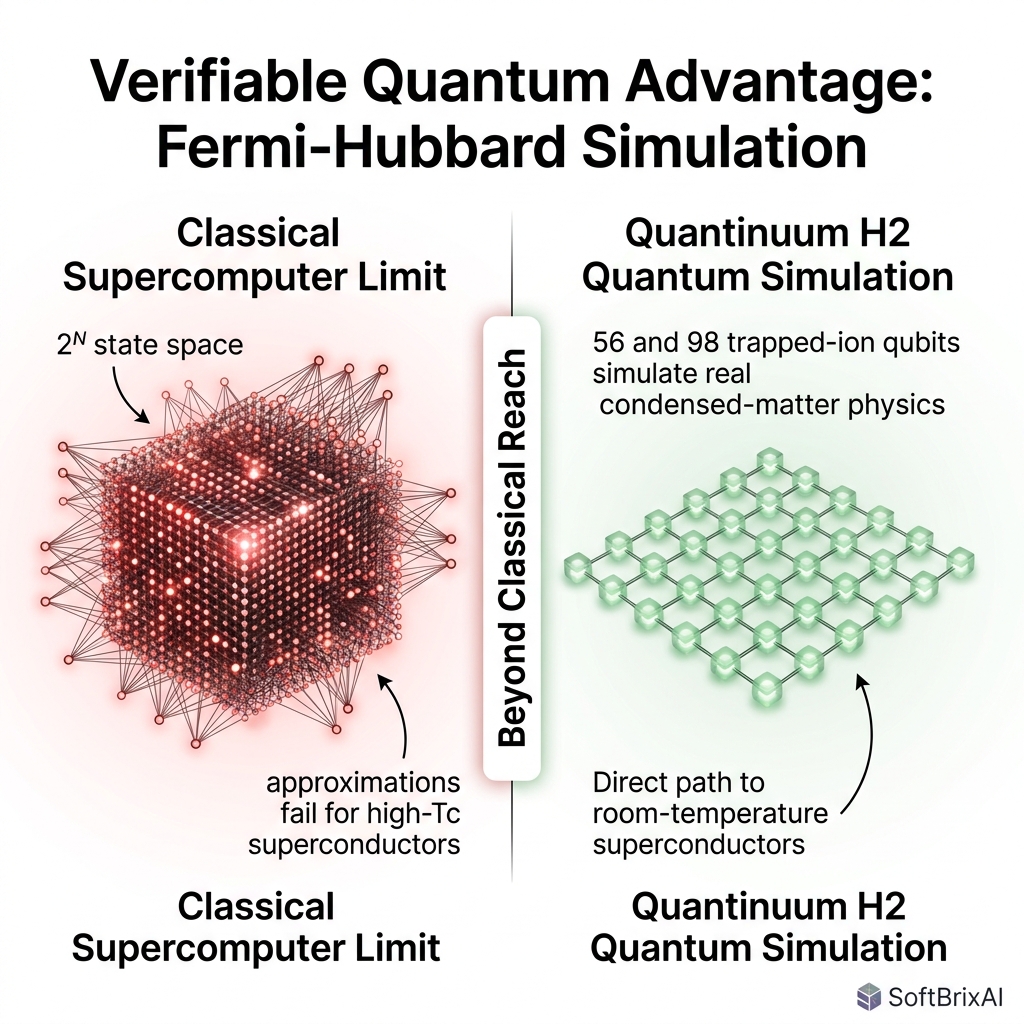
Quantinuum simulated the Fermi-Hubbard model, a foundational physics problem tied to room-temperature superconductors. The company reported the result in November 2025 using its trapped-ion devices. The simulation handled values that classical machines cannot compute in a practical timeframe. Room-temperature superconductors count as one of the largest open questions in condensed-matter physics, so a working simulation carries direct scientific value.
Why This Claim Is More Credible Than Google’s 2019 “Supremacy” Result
This claim holds more credibility than Google’s 2019 supremacy result because it targets a useful, hard-to-replicate problem. Google’s 2019 Sycamore claim solved a task with no application, and later work reproduced parts of it on classical computers. The Fermi-Hubbard simulation resists easy classical replication and points toward real materials science, which makes it a stronger example of verifiable quantum advantage.
Where Quantum Computing Is Already Being Put to Work
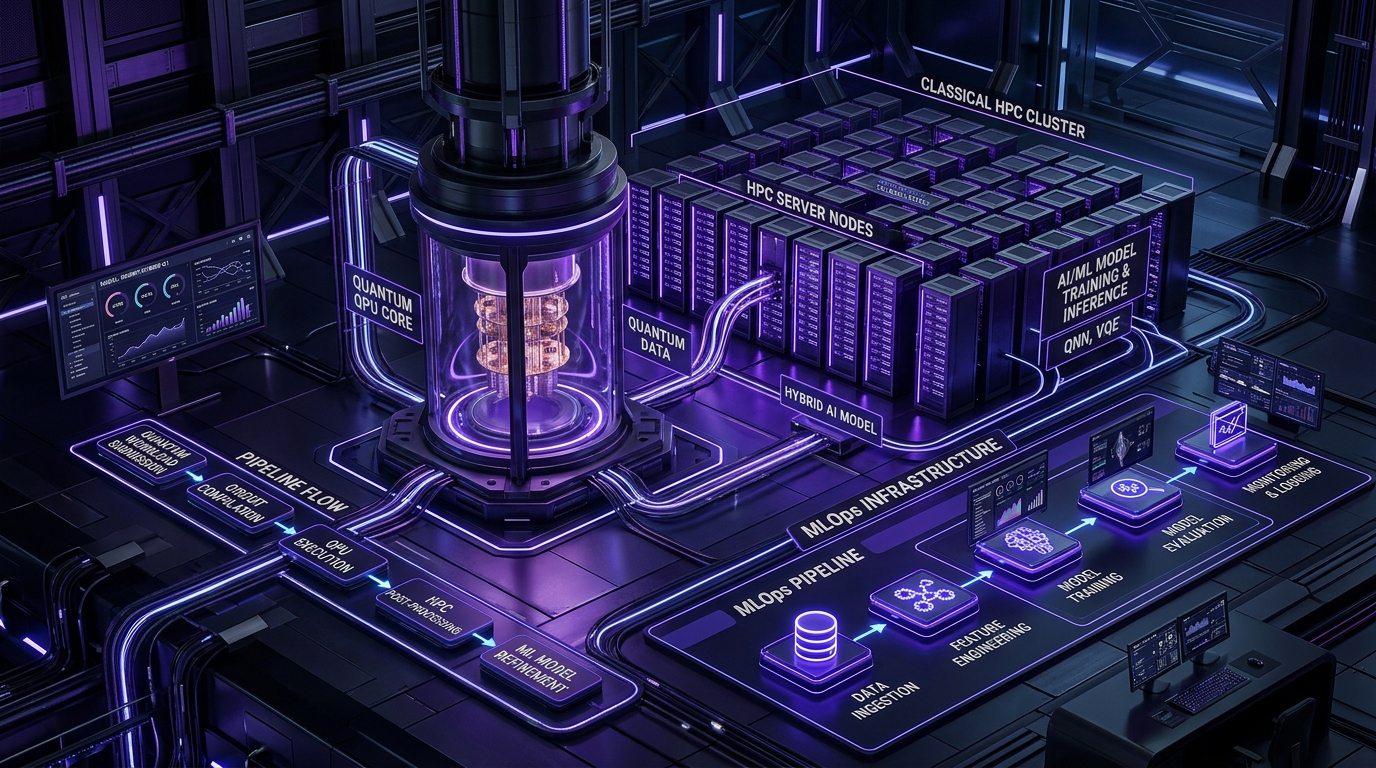
Quantum computing already supports pilot work in drug discovery, materials, energy, and finance, mostly through hybrid quantum-classical systems. Most near-term value pairs a small quantum routine with heavy classical computing and classical AI. Companies that ship production AI, such as SoftbrixAI, focus on the classical side of that pairing through custom build and production engineering, agents, orchestration, and multi-agent systems, and retrieval, grounding, and knowledge bases.
Drug Discovery: Modeling How Molecules Bind Inside Proteins
Quantum tools model how molecules bind inside protein cavities. Pasqal used neutral-atom processors to study how water molecules arrange inside protein pockets, a detail that controls how a drug binds to its target. Microsoft’s Azure Quantum Elements platform combined AI, high-performance computing, and quantum methods to run more than 1 million chemistry calculations for accurate energy estimates. This work leans on strong data pipelines, ingestion, and streaming to move molecular data between classical and quantum steps.
Materials and Energy: Better Batteries, Catalysts and Fusion Plasmas
Quantum simulations target better batteries, catalysts, and fusion plasmas. Research teams test quantum methods to design battery chemistries, improve industrial catalytic reactions with lower emissions, and model plasmas for fusion energy. Riverlane and the Massachusetts Institute of Technology (MIT) ran plasma-related work tied to fusion and other high-temperature systems. More accurate simulations develop new materials and cleaner industrial processes.
Finance and Logistics: Portfolio Risk and Routing as Early Optimization Targets
Finance and logistics teams test quantum optimization on portfolio risk and routing. The early targets include portfolio design, risk analysis, routing, scheduling, and matching. Most studies still run on simulators or modest hardware, so classical forecasting and modeling on business data carries the workload while teams learn where quantum optimization fits.
The Encryption Countdown: “Harvest Now, Decrypt Later” and the Migration Deadlines
The encryption countdown has already started, because attackers can store encrypted data today and decrypt it later with a future quantum computer. The 2026 qubit estimates turned a distant risk into a planning problem for this decade.
Why Data Stolen Today Is Already at Risk
Data stolen today is already at risk under a “harvest now, decrypt later” attack. An attacker copies encrypted traffic now, holds it, and decrypts it once a capable quantum machine exists. Any secret with a long shelf life, such as financial records, health data, or state communications, sits exposed under this model. This is where compliance, risk, policy, and auditability work starts, and our guide to AI contextual governance and business adaptation covers how to adjust oversight as the risk changes.
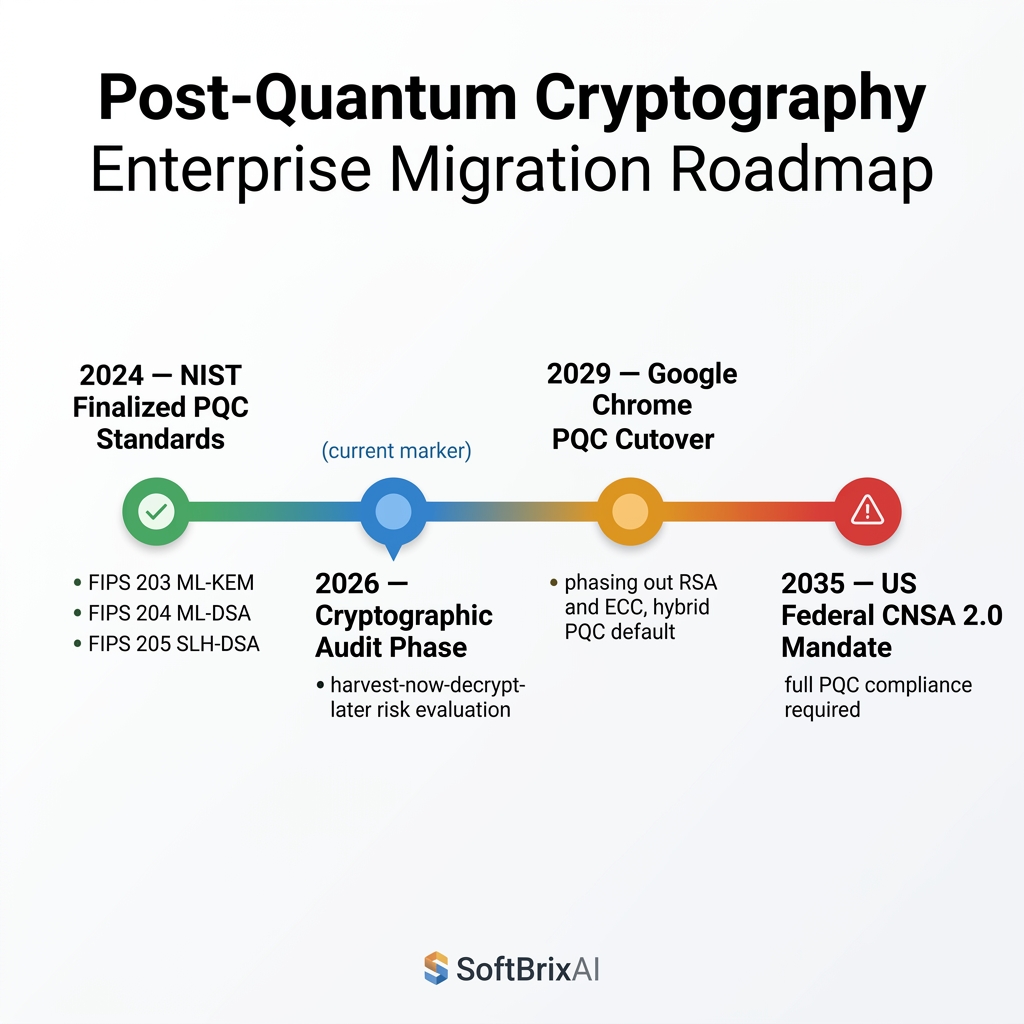
The Post-Quantum Timeline: NIST’s 2024 Standards, Google’s 2029 Cutover, the US 2035 Mandate
The post-quantum timeline runs from 2024 to 2035 across 3 fixed markers. In 2024, the National Institute of Standards and Technology (NIST) published post-quantum cryptography (PQC) standards, including ML-KEM, ML-DSA, and SLH-DSA. Google set a target to stop relying on RSA and ECC by 2029. The United States government set a plan to switch fully to the new codes by 2035. Start a PQC migration now, if your data must stay secret for more than a few years.
What’s Still Genuinely Hard About Building a Quantum Computer
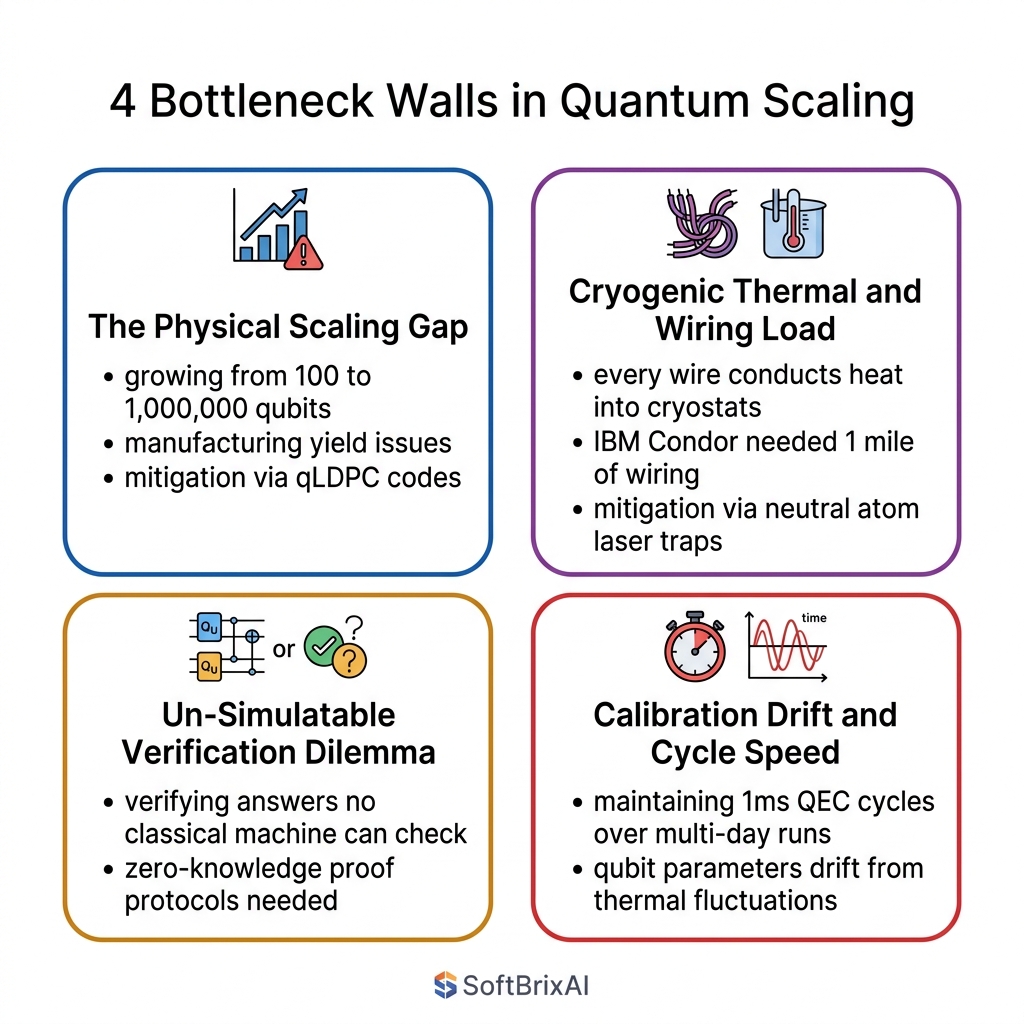
Building a quantum computer stays hard for 4 reasons: scale, noise, verification, and unproven engineering assumptions. The 2024 and 2026 results narrowed the gap, yet none of them delivered a working code-breaking machine.
Scaling From Thousands of Physical Qubits to Millions
Scaling from thousands of physical qubits to millions remains the hardest task. Powerful algorithms still need thousands of logical qubits and, depending on the code, up to hundreds of thousands or millions of physical ones. Current chips like Willow and Helios sit far below that scale, and each logical qubit still consumes many physical qubits.
Keeping Fragile Qubits Stable Against Noise, Heat and Crosstalk
Keeping qubits stable against noise, heat, and crosstalk demands heavy engineering. Superconducting qubits run near absolute zero and lose energy in microseconds. Large systems need 3 things: complex cooling equipment, precise laser or microwave control hardware, and careful layout to reduce crosstalk between qubits.
Verifying Results You Can’t Simulate to Check
Verifying results you cannot simulate creates a trust problem. A large quantum computation can grow too big for any classical machine to check directly. This raises open questions about reliability, and it mirrors the pipelines, deployment, monitoring, and drift controls that classical machine-learning systems already use to catch bad output.
The Skeptics’ Case: Why Some Physicists Doubt Oratomic’s Speed Assumptions
Skeptics doubt Oratomic’s speed assumptions and want a small-scale demonstration first. Jeff Thompson of Princeton University called the group’s operation-speed assumptions aggressive. The design assumes a full error-correction cycle every millisecond, sustained for days or weeks during a computation, which no group has achieved. Mark Saffman of the University of Wisconsin-Madison asked for a demonstration on 100 to 1,000 qubits before trusting the full projection.
What to Realistically Expect After These Breakthroughs
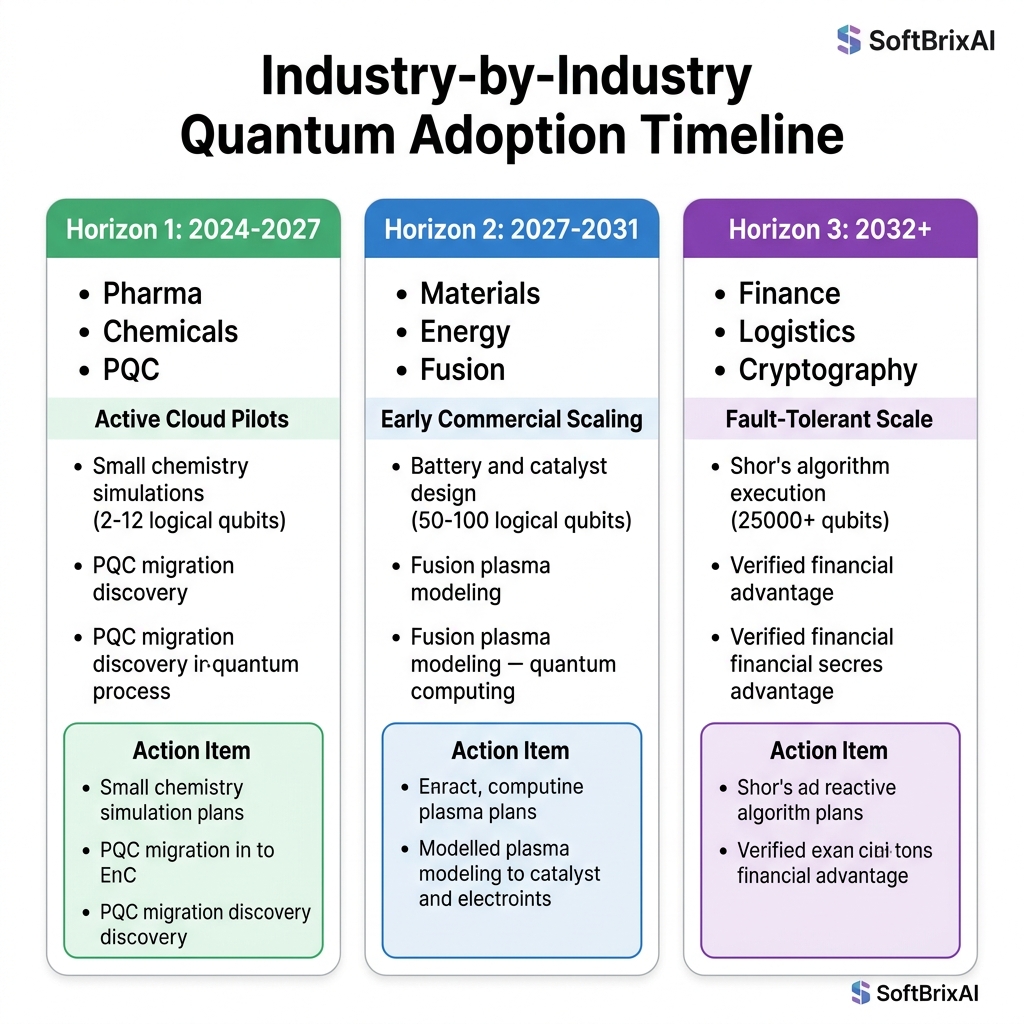
Expect steady, staged progress rather than a single overnight leap. The near term brings more logical qubits with lower error rates and wider hybrid quantum-classical use in chemistry, life sciences, and finance. The mid term, across the late 2020s and 2030s, brings the first fault-tolerant machines that run long programs on tens to hundreds of logical qubits, plus real advantages on industrial problems. Cryptography migration runs across the same window as a fixed deadline, not an option. For most companies the practical near-term move is classical: strategy, build vs buy, and assessment work that decides where quantum fits and where standard AI already delivers.
FAQ: Latest Quantum Computing Breakthroughs
Are quantum computers close to breaking encryption today?
No. No quantum computer today can break RSA or ECC, because current machines hold only hundreds of noisy qubits. The 2026 estimates dropped the requirement to about 25,000 to 30,000 qubits for some targets, so the risk shifted from decades away to years away. Start a post-quantum migration now, if your data must stay secret past 2030.
What is a logical qubit, and how is it different from a physical qubit?
A logical qubit is an error-protected unit built from many physical qubits. A physical qubit is a single hardware unit that loses information in microseconds. A logical qubit uses a quantum error correction code across many physical qubits so the encoded information survives long enough to compute.
What was the single biggest quantum computing breakthrough recently?
The biggest recent breakthrough is the 2026 finding that a quantum computer could break common encryption with tens of thousands of qubits instead of millions. A Caltech and Oratomic design plus a Google efficiency gain together cut the estimated cost of Shor’s algorithm by about 2 orders of magnitude.
Which industries are likely to benefit first?
Chemistry, drug discovery, materials, energy, and finance are likely to benefit first. These fields match the strengths of early quantum hardware, including molecular simulation, materials modeling, and selected optimization tasks. Most current work runs as hybrid quantum-classical pilots.
Is quantum computing real and usable right now?
Yes. Quantum computing is real and usable through cloud platforms from IBM, Google, Amazon, IonQ, and Quantinuum right now. Current systems handle research, education, and pilot projects, but they cannot yet run large general-purpose algorithms for everyday workloads.
How many qubits are needed to break Bitcoin?
Bitcoin could be vulnerable to a quantum computer with about 25,000 to 30,000 qubits, based on combined 2026 estimates from Caltech and Google. A year earlier, the best estimate ran into the millions. No machine at that scale exists today, so the threat stays future-facing but no longer distant.
Sources and References
- Google Quantum AI: Willow chip announcement (December 2024)
- Nature: “Quantum error correction below the surface code threshold” (2024)
- Quanta Magazine: “New Advances Bring the Era of Quantum Computers Closer Than Ever” (April 2026)
- Discover Magazine: “Quantum Computing Is Beginning to Take Shape — Here Are Three Recent Breakthroughs” (April 2026)
- arXiv: Caltech/Oratomic Shor’s algorithm resource estimate (2603.28627)
- arXiv / SciRate: Google ECC resource estimates (2603.28846)
- arXiv: Quantinuum Fermi-Hubbard simulation (2511.02125) and Helios 98-qubit system (2511.05465)
- NIST: Post-quantum cryptography standards (ML-KEM, ML-DSA, SLH-DSA), 2024
- Microsoft: Majorana 1 topological chip (February 2025)