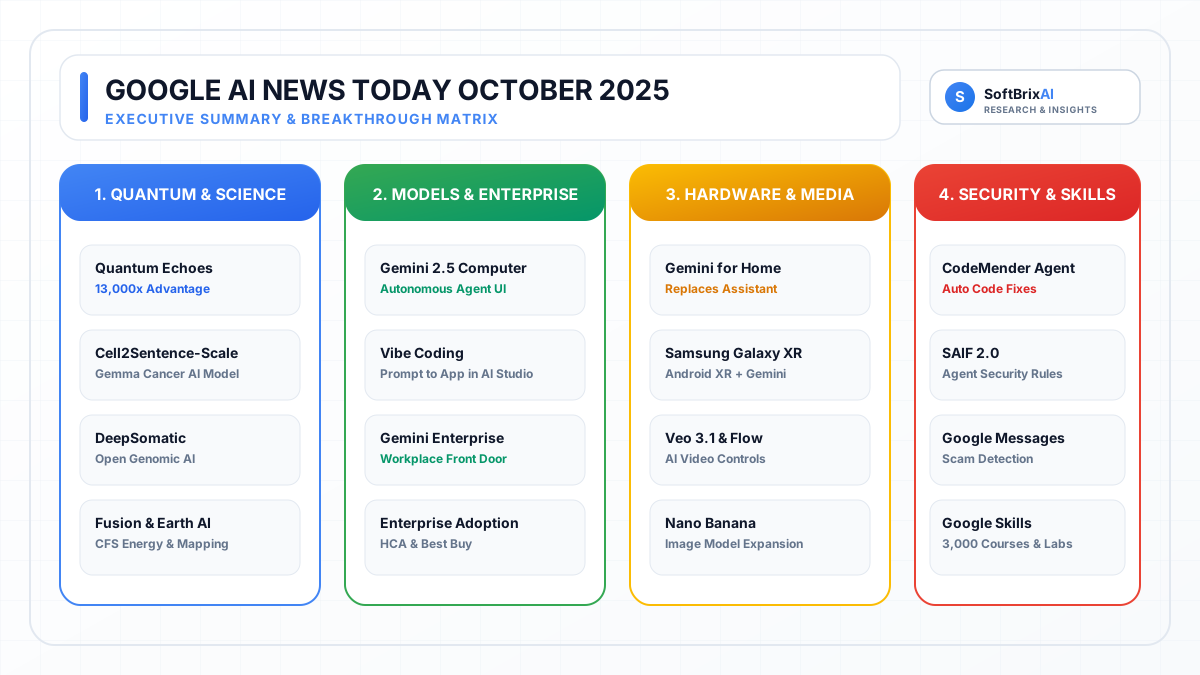
Google AI news today October 2025 covers the artificial intelligence (AI) announcements Google shipped across research, developer tools, enterprise software, Search, smart home, and security during October 2025. This roundup works as a single record of what Google, Google DeepMind, and Google Research launched in one month, sorted by category so you can track each release without opening ten tabs.
The main benefit of following Google AI news for October 2025 is speed of context. You get the biggest Google AI updates, the model names, the numbers, and the real-world use behind each one. The main uses are practical: developers scope new builds around the Gemini API, business leaders judge Gemini Enterprise against earlier tiers, and everyday users learn what changed in Google Home and Google Search.
October 2025 Google AI news breaks into 9 parts: scientific breakthroughs (Quantum Echoes, Cell2Sentence-Scale, DeepSomatic, fusion energy, Google Earth AI), new Gemini models and developer tools (Gemini 2.5 Computer Use, vibe coding), enterprise AI (Gemini Enterprise), Search and AI Mode, smart home and hardware (Gemini for Home, Samsung Galaxy XR), generative media (Veo 3.1, Flow, Nano Banana), security for Cybersecurity Awareness Month, skills and education (Google Skills), and an industry comparison against OpenAI, Oracle, Microsoft, and Anthropic. SoftBrixAI tracks these shifts because they change how teams build and ship production AI.
Table of Contents (Click to expand)
Key Takeaways: What Defined Google’s AI Landscape in October 2025
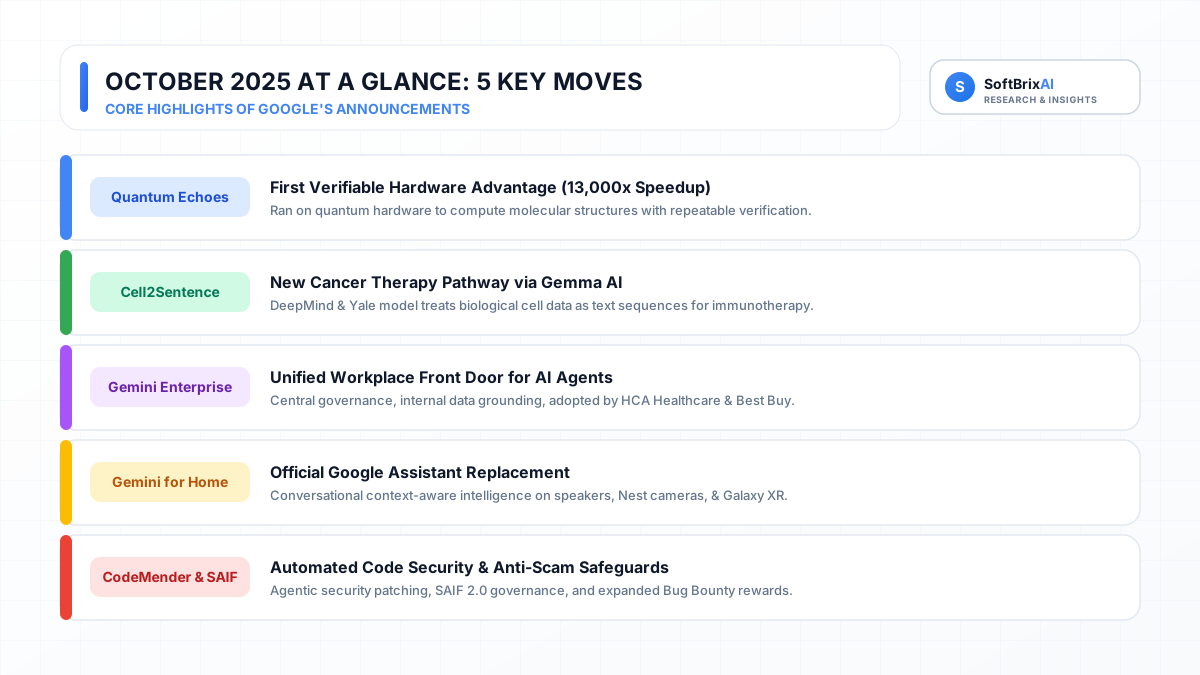
Google’s AI landscape in October 2025 was defined by 5 moves: a verifiable quantum computing breakthrough, a Gemma-based cancer research model, the launch of Gemini Enterprise, a redesigned Google Home built on Gemini, and new anti-scam security features for Cybersecurity Awareness Month.
- Google’s Quantum AI team ran Quantum Echoes, the first verifiable quantum algorithm on hardware, at 13,000x faster than the fastest classical supercomputers.
- Google DeepMind, Google Research, and Yale built Cell2Sentence-Scale, an AI model on the Gemma family that points to a new cancer therapy pathway.
- Gemini Enterprise launched as the “front door” for Google AI in the workplace, with HCA Healthcare and Best Buy as early adopters.
- Gemini for Home replaced Google Assistant on speakers and displays with a conversational, context-aware AI.
- Google shipped new Google Messages protections, the CodeMender code-security agent, an expanded AI Vulnerability Reward Program, and Secure AI Framework 2.0.
October 2025 at a Glance: The Biggest Google AI Updates This Month
The biggest Google AI updates this month spanned 6 categories: research, developer models, enterprise, Search, hardware, and security. October 2025 pushed Google AI from lab research into products people use daily, and it moved advanced AI into global challenges like cancer therapy and clean fusion energy.
Google released the Gemini 2.5 Computer Use model for developers, a specialized model that lets AI agents act inside user interfaces. Google added vibe coding to Google AI Studio, so a plain-language app idea turns into wired-up models and APIs. Google launched Gemini Enterprise for workplace AI. Google introduced Gemini for Home and new Nest devices. Google shipped Veo 3.1 inside the Flow filmmaking tool. Google announced Google Skills, a learning platform with nearly 3,000 courses and labs.
For teams tracking this alongside prior months, the earlier Latest AI News September 2025 roundup covers Sora 2, Gemini in Chrome, and the releases that set up October.
Core Infrastructure and Scientific AI Breakthroughs
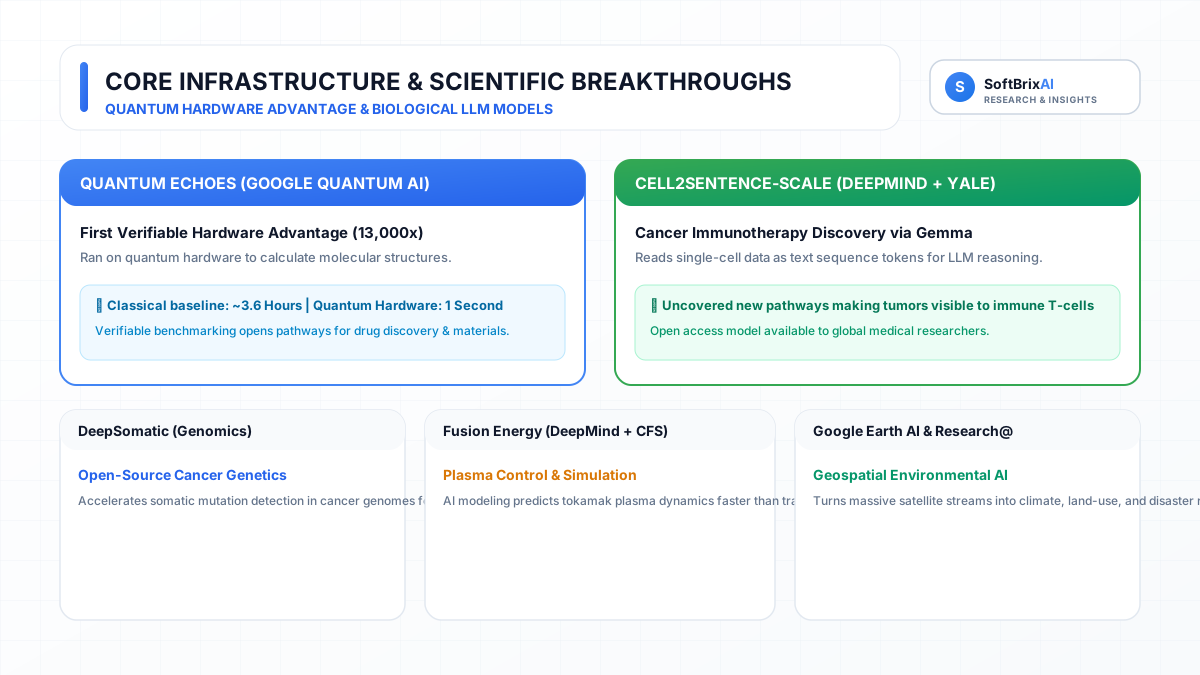
Google’s scientific AI breakthroughs in October 2025 covered 5 areas: quantum computing, cancer immunotherapy, open-source genomics, fusion energy, and geospatial analysis. Each result came from Google DeepMind, Google Research, or the Quantum AI team applying advanced AI to problems in medicine, energy, and materials science.
Quantum Echoes: Google Quantum AI Achieves the First Verifiable Hardware Advantage (13,000x Faster)
Quantum Echoes is the first-ever algorithm to achieve verifiable quantum advantage on hardware, running 13,000x faster than the fastest classical supercomputers. Google’s Quantum AI team ran the algorithm on quantum hardware and computed the structure of a molecule. For broader context on quantum computing evolution, explore our detailed analysis of quantum computing breakthroughs.
The word “verifiable” carries the weight here. A verifiable result can be repeated and confirmed, which turns a one-off benchmark into a reliable measurement. Quantum Echoes paved a path toward real-world applications, including quantum computers that drive discoveries in medicine and materials science. For context on scale, 13,000x faster means a task that runs in 1 second on the quantum hardware would take roughly 3.6 hours on the classical baseline.
Cell2Sentence-Scale: How Google DeepMind, Yale and Gemma Uncovered a New Cancer Therapy Pathway
Cell2Sentence-Scale is an AI model built on the Gemma family of open models that points to a new potential cancer therapy pathway. Google DeepMind and Google Research teamed up with Yale to create the model, which helps make tumors easier for the human immune system to spot and fight.
Researchers can access Cell2Sentence-Scale to build on the work. The model reads cell data as text-like sequences, which lets a language-model architecture reason over biology. Grounding a model in domain data this way mirrors how production teams use retrieval and knowledge bases to keep AI answers tied to real evidence rather than guesses.
DeepSomatic: Google’s Open-Source AI Model Accelerating Genetic Analysis for Cancer Research
DeepSomatic is an open-source AI model from Google that speeds up genetic analysis for cancer research. Google showcased DeepSomatic at the Research@ event as part of its cancer research work.
Open-source access matters for 2 reasons: outside labs can inspect the model, and they can extend it for their own genomic datasets. DeepSomatic sits next to Cell2Sentence-Scale as a second cancer-focused release in the same month, which signals a concentrated push on oncology from Google Research.
Fusion Energy Acceleration: DeepMind’s AI Collaboration With Commonwealth Fusion Systems
Google DeepMind’s collaboration with Commonwealth Fusion Systems (CFS) applies advanced AI to bring clean, safe, limitless fusion energy closer to reality. The work targets the next generation of fusion energy, where AI helps model and control the conditions needed for a stable reaction.
Fusion energy releases power by fusing atomic nuclei, and controlling the plasma is one of the hardest parts. AI models can predict plasma behavior faster than traditional simulation, which shortens the research loop for CFS.
Google Earth AI Upgrades: Expanded Geospatial Mapping and Environmental Analysis
Google Earth AI received new updates for geospatial mapping and environmental analysis, shared at the Research@ event. The upgrades expand how Google Earth AI reads and models the physical world, from terrain to environmental change.
Geospatial models turn satellite and map data into structured signals for climate, land use, and crisis response. Building that kind of system depends on strong data pipelines and streaming ingestion to move large volumes of imagery into a model reliably.
Research@ 2025: Inside Google’s “Magic Cycle” of Innovation Showcase
Research@ 2025 is the Google event where the company showed its “magic cycle” of innovation, quantum hardware progress, Google Earth AI updates, and the DeepSomatic model. The event tied research to reality by connecting lab breakthroughs to shipping products.
The “magic cycle” describes how research feeds products and products feed more research. Research@ 2025 grouped 4 threads in one place: quantum computing hardware, geospatial AI, open-source genomics, and the path from science to consumer tools.
New Gemini Models and Developer Tools Released in October 2025
Google released 2 headline developer updates in October 2025: the Gemini 2.5 Computer Use model and vibe coding in Google AI Studio. Both lower the effort needed to build agents and AI apps on the Gemini API.
Gemini 2.5 Computer Use Model: AI Agents That Navigate Websites and Fill Out Forms
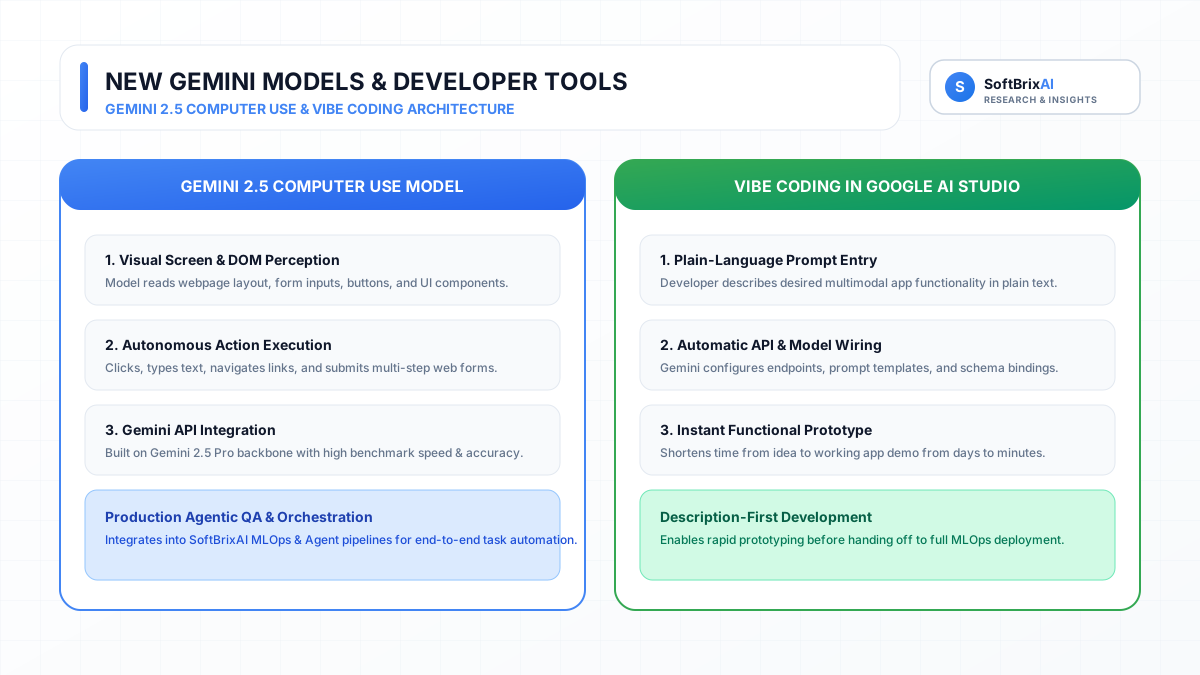
The Gemini 2.5 Computer Use model is a specialized model that lets AI agents interact directly with user interfaces, including navigating websites and filling out forms. The model is available via the Gemini API and is built on Gemini 2.5 Pro.
Gemini 2.5 Computer Use offers faster performance and outperforms alternatives on benchmarks. The model reads a screen, decides an action, and executes it, which is the core loop an agent needs to complete multi-step tasks. Teams building this kind of system rely on agent orchestration and multi-agent design to keep actions controlled and auditable.
Vibe Coding in Google AI Studio: Building Multimodal AI Apps From a Simple Prompt
Vibe coding in Google AI Studio lets you describe a multimodal app idea in plain language, and Gemini wires up the necessary models and APIs automatically. The feature lowers the barrier to building AI-powered applications.
To build an app with vibe coding, describe what you want, and Gemini handles the model and API setup. Google shared a primer on vibe coding to help people get started. The result moves app creation from manual integration to description-first development, which shortens the distance between idea and working prototype.
New Ways to Access Gemini APIs and Build AI Agents for Developers
Developers gained new ways to access Gemini APIs and build AI agents in October 2025 through the Gemini 2.5 Computer Use model and Google AI Studio. Both connect to the Gemini API, which is the shared entry point for Gemini models.
The pattern across both releases is agent-first. A developer can call Gemini 2.5 Pro capabilities for interface control, or prototype in Google AI Studio, then deploy. Moving a prototype to production needs pipelines, deployment, monitoring, and drift control, which is where MLOps turns a demo into a reliable service.
Enterprise and Workplace AI Advancements
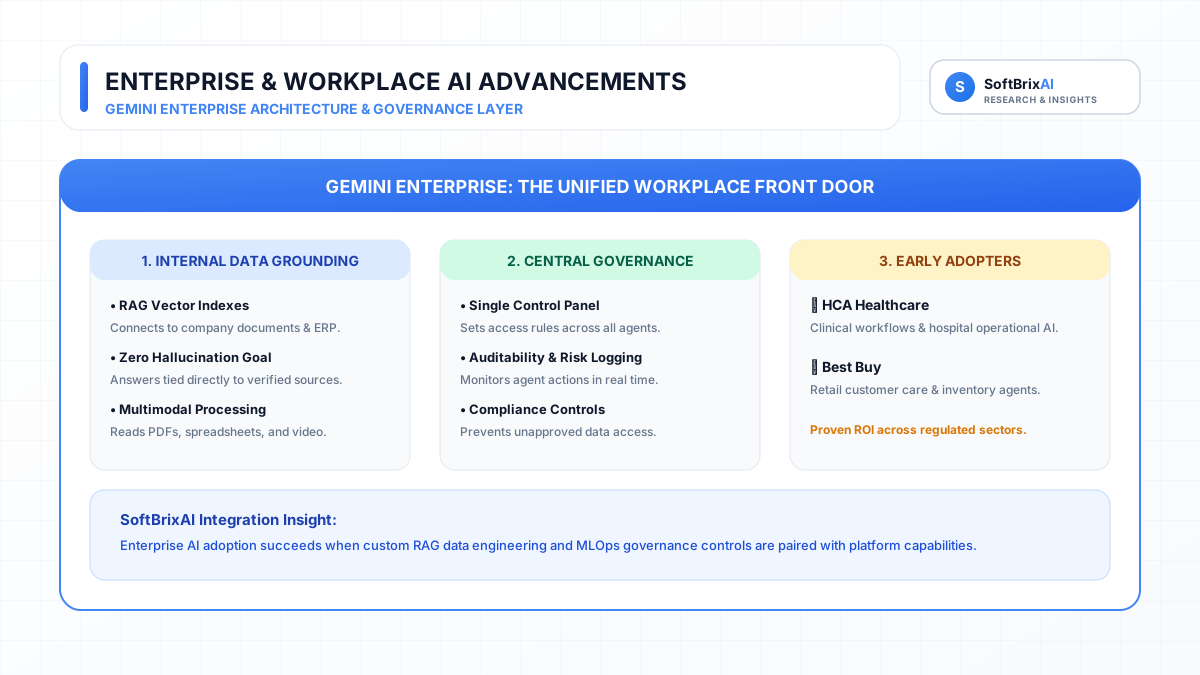
Google’s enterprise AI advancement in October 2025 was Gemini Enterprise, a single platform for building, deploying, and governing AI agents at work. CEO Sundar Pichai introduced it as the “front door” for Google AI in the workplace.
Gemini Enterprise: Google’s New Unified “Front Door” for AI in the Workplace
Gemini Enterprise is the new “front door” for Google AI in the workplace, introduced by Sundar Pichai. The platform moves beyond simple chatbots by using the most advanced Gemini models and grounding them in a company’s data.
Grounding means the model answers from a company’s own documents and systems, not just general knowledge, which raises accuracy for internal work. This grounding approach depends on retrieval and knowledge-base design to connect models to trusted sources.
How Companies Can Build, Deploy and Centrally Govern AI Agents
Companies can build, deploy, and centrally govern AI agents on Gemini Enterprise from one secure platform. Central governance lets an organization set rules for every agent in one place rather than per team.
To govern agents at scale, define access, monitor actions, and audit outputs across the platform. Central control reduces 3 risks: unapproved data access, inconsistent behavior, and untracked changes. AI governance consulting for compliance, risk, and auditability covers the same controls enterprises now expect before approving an agent rollout.
Early Adopter Results From HCA Healthcare, Best Buy and Other Businesses
HCA Healthcare and Best Buy are early adopters of Gemini Enterprise already reporting positive results. Both companies represent different sectors: HCA Healthcare in healthcare delivery and Best Buy in retail.
Early adopter results give buyers proof from live deployments rather than demos. Two named enterprises across 2 industries show that Gemini Enterprise fits both regulated healthcare workflows and high-volume retail operations.
Google Search, AI Mode and Discovery Evolution
Google Search evolved in October 2025 through AI Mode enhancements and deeper Gemini integration. AI Mode is the conversational search experience Google debuted earlier in 2025 and kept expanding.
AI Mode Enhancements: Text-Selection Follow-Ups, Categorized Map Pins and Global Rollout
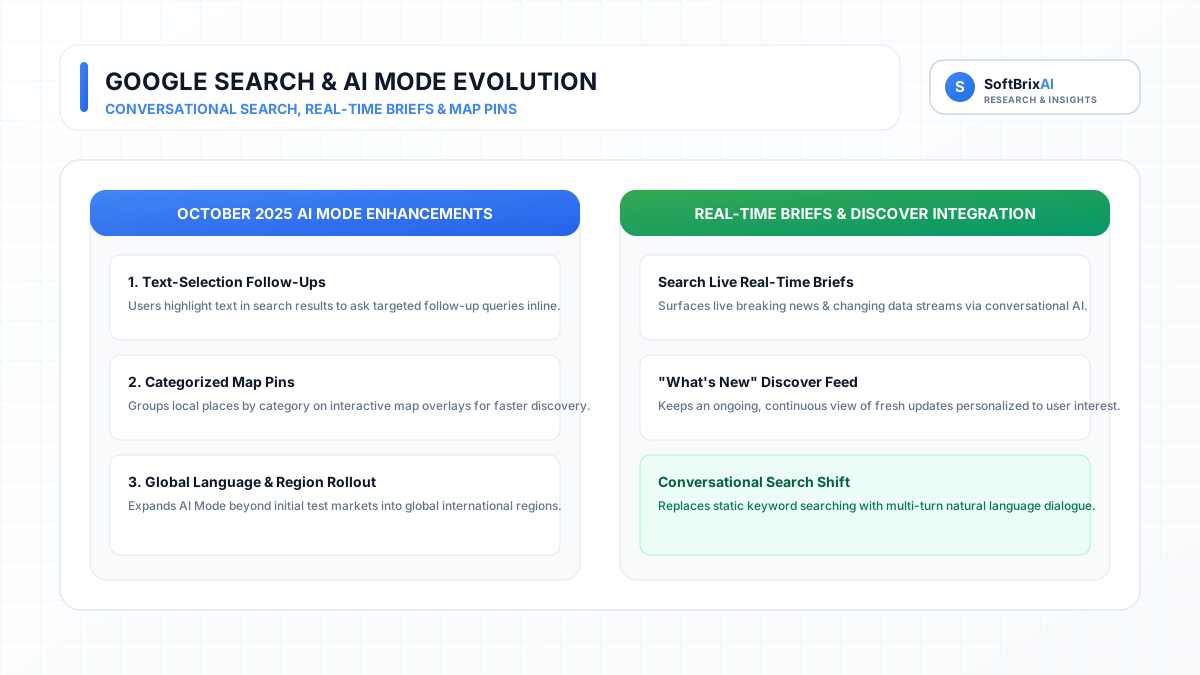
AI Mode gained enhancements in October 2025, including text-selection follow-ups, categorized map pins, and a wider global rollout. Text-selection follow-ups let you highlight part of a result and ask a follow-up question about it.
Categorized map pins group places by type, which makes local results easier to scan. The global rollout widens access beyond the launch regions, so more users reach AI Mode in Search. Each change shortens the path from question to answer inside the same interface.
Search Live and Discover Updates: Real-Time AI Briefs and “What’s New” Feeds
Search Live and Discover received updates for real-time AI briefs and “what’s new” feeds. Search Live lets you talk, listen, and explore in real time with AI Mode, and it reached its official launch earlier in 2025.
Real-time briefs surface current information as it changes, and “what’s new” feeds keep a running view of fresh updates. Both features move Search from static answers toward a live, ongoing stream.
How Gemini Integrations Made Google Search More Conversational
Gemini integrations made Google Search more conversational by bringing Gemini models into the query-and-answer flow. Conversational search lets a user ask follow-up questions in natural language and get grounded answers.
The shift changes search behavior. A user moves from typing keywords to holding a short conversation, and Search keeps context across turns. This is the same direction Gemini Live took inside Chrome, where voice, camera, and screen input feed the assistant.
Smart Home and Next-Generation AI Hardware
Google’s smart home and hardware news in October 2025 centered on Gemini for Home, a redesigned Google Home app, new Nest devices, and the Samsung Galaxy XR headset. Each product runs on Gemini’s AI capabilities.
Gemini for Home: How Google Officially Replaced Google Assistant on Speakers and Displays
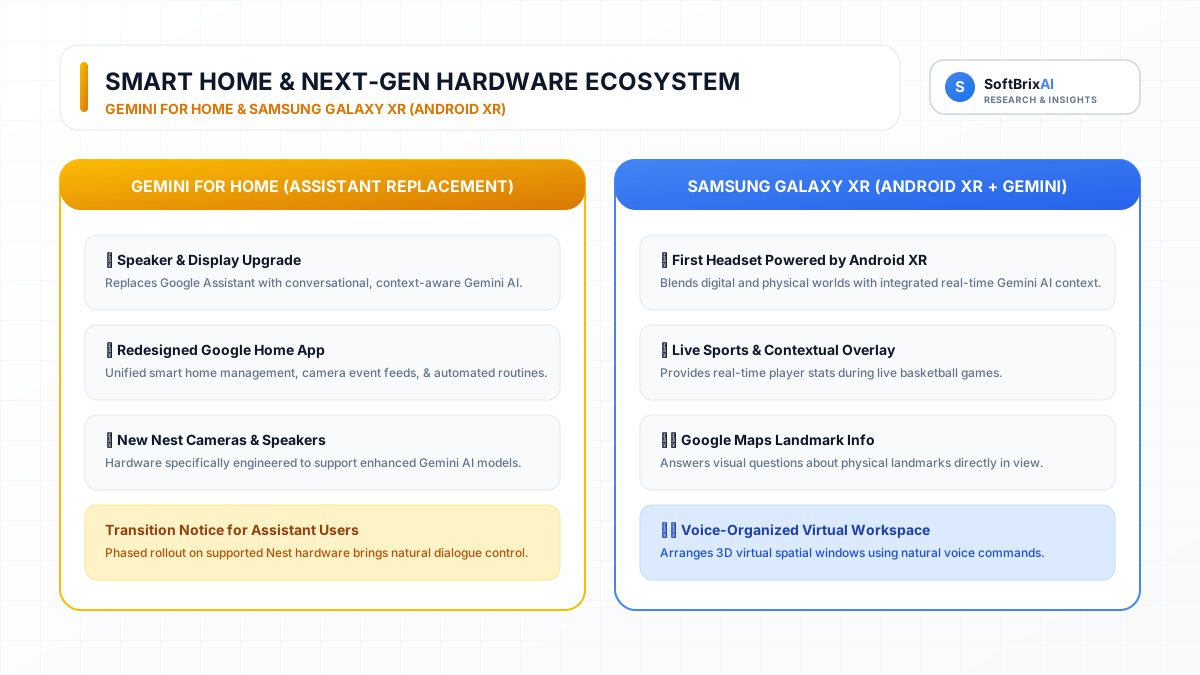
Gemini for Home officially replaced Google Assistant on speakers and displays with a more conversational, context-aware AI. Gemini for Home changes how you interact with smart home devices by understanding natural requests and context.
Context-aware means the AI uses details like your device, room, and recent activity to answer better. The replacement upgrades the voice layer of the home from command-based Assistant responses to conversation-based Gemini responses.
The Redesigned Google Home App and New Nest Cameras and Home Speaker
The redesigned Google Home app gives unified management for smart home devices, and new Nest cameras and a Google Home speaker are engineered for Gemini’s enhanced AI capabilities. Unified management puts device control, camera events, and automation in one place.
New Nest and Google Home devices are built specifically for Gemini, which means the hardware is tuned for the new AI features rather than retrofitted. The pairing of a new app and new devices creates one system where software and hardware match.
Samsung Galaxy XR: The First Headset Powered by Android XR and Gemini
The Samsung Galaxy XR headset is the first headset powered by Android XR, and it uses integrated Gemini AI to blend the digital and physical worlds. The AI understands your context to enable real-time help and actions.
Galaxy XR handles 3 example tasks: providing player stats during a basketball game, answering questions about landmarks in Google Maps, and organizing a virtual workspace by voice. Android XR is the platform layer, Gemini is the intelligence layer, and Samsung builds the hardware.
What Existing Google Assistant Users Need to Know About the Transition
Existing Google Assistant users need to know that Gemini for Home replaces Assistant on speakers and displays with a conversational, context-aware AI. The transition changes the voice experience on supported devices.
To prepare for the transition, expect Gemini to handle device control, camera events, and automation in place of Assistant. The switch rolls out on supported Nest and Google Home hardware, so the timing depends on your device and region.
Generative Media and Creative AI Tools Announced in October 2025
Google’s generative media news in October 2025 covered Veo 3.1 in the Flow filmmaking tool and Nano Banana reaching more Google products. Both give creators more control over AI output.
Veo 3.1 and Flow Updates: Greater Creative Control for AI Filmmaking and Video Generation
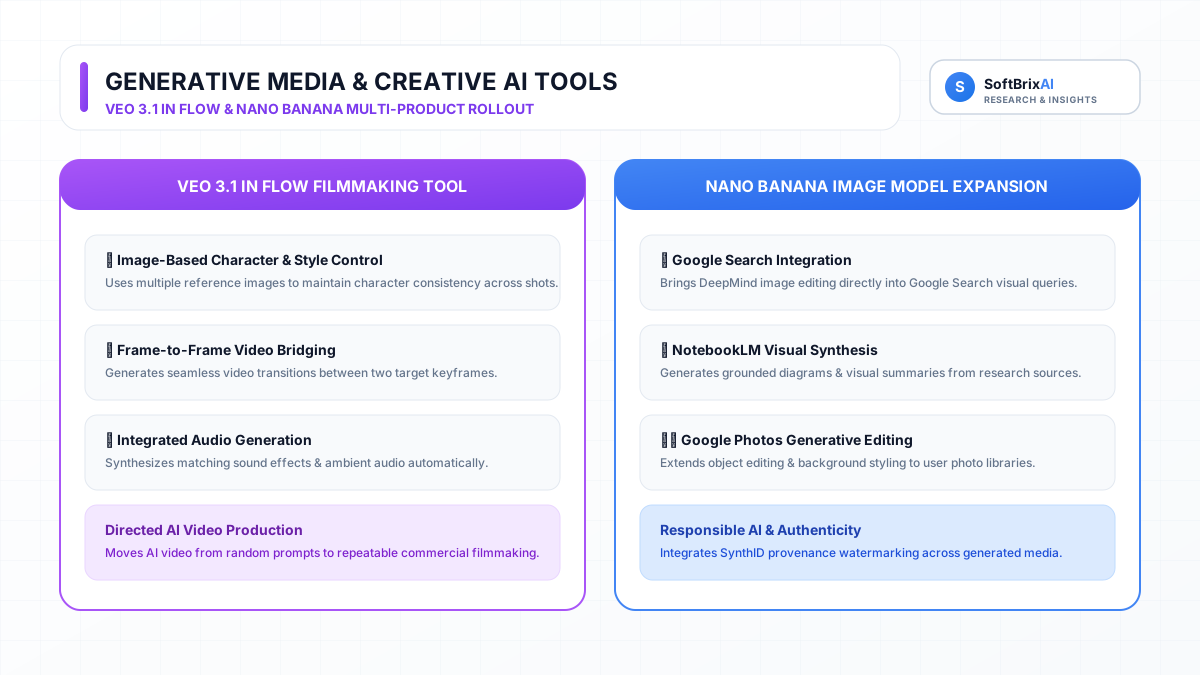
Veo 3.1 brings greater creative control to the Flow filmmaking tool, including using multiple images to control characters and style, bridging two frames into a seamless video, and generating integrated audio across all features. Flow is Google’s AI filmmaking tool, first shown at Google I/O.
Veo 3.1 gives creators 3 new controls: image-based character and style control, frame-to-frame video bridging, and rich integrated audio. Each control moves AI video from a single prompt toward a directed, repeatable production.
Nano Banana and Other Generative AI Tool Improvements
Nano Banana is coming to Google Search, NotebookLM, and Google Photos, extending the image editing model across more products. Nano Banana is the image editing model from Google DeepMind that Google unveiled earlier in 2025.
Spreading one model across 3 products means a single editing capability shows up wherever users already work. The move turns Nano Banana from a standalone tool into a shared feature inside Search, NotebookLM, and Photos.
Responsible AI and Content Authenticity Considerations
Responsible AI and content authenticity matter for generative media because realistic AI video and images raise questions around deepfakes, copyright, and provenance. Google ships generative tools alongside its security and safety work.
Content authenticity depends on tracking how media was made and whether it was AI-generated. As Veo 3.1 and Nano Banana raise realism, provenance signals become the check that keeps trust in what people see.
AI Cybersecurity and User Protection Updates for Cybersecurity Awareness Month
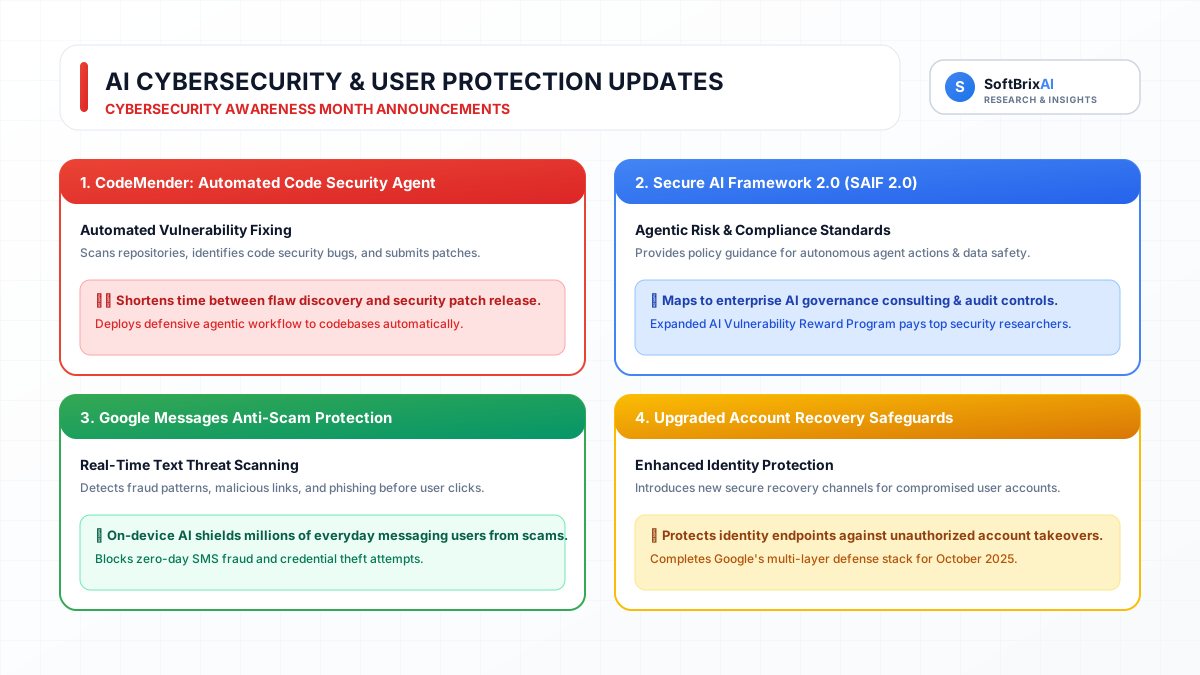
Google shipped 4 security updates for Cybersecurity Awareness Month in October 2025: Google Messages protections, the CodeMender code-security agent, an expanded AI Vulnerability Reward Program, and Secure AI Framework 2.0. Cybersecurity Awareness Month runs each October.
Upgraded Scam and Threat Protection in Google Messages
Google Messages received upgraded scam and threat protection to shield users from digital threats. The protections target scams that arrive through messaging, one of the most common fraud channels.
Message-level protection scans for scam patterns before a user acts on a link or request. The upgrade fits the wider anti-scam push Google ran for Cybersecurity Awareness Month.
CodeMender: Google’s New AI Agent for Automated Code Security
CodeMender is Google’s new AI agent for code security. The agent focuses on finding and fixing security issues in code automatically.
An AI agent for code security reads a codebase, spots vulnerabilities, and proposes fixes, which shortens the time between discovery and patch. CodeMender extends agent technology into defensive security, a use case that rewards speed.
Secure AI Framework 2.0 and the Expanded AI Vulnerability Reward Program
Secure AI Framework 2.0 (SAIF 2.0) gives guidance on agent security risks, and the expanded AI Vulnerability Reward Program pays researchers who report AI vulnerabilities. Both target the security of AI systems themselves.
SAIF 2.0 addresses the new risks that come when agents act on their own, such as unsafe actions or data exposure. The framework maps to the compliance, risk, and policy controls enterprises need for auditable agent deployments, a theme covered in this guide to AI contextual governance and business adaptation.
New Account Recovery Methods and Anti-Scam Safeguards
Google introduced new account recovery methods and anti-scam safeguards for Cybersecurity Awareness Month. New recovery methods give users more ways to regain access to a locked or compromised account.
Account recovery and anti-scam safeguards protect the 2 ends of an attack: the account itself and the scam attempt that targets it. Together they round out Google’s October security push across messaging, code, frameworks, and accounts.
AI Skills and Education Initiatives
Google’s education initiative in October 2025 was Google Skills, a learning platform for building expertise in AI and other technical areas. The platform opens Google’s training to a wide audience.
Google Skills: A New Learning Platform With Nearly 3,000 AI Courses and Labs
Google Skills is a new learning platform with nearly 3,000 courses and labs for building expertise in AI and technical areas. Learners study with Google experts, gain hands-on experience, and earn credentials.
Google Skills offers 3 things in one place: expert-led courses, hands-on labs, and credentials. Nearly 3,000 courses and labs give both beginners and working professionals a path to develop AI skills with practice, not just theory.
Strategic Comparison: Google AI vs. Industry Moves in October 2025
Google’s October 2025 AI moves competed against major releases from OpenAI, AMD, Oracle, Microsoft, and Anthropic. The month showed a clear split: Google led on scientific research and consumer products, while rivals led on compute deals and infrastructure. For analysis of emerging AI market leaders, see our tracker on the hottest AI startups.
Custom TPU Infrastructure vs. OpenAI and AMD Hardware Partnerships
Google runs its own custom Tensor Processing Unit (TPU) infrastructure, while OpenAI secured hardware through partnerships in October 2025. OpenAI announced a multi-billion-dollar partnership with AMD for up to 6 gigawatts (GW) of AI infrastructure and an option to acquire a 10% stake in AMD.
The contrast is ownership versus partnership. Google designs and runs TPUs in-house, which gives control over its AI stack from silicon to software. OpenAI’s infrastructure agreements surpassed 1 trillion US dollars, covering power generation, data-centre capacity, and semiconductor supply, which makes compute readiness a competitive metric. Oracle added scale from another angle with OCI Zettascale10, a cloud supercomputer claiming up to 16 zettaFLOPS across 800,000 NVIDIA GPUs on Oracle Cloud Infrastructure (OCI) with ultra-low-latency RoCE and InfiniBand networking.
Agentic Browser Race: Gemini in Chrome vs. ChatGPT Atlas
Gemini Live in Chrome and ChatGPT Atlas represent the agentic browser race in October 2025. Gemini Live is integrated into Google Chrome for voice, camera, and screen-view input, using webpage context to answer without opening new tabs.
ChatGPT Atlas is OpenAI’s AI-native browser that moves users from keyword search to conversational navigation, with an “Agent Mode” that performs actions and automates workflows. Both browsers push the same idea: the browser becomes an active AI assistant. Google’s edge is Chrome’s existing user base; OpenAI’s edge is a browser built around ChatGPT from the start.
How Google’s October Announcements Stack Up Against OpenAI, Microsoft and Anthropic
Google’s October announcements stacked up strongly on research and products, while OpenAI led on compute, Microsoft on workplace agents, and Anthropic on enterprise adoption. Each company played a different strength.
- Google shipped a verifiable quantum result, 2 cancer research models, Gemini Enterprise, and new consumer hardware.
- OpenAI focused on compute deals, Sora 2 video generation, and the ChatGPT Atlas browser.
- Microsoft advanced workplace automation with Copilot Cowork for executing tasks autonomously.
- Anthropic grew enterprise adoption of Claude while holding its safety approach on contested use cases.
Real-World Impact of Google’s October 2025 AI Announcements
Google’s October 2025 AI announcements affected 3 groups: everyday users, businesses, and developers. Each group gained a different benefit from the same set of releases.
What These Updates Mean for Everyday Users
Everyday users gained a smarter home, more conversational Search, and stronger scam protection from October’s updates. Gemini for Home upgrades voice control, AI Mode makes Search conversational, and Google Messages protections block more scams.
The daily impact is concrete. A user talks to Gemini for Home instead of issuing fixed commands, asks Search follow-up questions in plain language, and gets warned about scam messages before acting on them.
Benefits for Businesses and Enterprises
Businesses and enterprises gained Gemini Enterprise for grounded, governed AI agents built on their own data. The platform gives central governance, security, and proof from early adopters like HCA Healthcare and Best Buy.
Enterprises apply these tools to real workflows, from support to operations. Turning company data into decisions also depends on forecasting and modeling on business data, and on custom builds with production engineering when an off-the-shelf tool does not fit.
Opportunities for Developers and Content Creators
Developers and content creators gained new build tools and creative controls in October 2025. Developers use the Gemini 2.5 Computer Use model and vibe coding in Google AI Studio, while creators use Veo 3.1 in Flow and Nano Banana across Google products.
Developers get an agent model and a description-first app builder on the Gemini API. Content creators get image-based control, frame bridging, and integrated audio for AI video. Both groups move faster from idea to shipped output.
Future Outlook: Where Google AI Is Headed After October 2025
Google AI heads toward broader agent deployment, deeper Gemini integration, and larger models after October 2025. The October releases set the base for the next wave of Gemini updates.
Features Likely to Expand in the Coming Months
Features likely to expand in the coming months include Gemini for Home, AI Mode in Search, and Gemini Enterprise agents. Each launched with a clear rollout path that widens over time.
Gemini for Home expands from early access to more devices and regions. AI Mode expands its global rollout. Gemini Enterprise expands as more companies deploy and govern agents on the platform.
Upcoming Google AI Trends to Watch Heading Into 2026
The Google AI trends to watch heading into 2026 are agentic AI, on-device intelligence, and larger Gemini models. Agentic AI moves from single tasks toward multi-step autonomous work.
Google closed 2025 with Gemini 3 and Gemini 3 Flash, which signals faster and more capable models ahead. Planning for that shift is where AI strategy and build-versus-buy assessment helps teams decide what to adopt and what to build.
How October’s Updates Set the Stage for Google’s Next Releases
October’s updates set the stage for Google’s next releases by proving research, agents, and consumer AI in one month. The Quantum Echoes result, the Gemini 2.5 Computer Use model, and Gemini Enterprise each seeded a larger program.
Research feeds products through the “magic cycle,” agents move from developer preview toward enterprise scale, and consumer hardware ties Gemini to daily life. Each October release is a step in a longer roadmap, not a standalone launch.
Frequently Asked Questions (FAQs) – Google AI News October 2025
What Was Google’s Biggest AI Milestone in October 2025?
Google’s biggest AI milestone in October 2025 was Quantum Echoes, the first-ever algorithm to achieve verifiable quantum advantage on hardware at 13,000x faster than the fastest classical supercomputers. Google’s Quantum AI team ran the algorithm on quantum hardware and computed the structure of a molecule, paving a path toward real-world applications in medicine and materials science.
Did Google Release a New Gemini Model in October 2025?
Yes, Google released the Gemini 2.5 Computer Use model in October 2025. The model is built on Gemini 2.5 Pro, is available via the Gemini API, and lets AI agents interact with user interfaces by navigating websites and filling out forms with faster performance than alternatives.
Is Gemini Replacing Google Assistant on All Devices?
Gemini is replacing Google Assistant on speakers and displays through Gemini for Home, which brings a conversational, context-aware AI. The rollout reaches supported Nest and Google Home devices, so the exact timing depends on your device and region.
How Does Gemini Enterprise Differ From Earlier Gemini Business Tiers?
Gemini Enterprise differs from earlier Gemini business tiers by acting as a unified “front door” that grounds the most advanced Gemini models in a company’s own data and lets employees build, deploy, and centrally govern AI agents. Earlier tiers focused on chatbot access, while Gemini Enterprise adds central governance, security, and agent management on one platform.
What Is the Gemini 2.5 Computer Use Model and What Can It Do?
The Gemini 2.5 Computer Use model is a specialized model that lets AI agents interact directly with user interfaces. The model navigates websites, fills out forms, and handles complex multi-step tasks, and it runs on the Gemini API built on Gemini 2.5 Pro.
How Does Quantum Echoes Advance Real-World Computing Applications?
Quantum Echoes advances real-world computing applications by proving a verifiable quantum advantage on hardware, which means the result can be repeated and confirmed. The algorithm computed a molecule’s structure, pointing to quantum computers that drive discoveries in medicine and materials science.
Is the Cell2Sentence-Scale Cancer Research Model Accessible to External Developers?
Yes, the Cell2Sentence-Scale cancer research model is accessible to external researchers. Google DeepMind, Google Research, and Yale built the model on the Gemma family of open models, and researchers can access it to build on the cancer therapy work.
What New AI Features Came to Google Search and AI Mode in October 2025?
Google Search and AI Mode gained text-selection follow-ups, categorized map pins, a wider global rollout, and deeper Gemini integration in October 2025. These features make Search more conversational and let users ask follow-up questions inside the same result.
How Did Google’s October 2025 AI Updates Compare With OpenAI and Microsoft?
Google’s October 2025 AI updates led on scientific research and consumer products, while OpenAI led on compute deals and video generation and Microsoft led on workplace automation. OpenAI announced a multi-billion-dollar AMD partnership and the ChatGPT Atlas browser, and Microsoft launched Copilot Cowork for autonomous task execution.
Where Can I Find Official Google AI Announcements From October 2025?
You can find official Google AI announcements from October 2025 on the Google blog, the Google DeepMind blog, and the Google Research blog. Google published its October recap under “The latest AI news we announced in October,” which links to each individual announcement.
Conclusion: Navigating the Rapid Evolution of Google’s AI Ecosystem
Google AI news today October 2025 records one of the busiest months in Google’s AI history, spanning research breakthroughs, new Gemini models, enterprise AI, Search upgrades, smart home hardware, generative media, and security. The Quantum Echoes result, the Cell2Sentence-Scale cancer model, Gemini Enterprise, Gemini for Home, and Secure AI Framework 2.0 each moved Google AI from lab research into products and protections people use.
The pattern across October 2025 is clear: Google applied advanced AI to global challenges and everyday tools at the same time, while OpenAI, Oracle, Microsoft, and Anthropic pushed on compute, browsers, and enterprise adoption. For teams turning these Google AI updates into working systems, SoftBrixAI builds production AI, from custom development to agent orchestration and MLOps deployment. October 2025 set the stage for Gemini 3 and the next wave of Google AI announcements heading into 2026.