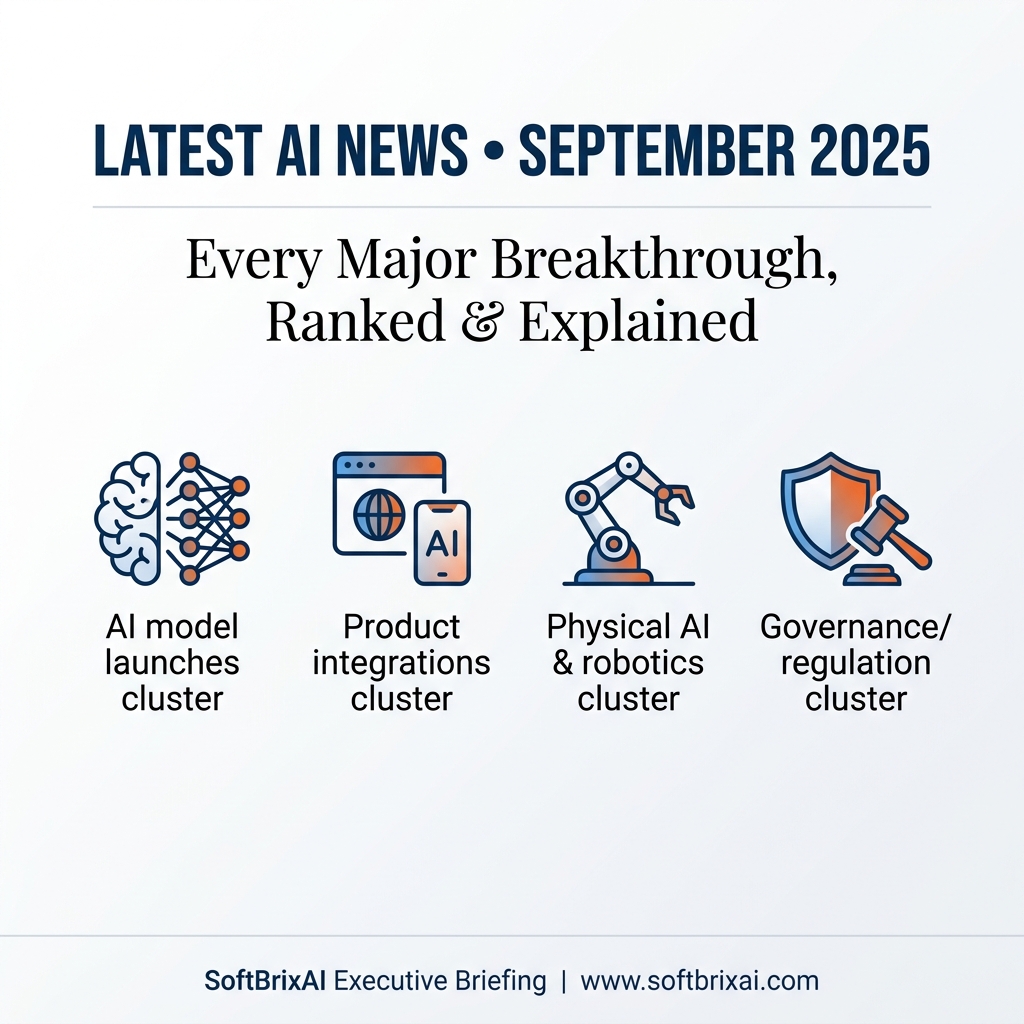
Latest AI News September 2025: Every Major Breakthrough, Ranked and Explained
Latest AI news September 2025: Sora 2, Qwen3-Max, SB 53, Gemini in Chrome, and more. Every major breakthrough ranked, explained, and what it means for your team.
toc Table of Contents Click to expand (44 sections) expand_more
Latest AI news September 2025 covers 9 major categories of artificial intelligence (AI) developments: new model launches from OpenAI, Alibaba, and Google; product integrations across Chrome, Microsoft 365, and Meta; robotics and Physical AI infrastructure from Nvidia and Arm; energy and data center bottlenecks at gigawatt scale; regulation from California’s SB 53 to global deepfake crackdowns; copyright lawsuits with real financial stakes; a healthcare AI market on a $187 billion (B) trajectory; rising workplace adoption; and industry-by-industry impact across retail, energy, manufacturing, government, healthcare, and enterprise tech.
This AI news roundup September 2025 ranks each story by practical weight: what it changes for teams shipping products, managing risk, or planning budgets in Q4 and beyond. The article breaks down what happened, who did it, and what it means in plain terms, so any reader can walk away with a clear picture of where generative AI, large language models (LLMs), and agentic AI stand right now.
September 2025 sits at a turning point. Trillion-parameter open-source models are live. Video generation reached consumer quality. Browsers became AI assistants. And the legal and energy constraints around AI got louder. These are the stories that set the tone for the rest of 2025.
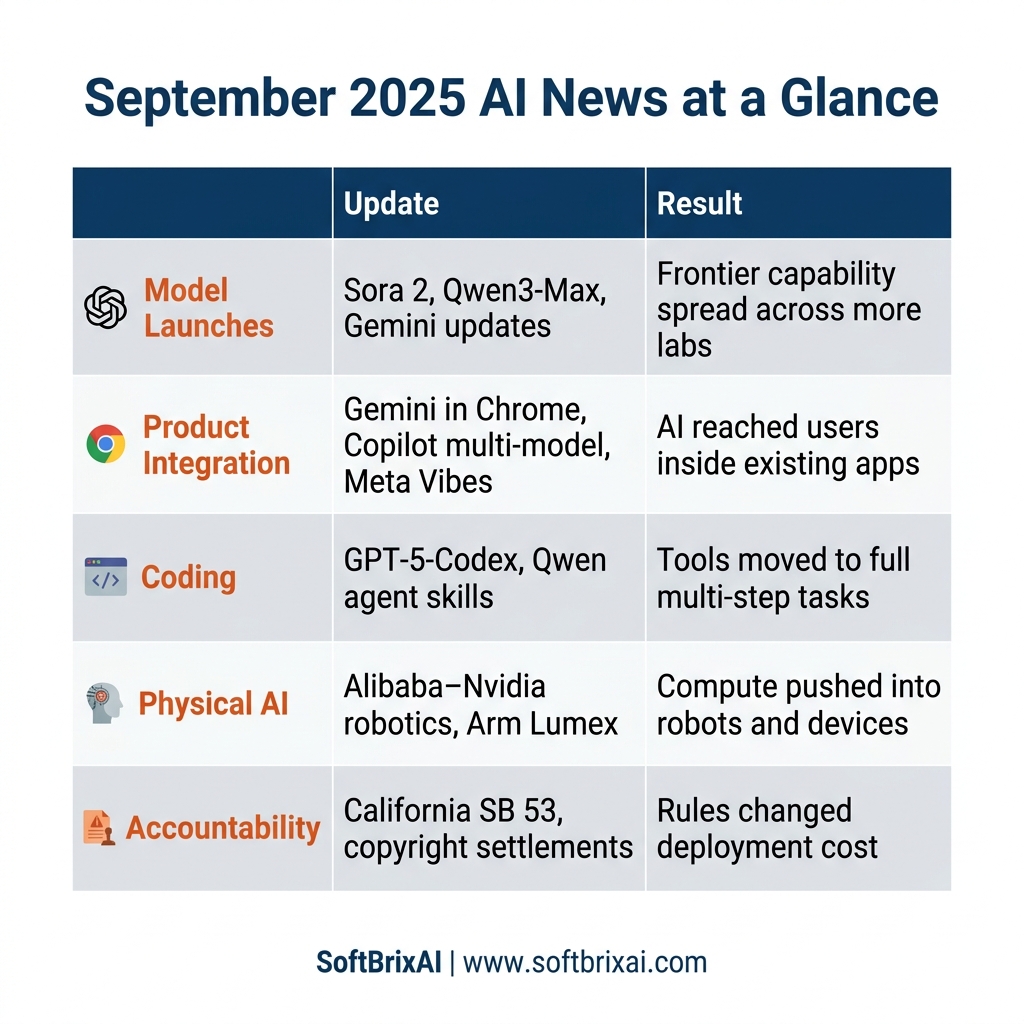
September 2025 AI News at a Glance
September 2025 packed more AI announcements into 30 days than most quarters. Here are the top AI developments September 2025 produced, grouped by theme:
- Model launches: Alibaba released Qwen3-Max (over one trillion parameters) and Qwen3-Omni (real-time multimodal, open source). OpenAI shipped Sora 2 for consumer video generation with synchronized dialogue and sound. Google pushed Gemini 2.5 Deep Think, Gemini Robotics 1.5, and Gemini Robotics-ER 1.5. Mistral AI closed a Series C round to grow European AI investment.
- Product integrations: Google embedded Gemini inside Chrome as a browsing assistant. Google expanded AI writing tools into Gboard and launched LearnLM for education. OpenAI upgraded Codex to handle multi-step coding tasks with GPT-5-Codex. Microsoft added Anthropic’s Claude Sonnet 4 and Claude Opus 4.1 to Copilot 365 and Copilot Studio. Meta rolled out Vibes, a short-form AI video discovery feed, to 40+ countries.
- Robotics and hardware: Alibaba and Nvidia partnered on Physical AI infrastructure across 8 countries. Arm revealed edge AI chips for low-latency, privacy-first on-device processing. Samsung hosted its AI Forum to spotlight vertical AI and next-gen semiconductors.
- Infrastructure: Stargate expansion plans accelerated, backed by Oracle, SoftBank, and OpenAI. Data center construction spending hit record levels. Gigawatt-scale power demands became the central constraint.
- Regulation and law: The California Senate advanced SB 53 with AI safety disclosures, incident reporting requirements, and whistleblower protections. Copyright lawsuits hit Apple, Anthropic (over pirated books), and Google (Penske Media lawsuit). Deepfake volumes surged worldwide, pushing digital provenance and watermarking into policy discussions.
- Economics: The Bank of America Institute published data showing AI adoption keeps climbing in the U.S. workforce. A healthcare AI market forecast projected growth from roughly $11B in 2021 to $187B by 2030. The Anthropic Economic Index tracked agentic AI use across enterprise sectors.
Each of these threads is covered in full below.

Major Model Launches and Releases
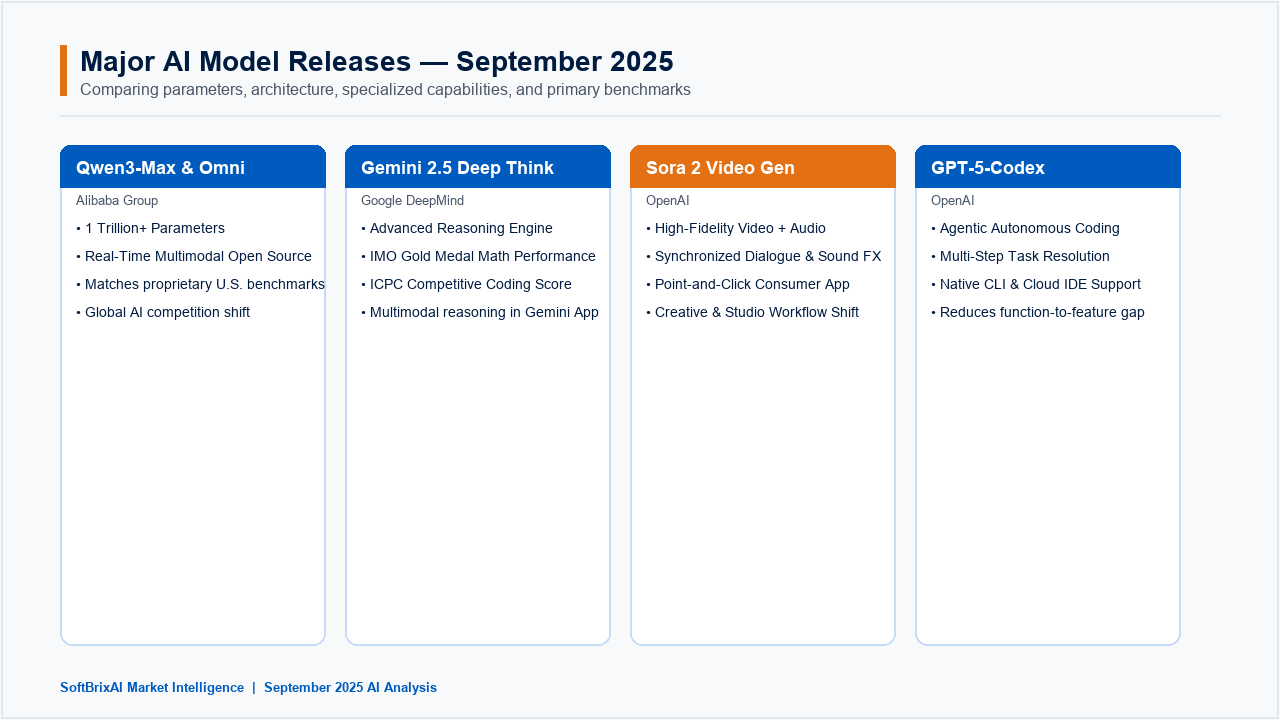
September 2025 AI model releases 2025 reshaped the competitive landscape. Four launches stood out.
OpenAI Sora 2 and the Jump in Consumer Video Generation
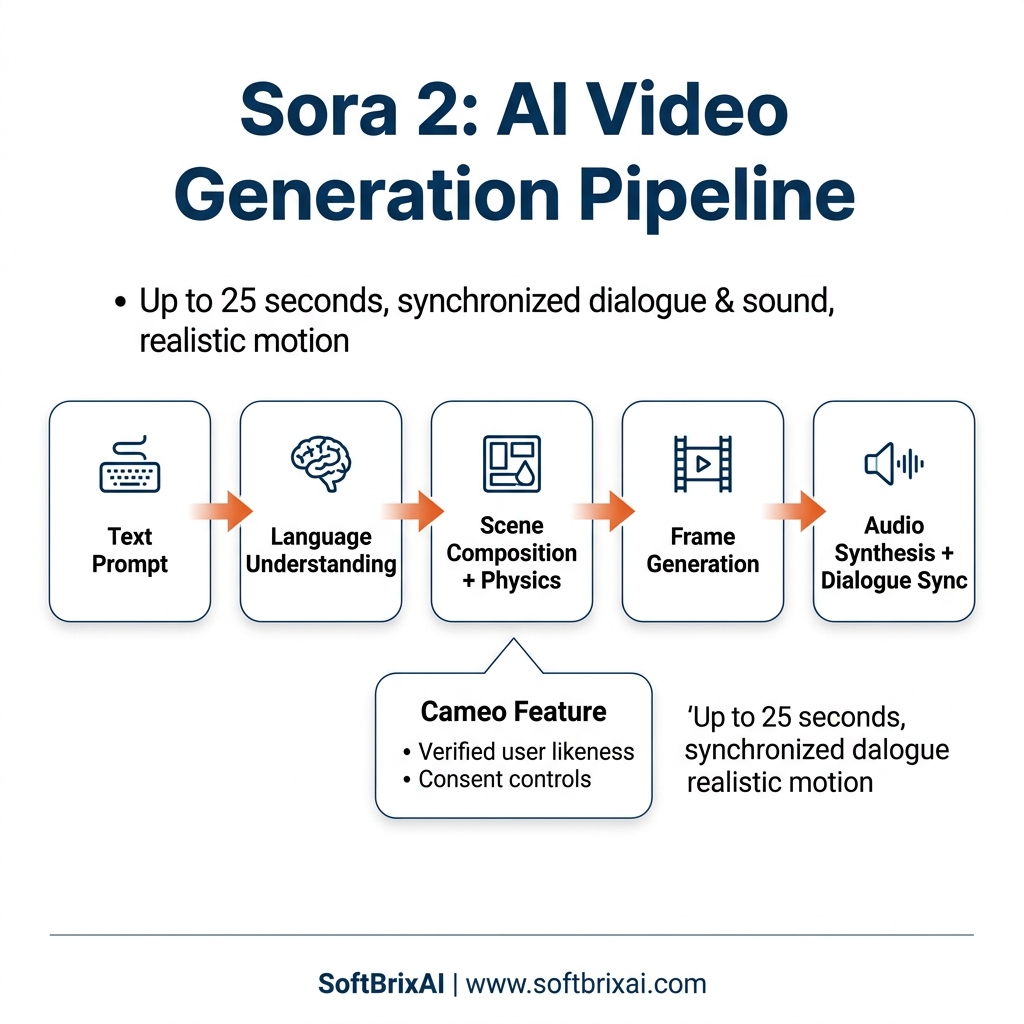
OpenAI launched Sora 2 in September 2025, its most capable video and audio generation model to date. Sora 2 produces short-form AI video with synchronized dialogue, sound effects, and realistic motion from a text prompt. Users access it through the Sora app, and the output quality crossed the threshold where consumer use became practical, not just a research demo.
Sora 2 matters for 3 reasons. First, it brings AI video generation news into the mainstream. Hollywood studios, TikTok creators, and marketing teams now have a tool that generates usable video in minutes. Second, the realism and controllability of Sora 2 outputs raised fresh questions about AI-generated media labeling and content rights. Third, it showed that OpenAI is expanding beyond text-based ChatGPT into multimodal AI creation tools that compete directly with dedicated video platforms.
Sam Altman framed Sora 2 as a step toward making professional-quality media creation accessible to anyone with an idea, not just those with a production budget.

Alibaba’s Trillion-Parameter Qwen Release
Alibaba Group released two models that shifted the global AI competition in September 2025. Qwen3-Max is a trillion-parameter model that matches or exceeds leading models from OpenAI and Google DeepMind on standard benchmarks. Qwen3-Omni is a real-time multimodal open-source model that handles text, image, audio, and video inputs in a single architecture.
The Qwen team made Qwen3-Omni fully open source, a move that gives developers worldwide access to a multimodal open-source AI model at a scale that was proprietary-only a year ago. China’s AI investment now stands at a level where the largest AI models 2025 are not exclusive to Silicon Valley or San Francisco labs. For a closer look at which Bay Area AI companies are competing at this scale, see our analysis of the hottest AI startups in Silicon Valley.
This is a geopolitics story wrapped in a model release. The global balance of AI capability is shifting, and the Qwen3-Max model proves that trillion-parameter AI 2025 is not a one-country race.
Google Gemini Deepens Its Model Push
Google used September 2025 to extend the Gemini family across products and capabilities:
- Gemini 2.5 Deep Think brought stronger AI reasoning capabilities to the Gemini app, handling complex multi-part questions and abstract problem-solving tasks. Google reported gold medal performance at the International Mathematical Olympiad (IMO) and strong results at the International Collegiate Programming Contest (ICPC) World Finals.
- Gemini Robotics 1.5 and Gemini Robotics-ER 1.5 targeted Physical AI use cases, enabling robots to interpret instructions and execute motor commands in real-world environments. Google DeepMind positioned these models as the bridge between big-picture reasoning and physical agents in robotics.
- NotebookLM received updates including Audio Overviews, a Learning Guide mode, and flashcard quiz generation, turning it into an AI study partner with personalized step-by-step tutoring.
- Gemini for Education launched alongside the AI for Education Accelerator, the AI Literacy curriculum, and partnerships with the White House AI Education Taskforce. LearnLM and Guided Learning tools rolled out for teachers and students.
- Gemini Live expanded language support to Hindi, Indonesian, Japanese, Korean, Brazilian Portuguese, and Spanish, covering a combined user base that makes Google’s language expansion globally significant.
Sundar Pichai described September’s Gemini Drop as the moment where Gemini stopped being a single model and became a platform, a claim backed by the breadth of launches that month.
Europe’s Model Investment Signal
Mistral AI closed a Series C funding round in September 2025, marking the largest European AI investment in a single company to date. The round signals that Europe’s AI ambitions are backed by real capital, not just policy statements like the EU AI Act.
Mistral’s fundraise matters because it shows that the AI supply chain does not have to run through the U.S. or China alone. European AI investment is building an alternative center of gravity, with regional AI goals that prioritize data sovereignty and GDPR-aligned AI governance.
Big Tech Product Integrations
September 2025 AI product launches shifted AI from standalone tools to embedded features inside software that billions of people already use.
AI Moves Inside the Browser (Gemini in Chrome)
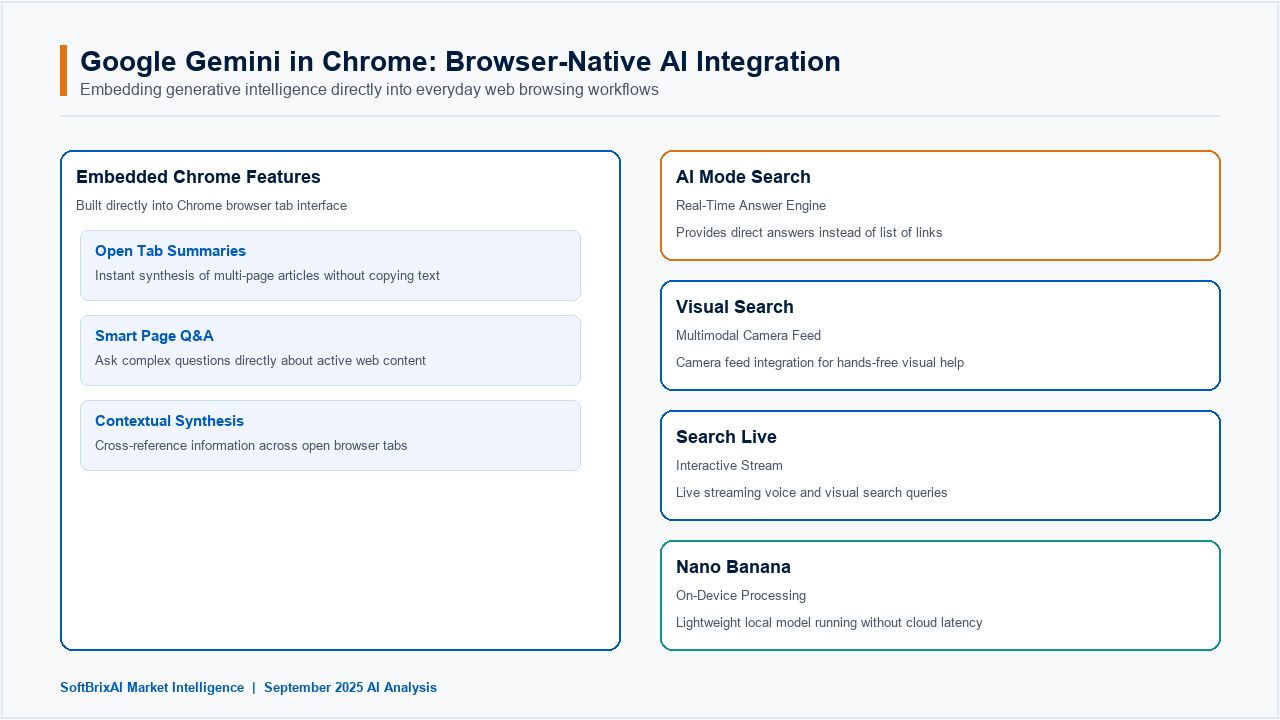
Google embedded Gemini directly into Chrome, turning the browser into an AI browsing assistant. Chrome users can now get real-time AI summaries of open tabs, ask complex multi-part questions about page content, and receive synthesized answers without leaving the browser window.
This Google AI update September 2025 changed how search and browsing interact. Users no longer need to copy text into a separate AI tool. The Gemini integration brings open tab understanding, visual search results, and natural language understanding into the same interface where people already spend their time. For background on how visual search engines process images, our guide to image search techniques covers the underlying methods.
AI Mode Search, Visual Search (with camera feed integration for hands-free multimodal help), and Search Live (real-time AI search with multimodal inputs) also rolled out alongside the Chrome Gemini integration, making Google’s AI in Chrome 2025 the most visible consumer AI shift of the month.

On-Device Writing and Source-Based Learning Tools
Google expanded AI writing tools into Gboard, adding tone revision, grammar correction, and context-aware suggestions directly on Android keyboards. The Canvas feature introduced no-code app building inside the Gemini app, and Quick Share gained QR code audio broadcast and file transfer previews.
On the education side, LearnLM and Guided Learning became available for schools through the AI for Education Accelerator. Features include active learning focus, AI-generated flashcard and quiz content, and personalized step-by-step tutoring. Google also released the “Raising kids in the age of AI” resource and the Be Internet Awesome curriculum, extending the Gemini for Education rollout alongside the White House AI Education Taskforce partnership.
Nano Banana, a lightweight on-device model, started powering AI features that run locally on Android without needing a cloud connection, representing a step toward privacy-first AI 2025 on consumer devices.
Coding Tools Shift to Longer, Multi-Step Tasks (Codex Updates)
OpenAI upgraded Codex with GPT-5-Codex, a model built for agent-style work in cloud development environments. The update targets multi-step task handling (writing code, running tests, fixing errors, and iterating across files) without requiring a human to guide each step.
Codex now runs through both a command-line interface (CLI) and integrated development environments (IDEs), making agentic AI news 2025 real for developers who write code daily. The shift from single-prompt code completion to autonomous multi-step AI tasks is what separates this Codex update from earlier versions.
This matters for enterprise AI adoption because it reduces the gap between “AI writes a function” and “AI ships a feature.” Teams using GPT-5-Codex cloud report handling routine engineering tasks in a fraction of the time, with human review required mainly for design decisions and edge cases. For teams evaluating how AI coding tools fit into their software testing basics workflow, the Codex update changes the calculus on which tests to automate first.
Microsoft 365 Copilot Goes Multi-Model with Claude
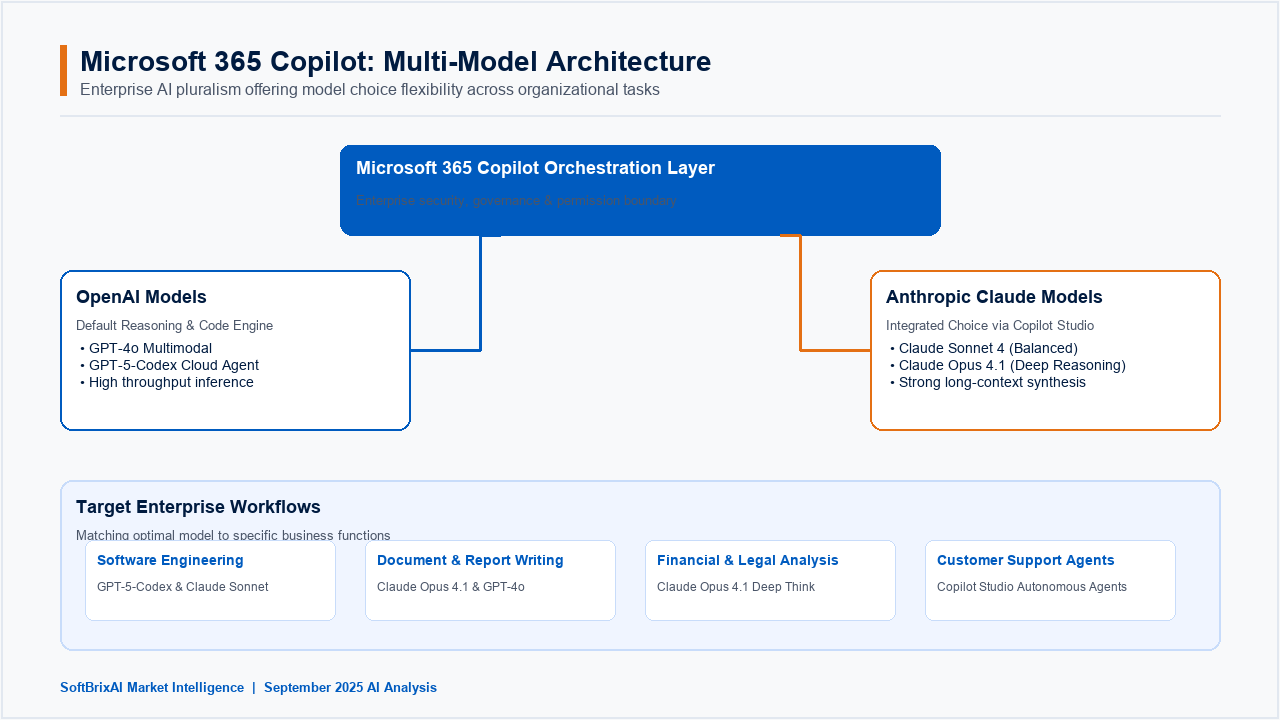
Microsoft integrated Anthropic’s Claude, including Claude Sonnet 4 and Claude Opus 4.1, into Microsoft 365 Copilot and Copilot Studio. Enterprise customers can now choose between OpenAI’s models and Anthropic’s Claude models depending on the task, creating a competitive model menu inside a single product.
This is the clearest signal of AI pluralism in enterprise software. Microsoft is no longer tied exclusively to OpenAI for its AI backbone. Organizations using Copilot 365 gain multi-model support and model choice flexibility, which means procurement and vendor planning now includes evaluating which model fits which workflow.
The Anthropic Economic Index, published in September 2025, showed that enterprise AI adoption increasingly favors a multi-model approach with different models for coding, writing, analysis, and customer interaction. Microsoft 365 Copilot is the first major productivity suite to ship this as a default configuration.

Meta “Vibes” and Short-Form AI Video Discovery
Meta launched Vibes, a generative AI-powered short-form video feed, across 40+ countries in September 2025. Vibes uses AI recommendation engine 2025 technology to personalize discovery, curate content, and drive engagement on the meta.ai platform.
Vibes is Meta AI’s answer to TikTok’s algorithmic feed, but with generative AI layered on top. The feed surfaces AI-generated media alongside human-created content, creating a hyper-personalized discovery experience. Content labeling and AI content authentication are built into the system, though the details of how AI-generated video is flagged remain under scrutiny.
For brands and creators, Vibes represents a shift in AI social media 2025: the content discovery layer is now driven by models, not just user behavior signals.
Robots and Physical AI Take a Step Forward
AI robotics news 2025 moved from research papers to real infrastructure commitments in September.
Alibaba and Nvidia Build Out “Physical AI” Infrastructure
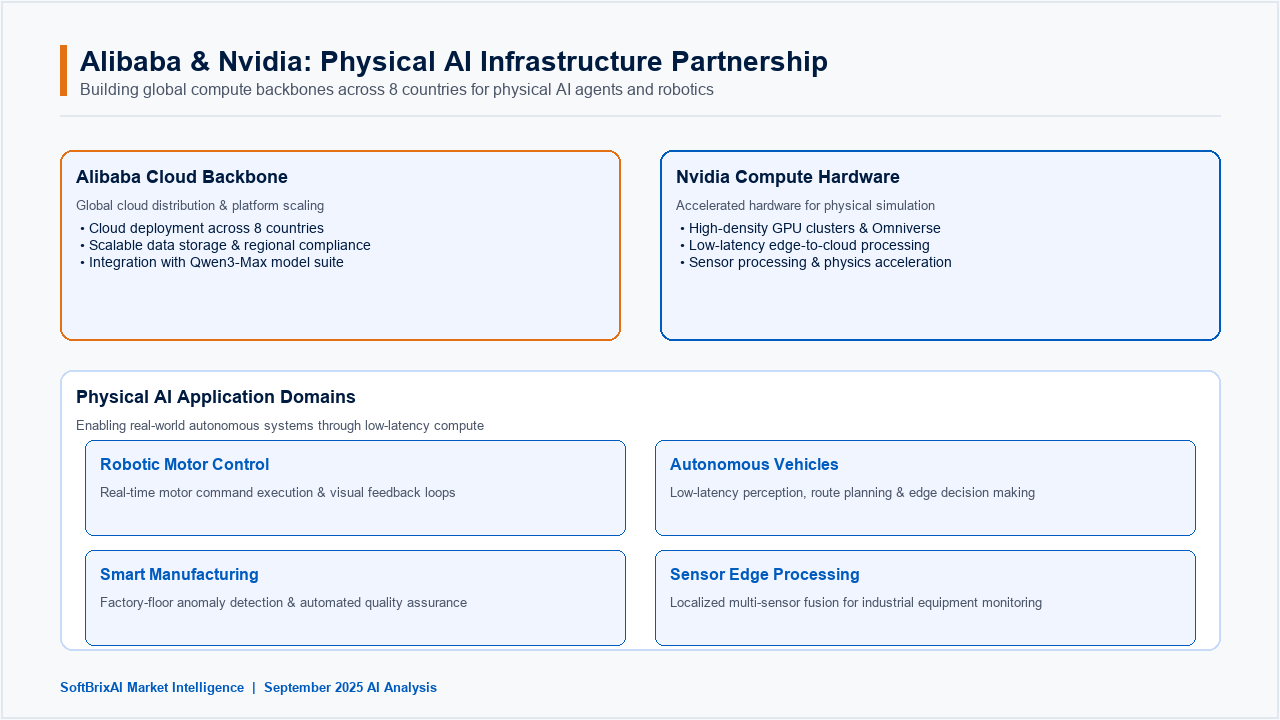
Alibaba and NVIDIA announced a partnership to build Physical AI infrastructure across 8 countries in September 2025. The project combines Nvidia’s compute hardware with Alibaba’s cloud platform to create scalable global infrastructure for AI workloads that interact with the physical world, including robotic systems, autonomous vehicles, industrial automation, and real-time sensor processing.
Physical AI infrastructure 2025 is different from cloud-only AI because it requires low-latency processing close to where physical agents operate. This Alibaba Nvidia partnership positions both companies as providers of the AI compute backbones that manufacturers, logistics companies, and government agencies will depend on through 2030 and beyond. For context on how edge infrastructure accelerates content delivery at scale, see our guide on application acceleration managers.

Arm Pushes Edge AI Into the Mainstream
Arm revealed new chip architectures in September 2025 designed for edge AI: on-device processing that runs AI models locally on phones, vehicles, cameras, and industrial sensors without routing data to a distant data center.
Arm’s privacy-first chips prioritize low-latency processing and data security. The target applications include real-time multimodal assistants, edge-native applications for automotive safety systems, and on-device AI for consumer electronics. Edge AI updates 2025 from Arm signal that the future of AI processing is not exclusively in the cloud, as processing moves closer to where decisions happen.
For enterprises, Arm’s edge deployment scale means faster decisions, lower bandwidth costs, and stronger data protection. Edge AI chip launches in September 2025 gave manufacturers and device makers a concrete path to ship AI features that work offline.
Samsung’s AI Forum and the Rise of Vertical AI
Samsung hosted its Samsung AI Forum in September 2025, gathering researchers and industry leaders to discuss vertical AI, which focuses on sector-specific AI systems designed for particular industries rather than general-purpose use.
Samsung’s focus areas included vertical AI systems for healthcare diagnostics, manufacturing quality control, and next-gen semiconductors optimized for AI workloads. The forum also covered how Samsung plans to integrate AI into its consumer electronics, from phones to appliances, using on-device processing.
The message from Samsung AI Forum was direct: general-purpose AI models are useful, but the return on investment for most companies comes from AI tailored to their specific workflows and data. Sector-specific AI is where operational efficiency gains live.
The Infrastructure and Energy Crunch
AI infrastructure news 2025 shifted from “how many GPUs” to “how many gigawatts.”
Why Gigawatts Became the Metric That Matters
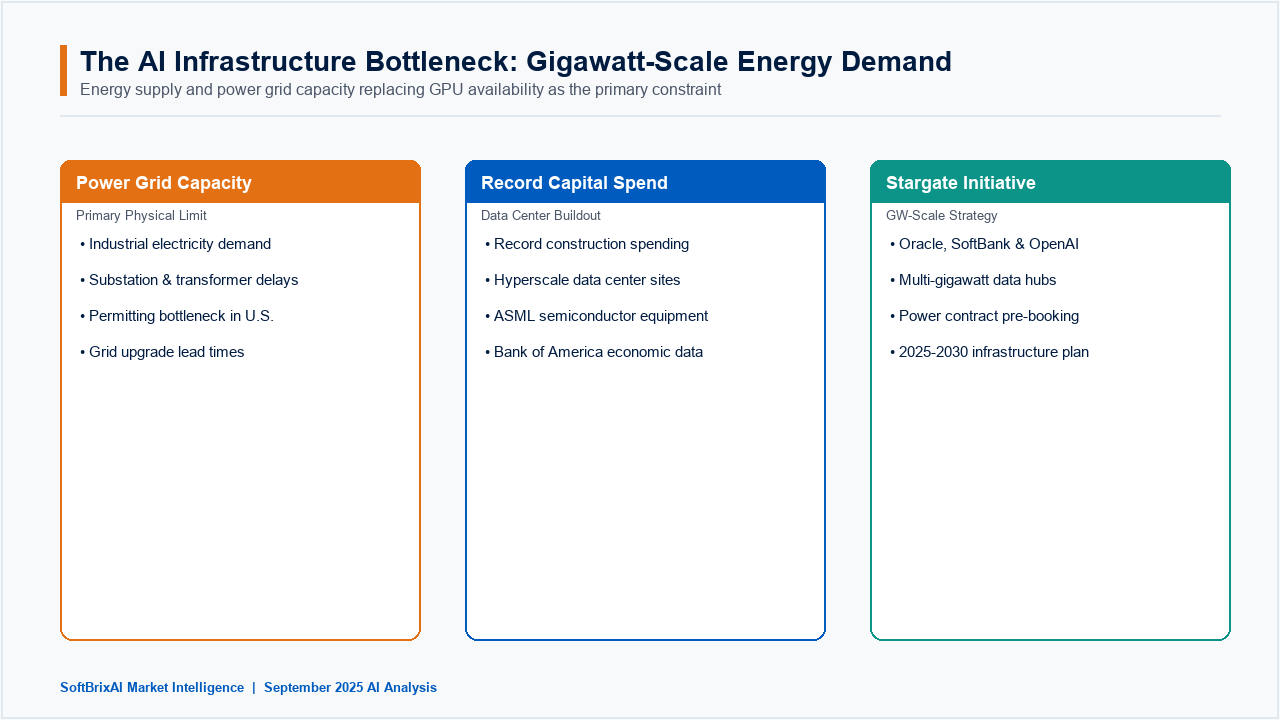
AI data center news 2025 is now measured in gigawatts, not server racks. Training and running large language models at trillion-parameter scale requires electricity supply at volumes that strain existing power grids. Record data center spending in September 2025 reflected this reality: the constraint on AI growth is not software capability but physical energy supply.
Grid upgrade permitting, electricity supply limits, and long-term infrastructure planning are now part of every major AI company’s strategy. Gigawatt-scale infrastructure is the bottleneck, and solving it determines which companies and countries can run the next generation of AI models.

Stargate Expansion Plans
The Stargate project, backed by Oracle, SoftBank, and OpenAI, accelerated its expansion plans in September 2025. Stargate aims to build a network of AI-optimized data centers across the U.S., providing the cloud compute power needed for next-generation model training and inference at scale.
The Stargate expansion signals that AI infrastructure is becoming a strategic partnership investment comparable to national energy projects. OpenAI Stargate infrastructure planning now involves securing power contracts, land permits, and cooling systems years in advance.
Real Signs of Compute Demand in the U.S.
Bank of America Institute data published in September 2025 confirmed that AI compute scaling 2025 is not speculative, as it is already driving measurable economic activity. Data center construction spending, semiconductor orders (tracked through companies like ASML), and cloud compute contracts all showed upward trends through Q3 2025.
U.S. AI news 2025 includes a geographic component: data center construction is concentrated in states with available power and favorable permitting. The infrastructure buildout is creating jobs, straining local grids, and reshaping regional economies in America. For teams evaluating how AI compute interacts with emerging hardware paradigms, our coverage of the latest breakthroughs in quantum computing provides additional context on the compute frontier.
Regulation, Law, and Safety
AI regulation news 2025 in September came from state legislatures, courtrooms, and international policy bodies.
California SB 53 and State-Level Safety Disclosures
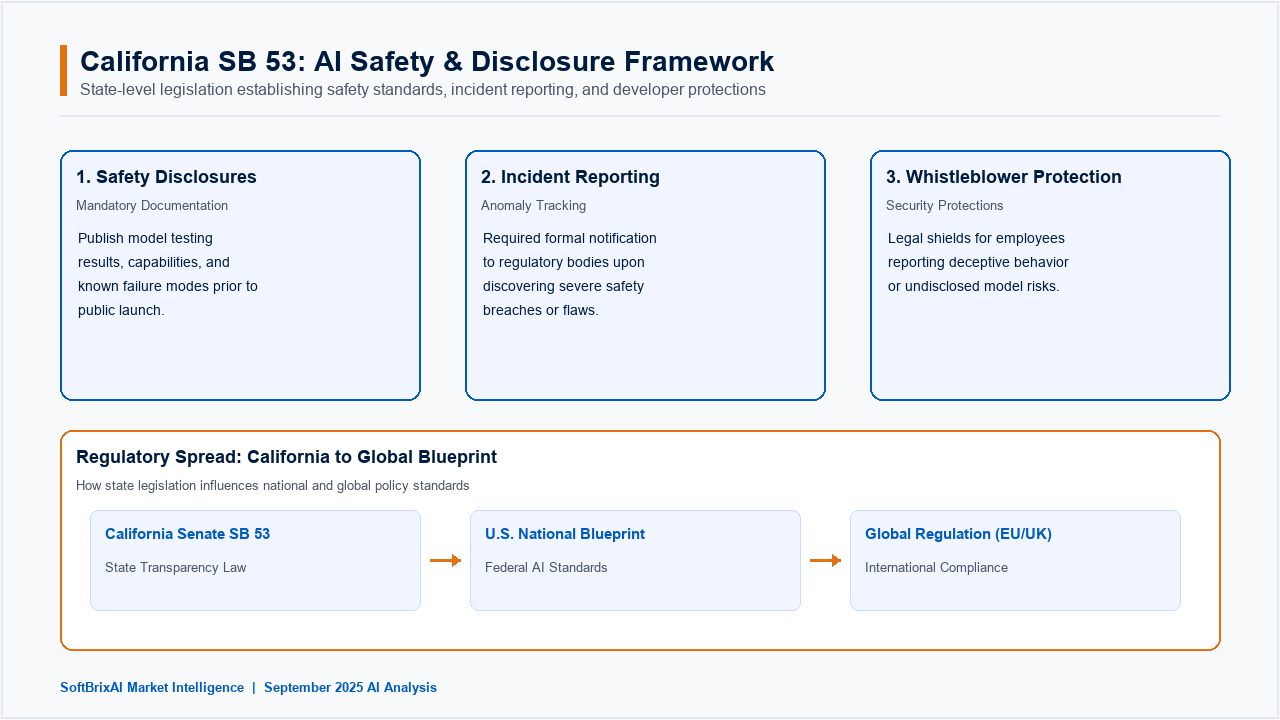
The California Senate advanced SB 53 in September 2025, a bill that requires AI safety disclosures, incident reporting requirements, and whistleblower protections for employees at companies building powerful AI systems. SB 53 legislation sets transparency standards for how large AI models are tested and deployed.
California AI law often sets the template for national and global AI regulation. SB 53 could become AI’s equivalent of the General Data Protection Regulation (GDPR), serving as a state-level framework that forces industry-wide compliance because of California’s market weight.
AI safety standards under SB 53 include mandatory documentation of model capabilities, known failure modes, and safety testing results before public release. Apollo Research, a firm focused on deceptive behavior research and agentic risk management, provided testimony during the bill’s hearings.

Copyright Lawsuits With Real Cost Impact
Three copyright cases in September 2025 carried real financial and strategic consequences for AI companies:
- Penske Media lawsuit against Google: Penske Media sued Google over AI summary search features, arguing that AI-generated summaries reduce publisher traffic and revenue. This publisher AI dispute tests whether AI search summaries 2025 constitute fair use or commercial harm.
- Anthropic pirated books case: Anthropic faced claims that its training data included pirated copyrighted material. The case puts training data transparency and synthetic data licensing at the center of AI legal news 2025.
- Apple author lawsuit: Authors sued Apple over using copyrighted works to train AI models, expanding the AI copyright lawsuit 2025 pattern to another major tech company.
These cases matter because the outcomes will shape copyright training data risk for every company building or using AI. Legal financial risk from training-data disputes is now a line item in AI procurement and vendor planning.
The Global Deepfake Surge
September 2025 saw a sharp increase in deepfake videos across social media, politics, and financial fraud. The deepfake news 2025 cycle triggered urgent calls for deepfake regulation 2025, including mandatory watermarking, AI deepfake detection tools, and digital provenance standards that track the origin of AI-generated media.
Governments in the U.S., Europe, Japan, and India responded with proposals for AI content authentication requirements. Deepfake watermarking regulation is now on the legislative agenda in multiple countries, with the EU AI Act providing one framework and California’s SB 53 providing another.
The deepfake surge is not a theoretical risk; it is producing measurable harm in elections, corporate fraud, and personal reputation attacks. AI watermarking news from September 2025 shows that detection and authentication technology is advancing, but not fast enough to match the speed of deepfake creation.
Publisher Disputes Over AI Summaries
Beyond the Penske Media lawsuit, multiple publishers raised formal objections to AI-powered search features that summarize their content without directing traffic to the original source. The dispute centers on whether AI summary search reduces the economic value of original reporting and analysis.
This AI content rights 2025 issue is distinct from the training-data lawsuits. Training-data cases ask whether AI can learn from copyrighted material. Publisher disputes ask whether AI can replace the need to visit the source. Both questions are unresolved, and both carry consequences for how AI companies design search and content features.
Economic and Social Impact
AI economic impact 2025 showed up in two areas with hard data behind them: healthcare market forecasts and workplace adoption surveys.
Healthcare AI Market on a $187B Trajectory
A September 2025 forecast projected the healthcare AI market to grow from approximately $11B in 2021 to $187B by 2030. The healthcare AI forecast 2030 covers diagnostics, administrative automation, drug discovery, clinical decision support, and patient monitoring.
The growth numbers are large, but the risks are proportional:
- Bias and equity gaps: AI diagnostics trained on unrepresentative data can amplify disparities in care quality across racial, geographic, and socioeconomic groups. AI bias healthcare remains a documented concern in peer-reviewed research.
- Opacity and accountability: Many AI models used in clinical settings behave as “black boxes,” producing predictions that clinicians cannot explain to patients. Explainable AI news 2025 highlights the gap between model accuracy and clinician AI trust.
- Security and systemic errors: Healthcare systems face unique risks where a model failure or data leak can produce real human harm at scale. Patient confidentiality AI and data leak harm prevention are now board-level discussions at hospital systems.
Equitable AI healthcare requires building an AI governance layer that includes model risk management, audit trail automation, data strategy auditability, and human review requirements. The $187B trajectory only holds if AI in healthcare proves safe, explainable, accountable, and equitable.

Workplace AI Adoption Keeps Climbing
A Gallup survey and the Anthropic Economic Index, both published in September 2025, confirmed that workplace AI adoption 2025 continues to increase across the U.S. workforce. The Bank of America Institute data added a financial dimension, showing that companies reporting AI deployment saw measurable productivity gains.
AI productivity tools 2025 are now standard in knowledge-work environments. The Gallup survey data showed that the share of workers using AI tools at least weekly rose compared to June 2025, with the largest gains in software development, marketing, customer service, and data analysis.
The remaining barriers to AI adoption are not technical; they are organizational. Sensitive data controls, responsible AI deployment policies, AI adoption governance frameworks, and model risk management practices determine which companies get value from AI tools and which face compliance or reputational problems.
How September 2025 AI Changes Hit Each Industry
The AI developments September 2025 produced are not abstract. Here is what they mean for 6 industries.
Retail
AI-generated content from Sora 2 and Meta Vibes is reshaping digital storefronts and product discovery. Hyper-personalized discovery powered by AI recommendation engines means retailers can serve different visual content to different customers in real time. Immersive shopping experience design now includes AI-generated video for product demonstrations and campaigns. Retail teams should evaluate AI content creation tools and AI-powered retail personalization platforms before the Q4 holiday cycle.
Energy
Edge AI from Arm and Physical AI infrastructure from Alibaba and Nvidia give energy providers tools for smarter grid deployment, real-time monitoring, and predictive maintenance at scale. Predictive maintenance scale reduces downtime and extends asset life. Energy companies should assess edge AI chip options and cloud-to-edge migration paths for grid management systems.
Manufacturing
Vertical AI from Samsung AI Forum and edge processing from Arm and Apple mean smarter factories with autonomous decision-making, real-time quality control, and agile supply chains. AI manufacturing news 2025 points toward factory floors where AI handles routine inspection and anomaly detection, freeing human operators for complex tasks. Manufacturing leaders should pilot vertical AI systems in one production line before expanding.
Government
SB 53, deepfake regulation, and the EU AI Act are raising regulatory expectations for public-sector AI use. Government agencies deploying AI must meet transparency, safety, and accountability standards. Public sector AI procurement now requires AI governance frameworks, incident reporting procedures, and human oversight mechanisms. Trust is the new infrastructure for government AI adoption.
Healthcare (Adoption and Clinical Use, Not Market Size)
On-device AI from Arm and Apple supports patient confidentiality while enabling smarter diagnostics, care assistants, and administrative automation healthcare. Clinicians using AI diagnostic tools need explainable outputs and clear audit trails. Healthcare AI diagnostics adoption depends on solving the black box problem, as clinicians will not trust predictions they cannot trace. Healthcare organizations should build responsible AI deployment frameworks that include bias testing, data governance, and clinician training before expanding AI use.
Enterprise Tech
The enterprise AI stack 2025 is evolving fast. Multi-model support from Microsoft Copilot (with Claude), trillion-parameter open-source models from Alibaba, edge deployment scale from Arm, and agentic capabilities from OpenAI Codex mean that enterprise AI planning now spans model selection, infrastructure, governance, and workforce training. Enterprise teams should map their AI tool landscape, establish model governance policies, and plan for multi-model architectures that avoid vendor lock-in.
What These Updates Mean for Teams Right Now
September 2025 AI updates create 5 action items for any team working with or alongside AI:
- Audit your AI model stack. Multi-model support is now the default in Microsoft 365 Copilot. If your team is locked into a single model provider, evaluate whether Claude, Gemini, or open-source options like Qwen3-Omni fit specific workflows better. Model choice flexibility reduces single-vendor risk.
- Review your training-data exposure. The Apple, Anthropic, and Penske Media lawsuits show that copyright training data risk is real. Check whether any AI tools your company uses have disclosed their training data sources. Legal financial risk from training-data disputes can affect procurement and vendor planning.
- Prepare for SB 53-style disclosures. AI safety disclosures, incident reporting, and whistleblower protections may become standard requirements by the end of 2025. If your company builds or deploys AI at scale, start documenting model capabilities, known limitations, and testing results now. Waiting for enforcement is a higher-cost path.
- Test edge AI and on-device options. Arm’s chips and Google’s Nano Banana model show that meaningful AI processing can happen without sending data to the cloud. For industries handling sensitive data (healthcare, finance, government), on-device AI reduces data exposure and latency. Edge deployment scale is no longer experimental.
- Set AI content policies. With Sora 2, Meta Vibes, and deepfake volumes rising, every organization needs a clear policy on AI-generated media: when to use it, how to label it, and how to detect it. AI content labeling and digital provenance standards are becoming baseline expectations.
Final Thoughts: Why September 2025 Set the Tone
September 2025 was the month where AI stopped being a technology category and became an infrastructure layer. Trillion-parameter models went open source. Video generation reached commercial quality. Browsers became AI assistants. And the legal, energy, and governance constraints around AI became as prominent as the technical advances.
The AI breakthroughs September 2025 delivered are not endpoints; they are starting conditions for Q4 2025 and beyond. Companies that adapt their AI strategy now, choosing the right models, building governance frameworks, securing compliant training data, and deploying edge AI where it fits, will move faster than those still evaluating whether AI matters to their business.
The AI transformation imperative is no longer about deciding whether to use AI. It is about deciding how to use AI responsibly, at scale, and ahead of competitors. September 2025 set that tone.
SoftBrixAI tracks these developments and helps teams build AI strategies grounded in real capability, not hype. Connect with our team to start mapping your next steps.
Frequently Asked Questions
What was the biggest AI change in September 2025?
The biggest AI change in September 2025 was Alibaba’s release of Qwen3-Max, a trillion-parameter model, alongside Qwen3-Omni, an open-source multimodal model. These releases shifted the global AI competition by proving that trillion-parameter AI is no longer exclusive to U.S.-based companies. OpenAI’s Sora 2 and Google’s Gemini Chrome integration were close seconds in terms of consumer impact.
What does multimodal AI mean in simple terms?
Multimodal AI means a single AI system that processes and generates more than one type of input or output (text, images, audio, and video) within the same model. Qwen3-Omni from Alibaba is a multimodal model because it handles text, image, audio, and video in one architecture. Gemini 2.5 from Google and Sora 2 from OpenAI are also multimodal. A text-only chatbot is not multimodal; a system that reads an image and describes it in text is multimodal.
Why did AI infrastructure news focus on gigawatts?
AI infrastructure news focused on gigawatts because training and running trillion-parameter models requires electricity at industrial scale, and power supply has become the primary bottleneck for AI growth. Building enough data centers is now less about buying GPUs and more about securing stable electricity. The Stargate project, backed by Oracle, SoftBank, and OpenAI, exists specifically to solve this energy constraint in the U.S. Grid upgrade permitting, electricity supply limits, and long-term power contracts are now core parts of AI strategy.
Why do training-data lawsuits matter for businesses?
Training-data lawsuits matter for businesses because the outcomes will determine whether AI tools built on copyrighted content face restrictions, licensing costs, or bans. The Penske Media lawsuit against Google, the Anthropic pirated books case, and the Apple author lawsuit all test whether using copyrighted material to train AI models counts as fair use. Businesses using AI tools should understand whether their vendors have training-data transparency. A ruling against fair use could force AI companies to retrain models on licensed or synthetic data, which would raise costs and potentially change model behavior.
How should a company decide which AI tools to allow?
A company should decide which AI tools to allow by evaluating 5 factors: data security, model transparency, regulatory compliance, integration capability, and output quality for the specific use case. Start by classifying which workflows involve sensitive data and require on-device or edge AI options. Check whether the AI vendor discloses training data sources and has a responsible AI deployment framework. Confirm that the tool meets current and anticipated regulatory requirements (SB 53 in California, the EU AI Act in Europe, GDPR for data handling). Test whether the tool integrates with existing enterprise systems (Microsoft 365, Google Workspace, internal platforms). Run a pilot with a small team before enterprise-wide rollout. AI adoption governance should include human review requirements for high-stakes decisions.
What was the key AI news on September 28, 2025?
The key AI news on September 28, 2025, included cloud computing and developer tools updates, alongside continued coverage of the Stargate expansion plans and SB 53 legislative progress. September 28, 2025, and September 29, 2025, were both dates when technology news outlets published roundups of the month’s AI developments, reflecting the density of announcements across the final week of September. Google’s Search Live tips and AI Mode Search updates also received coverage on those dates.
Umar Abbas
Umar Abbas is the Principal AI Architect and Operator of SoftBrixAI. With years of experience in distributed systems, security-first architectures, and high-performance computing, Umar leads the engineering team in designing production-ready, security-hardened AI solutions.