
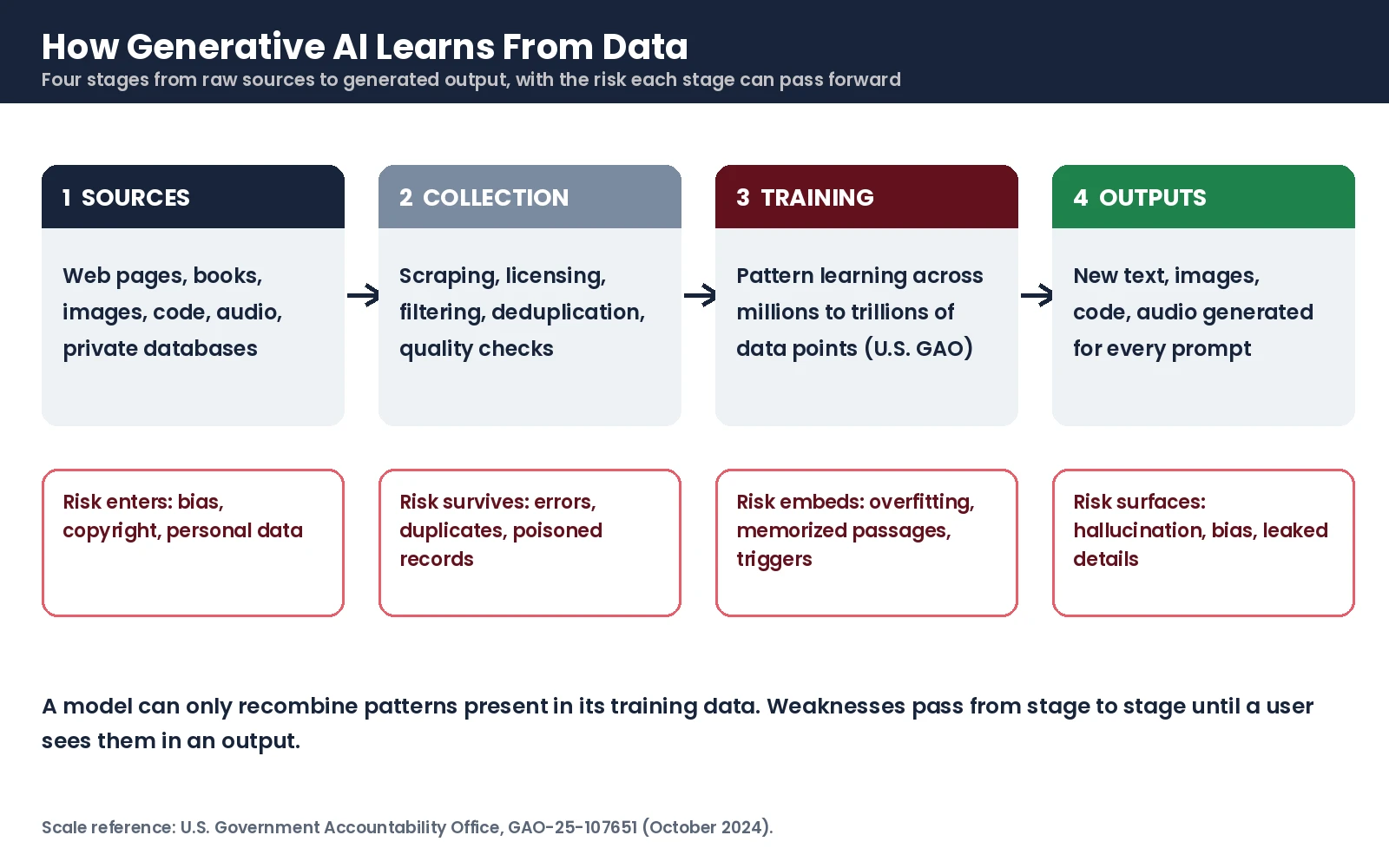
Generative AI faces nine recurring data challenges: poor quality, bias, privacy exposure, copyright disputes, scarce quality data, outdated data, poisoning attacks, AI-generated feedback, overfitting on narrow data. Each challenge traces back to one fact about how generative AI models learn patterns from training data. Weaknesses inside a dataset become weaknesses inside every output the model produces for its users.
The U.S. Government Accountability Office reports that generative AI training datasets range from millions to trillions of data points. Checking accuracy, origin, legality, safety across a dataset of that size defeats manual review completely. The question ‘what challenges does generative ai faces with respect to data’ has a short answer and a long one, both given in full below.
Why Data Decides What Generative AI Can Do
Generative AI models learn patterns from existing material, then recombine those patterns into new text, images, code, audio. Training data therefore functions as the model’s only textbook, reference library, source of examples. Gaps inside the textbook become gaps inside answers, while errors inside the textbook become confident errors outside.
Developers rarely disclose full details of their training datasets, according to the same GAO review of commercial developers. Limited disclosure makes outside verification of data quality, representation, licensing status nearly impossible for buyers. Provenance records, meaning documented answers about where data came from, carry growing weight in procurement decisions.
What Challenges Does Generative AI Face With Respect to Data?
The table below summarizes the generative ai data challenges, one row per challenge, before detailed treatment follows.
| Challenge | Root cause | Effect on output | First fix |
|---|---|---|---|
| Poor data quality | Errors, duplicates, contradictions inside collected data | Wrong facts stated with confidence | Clean, filter, deduplicate before training |
| Bias in training data | Skewed representation across groups, regions, languages | Unfair, stereotyped, exclusionary outputs | Audit representation, rebalance datasets |
| Privacy exposure | Personal, sensitive data inside training sets | Memorized details leaking into outputs | Remove sensitive data, apply access controls |
| Copyright disputes | Scraped works used without licenses | Legal claims, blocked deployments | Verify usage rights, license key sources |
| Scarce quality data | Finite supply of high-quality public text | Slower gains, costly data deals | License domain data, curate smaller sets |
| Outdated data | Static training snapshots in a changing world | Stale facts, superseded guidance | Refresh cycles, retrieval from current sources |
| Data poisoning | Malicious records inserted into data sources | Manipulated behavior on chosen inputs | Verify sources, validate incoming data |
| AI feedback loop | Generated content re-entering training sets | Model collapse across generations | Track provenance, filter synthetic content |
| Overfitting, language gaps | Narrow data, dominance of a few languages | Weak results on unseen data, rare languages | Broader coverage, multilingual evaluation |
Poor Data Quality
Large datasets routinely contain factual errors, duplicated pages, spam, contradictory claims, missing values, irrelevant material. Models cannot separate reliable passages from unreliable ones without explicit filtering signals during data preparation. Cleaning pipelines therefore remove duplicates, flag contradictions, drop low-value pages before any training run begins. Scale worsens the problem, because review coverage shrinks as dataset size grows beyond human capacity. For generative AI, data quality can matter as much as data quantity during model development.
Bias in Training Data
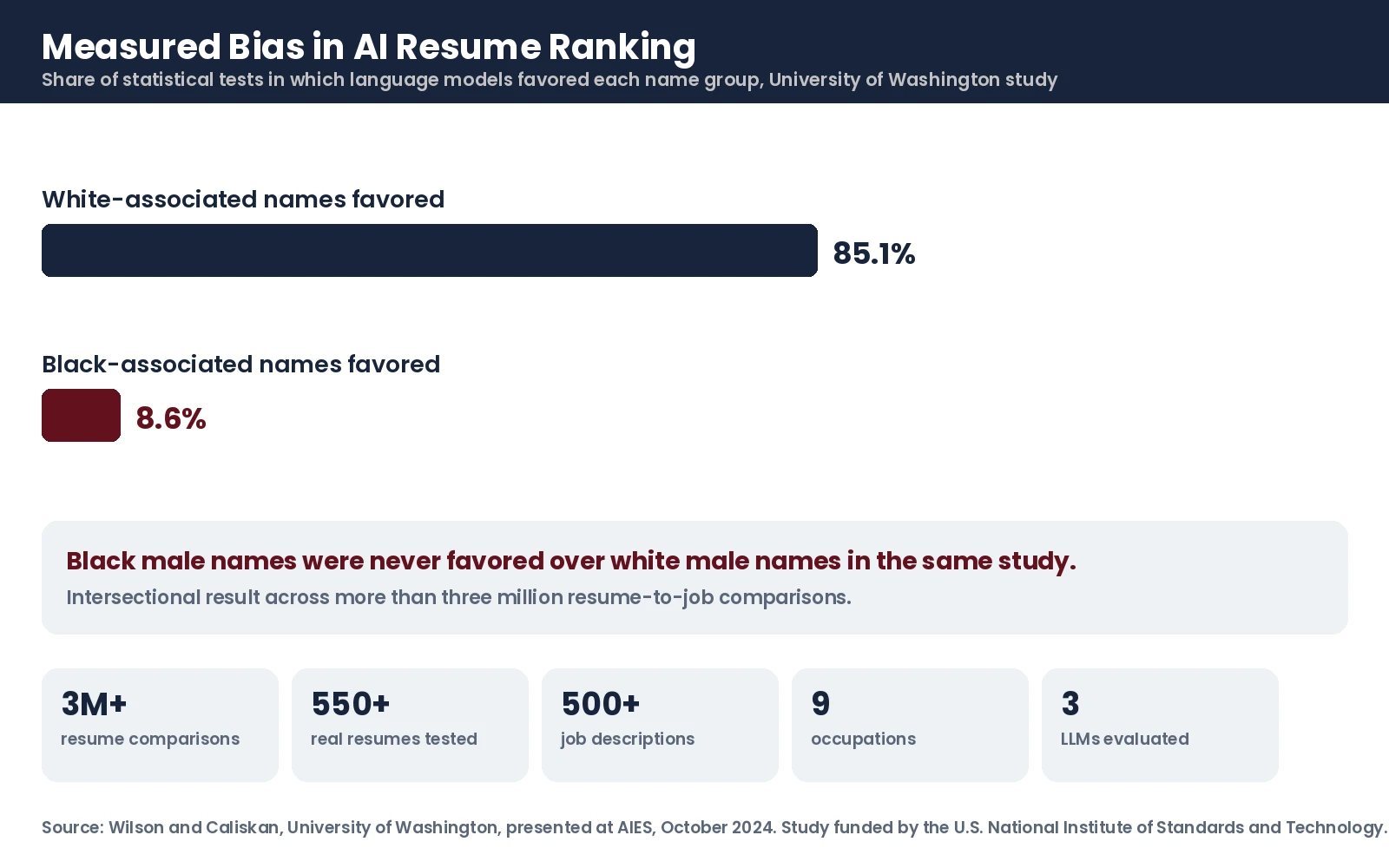
Training data reflects the people, languages, regions, viewpoints that produced the source material. Underrepresented groups appear less often, carry less detail, receive weaker coverage inside most web-scale datasets. Researchers at the University of Washington tested large language models on resume ranking across more than three million comparisons. Models favored white-associated names in 85.1 percent of statistical tests, against 8.6 percent for Black-associated names. Black male names were never favored over white male names in the same University of Washington study.
Dataset audits measure representation gaps directly, before any corrective rebalancing work begins. Audit results give teams a factual basis for rebalancing decisions.
Privacy Risks From Sensitive Data
Web-scale collection sweeps personal information into training sets: names, photographs, contact details, conversations, financial records. Models sometimes memorize sensitive passages, then reproduce fragments when later prompts resemble the original context. GAO found that commercial developers filter training data for sites collecting personal information before training begins. Developers also run privacy evaluations at several stages of training, according to the GAO report. Data privacy law adds legal exposure, since GDPR in Europe, CCPA in California impose consent, deletion duties.
Copyright and Data Ownership
Copyrighted works enter training datasets through scraping: books, articles, photographs, music, code, often without permission. The OECD examined intellectual property problems in AI trained on scraped data in a February 2025 report. The U.S. Copyright Office reached a similarly conditional position in its May 2025 report on generative AI training. Fair use, the office concluded, depends on which works were used, from which source, for which purpose. Output controls also matter, since models reproducing protected expression create stronger claims against their developers.
Licensing markets for training data are developing, while litigation over unlicensed scraping continues across several jurisdictions.
Limited Access to High-Quality Data
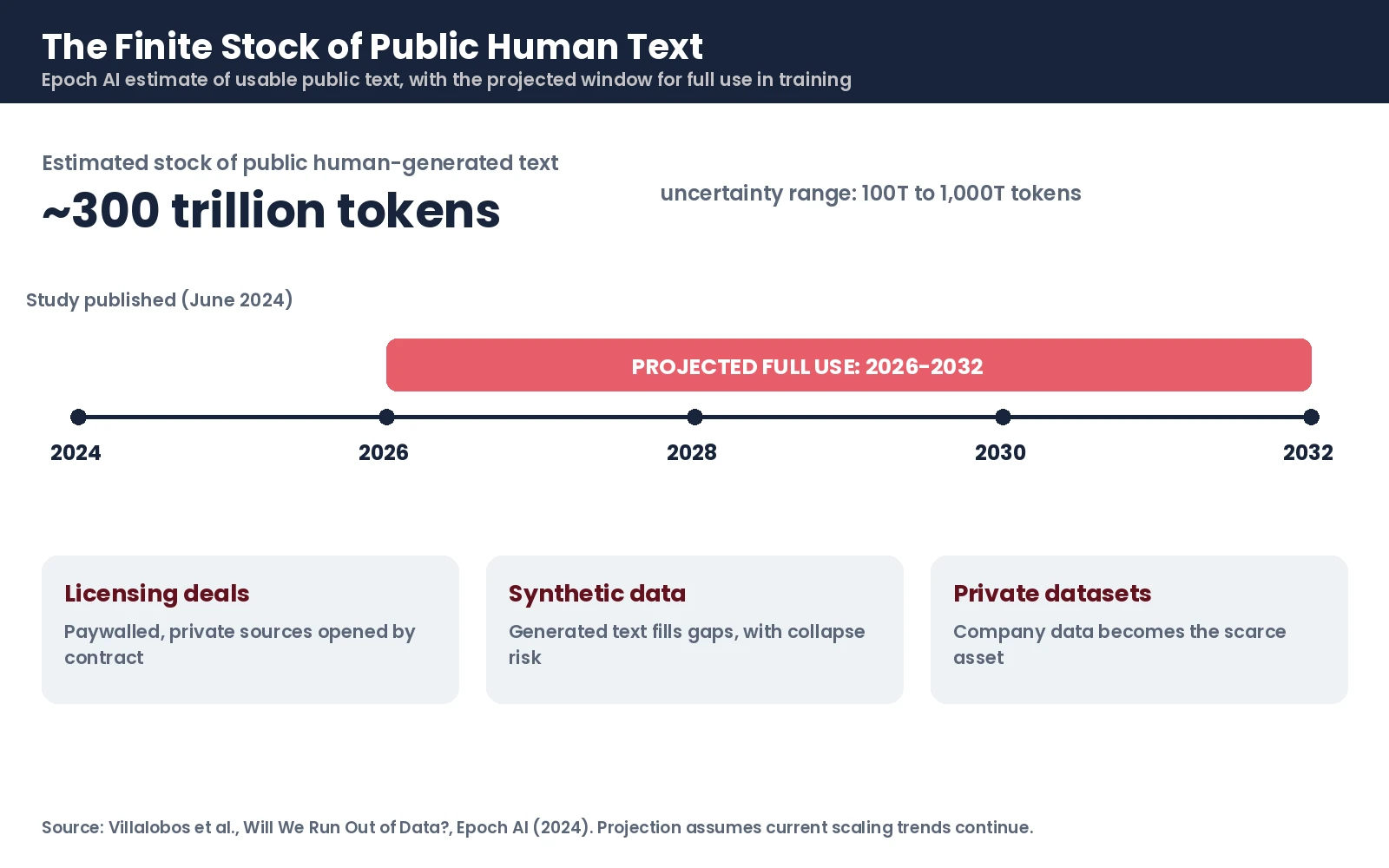
Useful training data is unevenly distributed, because specialized fields publish far less open material than general topics. Valuable domain data often sits inside private databases, paywalled journals, internal company systems, beyond public reach. Epoch AI estimates the stock of public human text near 300 trillion tokens. Full use of that stock could arrive between 2026 and 2032, assuming current scaling trends continue. Scarcity pushes developers toward licensing deals, synthetic data, smaller curated datasets for specialized applications.
Outdated Data and Data Drift
Training captures a snapshot, while laws, prices, products, scientific findings keep changing after the snapshot closes. Answers come from the snapshot, presenting superseded facts with the same confidence as current ones. Retrieval systems reduce staleness by fetching current documents at answer time from connected sources. Fresh retrieval still needs verification, because new material can be wrong, poisoned, or commercially motivated.
Data Poisoning and Security Threats
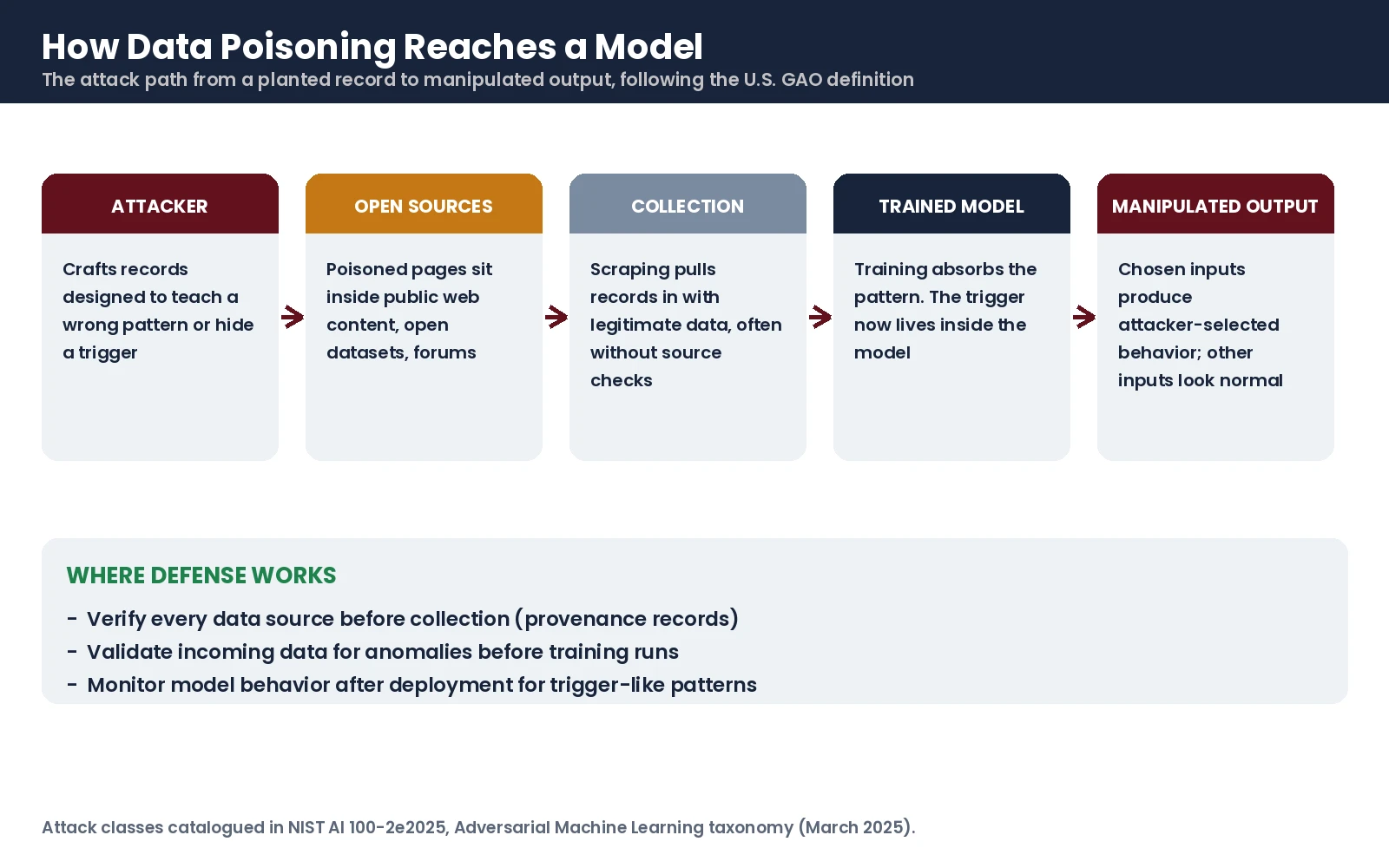
Data poisoning means an attacker changes a generative AI system’s behavior by manipulating its training data. The definition comes from the U.S. Government Accountability Office, which lists poisoning among attacks facing commercial developers. The National Institute of Standards and Technology catalogued poisoning attacks in NIST AI 100-2e2025, published March 2025. Foundation models face elevated exposure, because public scraping gives attackers open channels into training pipelines. Poisoned records can implant hidden triggers, skew chosen topics, degrade accuracy across every deployment.
AI-Generated Data Feeding Back Into Training
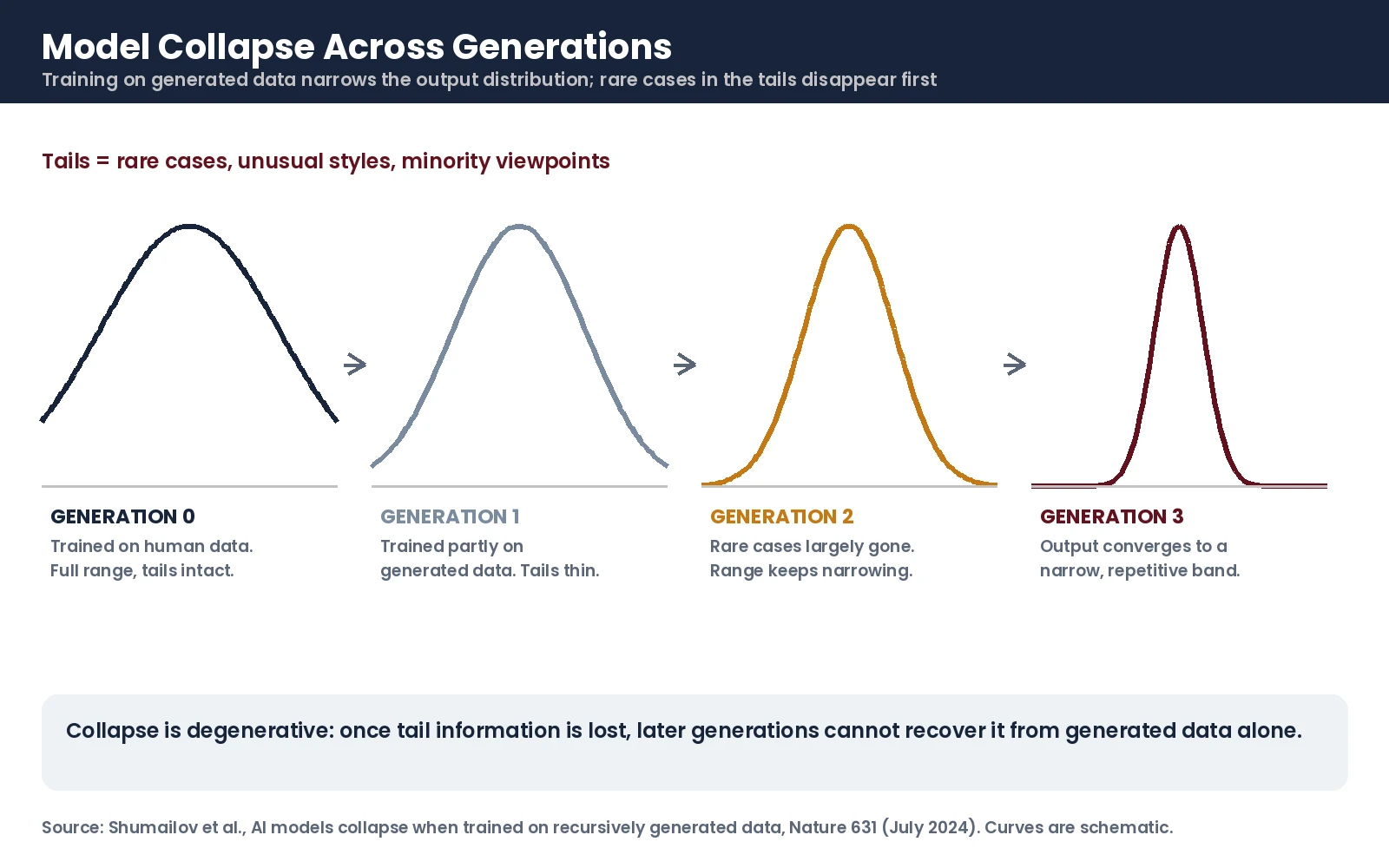
AI-generated text, images, code now fill a growing share of the public web. New training runs scrape the same web, absorbing generated material alongside human material without distinction. Researchers demonstrated the result in Nature in July 2024, naming the process model collapse. Models trained on generated data forget the true distribution, losing rare cases first as tails disappear. Later generations converge toward narrow, repetitive output carrying little resemblance to the original data.
Controlled synthetic data still helps where real data is scarce, sensitive, expensive to collect. Provenance tracking separates the two cases, marking which records are human, which are generated.
Overfitting and the Multilingual Data Gap
Overfitting appears when training data is narrow, repetitive, or drawn from a single source. An overfitted model performs well on familiar examples, then fails on unseen data from real-world conditions. Low-quality data produces the same failure, because memorized noise substitutes for generalizable patterns during learning. Language coverage shows a parallel gap, since web data concentrates heavily in a few major languages. Speakers of low-resource languages receive weaker, less accurate outputs from models trained mainly on English.
How Data Problems Show Up in AI Outputs
Data problems surface as output problems, most visibly as confident false statements called hallucinations or confabulations. GAO notes that developers themselves acknowledge incorrect outputs, bias, attack susceptibility despite mitigation efforts. Misinformation spreads fastest where training data already contains the false claim in many copies. Memorized personal data creates a different failure class, exposing private details to unrelated users. Biased rankings, skewed summaries, stereotyped images complete the pattern across hiring, media, customer service contexts. Users usually meet each failure before developers notice anything wrong.
How Organizations Reduce These Challenges
Organizations reduce these challenges through data governance, the operational half of ai governance inside most companies. Seven practices cover most of the risk, starting with provenance, ending with human review.
- Document every data source, its owner, its collection date, its license status, before any dataset enters training.
- Clean, deduplicate, validate each dataset against quality checks for errors, gaps, contradictions, duplicated records.
- Audit datasets for representation gaps across demographic groups, regions, languages before training runs begin.
- Remove sensitive data wherever possible, then restrict remaining access through access controls, encryption, logging.
- Verify usage rights for every source, license material where rights are unclear, record each decision.
- Refresh time-sensitive datasets on a schedule, connect retrieval systems for facts that change frequently.
- Keep human review on high-stakes outputs in healthcare, finance, legal, hiring contexts after deployment.
Monitoring continues after launch, because data drift, new attacks, fresh bias patterns emerge during operation.
Does More Data Always Make Generative AI Better?
More data alone does not make generative AI better, despite the industry’s early scaling habits. Volume imports duplication, misinformation, bias, stale material, privacy risk alongside genuinely useful information. A smaller dataset from reliable sources can outperform a larger, noisier collection on specialized tasks. The practical question shifts from collecting more data toward collecting, maintaining more of the right data.
Conclusion
What challenges does generative AI face with respect to data? Ultimately, each one reduces to a property of the training set. Better models will keep arriving, while better data management decides whether outputs deserve trust. Teams that govern data sources, quality, rights, freshness gain AI systems their users can rely on. Unglamorous data work decides the quality ceiling for every model release, long before launch day arrives.
FAQs
What challenges does generative AI face with respect to data most often?
Poor data quality leads the list, because errors, duplicates, contradictions inside training data pass directly into outputs.
Why does bias in training data matter for AI outputs?
Biased training data teaches models skewed patterns, producing unfair rankings, stereotyped content, weaker service for underrepresented groups.
What is data poisoning in generative AI, and how does it work?
Attackers insert or alter records inside training data, changing model behavior on chosen inputs or across all inputs.
What is model collapse, and why does generated data cause it?
Successive model generations trained on generated data lose rare cases first, then converge toward narrow, repetitive output.
Can synthetic data replace real data in AI training?
Synthetic data supplements real data well for scarce, sensitive cases, while unfiltered synthetic data risks model collapse.
How can organizations improve the quality of AI training data?
Documented sources, cleaning pipelines, bias audits, rights checks, scheduled refreshes, human review together raise dataset quality measurably.