Introduction
A research dossier for a target company brings critical business information into one organized, evidence-based document. It helps you understand a company’s background, products, leadership, business model, financial performance, competitors, risks, and growth opportunities. Instead of relying on a single website or unverified claim, a professional dossier compares information from multiple reliable sources.
Target company research supports investment decisions, competitor analysis, job preparation, sales outreach, partnerships, and business acquisitions. Useful research requires more than collecting basic facts. Every important detail needs verification for accuracy, date, context, and source reliability.
This guide explains how to create a complete research dossier for a target company, which information to include, where to find trustworthy data, and how to verify and organize your findings. Following this structured process produces a clear company research report that supports confident, informed decisions.
Why You Need a Dossier Before Reaching Out
A research dossier gives you an advantage before any business conversation. You enter discussions knowing the company’s situation, challenges, and priorities. This preparation separates professional outreach from generic pitches.
Instant Trust and Credibility
A well-researched dossier builds immediate credibility. When you reference specific details about a company’s recent product launch, leadership change, or market expansion, the other party notices. You demonstrate genuine interest rather than mass outreach.
People respond better when they sense you understand their business. Mentioning a recent funding round or a new office location shows you did homework. This small effort often determines whether a conversation continues or ends quickly.
Credibility comes from accuracy. A dossier with verified facts and proper sources prevents embarrassing mistakes. You avoid referencing outdated information or misattributing details to the wrong company.
Identifying Real Pain Points
A dossier reveals actual business challenges rather than assumed ones. You learn about hiring struggles, regulatory pressure, competitive threats, or supply chain issues. These insights help you frame conversations around genuine needs.
Pain points emerge from multiple sources. Job postings show where teams are stretched. News coverage reveals market pressures. Customer reviews expose service gaps. Combining these signals creates a clearer picture of where a company needs help.
Understanding pain points prevents wasted conversations. You avoid pitching solutions to problems the company does not have. Instead, you focus on areas where your offering creates measurable value.
Tailored Value Propositions
Generic pitches fail because they ignore context. A dossier lets you connect your product or service to specific company situations. You speak their language and reference their priorities.
Tailored propositions require knowing the company’s goals. A business expanding into new markets needs different support than one cutting costs. A company acquiring competitors needs integration help. A startup scaling operations needs process automation. The dossier tells you which scenario applies.
Value propositions also depend on timing. A company that just announced layoffs will not prioritize new spending. A company that raised funding will. The dossier captures these trigger events so you approach at the right moment.
What Is a Research Dossier for a Target Company?
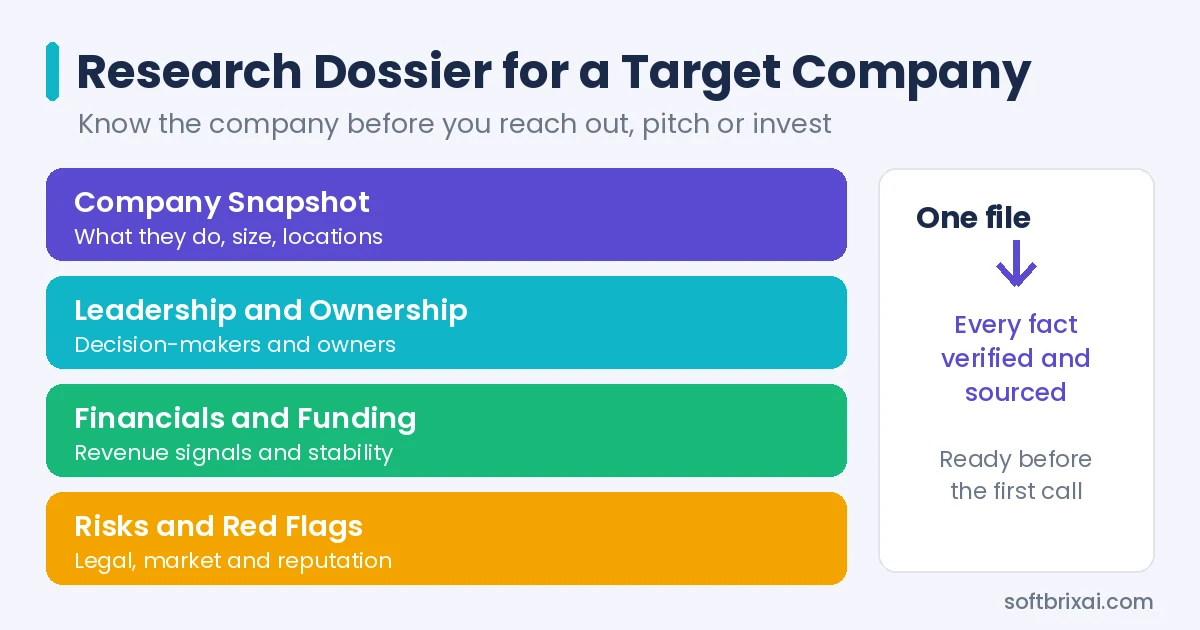
A research dossier for a target company is a structured report containing detailed, verified information about a business selected for investigation. The target may be a potential investment, acquisition, employer, business partner, customer, or competitor. The dossier organizes scattered company information into one clear document, making it easier to understand the organization and make informed decisions.
A complete dossier covers the company’s official identity, history, ownership, products, services, customers, leadership, business model, financial performance, competitors, and market position. It also highlights strengths, weaknesses, risks, and growth opportunities.
Unlike basic research, a dossier includes analysis and evidence from multiple sources. Information from the official website gets compared with annual reports, regulatory filings, government records, reputable news publications, and reliable industry sources. Each important finding includes its source and date so readers distinguish confirmed facts from company claims, estimates, and outdated information.
Research Dossier vs. Company Profile
A company profile provides a basic overview of a business. It covers identity, location, products, and leadership. A company profile answers “what does this company do?”
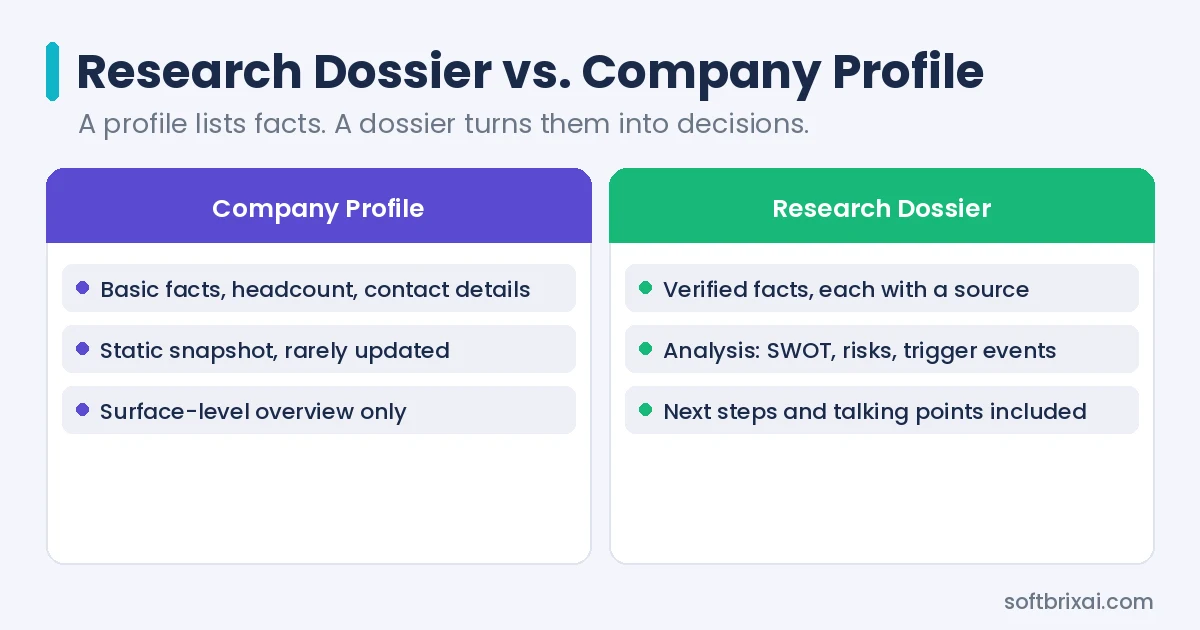
A research dossier goes deeper. It includes analysis, verification, and strategic context. A dossier answers “should we work with this company, invest in it, compete against it, or acquire it?” It examines financial performance, competitor positioning, risks, and opportunities.
The evidence standard differs. Company profiles accept company-published information at face value. Research dossiers verify claims through independent sources. A profile might state “the company serves 500 clients.” A dossier confirms whether that number comes from audited reports, press releases, or estimates.
Who Uses a Research Dossier and Why
Sales teams use dossiers to prepare for outreach. They learn about prospects’ business models, pain points, and recent developments before making contact. This preparation increases response rates and meeting conversions.
Investors use dossiers to evaluate opportunities. They examine financial statements, market position, competitive dynamics, and management quality. A thorough dossier supports investment committee decisions and reduces risk.
Job seekers use dossiers to prepare for interviews. They understand company culture, leadership style, recent performance, and strategic direction. This knowledge helps them ask better questions and assess fit.
Business development teams use dossiers to evaluate partnerships. They assess potential partners’ capabilities, reputation, and strategic alignment. A dossier reveals whether a partnership makes sense before negotiations begin.
Procurement teams use dossiers for vendor evaluation. They check financial stability, operational capacity, compliance history, and customer satisfaction. A dossier reduces supply chain risk.
Competitive intelligence teams use dossiers to track rivals. They monitor product launches, pricing changes, marketing campaigns, and strategic moves. Dossiers support competitive response planning.
Step-by-Step: How to Build Your Dossier
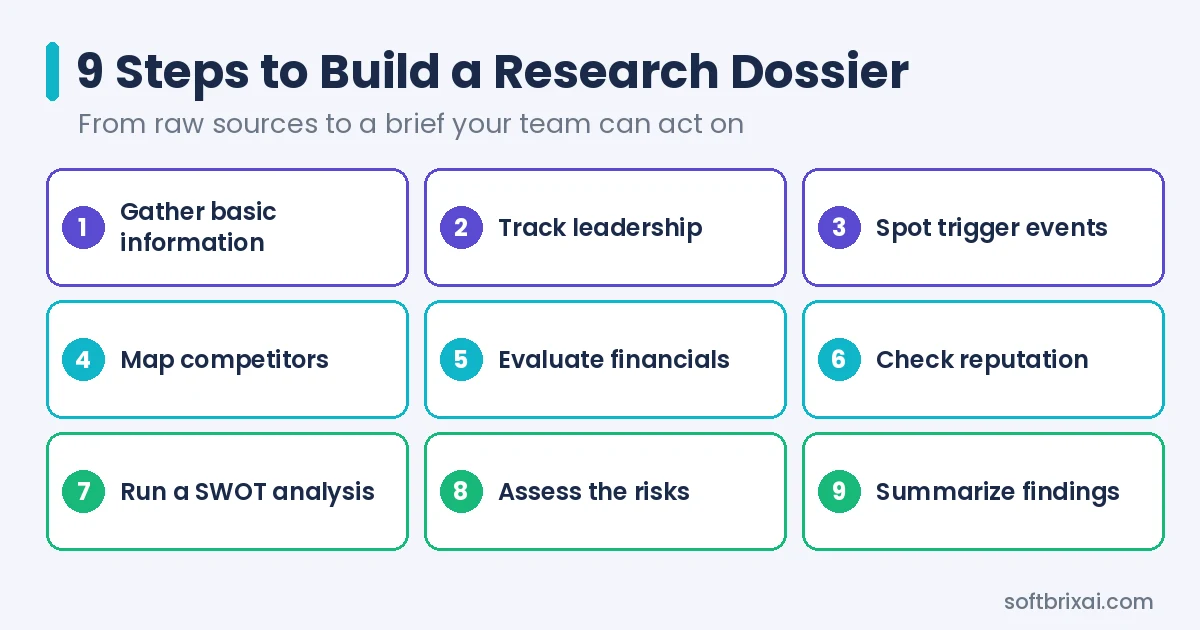
Building a research dossier follows a structured process. Each step builds on previous findings, creating a complete picture of the target company. Follow these nine steps to produce a thorough, reliable report.
Step 1: Gather Basic Company Information
Start by confirming the company’s identity. Begin target company URL research to verify the official name, website, headquarters, founding year, industry, and ownership type. Check registration details through government business registries when available.
Company Snapshot
Create a one-page summary covering essential facts. Include the official name, website URL, headquarters location, founding year, industry classification, ownership type, and registration details. Add employee count, office locations, and key markets served.
Verify the company’s identity carefully. Multiple businesses sometimes share similar names. A company may operate under a trading name different from its registered legal name. Compare registration details, business addresses, and official web domains to prevent information from being assigned to the wrong organization.
Record the company’s background and history. Note founders, important milestones, acquisitions, ownership changes, and major business developments. This context helps explain the company’s current position.
Business Model
Analyze how the company generates revenue. Identify revenue sources, customer segments, pricing models, distribution channels, and key partnerships. Determine whether the business operates through subscriptions, transactions, licensing, consulting, or a combination.
Review the value proposition. What problem does the company solve? Who are its target customers? What makes its offering different from alternatives? These answers shape your understanding of competitive positioning.
Examine operating methods. Does the company sell directly or through partners? Does it manufacture or outsource? Does it serve businesses or consumers? These details reveal operational strengths and vulnerabilities.
Products and Technology
List the company’s main products and services. Note pricing structures, target customers, and distribution channels. Identify which offerings appear most important to revenue and growth.
Review technology platforms and intellectual property. Check patent filings through USPTO and Google Patents. Review technical documentation, product pages, and public announcements. Technology position affects competitive advantage and risk exposure.
Assess product maturity. Are offerings new and growing, established and stable, or declining? Product lifecycle stage influences investment decisions, partnership potential, and competitive dynamics.
Step 2: Track Leadership and Decision-Makers
Leadership research reveals how decisions get made and who influences strategy. Focus on verified professional information from official sources.
Leadership and Ownership
Identify founders, executives, board members, and major shareholders. Record names, positions, appointment dates, and professional backgrounds. Use company leadership pages, annual reports, regulatory filings, and business registries.
For publicly traded U.S. businesses, SEC EDGAR provides access to company filings and executive disclosures. Other countries maintain their own corporate registries with ownership and director information.
Distinguish between founders, directors, executives, and legal owners. These roles may overlap but carry different responsibilities. A founder may no longer hold an executive role. A board member may represent an investor rather than management.
Check for recent leadership changes. New CEOs, CFOs, or board members often signal strategic shifts. Departures may indicate internal conflict, performance issues, or disagreements over direction. These signals matter for partnership, investment, and sales decisions.
Review executive backgrounds for relevant experience. Leaders who previously worked at competitors, regulators, or key customers bring valuable relationships and insights. Their career history reveals priorities and management style.
Step 3: Analyze Recent Trigger Events
Trigger events create openings for conversations. They signal when a company needs new solutions, partnerships, or support. Timing outreach around these events increases relevance and response rates.
Recent News
Review news coverage from the past six to twelve months. Look for product launches, funding announcements, leadership changes, partnerships, acquisitions, expansions, layoffs, and legal developments. Each event creates potential opportunities or risks.
Check the company’s newsroom and press releases for official announcements. Compare these with independent coverage from reputable news publications and industry sources. Independent reporting often provides context and analysis missing from company statements.
Note the tone and framing of coverage. Positive coverage suggests momentum and stability. Negative coverage signals challenges that may affect decisions. Neutral coverage provides factual updates without editorial spin.
Create a timeline of significant events. This helps identify patterns and understand the company’s trajectory. A company that recently raised funding and hired aggressively is in growth mode. A company facing lawsuits and executive departures is in crisis mode.
Hiring and Growth Signals
Job postings reveal strategic priorities. Companies hire for what they plan to build or expand. A surge in sales roles signals go-to-market investment. Engineering hiring indicates product development focus. Compliance and legal hiring suggests regulatory pressure.
Review job descriptions for technology mentions, reporting structures, and required skills. These details reveal internal systems, team organization, and capability gaps. A company hiring data scientists is investing in analytics. A company hiring customer success managers is focused on retention.
Track headcount trends through LinkedIn and company career pages. Rapid growth strains operations and creates demand for scalable solutions. Flat or declining headcount suggests cost cutting or stagnation.
Note office openings, expansions, or closures. Geographic moves reveal market priorities and operational strategy. New offices in specific regions signal expansion plans. Office closures indicate consolidation or retrenchment.
Step 4: Map Out Competitors and Industry Trends
Competitive context shapes every business decision. Understanding the competitive landscape helps you assess the target company’s position, strengths, and vulnerabilities.
Market and Competitors
Identify direct competitors offering similar products to similar customers. Then consider indirect competitors solving similar problems through different approaches. A project management software company competes with other platforms and with spreadsheets, email, and manual processes.
Compare competitors across key dimensions. Examine product features, pricing, target customers, market share, distribution channels, and brand reputation. This comparison reveals the target company’s competitive advantages and gaps.
Assess market position. Is the company a leader, challenger, follower, or niche player? Market position affects strategic options, partnership value, and investment potential. Leaders defend share. Challengers attack incumbents. Followers copy successful strategies. Niche players specialize.
Review industry trends. Note regulatory changes, technology shifts, customer preference evolution, and competitive dynamics. These trends create opportunities and threats that shape strategy.
Step 5: Evaluate Financial Performance
Financial analysis reveals business health, growth trajectory, and risk exposure. Access financial statements, annual reports, investor presentations, and securities filings for public companies. Private company financials are harder to obtain but may appear in press releases, funding announcements, or industry reports.
Financials or Funding
For public companies, review revenue, profit, margins, cash flow, assets, liabilities, and growth trends. Compare figures across multiple periods to identify patterns. Check whether growth is accelerating, stable, or declining.
For private companies, review funding history, investor lists, and valuation estimates. Crunchbase, PitchBook, and news coverage provide funding data. Note total capital raised, valuation at last round, and investor quality.
Assess financial stability. Can the company fund operations from revenue, or does it depend on external financing? Companies burning cash need continued funding. Companies generating profit have more strategic flexibility.
Review capital allocation. How does the company spend money? Heavy R&D investment signals innovation focus. Sales and marketing investment indicates growth priority. Debt repayment suggests deleveraging. Acquisition spending reveals consolidation strategy.
Step 6: Evaluate Reputation and Customer Experience
Reputation affects customer acquisition, retention, partnership potential, and talent recruitment. Customer experience drives loyalty and word-of-mouth. Both factors influence business outcomes.
Customer Review Platforms
Check review platforms relevant to the company’s industry. G2, Capterra, and TrustRadius cover software. Yelp and Google Reviews cover local businesses. Glassdoor and Indeed cover employer reputation. Industry-specific platforms exist for healthcare, finance, and other sectors.
Analyze review patterns. Look for recurring praise and complaints. Common themes reveal genuine strengths and weaknesses. Isolated negative reviews matter less than consistent patterns.
Note review volume and recency. High volume with recent reviews provides reliable signal. Low volume or old reviews limit confidence. Check whether the company responds to reviews and how it handles criticism.
Compare ratings across platforms. Consistent ratings suggest reliable signal. Divergent ratings may indicate different customer segments or review manipulation. Investigate discrepancies before drawing conclusions.
Step 7: Conduct a SWOT Analysis
SWOT analysis organizes findings into strengths, weaknesses, opportunities, and threats. This framework connects internal capabilities with external conditions.
List internal strengths. These include strong brand recognition, proprietary technology, talented leadership, loyal customers, efficient operations, and healthy finances. Every strength should be supported by evidence from your research.
List internal weaknesses. These include limited market share, dependence on few customers, outdated technology, leadership gaps, weak finances, and operational inefficiencies. Weaknesses reveal vulnerabilities that competitors or market changes could exploit.
List external opportunities. These include emerging markets, regulatory changes favoring the company, competitor weaknesses, technology shifts, and changing customer needs. Opportunities represent potential growth paths.
List external threats. These include new competitors, substitute products, regulatory pressure, economic downturns, supply chain disruptions, and changing customer preferences. Threats reveal risks to current performance.
Support every SWOT point with evidence. Avoid speculation. If you cannot verify a strength or weakness, note it as an area requiring further research rather than presenting it as fact.
Step 8: Assess Major Risks
Risk assessment identifies factors that could harm the company’s performance, reputation, or viability. Understanding risks helps you evaluate opportunities and prepare contingency plans.
Risks and Red Flags
Financial risks include excessive debt, cash flow problems, revenue concentration, customer churn, and dependence on external funding. These risks threaten solvency and strategic flexibility.
Operational risks include supply chain disruptions, key person dependence, technology failures, quality problems, and capacity constraints. These risks affect delivery and customer satisfaction.
Competitive risks include new entrants, substitute products, price wars, and loss of market share. These risks erode revenue and margins.
Reputational risks include negative press, customer complaints, employee lawsuits, and social media backlash. These risks damage brand value and customer trust.
Identify Legal, Regulatory, and Operational Risks
Legal risks include pending lawsuits, contract disputes, intellectual property conflicts, and compliance violations. Check court records, regulatory databases, and news coverage for legal issues.
Regulatory risks include changing rules, licensing requirements, and enforcement actions. Regulated industries face constant compliance pressure. Note pending legislation or regulatory reviews that could affect operations.
Operational risks include single points of failure, geographic concentration, and dependence on key suppliers or partners. These risks create vulnerability to disruptions.
Assign likelihood and impact ratings to each risk. High-likelihood, high-impact risks deserve immediate attention. Low-likelihood, low-impact risks can be monitored. This prioritization helps focus analysis and recommendations.
Step 9: Summarize the Findings
The summary connects research findings to your original objective. It highlights key insights, unresolved questions, and recommended next steps.
Summary and Recommended Next Steps
Restate the research objective. Why did you create this dossier? What decision does it support? This framing keeps the summary focused and relevant.
Highlight the most important findings. What are the company’s key strengths and weaknesses? What opportunities and risks matter most? What competitive position does it hold? What financial trends are evident?
Note unresolved questions. What information could not be verified? What requires further investigation? What assumptions need testing? Acknowledging gaps builds credibility and guides next steps.
Recommend next steps. Should you proceed with outreach, investment, partnership, or acquisition? What additional research is needed? What conditions should trigger a follow-up review? Clear recommendations make the dossier actionable.
How to Verify Target Company Information
Verification separates reliable research from speculation. Every important claim should be checked against trustworthy sources and clearly labeled by confidence level.
Best Sources to Feed the AI
AI tools produce better output when fed reliable sources. The following sources provide high-quality information for dossier generation.
Company websites and investor relations pages
Official company websites provide foundational information. Review the About, Products, Leadership, Careers, Newsroom, and Investor Relations sections. Investor Relations pages offer annual reports, financial statements, investor presentations, and press releases for public companies.
Company-published information reflects the company’s preferred narrative. Treat it as company claims rather than independent facts. Verify important details through external sources before presenting them as confirmed.
Business registries and SEC EDGAR filings
Government business registries confirm legal identity, ownership, and registration details. Each country maintains its own registry system. In the United States, state-level registries handle business incorporation.
SEC EDGAR provides securities filings for publicly traded U.S. companies. Annual reports (10-K), quarterly reports (10-Q), and current reports (8-K) contain detailed financial and operational information. These filings carry legal liability for accuracy, making them highly reliable.
Reputable news outlets and industry publications
Established news organizations and trade publications provide independent coverage. They report on company developments, market trends, and competitive dynamics. Editorial standards ensure basic fact-checking.
Prioritize publications with strong reputations for accuracy. Industry-specific publications often provide deeper coverage than general news outlets. Note publication dates to ensure relevance.
Job postings and hiring announcements
Job postings reveal strategic priorities, technology stacks, team structures, and capability gaps. They provide insight into what companies plan to build or expand.
Hiring announcements signal growth and investment. Layoff announcements indicate cost cutting or restructuring. Both types of events affect company trajectory and create conversation opportunities.
USPTO and Google Patents
Patent filings reveal innovation focus and intellectual property position. USPTO provides official records for U.S. patents. Google Patents offers searchable access to patents worldwide.
Review patent portfolios for technology areas, filing dates, and citation patterns. Strong patent portfolios signal innovation capability. Declining filings may indicate reduced R&D investment.
How to Prioritize Sources by Reliability
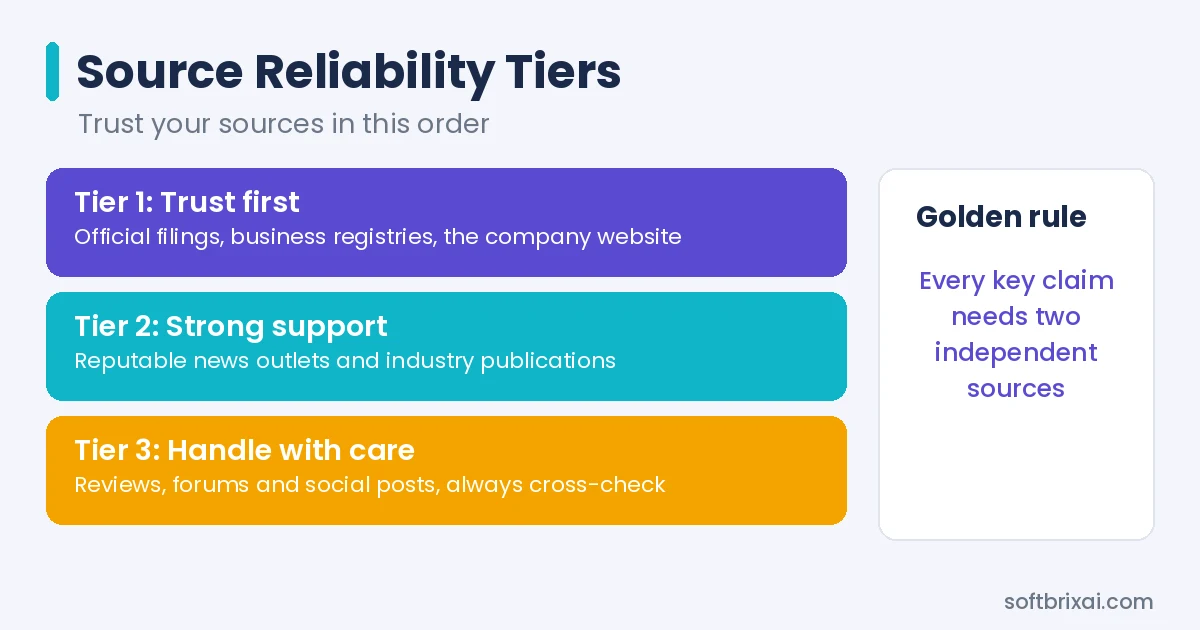
Not all sources carry equal weight. Prioritize sources by reliability to ensure accurate research.
Primary sources rank highest. These include official documents, regulatory filings, court records, and direct company statements. Primary sources provide original information without interpretation.
Secondary sources rank next. These include news reports, industry analyses, and expert commentary. Secondary sources interpret primary information and may introduce bias or error.
Tertiary sources rank lowest. These include encyclopedias, directories, and aggregated data. Tertiary sources compile information from other sources and may contain outdated or simplified content.
Within each category, consider source reputation, editorial standards, and potential conflicts of interest. A regulatory filing carries more weight than a press release. A major newspaper carries more weight than an anonymous blog.
Source Verification and Fact-Checking
Verify important claims through at least two independent sources. Check whether both sources refer to the same reporting period and use consistent definitions.
Separate information into four categories. Confirmed facts are verified through reliable sources. Company claims are statements from the company that lack independent verification. Third-party estimates are projections or analyses from external parties. Unverified details are information that cannot be confirmed.
Record source details for every important finding. Include source title, URL, publication date, access date, and key information taken from each source. This evidence log makes research transparent and allows updates when information changes.
Check for common errors. Outdated information, misattributed quotes, and confused company identities cause problems. Verify dates and company names carefully. Compare details across sources to catch inconsistencies.
Using AI to Build a Research Dossier
AI tools accelerate research dossier generation by gathering, organizing, and summarizing information. They handle repetitive tasks and surface patterns humans might miss. Human judgment remains essential for verification and analysis.
Common Business Use Cases
Sales teams use AI to research prospects before outreach. AI gathers company information, identifies trigger events, and suggests talking points. This preparation increases response rates and meeting quality.
Investors use AI to screen opportunities and gather preliminary intelligence. AI summarizes financial data, identifies risks, and compares competitors. This accelerates initial evaluation and focuses human analysis on promising targets.
Partnership teams use AI to evaluate potential partners. AI researches capabilities, reputation, and strategic fit. This supports partnership decisions and negotiation preparation.
Competitive intelligence teams use AI to monitor competitors. AI tracks product launches, pricing changes, and marketing campaigns. This provides early warning of competitive threats and opportunities.
Procurement teams use AI for vendor evaluation. AI checks financial stability, compliance history, and customer satisfaction. This reduces supply chain risk and supports vendor selection.
AI Limitations and the Importance of Human Analysis
AI tools have significant limitations. They can generate plausible-sounding but incorrect information. They may cite sources that do not exist or misattribute claims. They cannot verify facts independently.
AI lacks business judgment. It can summarize information but cannot assess strategic implications. It cannot evaluate management quality, cultural fit, or negotiation dynamics. These judgments require human expertise.
AI may miss context. It processes information without understanding industry nuances, competitive dynamics, or organizational politics. Human analysts catch these subtleties and adjust interpretations.
AI reflects training data limitations. It may have outdated information or gaps in coverage. It may inherit biases from training sources. Human analysts verify AI output against current, reliable sources.
Use AI as a research assistant, not a replacement for human analysis. AI gathers and organizes information. Humans verify, interpret, and decide.
Copy-Paste AI Prompt for a Target Company Dossier
Use this prompt to generate a research dossier for a target company. Customize the bracketed sections for your specific needs.
“You are a business research analyst. Create a comprehensive research dossier for [COMPANY NAME] to support [DECISION TYPE: sales outreach / partnership evaluation / investment analysis / vendor assessment].
Research and organize information on the following:
- Company Overview: Official name, website, headquarters, founding year, industry, ownership type, employee count, and key markets.
- Business Model: Revenue sources, customer segments, pricing model, distribution channels, and value proposition.
- Products and Services: Main offerings, target customers, technology platforms, and intellectual property.
- Leadership: Founders, executives, board members, and recent leadership changes.
- Financial Performance: Revenue, funding, profitability, and growth trends from available sources.
- Recent News: Product launches, partnerships, acquisitions, and other significant events from the past 12 months.
- Competitors: Direct and indirect competitors, market position, and competitive advantages.
- Risks: Financial, operational, legal, regulatory, and reputational risks.
- Opportunities: Growth potential, market trends, and strategic options.
For every claim, provide the source URL and publication date. Label each finding as: Confirmed Fact (verified through reliable sources), Company Claim (from company statements), Third-Party Estimate (from external analysis), or Unverified (could not confirm).
Do not fabricate information. If data is unavailable, state that clearly. Prioritize recent sources and official documents.”
Source Citation and Fact-Checking Rules
Require AI to cite sources for every important claim. Check that cited sources exist and contain the referenced information. AI sometimes generates plausible URLs that lead nowhere or misquotes source content.
Verify publication dates. AI may cite old sources as if they were current. Check whether cited information reflects the company’s current situation.
Cross-check AI output against original sources. Open cited URLs and confirm the information matches. Look for context the AI may have omitted or misinterpreted.
Flag unverified claims for human review. AI may present speculation as fact. Mark these claims and verify them before including in the final dossier.
How to Customize the Prompt for Sales, Partnerships, Investment, and Vendor Evaluation
Sales outreach prompts should emphasize pain points, trigger events, and conversation starters. Ask AI to identify recent changes that create opportunities and suggest personalized outreach angles.
Partnership evaluation prompts should emphasize capabilities, strategic fit, and partnership history. Ask AI to assess complementary strengths, potential conflicts, and collaboration models.
Investment analysis prompts should emphasize financial performance, market position, and risk factors. Ask AI to evaluate growth potential, competitive dynamics, and management quality.
Vendor evaluation prompts should emphasize operational reliability, compliance history, and customer satisfaction. Ask AI to assess financial stability, delivery capability, and reputation.
Tools for Company Discovery and Prospecting
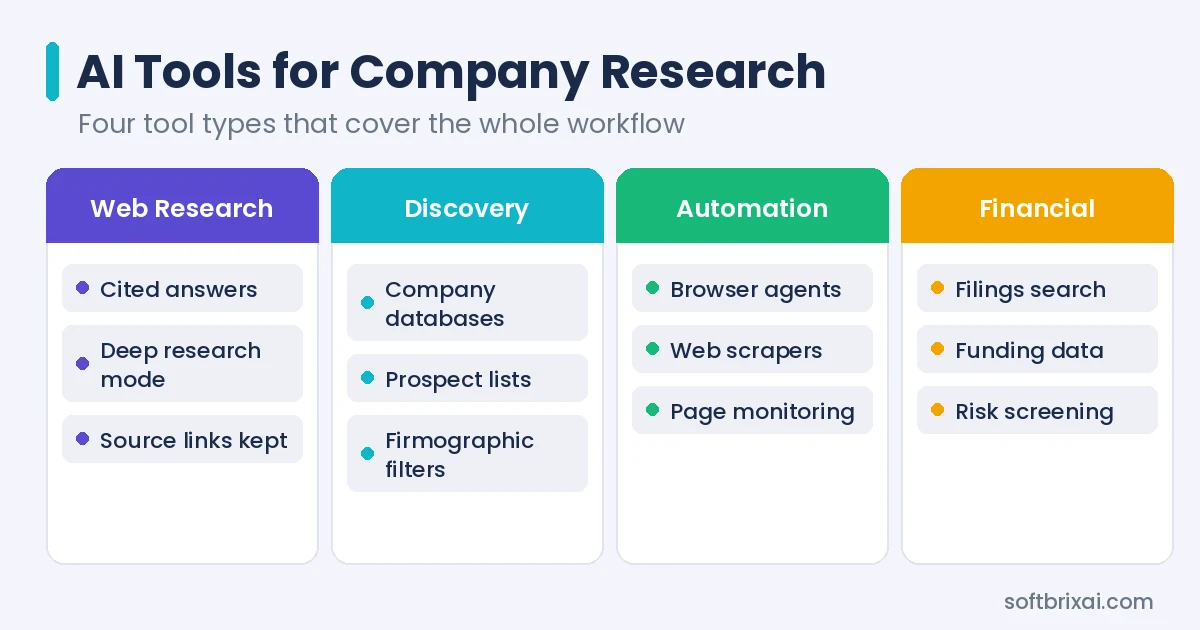
Several tools support company research and prospecting. Each serves different research needs.
AI Web Research and Citation Tools
Perplexity AI combines search with AI summarization and cites sources. It provides current information with links for verification.
ChatGPT with browsing enabled can research companies and provide sourced summaries. It works well for initial research but requires verification.
Claude with web access offers similar capabilities with strong analytical writing. It handles long documents and synthesizes information effectively.
Browser Automation and Web Scraping Tools
Apollo.io combines company data with contact information and outreach tools. It supports prospecting workflows.
ZoomInfo provides company and contact data for sales and marketing teams. It includes firmographic and technographic filters.
Clay aggregates data from multiple sources and enables automated research workflows. It supports personalized outreach at scale.
Sales and Account Research Tools
LinkedIn Sales Navigator provides company insights, employee data, and trigger events. It supports account-based research.
Crunchbase focuses on company funding, investors, and acquisitions. It works well for startup and growth-stage research.
PitchBook provides detailed financial data on private companies, investors, and deals. It supports investment research and due diligence.
Financial Research and Due Diligence Tools
Bloomberg Terminal provides comprehensive financial data, news, and analytics. It serves professional investors and analysts.
Dun & Bradstreet offers company credit reports, financial data, and risk assessments. It supports vendor evaluation and credit decisions.
LexisNexis provides legal, regulatory, and corporate records. It supports compliance and due diligence research.
Orbis from Bureau van Dijk covers private companies worldwide with financial and ownership data. It supports international research.
How to Choose the Right AI Research Tool
Match tools to research needs. Sales teams need contact data and trigger events. Investors need financial data and market analysis. Procurement teams need compliance and risk data.
Consider data coverage. Some tools focus on specific regions or company sizes. Check whether the tool covers your target companies.
Evaluate verification capabilities. Tools that cite sources allow fact-checking. Tools that provide unsourced summaries require more verification effort.
Assess integration with existing workflows. Tools that connect with CRM, email, or research platforms reduce friction and increase adoption.
Avoiding Common Pitfalls
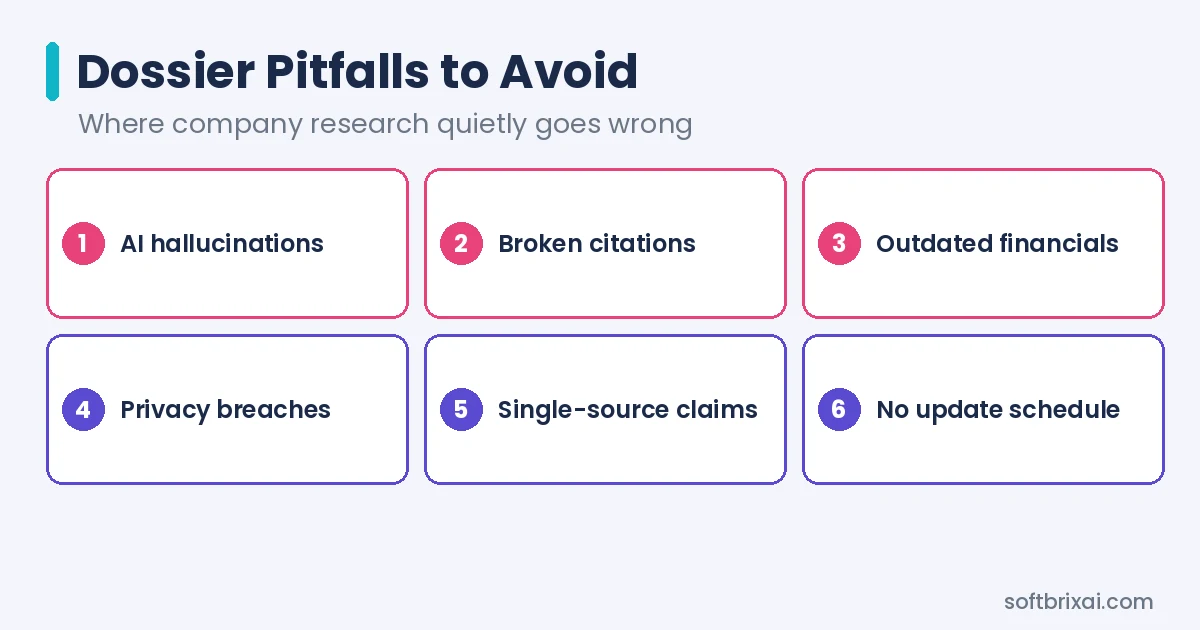
AI research introduces specific risks. Understanding these pitfalls helps you avoid errors and maintain research quality.
AI Hallucinations and Inaccurate Claims
AI models sometimes generate false information that sounds plausible. They may invent facts, misattribute quotes, or create fictional sources. These hallucinations undermine research reliability.
Verify every important claim against original sources. Do not trust AI output without checking. Treat AI-generated content as a draft requiring verification.
Watch for confident-sounding but unverifiable claims. AI presents speculation with the same tone as verified facts. Check whether cited sources actually support the claims.
Broken or Misleading Citations
AI may cite sources that do not exist or misquote source content. It may provide URLs that lead to unrelated pages or outdated articles.
Open every cited source and confirm the information matches. Check whether the source supports the specific claim, not just the general topic. Look for context the AI may have omitted.
Flag broken citations for manual research. If a source cannot be verified, find alternative sources or remove the claim.
Outdated Financial and Company Information
AI training data has cutoff dates. It may present old information as current. Company leadership, financials, and strategy change frequently.
Check publication dates on all sources. Prioritize recent information for time-sensitive claims. Verify current leadership, financials, and strategy through up-to-date sources.
Note the research date in your dossier. This helps readers understand when information was current and when it may need updating.
Data Privacy and Confidentiality
Research should respect privacy and confidentiality. Do not access non-public information through unauthorized means. Do not include personal information beyond what is relevant to business analysis.
Follow data protection regulations. GDPR, CCPA, and other laws govern personal data handling. Ensure research practices comply with applicable requirements.
Protect confidential information. If research reveals sensitive details, handle them appropriately. Do not share confidential information without authorization.
Cross-Checking Information With a Second Research Tool
Use multiple research tools to verify findings. Different tools draw from different sources and may surface different information.
Compare outputs from AI research tools, databases, and manual searches. Look for consistent findings across sources. Investigate discrepancies before drawing conclusions.
Cross-checking reduces reliance on any single tool’s limitations. It catches errors and fills gaps. It increases confidence in research findings.
Relying on a Single Source
Single-source research is fragile. One source may be biased, outdated, or incorrect. Multiple sources provide triangulation and confidence.
Verify important claims through at least two independent sources. Check whether sources agree on key facts. Investigate disagreements before presenting conclusions.
Even reliable sources make mistakes. Cross-referencing catches errors and ensures accuracy. A claim confirmed by multiple independent sources is more trustworthy than a claim from a single source.
How to Present Your Dossier to Your Team
Present research findings clearly and actionably. Your team needs to understand key insights and make decisions based on your research.
Start with an executive summary. Highlight the most important findings, risks, and recommendations. Keep it to one page so busy decision-makers can grasp key points quickly.
Organize findings by section. Follow the dossier structure with clear headings. Use tables and bullet points for easy scanning. Include source citations for every important claim.
Connect findings to decisions. Explain how each finding affects the decision at hand. A financial weakness matters more for investment decisions than for sales outreach. Tailor emphasis to the audience.
Include an appendix with detailed evidence. Provide source lists, methodology notes, and supporting data. This allows team members to verify findings and explore details.
Present verbally with slides. Walk through key findings and answer questions. Use visuals to illustrate patterns and comparisons. Allow discussion of implications and next steps.
Research Dossier Checklist
Use this checklist to ensure your dossier is complete and reliable.
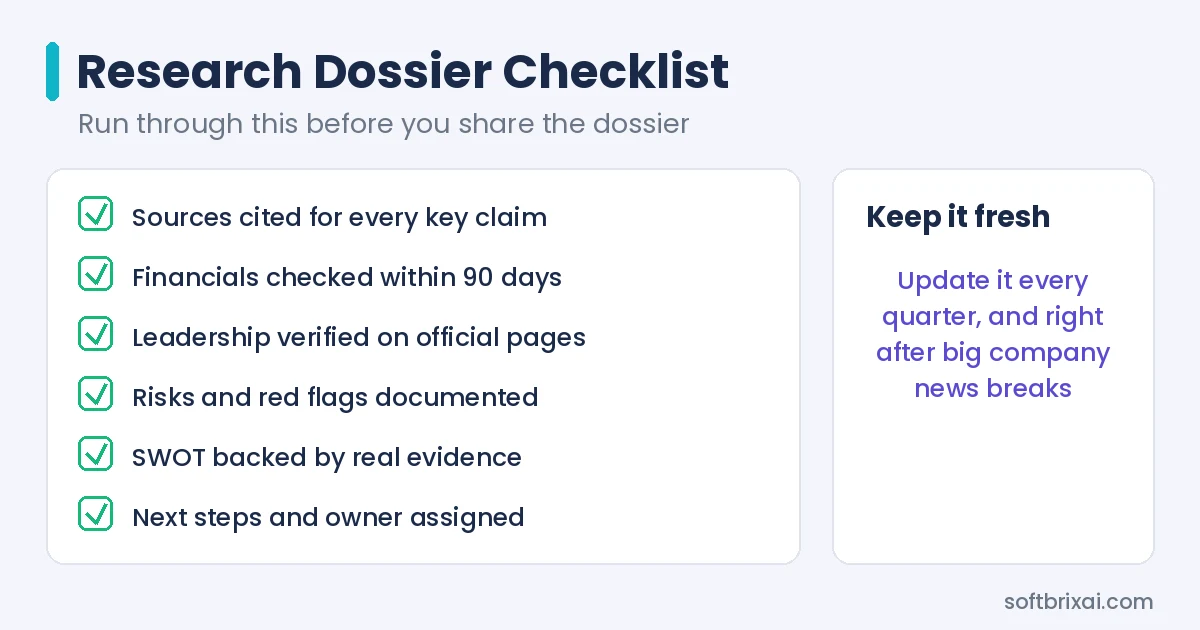
- Company identification: Official name, website, headquarters, founding year, industry, ownership type, and registration details verified.
- Background and history: Founders, milestones, acquisitions, and ownership changes documented.
- Products and services: Main offerings, pricing, target customers, value proposition, and distribution channels analyzed.
- Business model: Revenue sources, customer segments, partnerships, and operating methods explained.
- Leadership: Founders, executives, board members, and recent changes identified with sources.
- Financial performance: Revenue, profit, funding, and growth trends documented from reliable sources.
- Market and competitors: Market position, direct competitors, competitive advantages, and industry conditions analyzed.
- Reputation: Customer reviews, employee feedback, and news coverage reviewed.
- SWOT analysis: Strengths, weaknesses, opportunities, and threats identified with evidence.
- Risks: Financial, operational, legal, regulatory, and reputational risks assessed.
- Trigger events: Recent news, hiring signals, and strategic changes noted.
- Evidence log: Source title, URL, publication date, access date, and key findings recorded for every important claim.
How to Keep a Research Dossier Up to Date
Company information changes constantly. Set up monitoring to keep your dossier current.
Subscribe to company news and press releases. Follow the company on LinkedIn and other social platforms. Set Google Alerts for company name and key executives.
Review financial filings quarterly for public companies. Check for 10-Q and 8-K filings that reveal performance and material events.
Monitor job postings for hiring signals. Track leadership changes through LinkedIn and news coverage. Note product launches and partnership announcements.
Schedule regular dossier reviews. Quarterly updates work for most active research. Annual reviews suffice for stable companies. Event-driven updates handle major changes.
Record update dates and changes. Track what changed and when. This history helps understand company trajectory and assess information freshness.
Frequently Asked Questions
How can I verify target company information?
Verify target company information by comparing important details across at least two reliable sources. Check official company websites, annual reports, securities filings, government registries, regulatory databases, reputable news publications, and industry sources. Check publication dates and reporting periods to ensure relevance. Clearly separate confirmed facts from company claims, third-party estimates, and unverified information. Record source details for every important finding so others can verify your research.
What should a research dossier include?
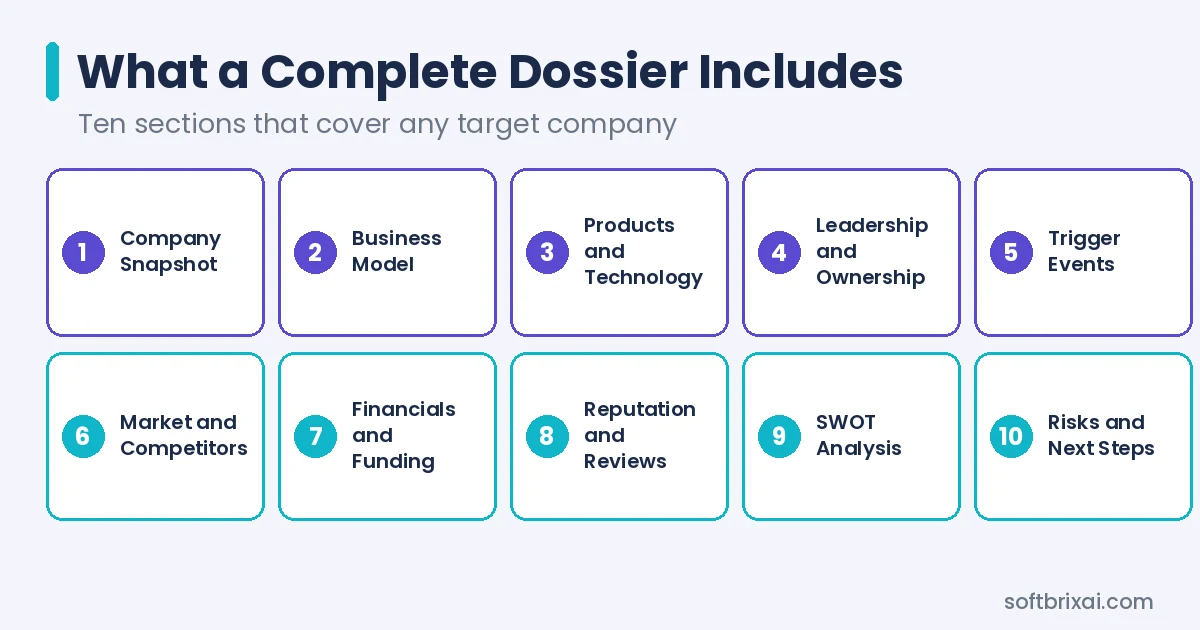
A research dossier should include company identification, background and history, products and services, business model, leadership and ownership, financial performance, market position, competitors, reputation, SWOT analysis, risk assessment, trigger events, and an evidence log. The exact contents vary by research objective. A sales dossier emphasizes pain points and trigger events. An investment dossier emphasizes financials and risks. A vendor evaluation emphasizes operational reliability and compliance.
How long should a company research dossier be?
A company research dossier typically ranges from 5 to 10 pages for basic research to 30 or more pages for comprehensive due diligence. Sales outreach dossiers may be 2 to 5 pages. Investment and acquisition dossiers often exceed 20 pages. Length should match research complexity and decision importance. Prioritize relevant, verified information over volume. A focused 10-page dossier with strong evidence outperforms a 50-page document filled with speculation.
How often should you update a research dossier?
Update a research dossier whenever the company announces major financial, leadership, ownership, product, or operational changes. For active decision-making, review time-sensitive information every three to six months. For ongoing monitoring, quarterly updates capture most significant changes. For stable companies with no active decisions pending, annual reviews suffice. Event-driven updates handle unexpected developments like acquisitions, lawsuits, or executive departures.
Is a research dossier the same as due diligence?
A research dossier is not the same as due diligence, though they overlap. A research dossier provides a broad overview of a company for various purposes like sales, partnerships, or initial investment screening. Due diligence is a deeper, more formal investigation conducted before major transactions like acquisitions or investments. Due diligence includes detailed financial audits, legal review, operational assessment, and verification of specific claims. A research dossier often precedes and informs due diligence.
Can AI create a complete company research dossier?
AI can accelerate research dossier generation but cannot create a complete, reliable dossier without human oversight. AI gathers information, summarizes findings, and identifies patterns. However, AI may hallucinate facts, cite non-existent sources, or miss important context. Human analysts must verify claims, assess strategic implications, and apply business judgment. Use AI as a research assistant that handles repetitive tasks while humans focus on verification and analysis.
Which sources are most reliable for company research?
The most reliable sources for company research are primary sources including regulatory filings, court records, government registries, and official company documents. SEC EDGAR filings carry legal liability for accuracy. Government business registries confirm legal identity and ownership. Reputable news publications and industry sources provide independent verification. Company websites provide useful information but reflect the company’s preferred narrative. Cross-reference important claims across multiple sources to ensure accuracy.
Conclusion
Creating a reliable research dossier for a target company requires more than collecting basic information from the company website. A strong dossier combines official records, financial documents, industry reports, reputable news sources, and independent evidence to present a complete and balanced view of the business.
Every important finding should be verified, dated, and linked to its original source. Confirmed facts must remain separate from company claims, third-party estimates, and unverified information. This approach makes the final report transparent, accurate, and easier to update.
By following a structured research framework, you can better understand a company’s background, business model, financial performance, competitors, strengths, risks, and growth opportunities. Whether the research supports an investment decision, partnership evaluation, job application, acquisition, or competitor analysis, a well-organized dossier provides the evidence needed to make more informed and confident decisions.
AI tools accelerate research dossier generation by gathering and organizing information. Human judgment remains essential for verification, analysis, and decision-making. Use AI as a research assistant while maintaining rigorous fact-checking and source verification standards.
The time invested in creating a thorough research dossier pays dividends. You enter conversations prepared. You make decisions with confidence. You avoid costly mistakes from incomplete or inaccurate information. A professional research dossier for a target company is an investment in better business outcomes.