
The Mac mini M5 Pro is the first Apple desktop that local AI fans can take seriously without apology. It packs up to 64GB of unified memory into the same small box, and that is the memory tier where genuinely large open models start to fit. For developers who want AI models running on their own desk, it changes the math.
Apple announced the new Mac mini and Mac Studio on August 25, 2026, and both lines went on general sale on September 22, 2026, running macOS 27. The headline is not raw chip speed. It is how much memory each machine can hold, why the range costs more than the M4 generation did, and what that means for anyone who runs AI models locally.
What Did Apple Launch?
Apple refreshed its whole compact desktop range in one move. The entry Mac mini now runs the M6 chip, Apple’s first chip built on a 2-nanometer process, with a 12-core CPU, a 12-core GPU and 16GB of unified memory. Above it sits the Mac mini with M5 Pro, aimed at heavier creative and development work. The Mac Studio line moved to the M5 Max and the M5 Ultra, for buyers who need far more memory than any mini can offer. MacRumors covered the launch as pre-orders opened on announcement day, and the machines reached general sale on September 22, as the Mac Observer reported.
| Model | Chip | Memory | Bandwidth | Starting price |
|---|---|---|---|---|
| Mac mini M6 | M6 | 16GB | 170GB/s | $899 |
| Mac mini M5 Pro | M5 Pro | 24GB, up to 64GB | 307GB/s | $1,699 |
| Mac Studio M5 Max | M5 Max | 36GB, up to 128GB | 614GB/s | $2,499 |
| Mac Studio M5 Ultra | M5 Ultra | 96GB, up to 512GB | 1.2TB/s | $5,499 |
Education pricing trims every machine in the range: $799 for the M6 mini, $1,599 for the M5 Pro mini, $2,299 for the M5 Max Studio and $5,099 for the M5 Ultra Studio. For most readers, though, the M5 Pro mini is the interesting one, because it is the cheapest Mac that can hold a large local model in memory.
Mac Mini M5 Pro Specs in Detail
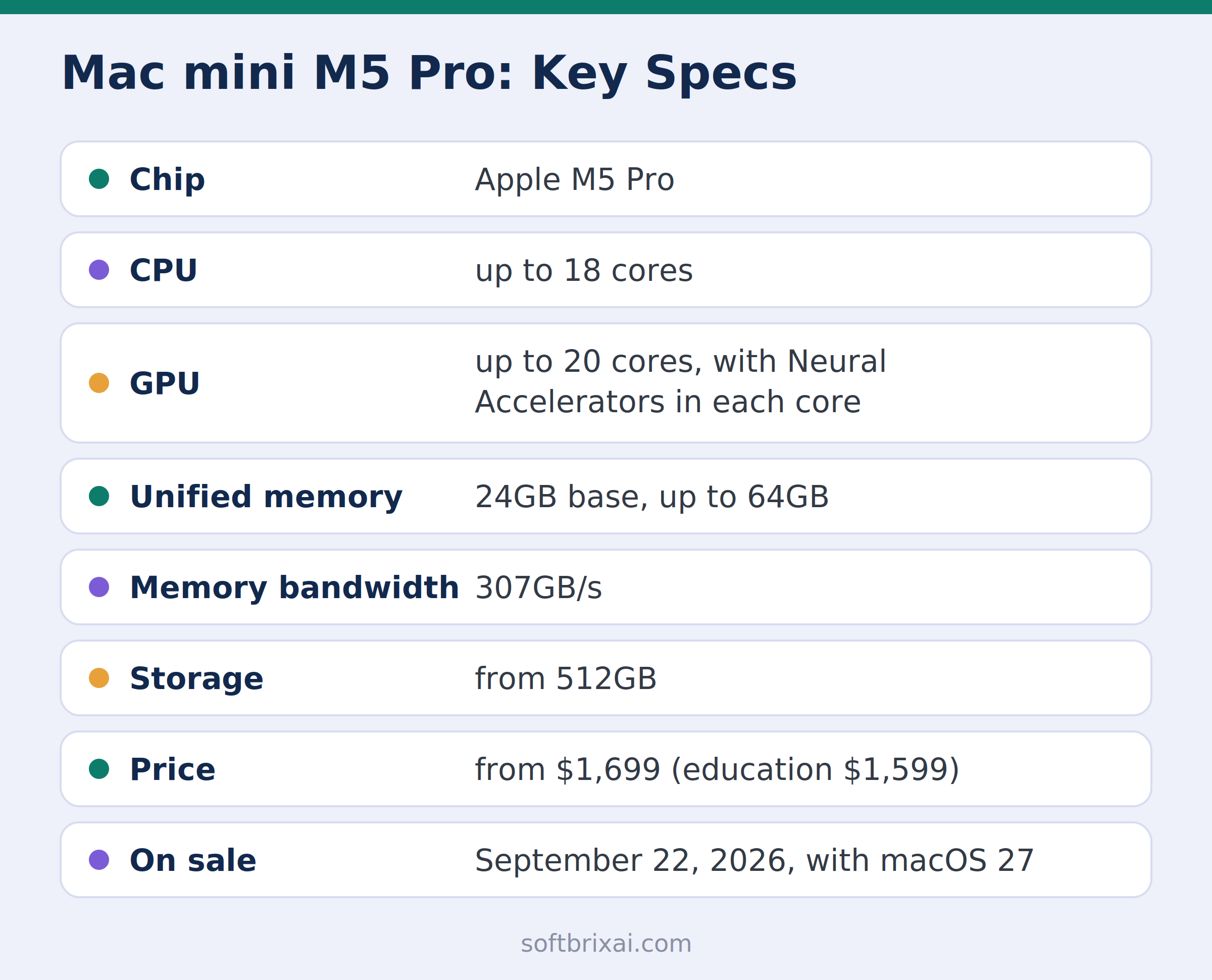
The base Mac mini M5 Pro costs $1,699, or $1,599 with education pricing. It comes with a 15-core CPU, a 16-core GPU, 24GB of unified memory and 512GB of storage. Memory bandwidth is 307GB/s, a figure that matters more for AI work than most buyers realize, because a model answers by reading its own weights from memory again and again.
The options list is where the machine gets serious. You can step up to an 18-core CPU and a 20-core GPU, and you can raise the unified memory as high as 64GB. Apple also built Neural Accelerators into the M5 Pro GPU cores, dedicated hardware that speeds up the kind of math AI models do all day. Push every option to the top, including the largest storage, and a fully loaded M5 Pro mini reaches $6,799, which shows how wide the range really is. The sensible AI configuration sits in the middle of it: the 24GB base machine is a starter, while the 64GB build is the one local AI fans will actually shop for.
Why Local AI Fans Care About Unified Memory
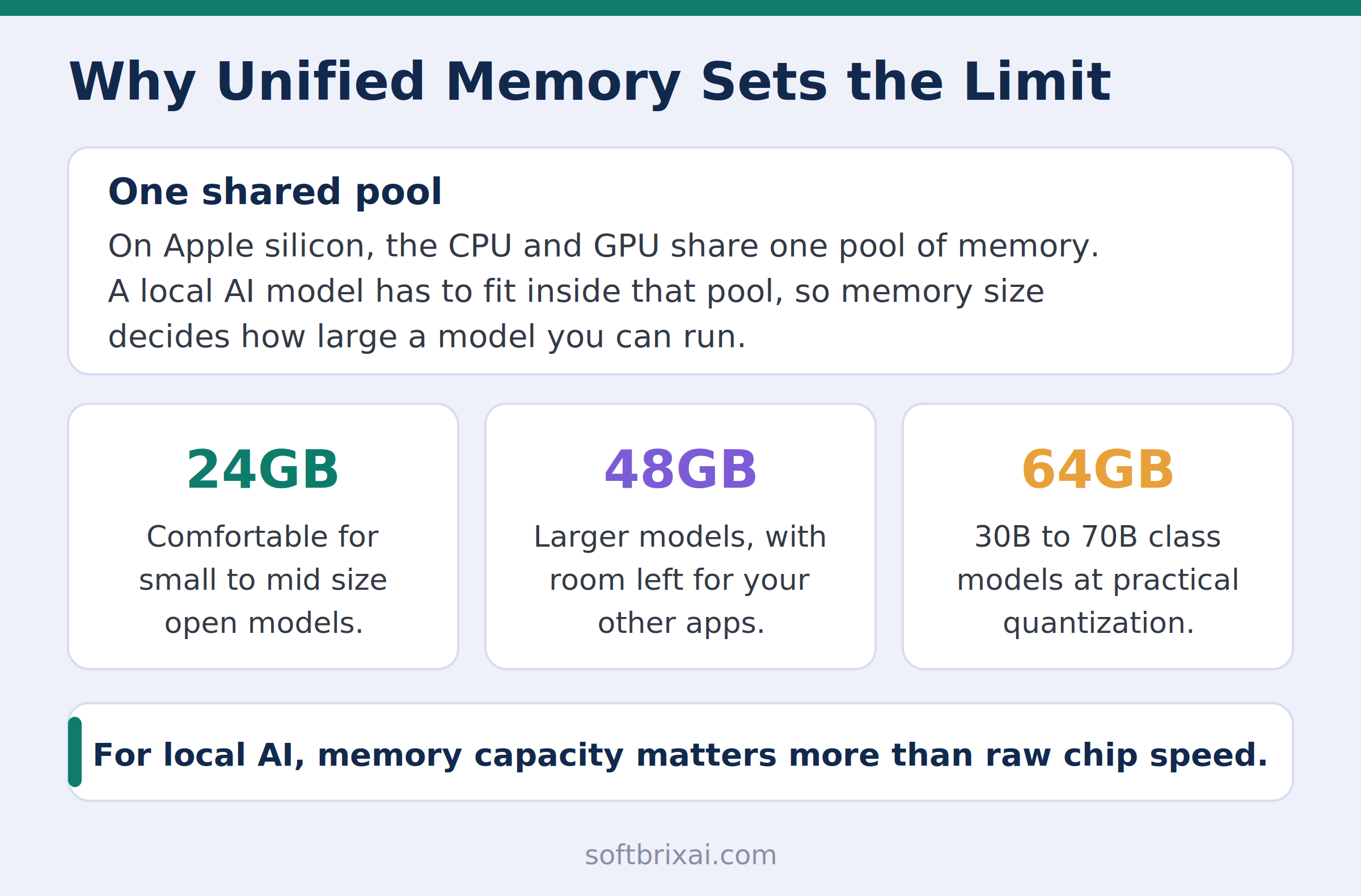
Local AI means running a model on your own machine instead of renting one from a cloud company, and on a Mac it lives or dies on one spec: unified memory. On Apple silicon, the CPU and the GPU share a single pool of memory rather than each keeping a separate supply. When you load a model, its weights sit in that shared pool, next to your operating system, your apps and the room the model needs to think. If the model does not fit, it does not run. That is why memory size, not the chip’s headline speed, sets the ceiling on how large a local model you can use.
Two habits make local models practical. First, people run quantized models, which store the weights in a compressed form. Compression shrinks the memory a model needs, so a bigger model fits in the same space, at a small cost in answer quality. Second, buyers match the machine to the model class before they pay. As a rule of thumb, a 24GB machine suits small to mid-size open models, the kind that handle chat, summaries and coding help well. A machine with 48GB to 64GB suits large models in the 30B to 70B class at practical quantization, the tier where local answers start to feel close to paid cloud services. Treat those tiers as guidance, not promises, because the operating system and your other apps always take a share of the pool first.
This is the ground floor of a bigger argument. When OpenAI’s Sam Altman called memory in home PCs a poor use of a scarce resource, local AI fans pushed back hard, and the Sam Altman RAM debate over local inference comes down to exactly this question: is memory better used busy in a data center, or sitting in a machine like this one, ready the moment its owner needs it? Machines like the M5 Pro mini are the local side’s best answer, because 64GB on a desk is finally enough memory to make the argument real.
That is why the memory choice is the whole purchase. A developer who mostly chats with small models, drafts code and tests prompts will live happily on the 24GB base machine and save real money. A developer who wants a 70B class model answering at the desk should go straight to the 64GB build and skip the middle steps, because unified memory is part of the chip itself, so the amount you order is the amount the machine keeps. Picking the wrong tier does not slow the machine down. It rules whole model classes out.

Why the Price Went Up: Blame Memory
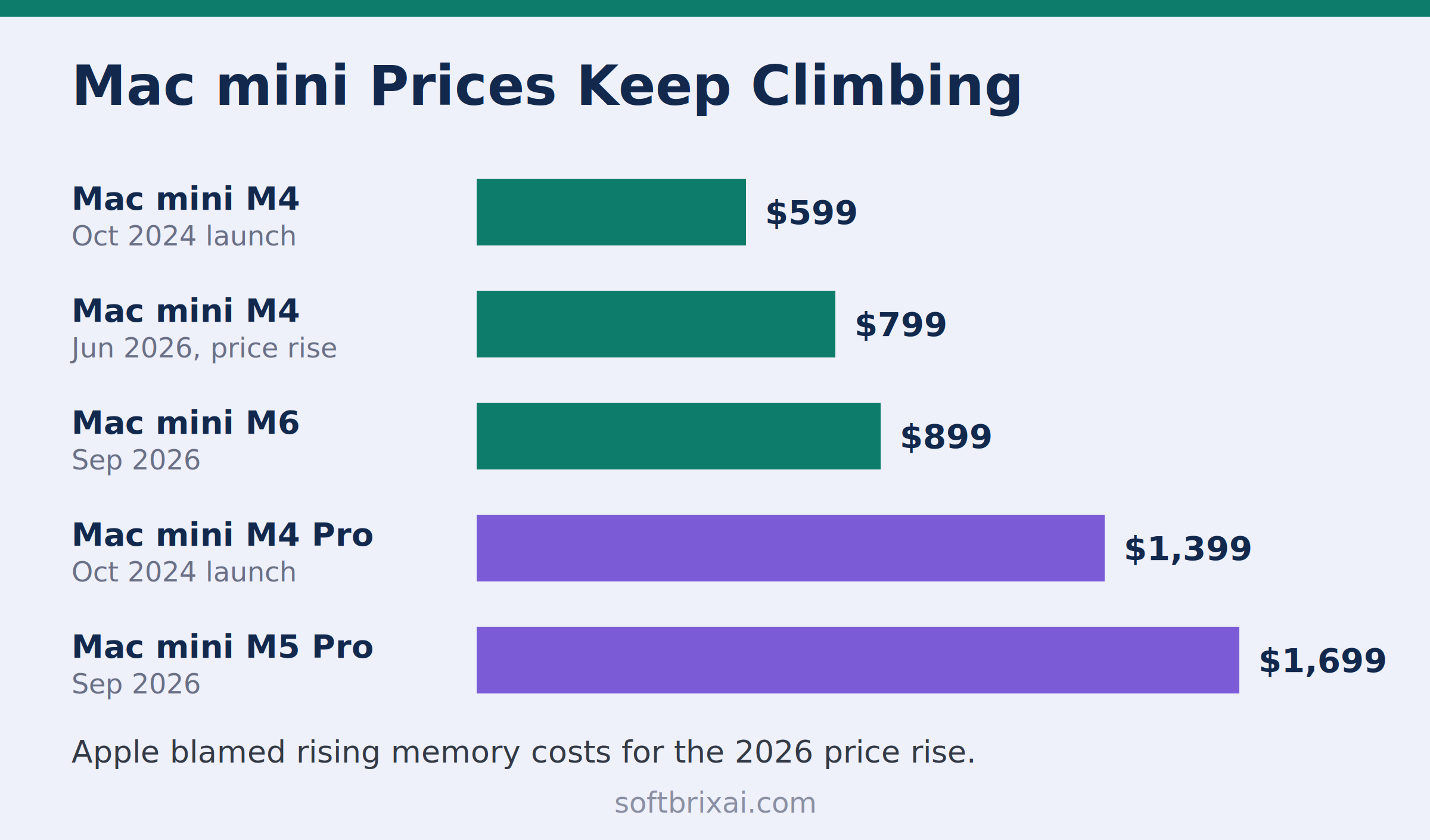
Long-time Mac mini buyers will feel the jump. The M4 Mac mini launched at $599 in October 2024, a price that made it the default recommendation for a cheap, capable desktop. In June 2026 Apple raised the M4 mini to $799, and CNBC reported that Apple blamed the rise on memory costs. The new range starts $100 above those raised prices, so the M6 mini opens at $899, and the M5 Pro mini at $1,699 sits $300 above the M4 Pro mini’s $1,399 launch price.
Apple is not inventing an excuse. Memory is the same supply that AI data centers have been absorbing all year, as suppliers sign long deals with the biggest buyers and shift production toward server memory. When the price of that memory climbs, every computer maker pays more, and Apple passes the bill along like everyone else. The honest way to read the new prices is that the mini is no longer the bargain it was in 2024. It is a fairly priced machine in a market where its most important component got much more expensive.
Mac Mini M5 Pro or Mac Studio: Which One for AI Work?
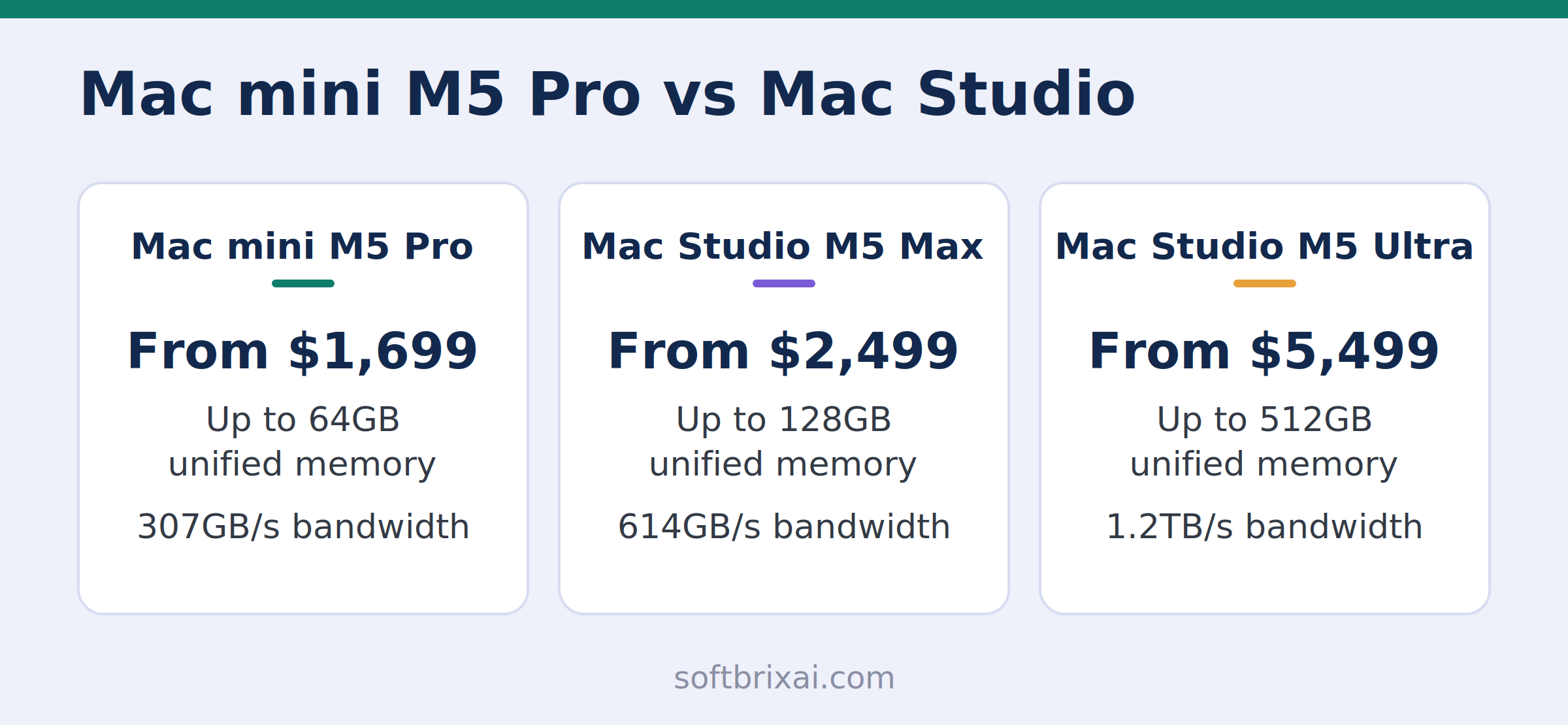
The choice turns on memory headroom. The M5 Pro mini tops out at 64GB with 307GB/s of bandwidth, which covers large open models at practical quantization and leaves room for a normal working day of apps beside them. The Mac Studio with M5 Max starts at $2,499 with 36GB and climbs to 128GB, with bandwidth of 614GB/s, roughly double the mini. The Studio with M5 Ultra starts at $5,499 with 96GB and reaches a remarkable 512GB of unified memory at 1.2TB/s of bandwidth, a configuration that shipped later than the rest, in late October 2026. TechRepublic compared the M5 Pro mini against the M5 Max tier for buyers weighing exactly this step up.
Our guidance is simple. Buy the M5 Pro mini with 64GB if you run one large model at a time for development, testing or private work, because it does that job at the lowest price in the range. Step up to the Studio when your models outgrow 64GB, when you serve a model to a whole team from one machine, or when bandwidth decides how fast answers stream back. The Ultra’s 512GB tier is specialist territory, priced for labs and production inference rather than for a desk.
Local Mac or Cloud AI: How to Decide
A strong local machine does not end the cloud argument, and it should not try to. Local and cloud AI are good at different jobs, and the M5 Pro mini simply makes the local side cheaper and more capable than it used to be.
Choose local when privacy leads. Prompts, documents and code stay on your own hardware, nothing travels to a provider, and the machine works offline and at a fixed cost with no per call fees. Steady, predictable workloads suit local hardware best, because a machine you already own earns its keep every hour it runs. Choose cloud when you need the largest frontier models, which outgrow any desktop’s memory, or when demand arrives in spikes that would leave owned hardware idle most of the month. Most teams we talk to end up with both: a local machine for daily development and sensitive data, and cloud capacity for the biggest models and the busy weeks. The same trade-offs shape everyday tool choices too, as our guide to AI assistants for productivity shows when it weighs connected tools against private ones.
Conclusion
The Mac mini M5 Pro matters because of a single number: 64GB of unified memory in a small, quiet box that starts at $1,699. That memory tier turns a desktop into a credible local AI machine for large open models, with no subscription and no data leaving the room. The price rises are real, and memory costs explain them better than greed does. If you want the largest models or elastic scale, the cloud still wins. If you want capable AI that answers only to you, this is the Mac that makes it practical.
Frequently Asked Questions
How much memory does the Mac mini M5 Pro have?
The Mac mini M5 Pro starts with 24GB of unified memory, and Apple offers options up to 64GB. You pick the amount when you order, so choose for the largest models you plan to run, because the memory sets the ceiling for local AI work.
Can the Mac mini M5 Pro run AI models locally?
Yes. The M5 Pro chip shares its unified memory between the CPU and the GPU, and its GPU cores carry Neural Accelerators built for AI work. As a rule of thumb, the 24GB model suits small to mid-size open models in quantized form, while 48GB to 64GB configurations suit large models in the 30B to 70B class at practical quantization.
Why is the new Mac mini more expensive than the M4?
Memory costs. The M4 Mac mini launched at $599 in October 2024, and Apple raised it to $799 in June 2026, a rise CNBC reported Apple blamed on memory costs. The new range starts $100 above those raised prices, so the M5 Pro mini at $1,699 sits $300 above the M4 Pro mini launch price of $1,399.
Image credits: Apple desk setup photo by Ionela Mat via Pexels (pexels.com/photo/17198943). Developer workspace photo by Djordje Petrovic via Pexels (pexels.com/photo/2102416). Server room photo by Panumas Nikhomkhai via Pexels (pexels.com/photo/17489155). All photos are used under the Pexels License, which allows free use; credit is given voluntarily. The four infographics are original works created for SoftBrixAI, with data from Apple announcements as reported by MacRumors, Mac Observer and TechRepublic.