The Sam Altman RAM story starts with one sentence on a podcast. The OpenAI chief executive said it is “quite terrible” for the world’s limited supply of DRAM to sit inside personal computers that use it only about 5 percent of the time, and that scarce memory does more good inside cloud data centers that stay busy around the clock.
PC builders and gamers heard that as blame aimed at the wrong people. Memory prices have climbed steeply all year, and AI companies, OpenAI first among them, are the buyers absorbing most of the supply. This article sets out exactly what Altman said, which parts of his argument hold up, why RAM costs so much right now, and what the fight means for anyone building or buying AI systems.

What Did Sam Altman Say About RAM?
Altman made the remarks on Cheeky Pint, the interview podcast hosted by Stripe co-founder John Collison, in an episode released on October 29, 2026. The memory discussion came about 29 minutes in, during a wider talk about supply chain shortages. Collison raised the fashion for local inference, which means running AI models on your own computer instead of on a company’s servers. Altman pushed back on the idea that local AI removes the need for data centers:
“A lot of people want local inference. And somehow, they assume that the problem is solved now because we are going to have open-source models, we’re going to be able to run them on our computers, and so we’re not going to need all the stuff in the data center. But from a global allocation perspective, actually, it’s quite terrible to have everybody have a bunch of the world’s limited supply of DRAM sitting in their own computer and being used 5% of the time. You want maximum utilization in the cloud if you’re trying to deal with this very supply-constrained environment.”
Two details matter before judging the quote. First, Altman was answering a question about local AI, not proposing that anyone hand over their hardware. He did not suggest banning consumer RAM or removing memory from existing machines. Second, the 5 percent figure is his own estimate. No outlet covering the interview found an industry measurement behind it, and Altman presented none. Treat it as an illustration of his argument, not as data. You can hear the exchange in context in the full Cheeky Pint interview on YouTube.
He also offered a reason the shortage persists. Asked why record prices have not pulled new suppliers into the memory market, he answered, “I think the invisible hand is failing right now.” Building memory factories takes years and billions of dollars, so supply cannot respond the way a normal market would.
Why Did PC Owners React So Strongly?
The reaction was fast and mostly negative, and the timing explains a lot of it. Altman made the case for moving memory into data centers in the same year that data center demand pushed the price of that memory to record levels for ordinary buyers. As Tom’s Hardware reported, the argument also lines up neatly with OpenAI’s business model, since OpenAI earns money when people rent its cloud models instead of running free ones at home.
Critics made three main points. The first is that idle is not the same as wasted. A home PC’s memory sits ready for the moment it is needed, the same way a car in a garage is not a failed use of a car. Games, video editing and everyday software all draw on RAM in bursts, and the owner paid for that headroom on purpose. The second point is control. Local hardware runs offline, keeps private data on the machine and cannot be repriced or switched off by a provider. The third point is about who caused the shortage. Builders pointed out that AI buyers locked up the supply first, and that being lectured about waste by the largest of those buyers landed badly. The frustration spilled into jokes across social media, including one widely shared post from a developer showing off a machine with hundreds of gigabytes of RAM and another user pretending to stir coffee with a memory stick.
Is AI Really Causing the RAM Shortage?
Mostly, yes, and the memory makers’ own decisions show it. DRAM is the working memory inside PCs, phones, consoles and servers. Only a handful of companies make it at scale, mainly Samsung, SK hynix and Micron, and all three have shifted production toward the memory AI buyers want most: high-bandwidth memory for accelerators and server-grade DRAM. That leaves less capacity for the ordinary memory that goes into laptops and DIY PCs.
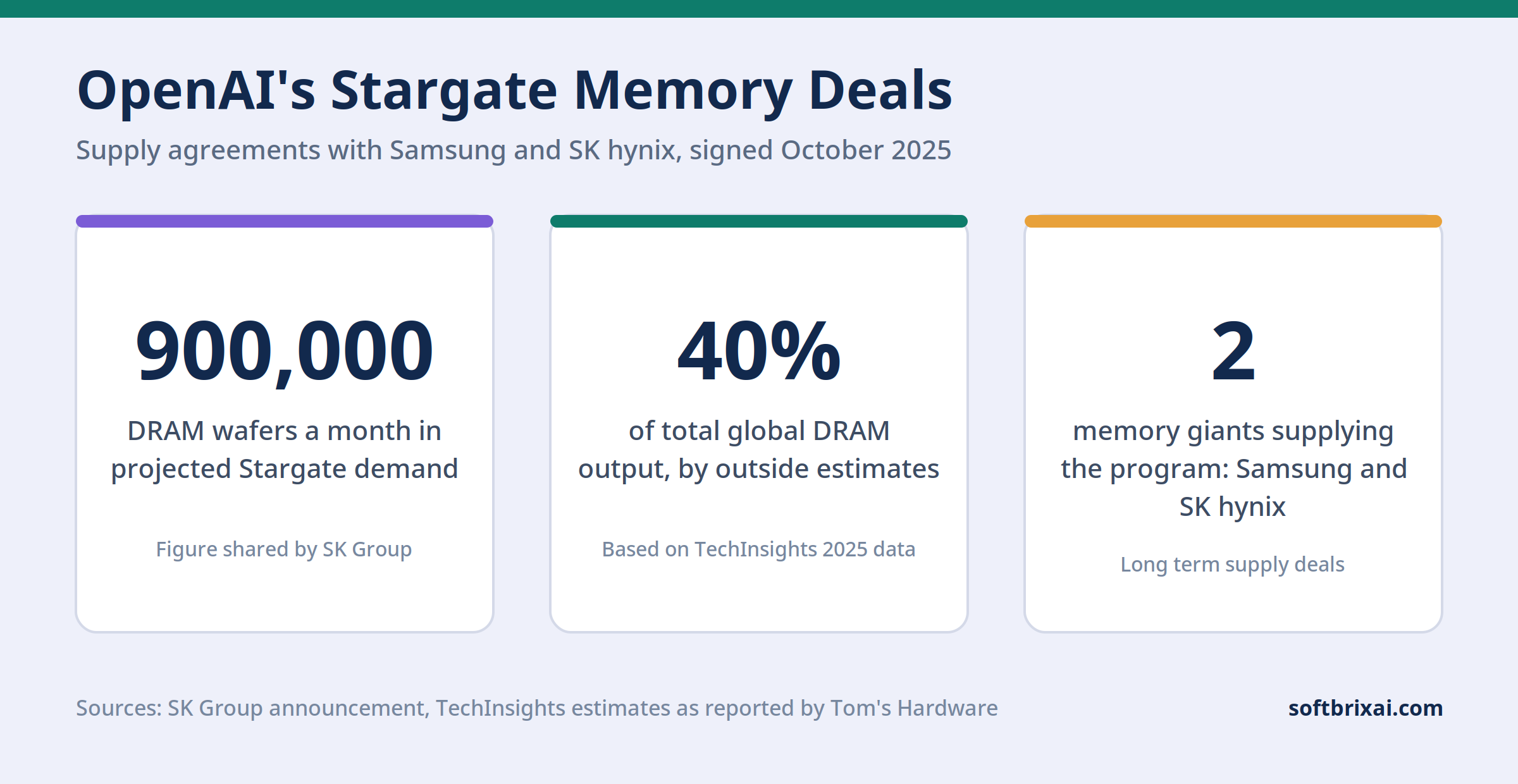
OpenAI’s own demand is the clearest example. In October 2025 the company signed agreements with Samsung and SK hynix to supply memory for Stargate, its giant data center program. SK Group put OpenAI’s projected demand at up to 900,000 DRAM wafers a month, which outside analysts estimate at close to 40 percent of total global DRAM output. One buyer taking that share of world supply changes prices for everyone else.
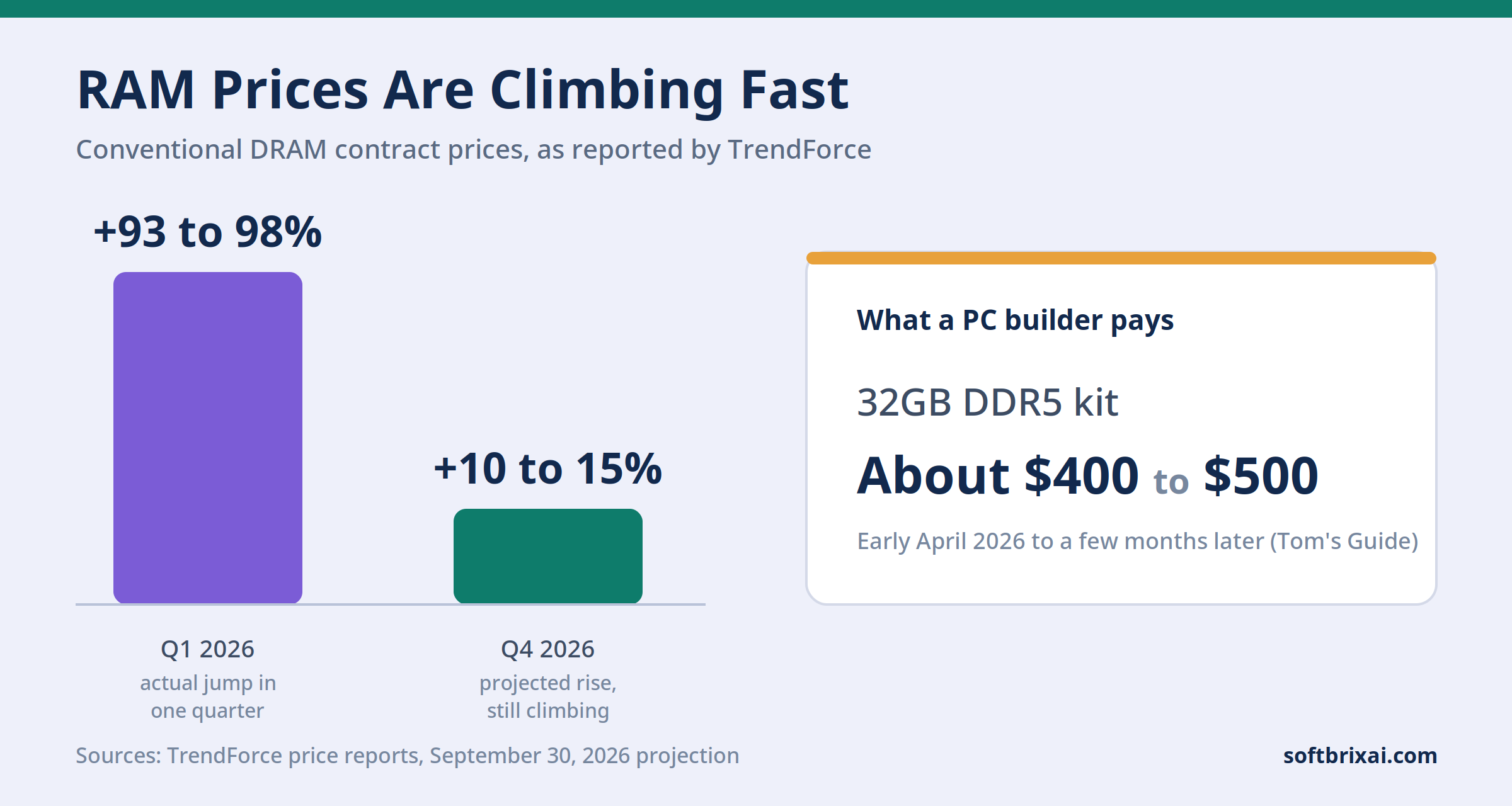
The price data tells the same story. TrendForce reported that conventional DRAM contract prices jumped roughly 93 to 98 percent in the first quarter of 2026 alone, and in September it projected a further rise of 10 to 15 percent for the fourth quarter. At retail, a 32GB DDR5 kit that cost about $400 in early April 2026 was selling for around $500 a few months later. Sony raised the PS5 Pro’s price in March, citing the memory shortage, and IDC reported that PC hardware shipments fell 20.1 percent in the third quarter of 2026 as higher prices cooled demand. Micron added the strongest signal of all in December 2025, when it announced it would stop selling memory to consumers under its own brand and focus on larger strategic customers instead. SK hynix has said the shortage could last until 2030, and Micron expects tight supply through 2028, so none of this looks like a short squeeze.
Cloud Memory or Local Memory: Which Side Is Right?
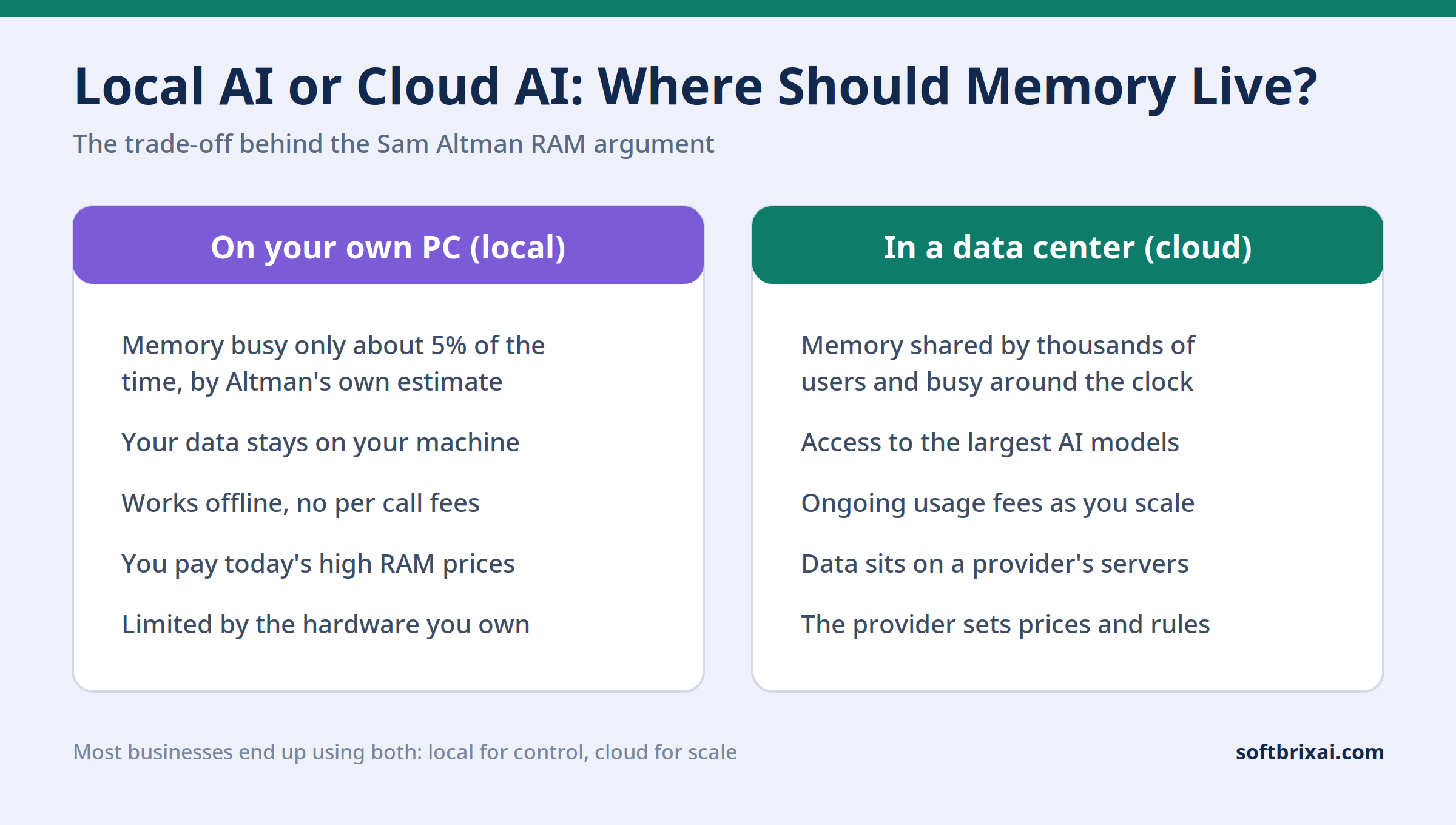
Both sides are answering different questions. Altman is talking about global efficiency, and on that narrow point he has a case: a server shared by thousands of users really does keep its memory busy far more of the day than a desktop that sleeps at night. His critics are talking about ownership, and on that point they have a case too: memory you own cannot be repriced, throttled or taken away. The honest comparison looks like this:
| Factor | Local AI on your own hardware | Cloud AI in a data center |
|---|---|---|
| Memory use | Bought once and idle between your tasks | Shared across many users and kept busy around the clock |
| Cost pattern | High upfront hardware cost, no per call fees | No hardware to buy, ongoing usage fees that scale with demand |
| Privacy and control | Data stays on your machine, works offline | Data travels to a provider’s servers under their rules |
| Performance ceiling | Limited by the memory and chip you own | Access to the largest models and newest hardware |
| Exposure to the shortage | You pay today’s high RAM prices directly | Providers absorb hardware costs and pass them on in pricing |
Coverage in The Verge framed the remark the same way: an argument that scarce memory earns its keep in a data center rather than on a desk. What the argument leaves out is why people accept the inefficiency. For many users, an idle machine that answers only to them is the point, not the problem.
What the Sam Altman RAM Debate Means for Businesses Building AI
For companies, this is not a podcast argument. It is a planning problem that now sits inside every serious AI budget, for three reasons.
Inference is a memory business. Every AI feature a company ships runs on hardware that needs large amounts of fast memory, and that memory now costs far more than it did a year ago. Teams that priced a product on 2025 infrastructure costs can find the maths changed under them. The practical response is to measure cost per request early, cache aggressively, and route simple work to smaller models, habits that separate durable products from demos. Our guide to AI assistants for productivity shows how much of that saving comes from design rather than hardware.
Hybrid beats dogma. The sensible architecture for most businesses is neither all cloud nor all local. Sensitive data and steady, predictable workloads often belong on self-hosted models under your own control, where data never leaves the building. Spiky demand and the largest frontier models belong in the cloud, where capacity can be rented by the hour. Altman’s argument is a useful push toward measuring utilization honestly, but a company that moves everything to rented cloud inherits the provider’s prices and outages as its own.
Scarcity is now a design constraint. With suppliers guiding tight memory markets through 2028 and possibly 2030, hardware availability belongs in project plans next to budget and deadlines. Model choice, context length and batching strategy all change how much memory a system needs, so engineering teams that design for memory efficiency will ship on time while others wait on allocation. That is the real lesson of the Sam Altman RAM debate for builders: the argument about whose RAM it is will fade, but the shortage behind it is a multi-year fact.
What Happens Next?
Nothing in the supply picture points to quick relief. Memory makers have committed most of their output to AI and cloud buyers under long term deals, new factories take years to build, and the biggest buyer in the market is still expanding. Expect RAM, laptops and consoles to stay expensive into next year, expect the local AI community to keep growing anyway because open models keep improving, and expect this argument to return every time prices jump. Altman is right that the world’s memory is used inefficiently. His critics are right that efficiency is not the only value a computer can have.
Conclusion
The Sam Altman RAM comment was one sentence in a long interview, but it touched the two live wires of the AI era: a genuine memory shortage and a genuine fight over who controls computing. He described memory in home PCs as quite terrible from a global allocation view, and the backlash showed how many people hear that as a cloud company asking customers to give up ownership. For readers, the useful takeaways are simple. The 5 percent figure is an estimate, not a measurement. The shortage is real, driven mainly by AI demand, and likely to last for years. And whether you are buying a gaming PC or planning a company’s AI infrastructure, the winning move is the same: decide what must stay local, rent what scales, and do the utilization maths before someone else does it for you.
Frequently Asked Questions
What did Sam Altman say about RAM?
Sam Altman said it is quite terrible, from a global allocation perspective, for everyone to hold a share of the world’s limited DRAM supply in their own computers, where he estimates it is used only about 5 percent of the time. He argued that in a supply constrained market, memory does more good in cloud data centers that keep it busy around the clock.
Why are RAM prices rising in 2026?
RAM prices are rising because AI data centers are absorbing most new memory supply. Samsung, SK hynix and Micron have shifted production toward server memory and signed long term deals with AI buyers, including OpenAI’s Stargate program. TrendForce reported conventional DRAM contract prices jumped about 93 to 98 percent in the first quarter of 2026 alone.
Is local AI better than cloud AI?
Neither is better for every job. Local AI keeps data on your own hardware, works offline and avoids per call fees, but it needs costly memory that sits idle between tasks. Cloud AI shares memory across many users and scales on demand, but it adds ongoing cost and sends data to someone else’s servers. Many teams end up using both.
Image credits: Portrait of Sam Altman by Steve Jurvetson, CC BY 2.0, via Wikimedia Commons (cropped from the original). Featured photo and server close-up by Panumas Nikhomkhai via Pexels (pexels.com/photo/1148820 and pexels.com/photo/17489156). RAM module photos by William Warby via Pexels (pexels.com/photo/19716297 and pexels.com/photo/19693216). All photos are used under the Pexels License, which allows free use; credit is given voluntarily. The three infographics are original works created for SoftBrixAI, with data from TrendForce, SK Group and TechInsights as reported.