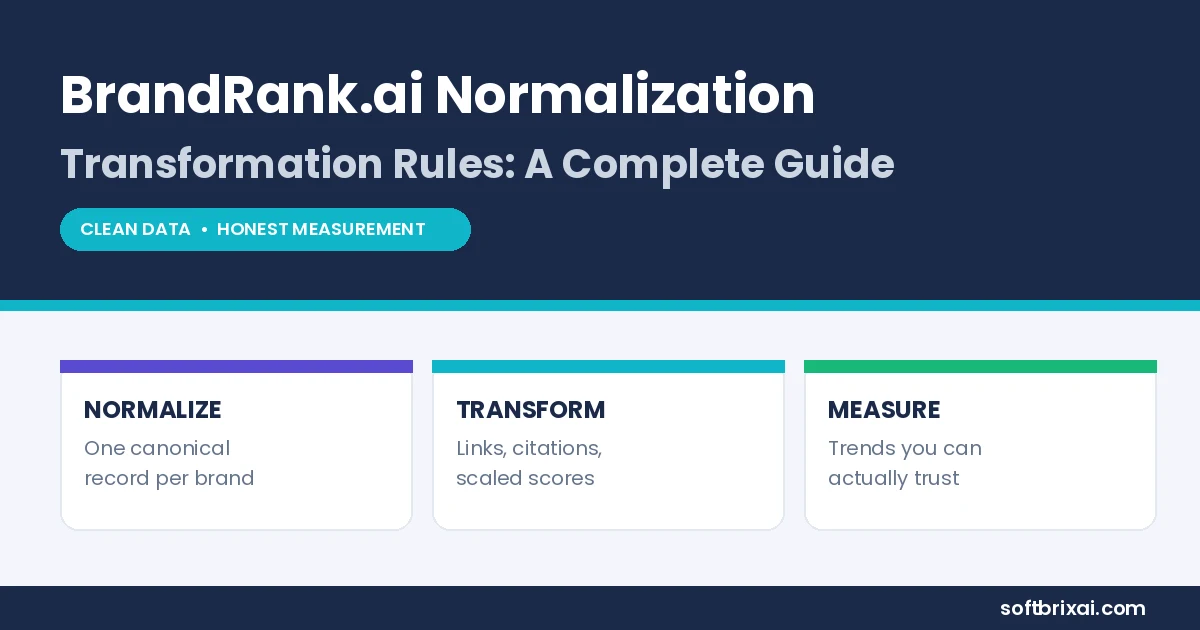
BrandRank.ai normalization transformation rules are the data-handling standards that turn messy brand mentions into one consistent, comparable record that AI systems can read, verify, and cite. The rules work in two stages: normalization standardizes raw inputs (names, URLs, locations, duplicates) into a single canonical form, and transformation reshapes that clean data into AI-ready structures such as linked entities, attributed claims, and calibrated scores. The main benefits are measurement consistency, cleaner AI brand answers, and reliable reporting across tools. The main uses are brand monitoring, competitive analysis, content planning, reputation management, and marketing reporting. The main components are an ordered rulebook, entity resolution, source priority, exception handling, provenance tracking, and score scaling.
One point needs stating plainly at the start: BrandRank.AI has not publicly documented an official framework called “normalization transformation rules.” This guide applies established data-normalization principles to AI brand visibility. Treat every rule here as a working practice, not as BrandRank.AI’s disclosed proprietary algorithms or internal schemas.
Key Takeaways
- BrandRank.ai normalization transformation rules are not an official published BrandRank.AI framework. They are proven data-normalization practices applied to AI brand visibility work.
- Normalization creates one canonical record per brand, product, and location. Transformation reshapes that clean data into entity links, citations, sentiment labels, and scaled scores.
- Rule order matters. Exceptions run first, identity resolution runs before deduplication, and validation runs before any scoring.
- Normalization improves measurement consistency. It does not raise rankings directly. Cleaner data produces more trustworthy visibility signals, and those signals inform the content and reputation work that does influence AI answers.
- Provenance, the recorded origin and history of each value, decides whether a normalized value deserves trust.
- The “ignore the first 10 data points” trick and the “average filter” tip are myths. Both hide real signal. This guide debunks them rather than endorsing them.
What Are BrandRank.ai Normalization Transformation Rules?
BrandRank.ai normalization transformation rules are a working set of conditions and actions that convert inconsistent brand data into one standard form, then restructure that form for AI analysis. Each rule has a pattern (what to match), a replacement (what to write instead), and a scope (where the rule applies). A rule might map “Acme Co.,” “ACME Inc,” and “Acme Corporation” to one canonical name, or convert every tracking-parameter URL variant into a single clean address.
The rules serve AI brand monitoring: the practice of tracking how AI models such as ChatGPT, Gemini, and Copilot describe a brand. AI models pull from many sources with conflicting details. A brand name spelled three ways, a headquarters listed in two cities, and a product name confused with the company name all create noise. Normalization transformation rules remove that noise before anyone measures AI visibility, which is how often and how favorably a brand appears in AI-generated answers.
What Is BrandRank.ai?
BrandRank.ai is a brand visibility analytics platform that tracks how AI models mention, describe, and rank brands. The platform falls into the brand monitoring and AI visibility category, alongside tools that watch traditional search results. BrandRank.ai use cases include AI brand monitoring, competitive analysis, content strategy, reputation management, and marketing reporting. The company’s publicly described capability areas include AI Search Visibility, Recommendation Share, Brand Vulnerability, and Content Readiness; those are product areas, not the normalization rulebook itself.
The platform’s practical value depends on data quality. An AI brand monitoring tool reads mentions from news sites, review platforms, directories, social posts, and knowledge bases. Those sources disagree constantly. One directory lists “Acme Analytics, Inc.” Another writes “Acme Analytics.” A third drops the category label entirely. Without brand data normalization, a monitoring tool counts these as three entities, and the brand’s AI presence looks smaller and messier than it is. Normalization transformation rules exist to prevent that failure.
Normalization vs. Transformation
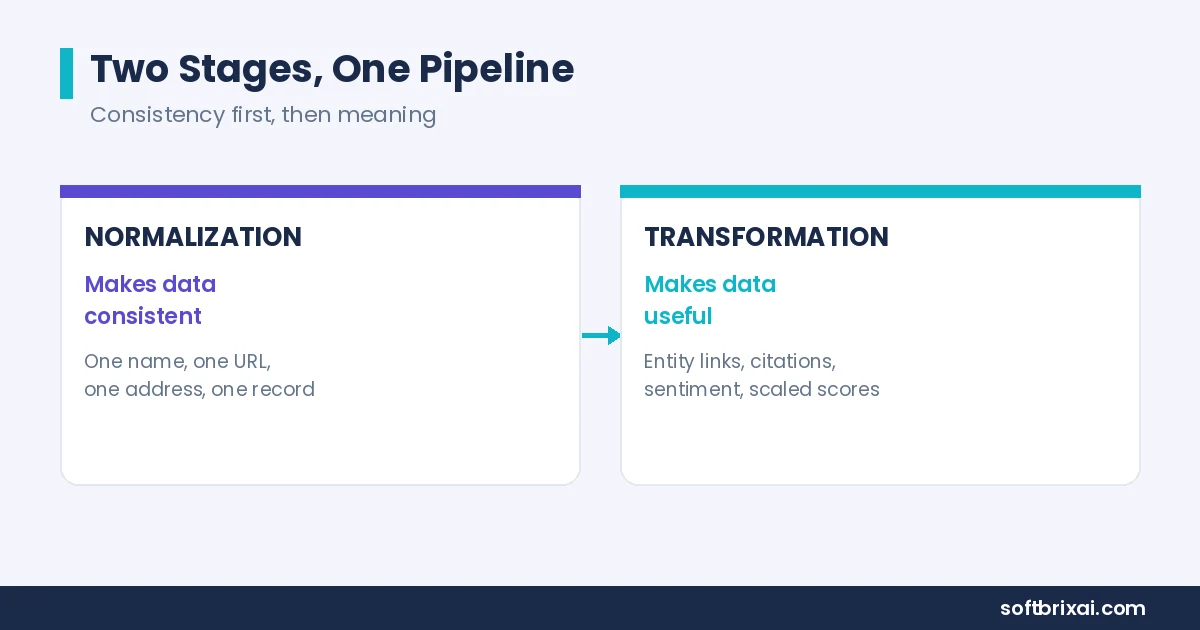
Normalization and transformation are two stages of the same pipeline. The difference between normalization and transformation comes down to purpose: normalization makes data consistent, and transformation makes data useful.
Normalization
Normalization is the process of reducing many raw variants to one standard form. Data normalization covers brand names, URLs, addresses, phone numbers, product labels, and dates. Text normalization handles case folding (lowercasing), whitespace cleanup, punctuation removal, and Unicode normalization, which converts visually identical characters into one machine-readable form. Entity normalization collapses alternate names for the same organization into a single entry.
A normalized value answers one question: what is the one correct way to write this fact? “Acme Analytics, Inc.” becomes the canonical brand name “Acme Analytics.” Every variant maps to it.
Transformation
Transformation is the process of reshaping normalized data into structures an analysis layer can use. Data transformation includes linking each brand record to a knowledge-base entity, attaching source citations to each claim, labeling sentiment, and scaling raw counts into comparable scores. Transformation rules convert a clean list of mentions into a ranked, attributed, and scored dataset.
A transformed value answers a different question: what does this fact mean in context? A mention count of 47 becomes a percentile rank against competitors. A sentence about the brand becomes a sentiment label with a confidence note.
Normalization without transformation produces tidy data nobody can analyze. Transformation without normalization produces analysis built on conflicting facts. The two stages depend on each other, which is why the full phrase, brandrank.ai normalization transformation rules, describes one connected process.
BrandRank.ai Normalization vs. AI Visibility Optimization
BrandRank.ai normalization and AI visibility optimization are different jobs. Normalization is a data-quality task: it fixes how a brand’s information is recorded and compared. AI visibility optimization is a content and reputation task: it shapes what AI models say about a brand by improving the sources those models read.
Normalization improves measurement consistency. It does not improve rankings directly. A brand with perfect normalization and no authoritative content still gets weak AI answers, because AI models cite what they find, not what a database says. What normalization does is make the measurement honest. When, for example, a dashboard reports that a brand appears in 62% of AI answers for its category, normalization is what makes that 62% mean something. Without it, the number might count three spellings of the brand as three separate entities, or miss variants entirely.
AI visibility optimization then acts on the clean signal. Teams use normalized data to find which sources AI models cite, which product claims get repeated, and which competitors appear where the brand does not. Content strategy, reputation management, and marketing reporting all run on that signal. Normalization feeds the work. It does not replace the work.
Why Brand Name Normalization Rules Matter for AI Search
Brand name normalization rules matter for AI search because AI models assemble answers from conflicting sources, and inconsistent brand data splits a brand’s identity into fragments. When a model sees “Acme Analytics,” “Acme Analytics Inc.,” and “Acme Analytics Platform” across different sites, it may treat them as separate things, describe the brand vaguely, or cite a competitor with cleaner data.
The stakes show up in the data categories that AI brand monitoring tracks:
- Mentions: how often a brand appears in AI answers. Split identities undercount mentions.
- Sentiment: whether the surrounding language is positive, neutral, or negative. Unmerged records scatter sentiment across fragments.
- Context: what topics and use cases the brand is associated with. Duplicate records dilute context.
- Positioning: where the brand sits relative to competitors in an answer. Mixed identities distort position.
- Frequency and prominence: how early and how often the brand appears. Fragmented data hides prominence.
- Source diversity: how many independent sources support a claim. Duplicates inflate source counts.
- Query types: which question patterns trigger brand mentions. Clean records reveal patterns that messy records obscure.
Brand name normalization rules also protect the use cases built on this data. Brand monitoring flags changes over time, and change detection fails when the underlying records shift shape. Competitive analysis compares brands, and comparison fails when one brand is counted three times. Content strategy targets gaps, and gaps look bigger when the brand’s existing coverage is scattered. Reputation management tracks narrative shifts, and narrative tracking needs stable entities. Marketing reporting rolls everything into numbers executives act on, and those numbers inherit every flaw in the data beneath them.
Core BrandRank.ai Normalization Rules
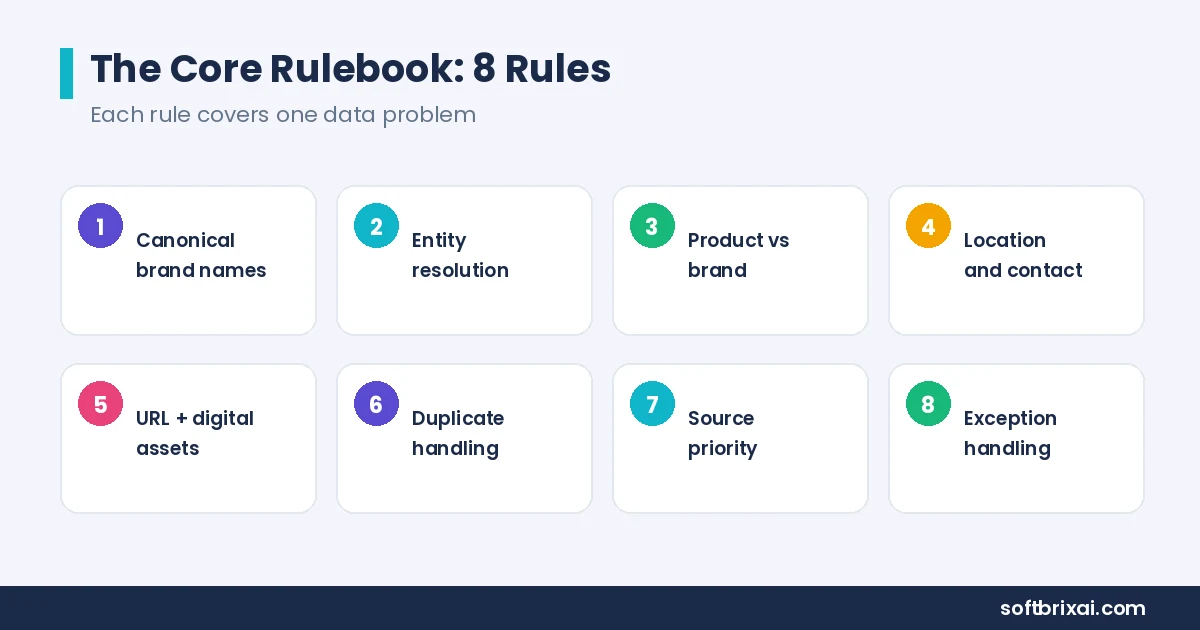
The core BrandRank.ai normalization rules form an ordered rulebook. Each rule below covers one data problem, and the order in which the rules run matters as much as the rules themselves.
Canonical Brand Names
Canonical brand names are the single approved spelling and form for each brand. Pick one form per brand, record it, and map every variant to it. “IBM” stays “IBM,” not “International Business Machines” in some records and “I.B.M.” in others. Brand name and identity consistency requires a lookup table that lists every known variant, including legal suffixes (“Inc.,” “LLC,” “GmbH”), punctuation differences, and spacing errors. The canonical name is the anchor for every other rule.
Entity Resolution and Matching
Entity resolution is the process of deciding when two records refer to the same real-world thing. Entity matching compares names, domains, addresses, and identifiers to make that call. Match on multiple signals, never on name alone. Two companies can share a name. One company can appear under many names. A match requires agreement across at least two independent signals, such as a shared domain plus a shared address. When signals conflict, the record goes to the exceptions list rather than getting forced into a match.
Product and Brand Separation
Product and brand separation keeps a company distinct from what it sells. “Acme Analytics” is the brand. “Acme Analytics Pro” is a product. Maintain separate canonical records for the organization and each product or service, linked but not merged. Product and service descriptors attach to the product record. Brand-level claims attach to the organization record. Mixing the two inflates brand mention counts with product mentions and muddies competitive positioning, because a product competes with products while a brand competes with brands.
Location, Address, and Contact Handling
Location handling standardizes how addresses, regions, and contact details are recorded. Address and location data standardization follows a fixed format per country: street, city, region, postal code, country, written in one order with one abbreviation set. Geocoding, the conversion of an address into latitude and longitude coordinates, gives each location a stable identifier that survives formatting changes. Contact information uniformity covers phone numbers (one format, country code included) and email domains. A brand with five office addresses written five ways looks like five companies to a matching algorithm.
URL and Digital Asset Normalization
URL normalization converts every link variant into one clean address. Lowercase the scheme and host, strip tracking parameters, resolve redirects to the final destination, and standardize trailing slashes. URL and digital asset consistency extends to metadata standardization: page titles, meta descriptions, tags, and categories get one canonical form each, so the same page is not recorded under two titles. Digital assets include social profiles, app listings, and directory entries. Each asset gets one canonical URL in the brand record. When a source cites a tracking-heavy link, the normalized record points to the clean destination.
Duplicate Handling
Duplicate handling removes repeated records without destroying real signal. Deduplicate after entity resolution, never before. Merging duplicates first can collapse two genuinely different entities into one. Duplicate handling has three tiers. Exact duplicates (identical strings) merge automatically. Near duplicates (minor formatting differences) merge when entity matching confirms the same entity. Ambiguous cases go to human review. Every merge keeps a link to the original records, so the merge can be reversed.
Source Priority
Source priority ranks which source wins when records conflict. Define the order in advance and apply it mechanically. A typical order runs: the brand’s own verified properties first, official registries and structured knowledge bases second, major reference sources third, reputable press fourth, directories and aggregators fifth, user-generated content last. Source priority settles conflicts like two different founding years. The higher-priority source’s value becomes the canonical value, and the losing value stays in the record as a documented exception with its source attached.
Exception Handling
Exception handling captures every case the rules cannot resolve cleanly. Exceptions run first in the pipeline and route to a human queue, never to silent guesses. An exception record states the conflicting values, the sources, the rule that failed, and the decision. Custom rules and exceptions grow over time as the queue reveals patterns. A recurring exception often signals a missing rule, and the fix is a new rule plus a re-run, not a one-off patch.
BrandRank.ai Transformation Rules: Turning Clean Data Into AI-Ready Structure
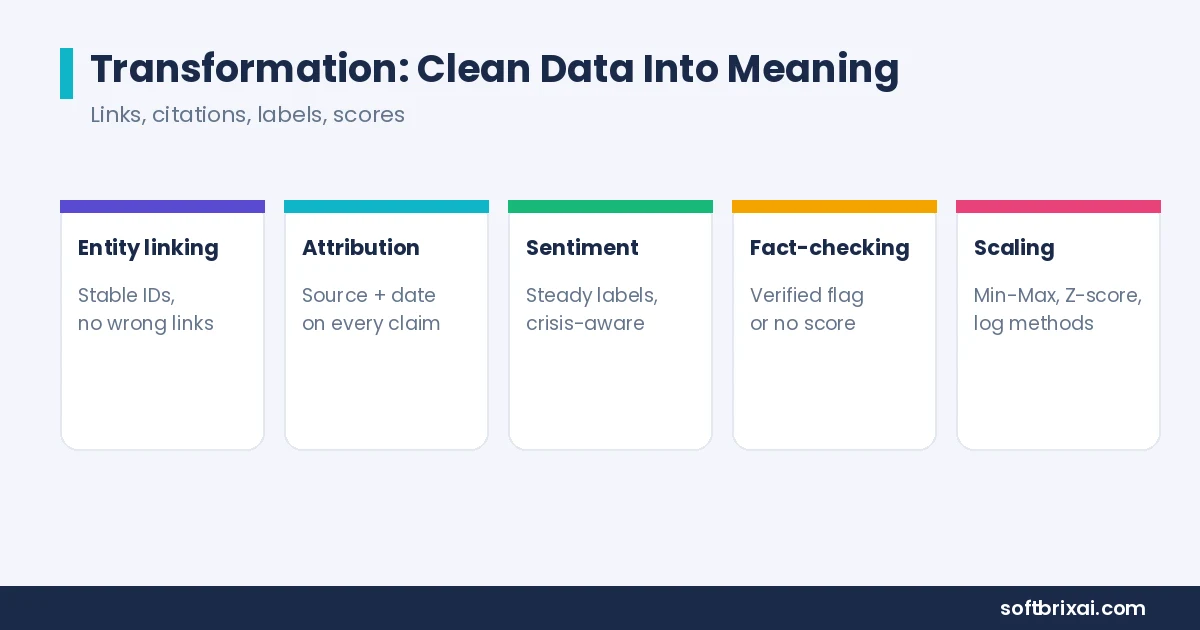
Transformation rules take the normalized record and restructure it for analysis. Where normalization produces one clean fact, transformation produces meaning: links, citations, labels, and scores.
Entity Linking and Disambiguation
Entity linking connects each canonical record to a stable identifier in a knowledge base, such as a Schema.org Organization entry or a Wikidata ID. Disambiguation is the step that prevents wrong links: it confirms that “Acme Analytics” in a news article refers to the same Acme Analytics in the brand record, not a similarly named firm in another industry. Link only when context signals agree (industry, location, products). Unlinked records stay unlinked until evidence arrives. A wrong link poisons every downstream metric, so disambiguation favors caution.
Attribution and Citation Rules
Attribution and citation rules decide which source gets credit for each claim in the transformed dataset. Every transformed claim carries its source URL, retrieval date, and source-priority tier. When two sources support the same claim, both get recorded, and the higher-priority source leads. When sources conflict, the claim splits into two attributed variants rather than one averaged value. Attribution makes brand scoring auditable: anyone can trace a score back to the sentences and pages that produced it.
Sentiment and Tone Calibration
Sentiment and tone alignment rules convert raw language into consistent labels. Score sentiment against a fixed word list (lexicon), then calibrate with brand voice and tone guidelines so the labels match how the brand’s audience actually writes. Crisis-communication directives attach to the calibration layer: during a declared crisis window, sentiment scoring flags spikes and holds narrative conclusions until the window closes, because crisis language inflates negative scores for reasons unrelated to brand health. Calibration keeps sentiment comparable across sources, quarters, and competitors.
Fact-Checking and Verification
Fact-checking and verification rules confirm that transformed claims match reality before they enter reports. A transformed claim needs at least two independent sources, or one top-tier source, to carry a verified flag. Unverified claims stay in the dataset but never feed scores. Verification checks the boring details that AI models repeat: founding year, headquarters, leadership names, product categories. AI-generated content raises the stakes here, because models can repeat a wrong detail with full confidence, and a verified canonical record is the correction.
Scaling Scores: Min-Max, Z-Score, and Log Methods
Mathematical scaling models convert raw counts into comparable scores. Three methods cover most needs:
- Min-Max scaling rescales values to a fixed range, usually 0 to 100, using the formula (value minus minimum) divided by (maximum minus minimum). It is simple and readable, but one extreme outlier compresses everyone else toward the middle.
- Z-score scaling expresses each value as the number of standard deviations from the mean, using (value minus mean) divided by standard deviation. It preserves relative distance and handles outliers better, but scores go negative and confuse non-technical readers.
- Log scaling compresses large counts with a logarithm, so a brand with 10,000 mentions does not dwarf a brand with 500. It suits mention counts and traffic-like data with long tails.
Pick one method per metric, document it, and never mix methods within a single report. Rank normalization, the practice of converting raw values into rank positions, is a fourth option when relative order matters more than magnitude. A normalized rank transformation converts ranks into percentiles so they stay comparable as the brand set changes.
How BrandRank.ai Normalization Transformation Rules Work, Step by Step
The normalization transformation process runs in seven steps. Each step depends on the one before it, and skipping ahead breaks the chain.
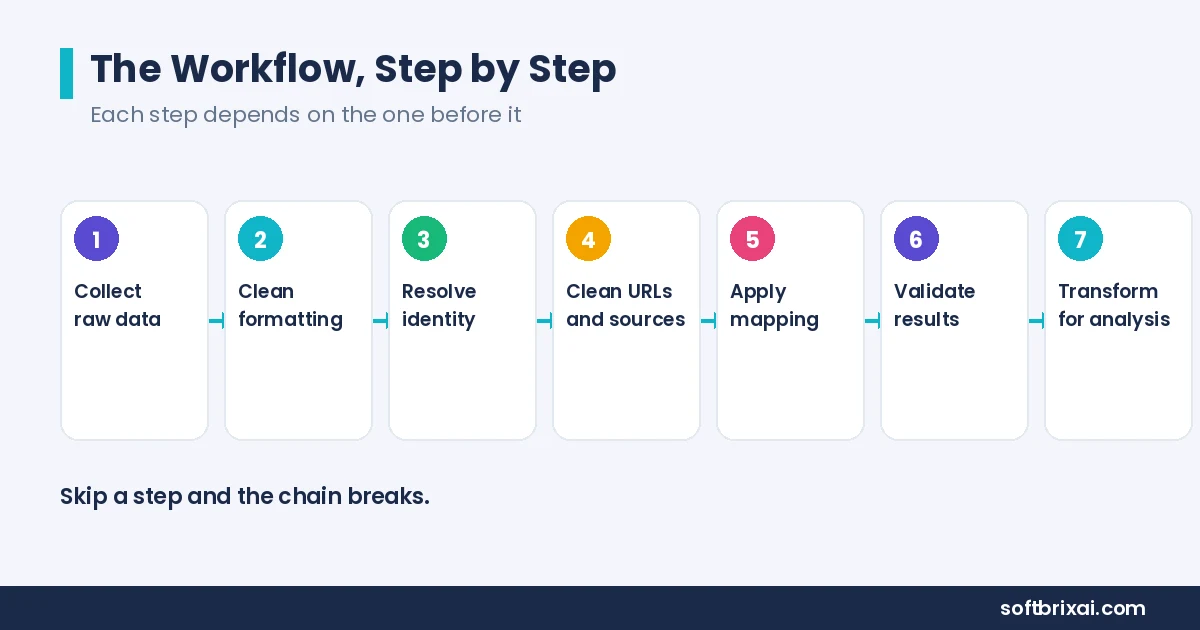
Step 1: Collect the Raw Data
Data ingestion and validation pipelines pull mentions, pages, profiles, and directory entries from every monitored source. Raw data stays untouched in a landing layer. Store the original exactly as found, including formatting errors, because provenance starts here. Every later value traces back to this raw copy.
Step 2: Clean Basic Formatting
Basic cleanup applies text normalization: case folding, whitespace collapsing, punctuation standardization, and Unicode normalization. HTML entities get decoded. Encoding errors get fixed. This step changes form, never meaning. It runs before anything else because matching on dirty strings produces false mismatches.
Step 3: Resolve Brand Identity
Entity resolution assigns each cleaned record to a canonical brand, product, or location. Matching runs on multiple signals: name variants from the lookup table, domains, addresses, and known identifiers. Confident matches attach to existing entities. New entities get created for genuinely new brands. Ambiguous cases route to the exceptions queue. This step is the most consequential in the pipeline, because every later metric inherits its decisions.
Step 4: Normalize URLs and Sources
URL normalization cleans every link, and source classification assigns each source its priority tier. Metadata standardization aligns page titles, descriptions, and tags. The output is a record where every claim has a clean address and a known source rank.
Step 5: Apply Mapping Rules
Mapping rules transform the normalized fields into analysis-ready form: entity links, sentiment labels, category tags, and scaled scores. The mapping table is versioned, so every transformed value records which rule version produced it. Pinning the rule version means a report can be reproduced exactly, even after rules change.
Step 6: Validate the Results
Validation checks the transformed output against the rules: no orphan records, no unresolved conflicts in scored fields, no scores outside their defined range, no links to wrong entities. Validation failures route back to the exceptions queue. Nothing enters analysis without passing validation. This gate catches the errors that would otherwise surface as strange numbers in an executive report.
Step 7: Transform the Data for Analysis
The final step assembles the validated records into the structures reports consume: time series of mention counts, sentiment trends, competitive position tables, and source diversity summaries. A trace records how each output goes back through the rules to raw data. The output is AI-ready: structured, attributed, and reproducible.
Why BrandRank.ai Normalization Rule Order Matters
BrandRank.ai normalization rule order matters because rules interact, and the wrong sequence produces silent errors. The priority sequence runs exceptions first, then identity resolution, then deduplication, then source priority, then mapping, then validation.
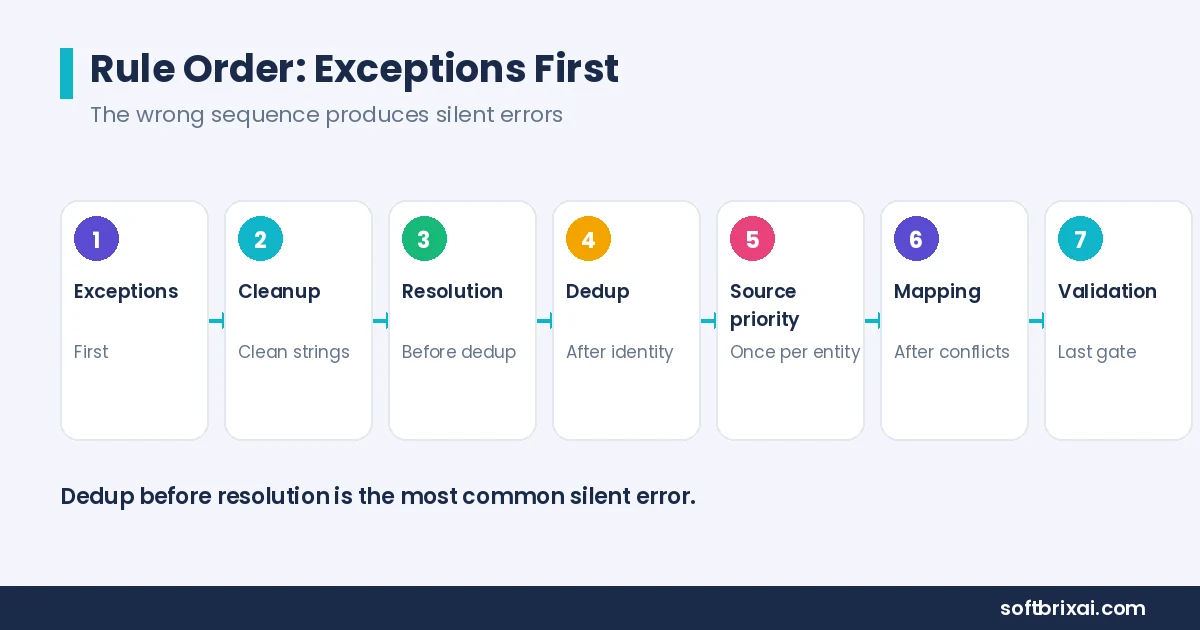
| Order | Rule Stage | Runs When | Why This Position |
|---|---|---|---|
| 1 | Exception handling | Before all rules | Ambiguous records must not enter automated matching, or errors propagate |
| 2 | Basic formatting cleanup | After exceptions cleared | Matching needs clean strings |
| 3 | Entity resolution | Before deduplication | Merging before resolution can collapse distinct entities |
| 4 | Duplicate handling | After resolution | Duplicates are only safe to merge once identity is confirmed |
| 5 | Source priority | After deduplication | Conflicts resolve once per entity, not once per duplicate |
| 6 | Mapping and transformation | After conflicts settle | Scores built on unresolved conflicts are meaningless |
| 7 | Validation | Last gate | Catches order violations before analysis |
Two order violations cause most failures. Deduplicating before entity resolution merges records that merely look alike, and the merge destroys the evidence needed to separate them later. Applying source priority before deduplication resolves the same conflict repeatedly across duplicates, and inconsistent resolutions create contradictory canonical values. When two rules would produce different outputs for the same input, the pipeline halts that record and flags the conflict instead of picking a winner silently.
A Worked Example: One Brand, Five Messy Records
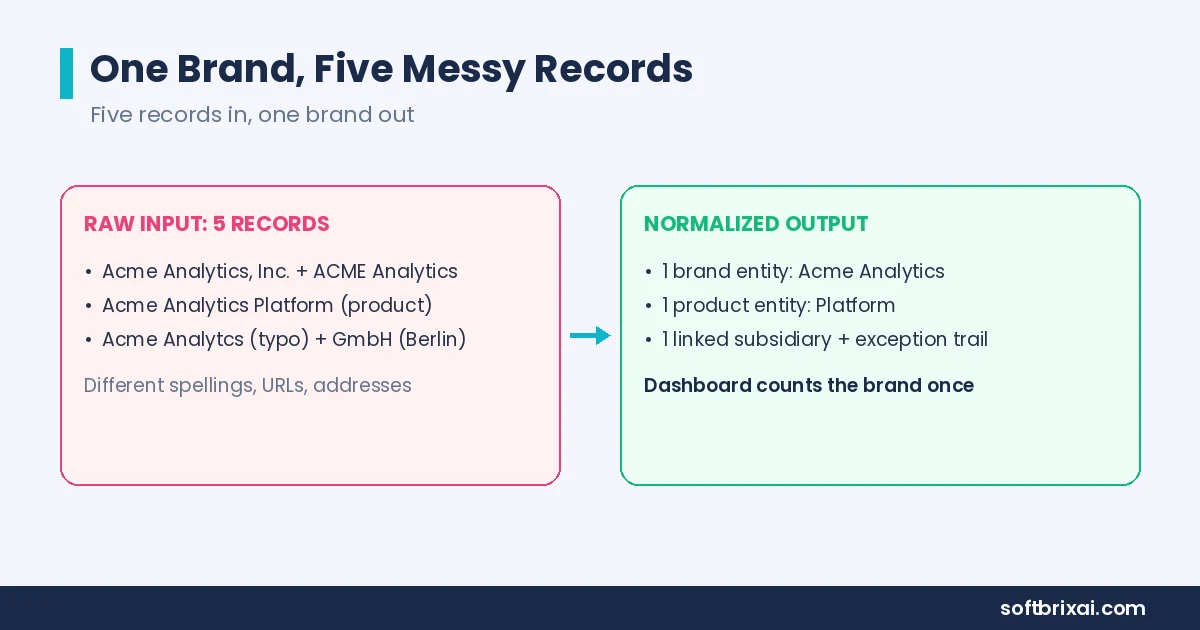
Five records arrive for one company. The raw data:
- “Acme Analytics, Inc.” at acme-analytics.com, address “500 Market St, San Francisco, CA”
- “ACME Analytics” at acme-analytics.com/?utm_source=dir, address “500 Market Street, San Francisco”
- “Acme Analytics Platform” at acmeanalytics.io, described as a product
- “Acme Analytcs” (typo) at acme-analytics.com/about, address “San Francisco, CA”
- “Acme Analytics GmbH” at acme-analytics.de, address “Berlin, Germany”
Step 2 cleans formatting: case folds, whitespace collapses, and the tracking parameter comes off the URL in record 2. Step 3 resolves identity. Records 1, 2, and 4 match on domain plus address, so they join one canonical brand, “Acme Analytics.” Record 3 matches the domain family but describes a product, so product and brand separation creates a linked product record, “Acme Analytics Platform,” under the same brand. Record 5 shares the name but has a different domain and country. Entity matching holds it as a separate legal entity, linked to the brand as a subsidiary, pending confirmation from the exceptions queue.
Step 4 normalizes URLs and assigns source tiers. Step 5 maps the records: the brand gets one canonical name, one canonical domain, one headquarters location (San Francisco, from the higher-priority source), and one product link. Step 6 validates: no orphan records, no unresolved scored conflicts. Step 7 transforms: the five messy records become one brand entity, one product entity, one linked subsidiary, and a documented exception trail. A dashboard counting this brand now counts it once, and the mention history from all five records merges into one trend line.
Data Provenance: Why You Should Trust a Normalized Value
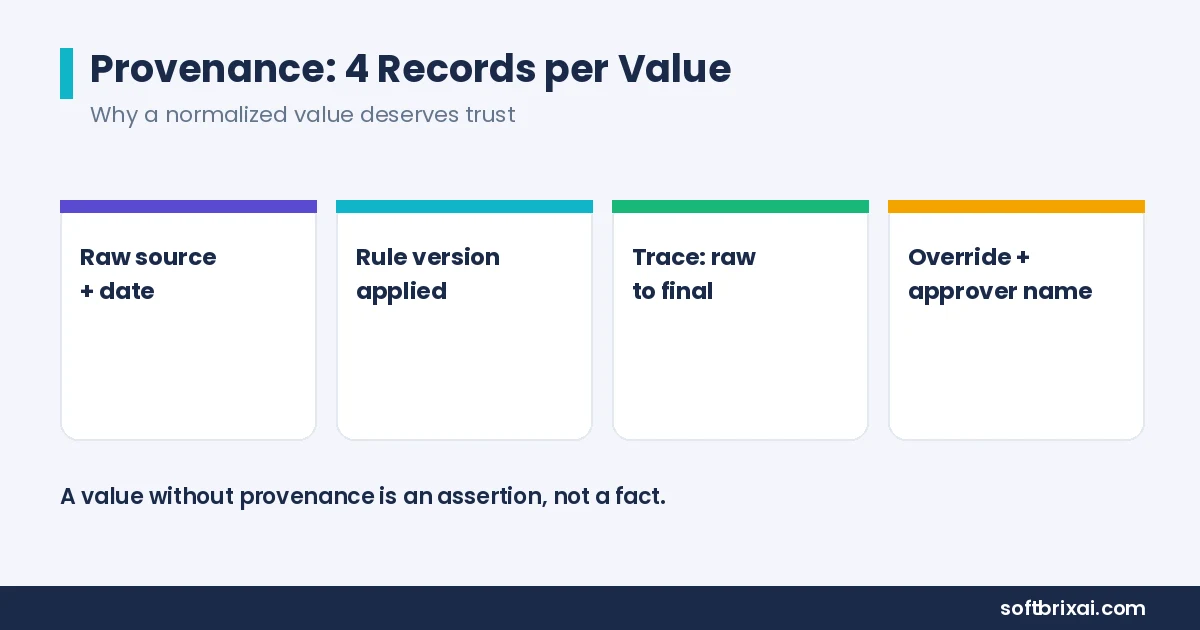
Data provenance is the recorded origin and history of a value: where it came from, which rules touched it, and who approved any override. Provenance decides whether a normalized value deserves trust. A founding year with provenance (three sources, two rule versions, one human review) is trustworthy. A founding year with no trail is a guess wearing a suit.
Provenance requires four records per value: the raw source and retrieval date, the rule version applied, the transformation lineage (each step from raw to final), and any manual override with the approver’s name. These records are kept for a defined period, often the life of the report plus one audit cycle. When a dashboard number looks wrong, provenance answers the question in minutes: which source, which rule, which version. Without it, the only answer is to re-run everything and hope.
Common BrandRank.ai Normalization Mistakes and How They Fail
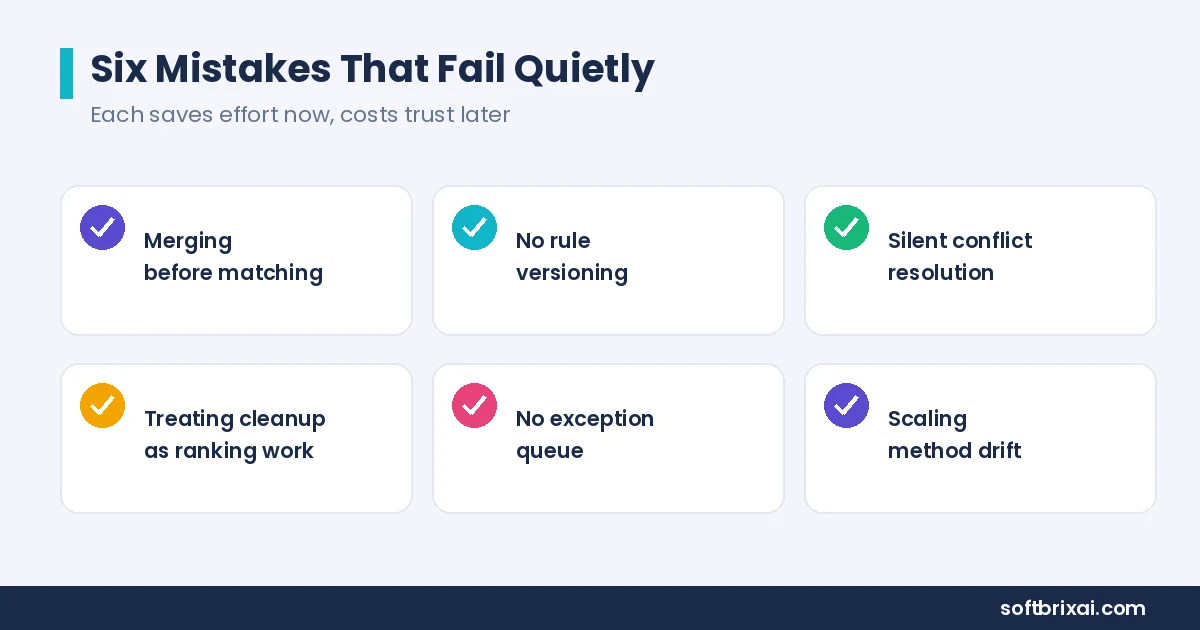
Six mistakes cause most normalization failures:
- Merging before matching. Deduplicating on name similarity alone collapses distinct entities. The failure mode: two companies become one, and every metric for both is wrong.
- No rule versioning. Rules change, and old reports silently shift. The failure mode: numbers that cannot be reproduced, and audits that cannot close.
- Silent conflict resolution. The pipeline picks a winner without logging it. The failure mode: canonical values that flip between runs.
- Treating normalization as ranking work. Teams expect cleaner data to raise AI visibility directly. The failure mode: disappointment, because normalization only makes measurement honest.
- No exception queue. Edge cases get forced through rules. The failure mode: quiet corruption that surfaces months later in a board deck.
- Scaling method drift. One report uses Min-Max, the next uses Z-scores, and nobody notes the change. The failure mode: trend lines that show movement that never happened.
Each mistake shares a trait: it saves effort now and costs trust later. Deliberately feeding the pipeline messy inputs to see where rules break catches these failures before production data does.
Myths About BrandRank.ai Normalization Transformation Rules
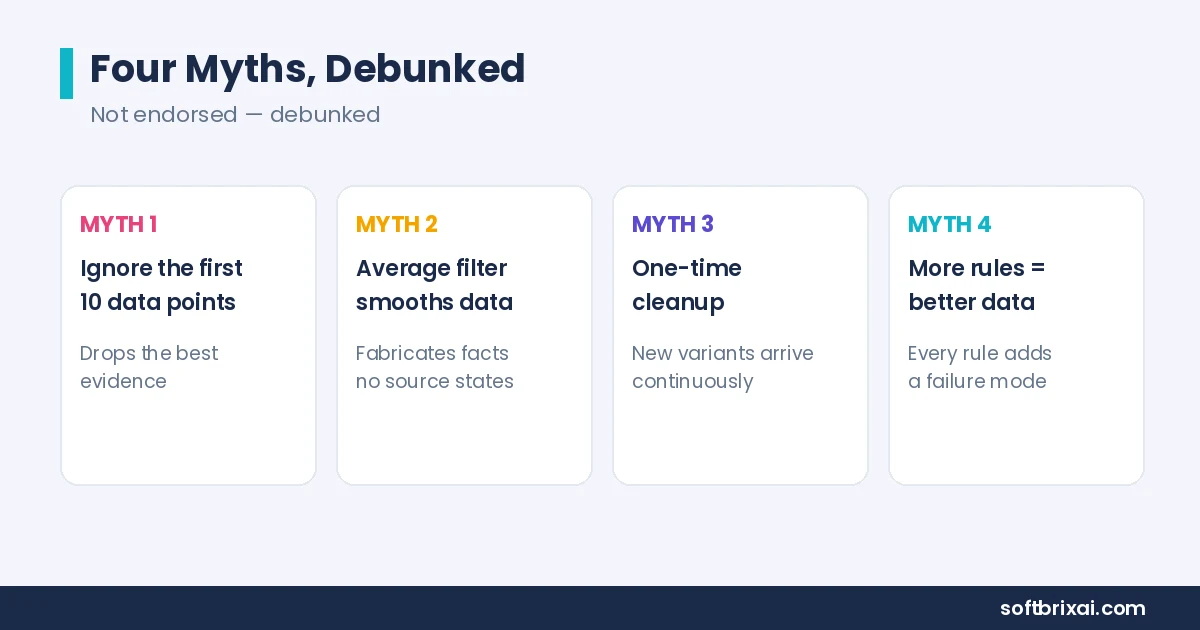
Four myths circulate about brand data normalization for AI. Each one fails on contact with real data.
Myth 1: “Ignore the first 10 data points.” The claim: early records are unreliable, so drop them. The failure: the first records often come from the highest-priority sources, and dropping them discards the best evidence. There is no statistical basis for a fixed cutoff. Outlier-resistant rank transforms handle genuine outliers; arbitrary deletion handles nothing.
Myth 2: “Apply an average filter to smooth the data.” The claim: averaging values removes noise. The failure: averaging conflicting values fabricates a fact that no source states. If one source says 2015 and another says 2017, the average, 2016, is wrong twice. Source priority resolves conflicts; averaging hides them.
Myth 3: “Normalization is a one-time cleanup.” The claim: fix the data once and done. The failure: new sources, new variants, and new products arrive continuously. Normalization is a pipeline that runs on every ingestion, not a project with an end date.
Myth 4: “More rules mean better data.” The claim: a bigger rulebook wins. The failure: every rule adds a failure mode, and interacting rules create conflicts. Conflict checks exist because rule count is a cost, not a virtue. The goal is the smallest rulebook that covers the real cases, plus an exception queue for the rest.
BrandRank.ai Normalization Guidelines in Practice
The BrandRank.ai normalization guidelines below turn the rules into an operating routine. Five practices cover most of the work.
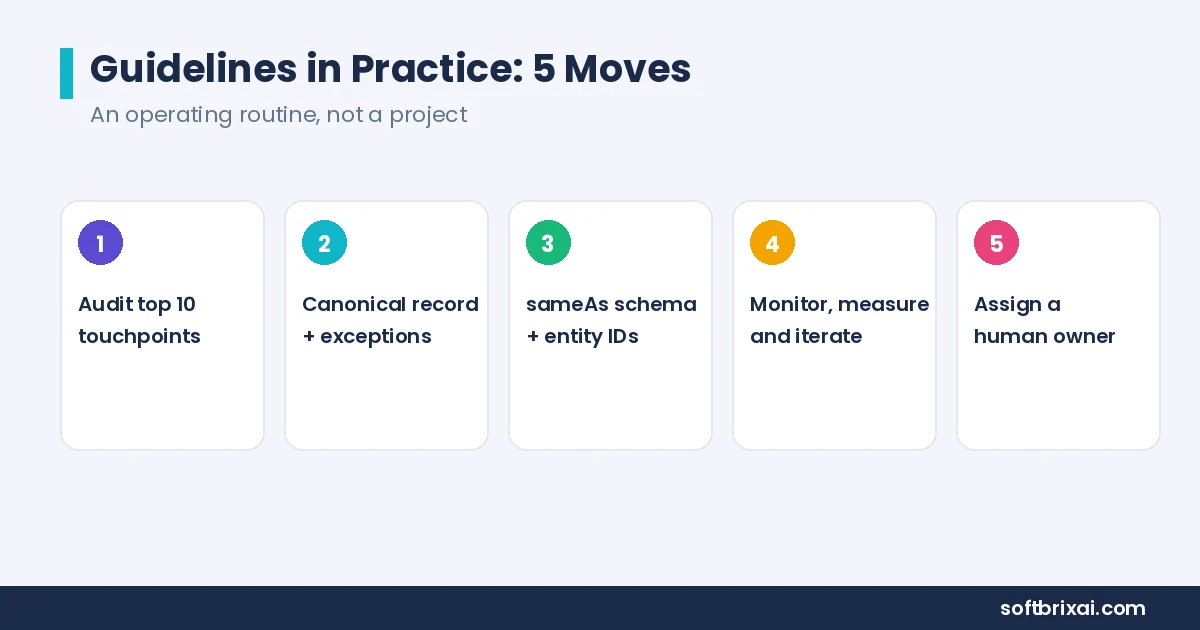
Audit Your Top 10 Touchpoints First
Audit the ten places AI models most often read about the brand: the homepage, key product pages, major directories, review profiles, social profiles, and knowledge-base entries. Fix those ten before touching anything else. The top touchpoints drive most AI citations, so normalization effort there returns the most measurement value.
Write the Canonical Record and the Exceptions List
Write the canonical record for each brand, product, and location: one name, one domain, one address format, one set of identifiers. Write the exceptions list beside it: every known variant, every unresolved conflict, every pending decision. The canonical record is the target; the exceptions list is the work queue. Both live in version control.
Add sameAs Schema and Entity IDs
sameAs schema is a structured data property (in JSON-LD, the format search engines and AI crawlers read most easily) that lists the URLs of a brand’s official profiles and records. Add sameAs links from the brand’s site to its knowledge-base entry, social profiles, and registry listings. Attach stable entity IDs (a Wikidata ID, for example) to the canonical record. These machine-readable links do more for entity consistency than any amount of text cleanup, because they tell AI models directly which records describe the same thing.
Monitor, Measure, and Iterate
Monitor the pipeline’s outputs, not just its inputs: match rates, exception queue size, validation failures, and score stability across runs. Stability checks confirm that a rule change did not move scores for reasons unrelated to real-world change. Version history records every rule change with a date and reason. Manual-override limits cap how many records a person can hand-edit per cycle, because overrides that bypass the rules recreate the inconsistency the rules exist to remove. Iterate on a schedule: review the exception queue monthly, promote recurring exceptions into rules, and re-run. Expect owned-channel fixes to show in weeks; third-party listings and historical content usually take a quarter or two to settle.
Assign a Human Owner
Assign one person accountability for brand governance: the canonical record, the rulebook, the exception queue, and the override log. Long-term data quality depends on ownership more than on tooling. A named owner catches drift, approves rule changes, and answers the audit questions. Without an owner, normalization decays within two quarters.
How to Tell If BrandRank.ai Normalization Is Working
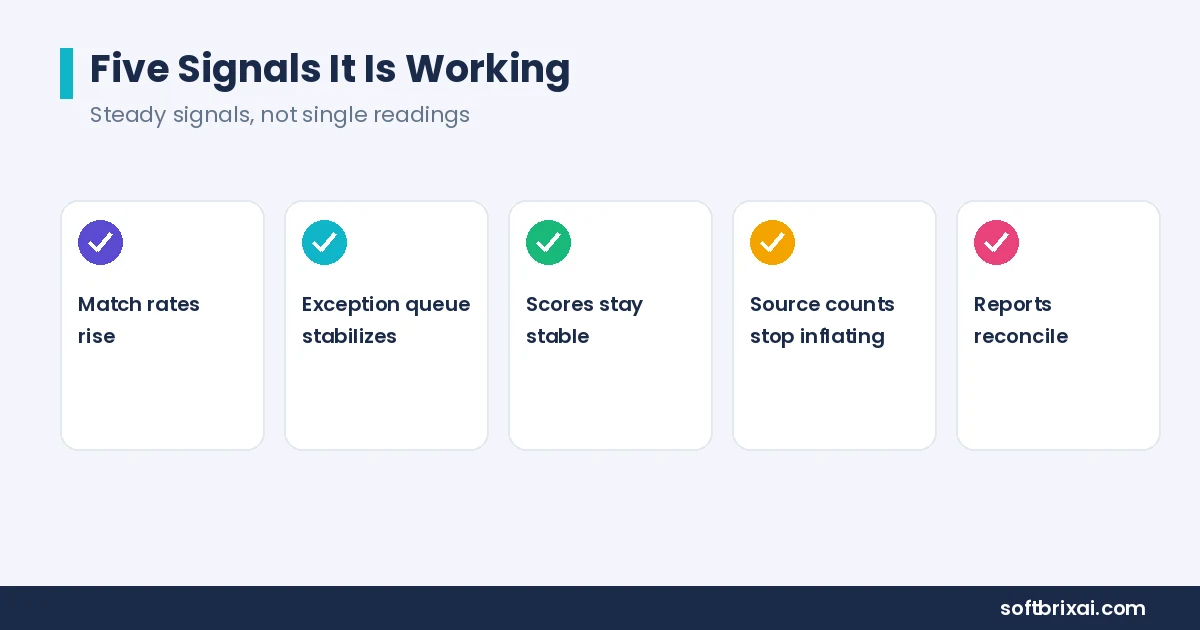
Normalization is working when five signals hold steady. First, match rates rise: a growing share of raw records attach to existing entities instead of creating new ones. Second, the exception queue shrinks or stabilizes rather than growing without bound. Third, score stability improves: repeated runs on unchanged data produce unchanged scores, confirmed by stability checks on repeated runs. Fourth, source diversity counts stop inflating from duplicates. Fifth, reports reconcile: the mention count in the dashboard matches the count from a manual spot check.
One caution belongs here. AI answers change for reasons unrelated to data quality. Prompt wording shifts results. Model updates shift results. The same question asked twice can return different answers, and choosing the right time window before comparing periods keeps those shifts from reading as brand movement. When AI brand answers swing, check prompt variance and model version before blaming the pipeline. Comparing score behavior across rule versions and time windows separates real change from noise.
Final Thoughts
BrandRank.ai normalization transformation rules are a discipline, not a switch. The discipline: state plainly that no official BrandRank.AI framework exists, then apply proven data-normalization practices with the same rigor. Normalize names, URLs, locations, and duplicates into canonical records. Transform those records into linked entities, attributed claims, and scaled scores. Run exceptions first, resolve identity before deduplication, and validate before anything reaches a report. Keep provenance on every value, version every rule, and give one person ownership.
The payoff is honest measurement. Normalization does not raise AI rankings. It makes the numbers that guide ranking work trustworthy, and trustworthy numbers are the only ones worth acting on.
Frequently Asked Questions
What are BrandRank.ai normalization transformation rules?
BrandRank.ai normalization transformation rules are a working set of conditions and actions that convert inconsistent brand data into one canonical form, then restructure that form for AI analysis. Normalization standardizes names, URLs, addresses, and duplicates. Transformation links entities, attributes claims to sources, labels sentiment, and scales scores. BrandRank.AI has not published an official framework under this name. The rules described here are established data-normalization practices applied to AI brand visibility work, presented as working guidance rather than disclosed proprietary methods.
Are BrandRank.ai normalization transformation rules official?
No. BrandRank.AI has not publicly documented an official framework called normalization transformation rules. Any specific formulas, regex patterns, thresholds, or internal schemas attributed to BrandRank.AI should be treated as unverified unless the company publishes them. The rules in this guide come from general data-normalization practice: canonical naming, entity resolution, source priority, exception handling, and score scaling. Teams can apply them with any AI brand monitoring tool. The principles are standard; the branding is not an endorsement. Until BrandRank.AI publishes such documentation, treat every claimed rulebook as practitioner guidance, not vendor fact.
What is the difference between normalization and transformation?
Normalization makes data consistent by reducing many raw variants to one standard form: one brand name, one URL format, one address style. Transformation makes data useful by reshaping the clean records into analysis-ready structures: entity links, source citations, sentiment labels, and scaled scores. The difference between normalization and transformation is purpose, not sequence alone. Normalization answers “what is the one correct way to record this fact?” Transformation answers “what does this fact mean in context?” Both stages run in order, and transformation depends on clean normalized input.
Can BrandRank.ai normalization improve AI rankings?
Normalization improves measurement consistency, not rankings directly. Cleaner data produces more accurate mention counts, sentiment trends, and competitive comparisons, and those accurate signals guide the content and reputation work that can influence AI answers. A brand with perfect normalization and thin authoritative content still gets weak AI visibility. Expect normalization to make dashboards honest and decisions better informed. Expect ranking movement only when the content, citation, and entity work that follows the measurement actually happens. Treat any vendor promise of direct ranking gains from cleanup alone as marketing, not measurement.
Does BrandRank.ai normalization replace SEO?
No. Normalization supports SEO and AI visibility work; it does not replace either. Traditional SEO metrics cover search rankings, traffic, and crawl health. Normalization covers data consistency across the sources AI models and search engines read. The two share foundations: canonical names, clean URLs, and structured data such as sameAs schema help both. Teams still need content strategy, technical SEO, and reputation work. Normalization is the data-quality layer beneath those efforts, not a substitute for them. Budget for both: data quality work and the content and technical work that actually moves visibility.
Can a tool fully automate BrandRank.ai normalization?
No tool fully automates normalization, because entity resolution and conflict handling require judgment at the edges. Tools automate the mechanical majority: formatting cleanup, URL normalization, exact-duplicate merging, and rule application at scale. Ambiguous matches, conflicting sources, and new entity types need human review through an exception queue. Plan for a hybrid: automation for volume, a named owner for decisions, and manual-override limits so hand edits do not recreate the inconsistency the rules remove. Full automation claims usually hide silent errors.
Why does data provenance matter?
Data provenance matters because it decides whether a normalized value deserves trust. Provenance records where a value came from, which rule version touched it, how it moved through the pipeline, and who approved any override. With provenance, a questionable dashboard number traces back to its source in minutes. Without it, the only recourse is a full re-run and a guess. Provenance also supports audits, reproduces old reports after rules change, and exposes silent conflict resolution. A normalized value without provenance is an assertion, not a fact.
How should businesses measure AI brand visibility?
Businesses should measure AI brand visibility with normalized data across seven categories: mentions, sentiment, context, positioning, frequency and prominence, source diversity, and query types. Track each category over time with one documented scaling method per metric. Spot-check dashboards against manual counts. Watch match rates, exception queue size, and score stability as pipeline health signals. Compare against competitors on the same normalized basis. Report trends, not single readings, because AI answers vary with prompt wording and model updates. Clean measurement makes the trends meaningful.