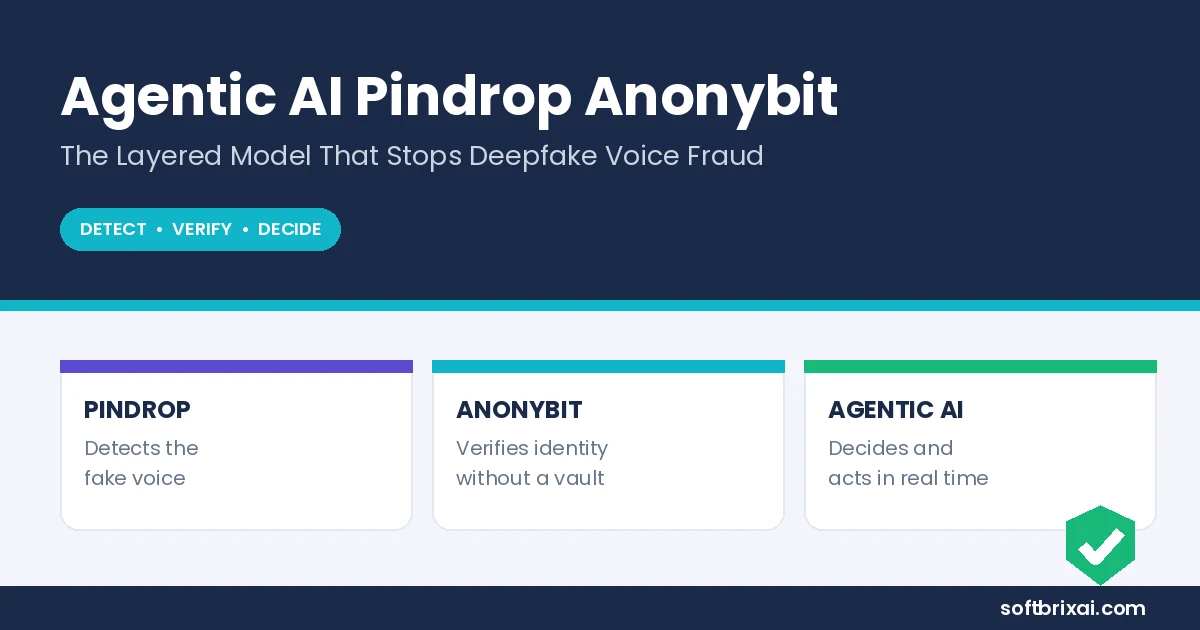
Agentic AI Pindrop Anonybit describes a three-layer security model that combines autonomous AI agents, Pindrop’s voice analysis and deepfake detection, and Anonybit’s decentralized biometric storage to stop deepfake voice fraud. The model works by splitting identity verification across separate layers: Pindrop examines the audio signal for signs of synthetic speech, Anonybit stores biometric data as encrypted fragments that never sit in one central database, and agentic AI coordinates decisions in real time without a human operator approving each step. The main benefits are fewer successful voice scams, less exposure of stored voiceprints, and faster verification during live transactions. The main uses are banking, healthcare, and contact center authentication. The main components are the detection layer (Pindrop), the storage and privacy layer (Anonybit), and the decision layer (agentic AI).
This framework matters because voice fraud has changed shape. Cloned voices are cheap to produce, and a convincing 10-second sample is enough to imitate a target. Traditional knowledge-based checks and single-factor voice authentication fail against that. The layered model does not depend on one control holding. It assumes one layer will be tested and designs the other two to catch what gets through.
Key Takeaways
- “Agentic AI Pindrop Anonybit” is a conceptual security stack, not a single product sold by one vendor. Pindrop and Anonybit are separate companies with separate products.
- Pindrop focuses on the audio signal. Its deepfake detection analyzes voice characteristics that synthetic speech struggles to reproduce, and it reports high detection rates in its own published research.
- Anonybit removes the central biometric database. It stores biometric data as encrypted fragments (shards) spread across separate locations, and verification happens without rebuilding the full record.
- Agentic AI acts as the decision layer. Autonomous agents score risk, choose which checks to run, and trigger step-up verification when signals conflict.
- Voice fraud losses are documented by regulators. The FTC reported $12.5 billion in total 2024 fraud losses, with imposter scams the most-reported category.
- Deployments are quote-based enterprise subscriptions. No public per-seat pricing exists for either vendor.
- The model has real limits: replay attacks, call quality, accessibility, and consent rules all affect accuracy.
What Is Agentic AI Pindrop Anonybit?
Agentic AI Pindrop Anonybit is a reference architecture for voice fraud prevention that joins three independent technologies into one verification flow. It is not a brand, a merger, or an off-the-shelf platform. Security teams assemble it from three parts: Pindrop’s voice security products, Anonybit’s decentralized biometric infrastructure, and an agentic AI orchestration layer that runs the decision logic.
The term “agentic” means the AI system takes actions on its own within set boundaries. An agentic system does not just flag a call as suspicious and wait for a human. It decides to run an extra liveness check, route the caller to a different verification path, or block a transaction, then logs why. A human reviews exceptions, not every decision.
The three components serve different jobs:
- Detection. Pindrop analyzes the audio itself: the channel, the device, the voice, and the behavior of the caller. Its deepfake detection looks for artifacts that voice cloning tools leave behind.
- Storage and privacy. Anonybit handles biometric data so that no central biometric database exists to breach. Voiceprints and face templates become encrypted fragments held in separate stores.
- Decision. Agentic AI combines the outputs of both systems, applies policy, and acts. It answers the question: given this detection score and this identity match, what should happen next?
The model fits the growing category of AI-driven identity fraud defense, where attackers use automation and defenders must respond at machine speed. A human fraud analyst cannot review every inbound call. An agentic layer can.
Why Voice Fraud Exploded
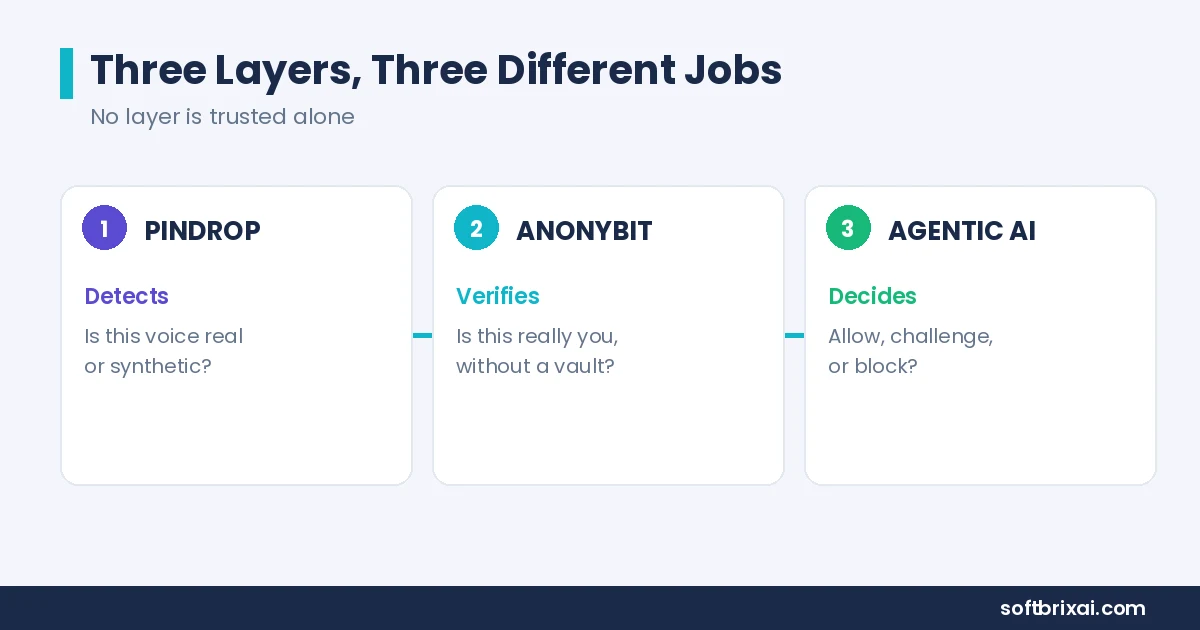
Voice fraud exploded because three conditions aligned: cheap voice cloning, leaked personal data, and phone-based customer service. Each one alone was manageable. Together they turned a phone call into a low-cost attack channel.
Voice cloning tools now produce a passable imitation of a target voice from a short audio sample. Public speeches, social media videos, and voicemail greetings supply that sample. The attacker does not need studio equipment. A laptop and a cloned voice model handle the rest.
Leaked personal data supplies the context that makes a scam convincing. Account numbers, recent transactions, and family names appear in breach dumps. An attacker who knows the last four digits of an account and the name of the customer’s bank can script a call that sounds routine.
Phone channels remain the weakest link in customer service. Call centers verify identity under time pressure, with agents measured on handle time (how quickly they finish each call). An agent who asks too many questions gets penalized on metrics. Attackers know this and exploit it.
The financial toll is documented. The Federal Trade Commission (FTC) reported $12.5 billion in total consumer fraud losses for 2024, a 25 percent increase over 2023. Imposter scams, the category that includes voice impersonation of family members and officials, were the most-reported fraud type. Pindrop’s 2025 Voice Intelligence and Security Report frames the same trend from the enterprise side, tracking growth in synthetic voice attacks against call centers.
A widely reported 2019 case shows how convincing this gets: a UK energy firm’s chief executive was tricked by a cloned voice imitating his parent-company boss into authorizing a transfer. No technology flagged the call, because nothing about the voice alone looked wrong to the people on it.
AI voice scams scale in a way earlier phone scams could not. One operator can run many calls at once with cloned voices and scripted responses. The economics of fraud changed, and authentication built for a slower era did not keep pace.
Why Traditional Authentication Fails
Traditional authentication fails against deepfake voice fraud for five reasons: it trusts knowledge, it trusts a single factor, it stores secrets in one place, it cannot see synthetic audio, and it runs on static rules.
Knowledge checks assume the attacker lacks information. Security questions, account PINs, and date-of-birth checks depend on secrets staying secret. Breach data exposes those secrets at scale. An attacker with a leaked profile answers the questions correctly.
Single-factor voice authentication trusts the voice alone. A voice biometric system that only compares a caller’s voice to an enrolled voiceprint will accept a good clone. The system answers one question: does this sound like the enrolled speaker? It does not ask whether the speaker is a live human in real time.
Central biometric databases create a single point of failure. When every voiceprint sits in one repository, one breach exposes every enrolled identity permanently. A voice cannot be reissued the way a password can. The enrolled template is bound to a person’s body.
Static rules cannot adapt. Rule-based fraud engines apply fixed thresholds. Attackers probe the rules, find the edges, and work just inside them. Rules also generate false positives that frustrate legitimate customers, so teams loosen them, which widens the gap.
Audio spoofing defeats systems that ignore the channel. Many authentication systems never examine the audio signal for signs of synthesis, replay, or injection. They treat the call as a clean input. Attackers exploit that assumption with replayed recordings and synthetic speech.
Traditional identity security solutions were built for a world where the attacker was a person guessing passwords. The attacker is now a script running cloned voices at volume. The controls need to match the threat.
Who Is Pindrop?
Pindrop is a voice security company founded in 2011 by Vijay Balasubramaniyan and colleagues from Georgia Tech research on phone fraud. The company builds voice authentication, deepfake detection, and fraud analytics products for contact centers and enterprises. Pindrop Security sells to banks, insurers, retailers, and contact center operators, and it also works through managed security service provider (MSSP) partners that resell and manage its products.
Pindrop’s core claim is that a phone call carries more signal than the words spoken. The audio contains information about the device, the network path, the audio encoding format (codec), and the acoustic environment. Pindrop’s models analyze those signals to score risk before a caller ever reaches an agent.
The company publishes research on deepfake voice detection and operates a voice intelligence report that tracks attack trends. Its messaging to buyers is direct: verify, do not assume. That framing appears on its webinar registration pages and in its product material.
Pindrop sells its capability as a product family. Protect scores fraud risk across the IVR and live-agent stages of a call. Passport passively authenticates genuine callers without security questions or one-time codes. Pulse flags synthetic audio, and Pulse for Meetings extends detection to live meetings. Pindrop reports that Pulse analyzes more than 1,300 voice, device, and behavior signals and returns a liveness verdict in about two seconds. Treat those figures as vendor-reported, and validate them on your own call audio.
The company also cites outside recognition for its work, including a win in the FTC’s Voice Cloning Challenge and TIME recognition for its meeting product. Treat those citations as company-reported recognition, not independent test results.
How Pindrop Detects a Deepfake Voice
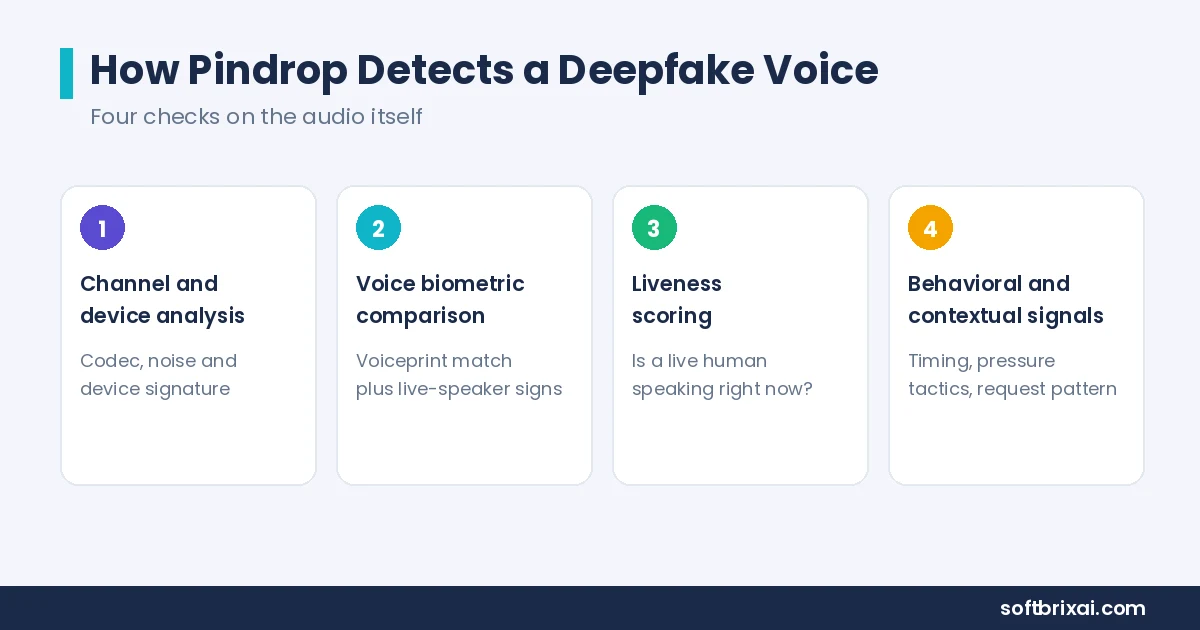
Pindrop detects a deepfake voice by analyzing the audio signal for physical and statistical artifacts that synthetic speech generation leaves behind. The detection runs in real time during the call, before a transaction or account change is approved.
The approach has four parts:
- Channel and device analysis. Pindrop examines the audio path: audio encoding, background noise, and device characteristics. A cloned voice injected directly into a call stream often carries a different channel signature than a real phone call from a real handset.
- Voice biometric comparison. The system compares the caller’s voice against the enrolled voiceprint for that identity. It also checks for signs that the voice does not belong to a live speaker, such as unnatural rhythm and intonation or missing breath patterns.
- Liveness scoring. A liveness score estimates whether the audio comes from a live human speaking in real time. Replayed recordings, synthesized speech, and injected audio score lower. This is the control that catches a clone even when it sounds like the right person.
- Behavioral and contextual signals. Pindrop weighs how the caller interacts: response timing, pressure tactics, and the pattern of the request. A caller who demands an urgent transfer while refusing verification steps raises the score.
Pindrop reports that its deepfake detection achieves high accuracy in its own testing, including in published research on synthetic voice detection. Treat those figures as vendor-reported. Independent validation matters, and buyers should ask for test results on their own audio conditions.
The output is a risk score and a set of reasons. The score feeds the decision layer. Pindrop does not make the final call on its own in this model. It supplies evidence.
Who Is Anonybit?
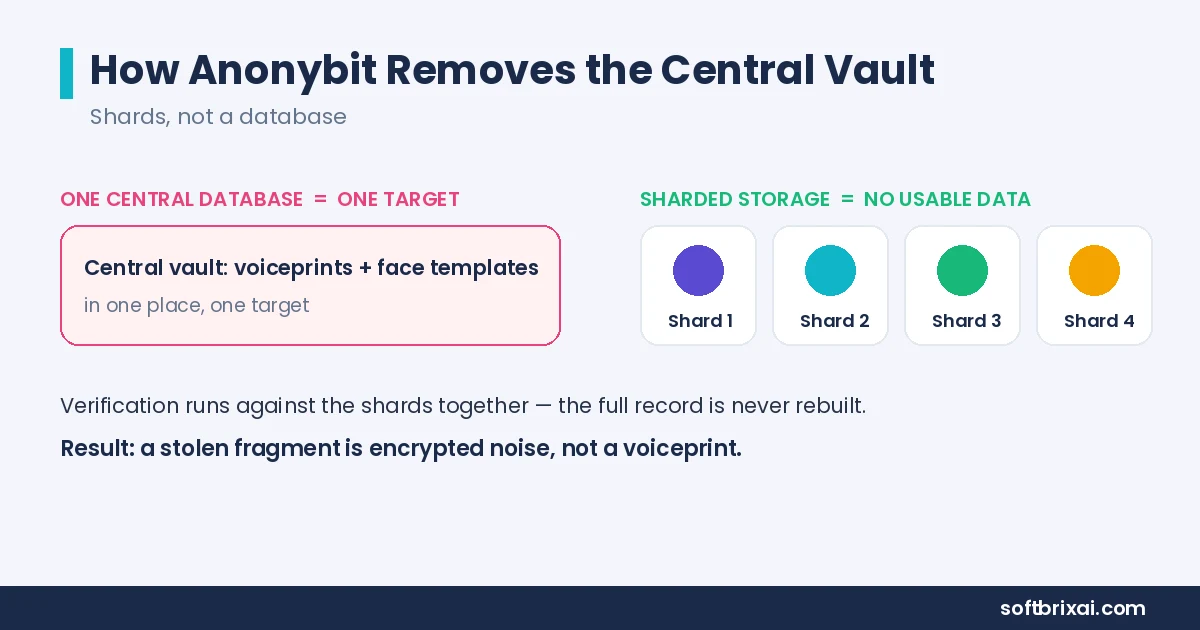
Anonybit is a decentralized biometrics company co-founded by Frances Zelazny and others, focused on privacy-preserving identity infrastructure. Anonybit’s product replaces the central biometric database with a distributed storage model. Biometric data is broken into encrypted fragments, called shards, and each shard is stored in a separate location. No single server holds enough data to reconstruct a person’s biometric record.
Verification works without reassembling the record. The system compares the incoming biometric sample against the shards in a distributed computation, and it returns a match result without ever rebuilding the full template. This is cryptographic fragmentation with distributed matching, not a pure zero-knowledge proof system. The distinction matters for security reviews: the guarantee comes from the data being split and encrypted, with matching performed across the fragments.
The practical effect is that a breach of one storage node yields nothing usable. An attacker who compromises a single location gets an encrypted fragment, not a voiceprint. The enrolled biometric stays protected even after a breach, which is the property a central biometric database cannot offer.
Anonybit’s model also supports biometric authentication across modalities, including face and voice, and it fits passwordless authentication and digital ID registration programs. For the agentic AI Pindrop Anonybit stack, Anonybit supplies the identity protection layer: the place where biometric data lives and the mechanism that verifies it without exposing it.
Anonybit’s CEO has described this approach as a Circle of Identity: biometric-bound identity that follows the person across credentials, devices, and tokens, so an AI agent’s actions stay tied to the human who authorized them. Each action carries a time-bound biometric signature, which means a stolen token cannot simply be replayed for another transaction.
What Agentic AI Adds
Agentic AI adds the decision layer that neither detection nor storage provides on its own. Pindrop produces risk signals. Anonybit produces identity matches without exposing biometrics. Agentic AI decides what those signals mean together and what to do next.
An agentic system in this stack performs five functions:
- Combines signals. The agent weighs the Pindrop risk score, the liveness score, the Anonybit match result, and transaction context into one decision.
- Chooses the next check. When signals conflict, the agent selects a step-up verification method. Step-up verification means asking the caller for a stronger proof of identity, such as a second biometric factor or a callback to a registered number.
- Acts within policy. The agent blocks, approves, or routes according to rules the security team sets. It does not invent policy. It executes it.
- Explains decisions. Each action is logged with the signals that drove it. Auditors and fraud teams can review why a call was blocked.
- Adapts thresholds. Over time, the agent adjusts thresholds based on outcomes, within limits set by humans.
The value is speed and consistency. A human analyst reviewing every suspicious call creates a bottleneck and applies judgment unevenly. An agentic layer applies the same policy to every call in milliseconds, and it escalates only the cases that need a person.
Agentic AI also changes the economics of defense. Attackers use automation. A defense that requires a human for every decision cannot match that volume. An agentic layer can.
Guardrails decide whether the layer helps or harms. Cap what the agent can approve on its own: high-value transfers and account changes should always route to a human, no matter how clean the scores look. Log every automated decision with its evidence, and review a sample weekly. When a decision is wrong, fix the policy, not just the single case, or the same error will repeat at machine speed.
How the Three Layers Work Together
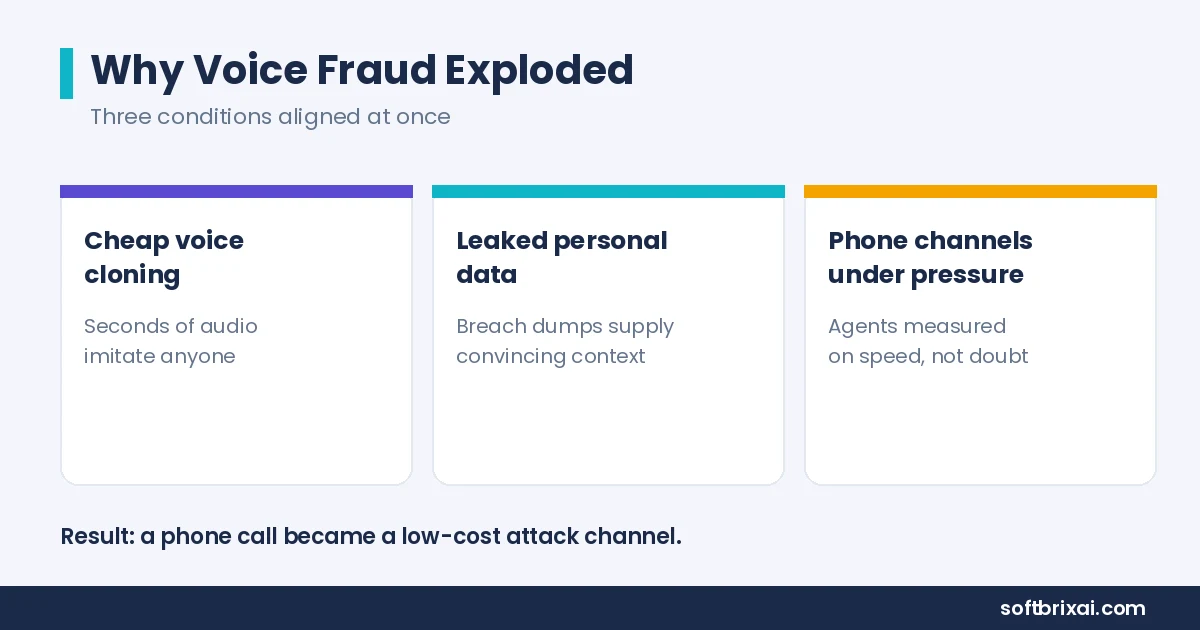
The three layers work together as a pipeline: detect, verify, decide. Each layer covers a weakness in the others, and no layer is trusted alone.
Pindrop covers the audio. It answers whether the voice is real and whether the caller is who the voice claims to be. It cannot protect stored biometrics, and it does not own the transaction decision.
Anonybit covers the data. It answers whether the biometric sample matches the enrolled identity without exposing the enrolled record. It cannot detect a deepfake on its own, because it compares samples, not liveness.
Agentic AI covers the decision. It answers what should happen given all the evidence. It cannot generate the evidence itself.
The combination produces defense in depth. A cloned voice that fools the liveness check still has to match the Anonybit-stored biometric. A stolen biometric fragment still has to pass Pindrop’s channel and behavioral analysis. An attacker has to defeat three independent controls, each built on different data and different assumptions.
A Live Transaction, Step by Step
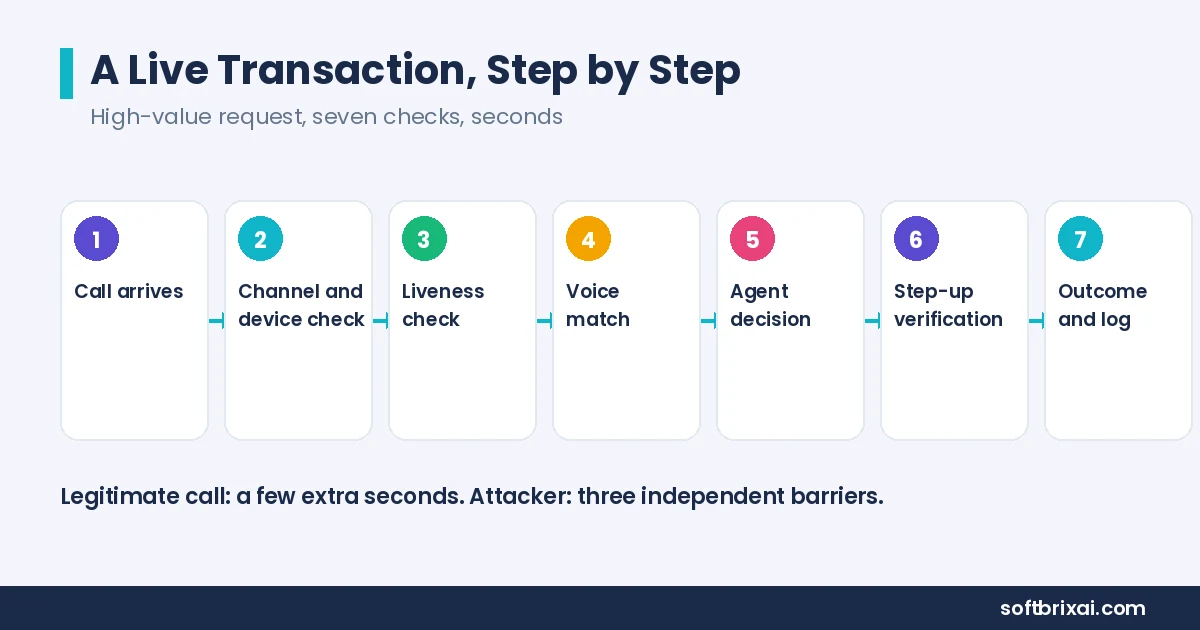
A live transaction moves through the stack in seconds. Here is the sequence for a high-value request, such as a wire transfer authorized by phone.
- Call arrives. The caller reaches the IVR (interactive voice response, the phone menu system) or an agent. Pindrop begins analysis on the first audio.
- Channel and device check. Pindrop scores the audio path. A call injected from an internet phone app (softphone) or a recording device scores as higher risk.
- Liveness check. The system asks the caller to speak a prompted phrase. The liveness score estimates whether a live human is speaking. A replayed recording fails.
- Voice biometric match. The caller’s voice is compared to the enrolled voiceprint. In the Anonybit layer, the comparison runs against encrypted shards without rebuilding the template.
- Agent decision. The agentic layer combines the scores. If all signals agree and risk is low, the agent approves the transaction. If signals conflict, the agent triggers step-up verification.
- Step-up verification. The caller completes a second factor, such as a face match through the mobile app or a callback to a registered number. The agent evaluates the result.
- Outcome and log. The agent approves, blocks, or routes to a human reviewer, and it writes the decision and the evidence to the audit log.
The whole flow adds a few seconds to a legitimate call. For an attacker, it adds three independent barriers, and each barrier fails in a different way.
Where the Model Is Used
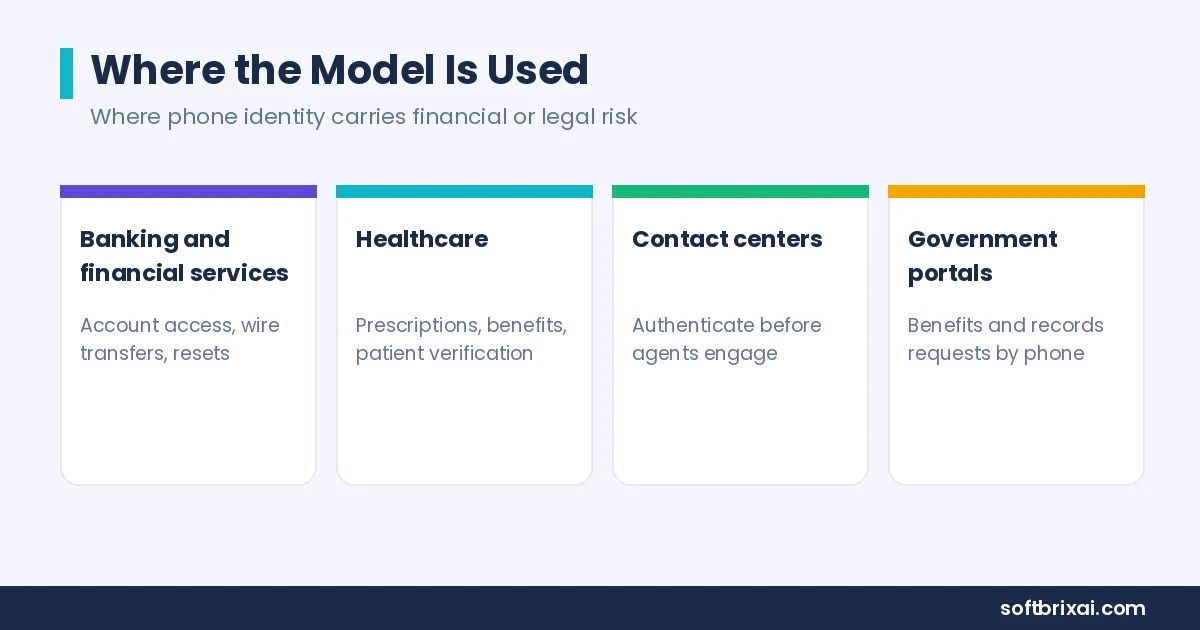
The model is used where phone-based identity verification carries financial or legal risk. Three sectors dominate: banking, healthcare, and contact centers. Government service portals follow a similar pattern: benefits inquiries and records requests over the phone carry the same impersonation risk, with the added weight of public accountability when a wrong decision is made.
Banking and Financial Services
Banks use the stack to protect account access, wire transfers, and password resets handled by phone. Financial fraud through voice channels is expensive and regulated. A cloned voice that passes a bank’s verification can authorize a transfer in minutes. The layered model puts liveness detection and decentralized biometric matching between the caller and the money. Banks also use the audit trail for dispute resolution and regulatory reporting.
Healthcare
Healthcare providers use the model to verify patients and staff over the phone, especially for prescription requests and benefits inquiries. Healthcare fraud carries privacy exposure under HIPAA, and a breached voiceprint is a biometric identifier. Anonybit’s fragmented storage limits that exposure. Pindrop’s detection blocks impersonation of patients and providers. The agentic layer enforces policy that matches the sensitivity of the request, so a prescription refill and a records request get different scrutiny.
Contact Centers and Customer Service
Contact centers use the stack to authenticate callers before agents engage, which cuts handle time and reduces account takeover. Agents see a risk score and a verification result instead of running manual security questions. The agentic layer routes high-risk calls to specialists. Contact center operators also value the reduction in false declines, because a layered decision is more accurate than a single threshold.
Industry Voices: What Pindrop, Anonybit, and Validsoft Each Warn About
Each vendor in this space warns about a different failure mode, and the warnings are complementary.
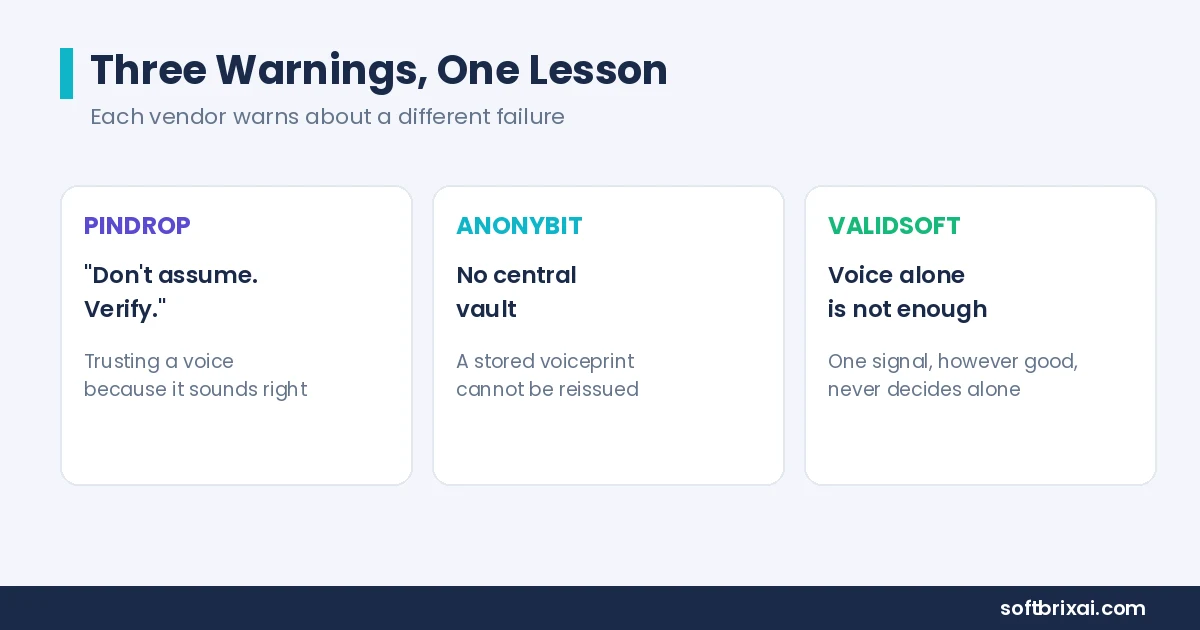
Pindrop warns that verification cannot be assumed. Its public framing, “Don’t assume. Verify.,” targets the habit of trusting a caller because the voice sounds right. Pindrop’s research tracks the growth of synthetic voice attacks and argues that detection must run on the audio itself, in real time, not on metadata alone. The warning is aimed at organizations that still treat voice as a low-risk channel.
Anonybit warns about the central biometric database. Its core argument is that storing biometrics in one place creates a permanent, irreversible liability. A password can be reset after a breach. A voiceprint cannot. Anonybit’s message to buyers is that privacy-preserving architecture is a security requirement, not a compliance checkbox, and that decentralized biometric storage removes the target that attackers want most.
Validsoft warns about the limits of single-factor voice authentication. Validsoft, a voice biometric and identity assurance vendor, has publicly argued that voice alone is not enough and that authentication needs multiple factors and channel intelligence. Its position aligns with the layered model: voice is one signal among several, and the decision must weigh context.
Anonybit’s CEO has also argued that agents must authenticate each other, not just humans. When one AI agent hands work to another, the receiving agent needs proof that the sending agent is legitimate, so-called machine-to-machine authentication. Without it, agent-to-agent handoffs become a new attack surface.
Hiring is another vector the industry now watches. Fraudsters have used cloned voices and video avatars to pose as job candidates and gain access to company systems. A hiring flow that verifies only a resume and a live-looking video call is exactly the kind of single check this layered model is built to replace.
The common thread: no single control holds. Each vendor argues for its layer and against overreliance on any one check. The agentic AI Pindrop Anonybit stack takes all three warnings seriously by design.
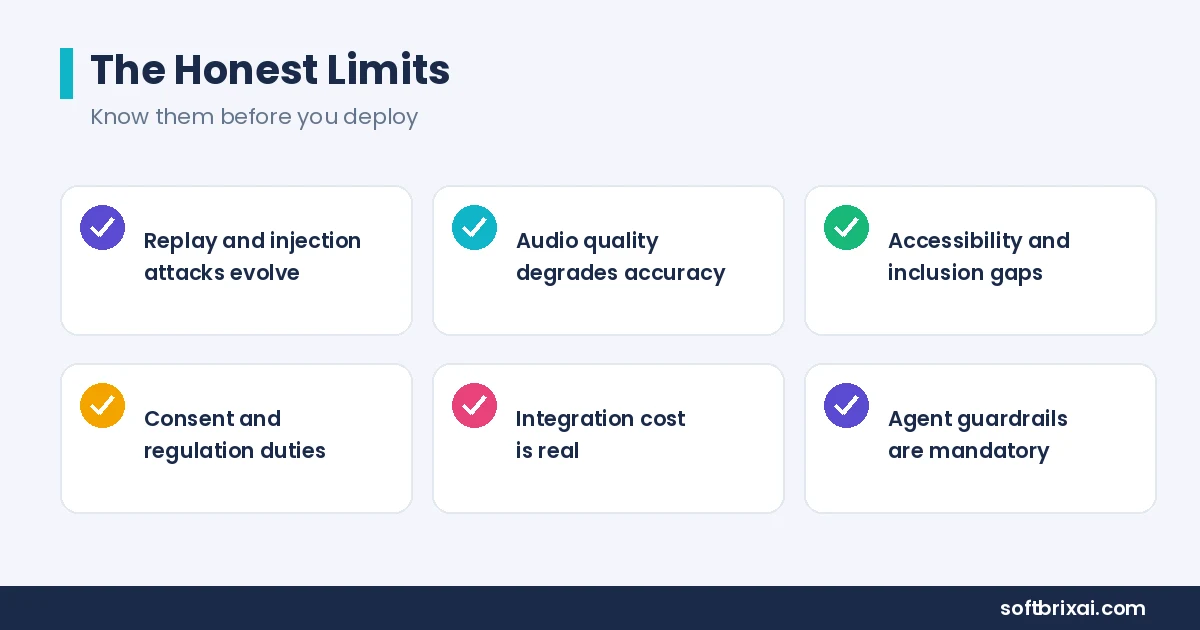
The Honest Limits
The model has limits, and buyers should know them before deploying.
Replay and injection attacks evolve. Detection models are trained on known synthesis methods. Attackers adapt. Pindrop updates its models, but no detector catches every attack, and vendor accuracy claims come from controlled tests, not from every customer’s audio environment.
Attackers also learn from the detector. Every blocked attempt teaches a fraud ring something about the thresholds, and synthesis tools improve monthly. A deployment that is never retuned quietly degrades: catch rates fall while false declines stay flat, so the numbers look stable until a new wave gets through. Budget for continuous retuning, not a one-time setup.
Audio quality affects accuracy. Compressed calls, background noise, and poor microphones degrade both liveness detection and biometric matching. False declines (legitimate callers wrongly rejected) hit legitimate customers with old phones or noisy locations.
Accessibility and inclusion matter. Voice biometrics can underperform for people with speech impairments, heavy accents, or respiratory conditions. A layered model must include fallback paths that do not lock out legitimate users.
Consent and regulation constrain deployment. Voice is biometric data under GDPR and several US state laws, including Illinois Biometric Information Privacy Act (BIPA) and California’s Consumer Privacy Act (CCPA). Enrollment requires clear consent, and retention rules apply. Anonybit’s fragmented storage helps with data minimization, but it does not remove the legal obligation to obtain consent.
Integration cost is real. The stack requires connecting Pindrop, Anonybit, and an orchestration layer to existing IVR, CRM, and fraud systems. That work takes months, not days, and it needs security review at each seam.
Agentic AI needs guardrails. An autonomous decision layer that blocks transactions can cause harm if its policy is wrong. Human oversight, audit logs, and rollback procedures are mandatory, not optional.
How to Evaluate and Deploy It
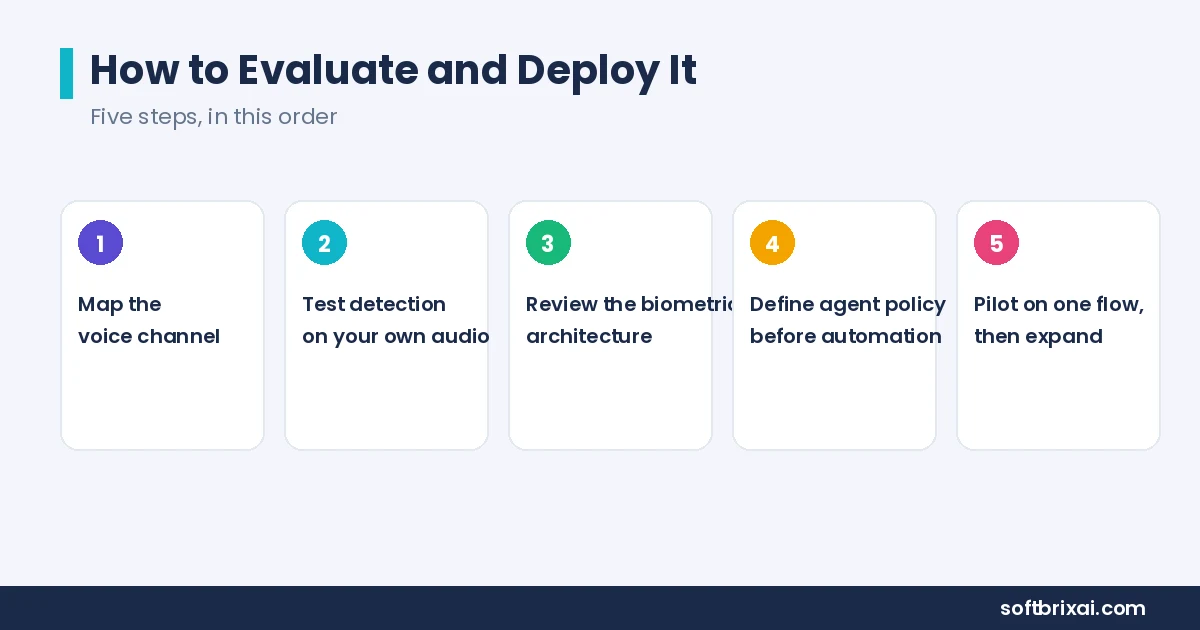
Evaluate the stack in five steps, in this order.
- Map the voice channel. Identify every phone flow where identity matters: account access, payments, resets, and records requests. Rank them by loss exposure.
- Test detection on your own audio. Run Pindrop or a comparable detector against recordings from your actual call environment, including known fraud attempts. Vendor benchmarks do not substitute for your data.
- Review the biometric architecture. Ask where biometric templates are stored, how they are encrypted, and whether matching requires reassembling them. Anonybit’s sharded model is one answer; confirm it fits your privacy obligations.
- Define agent policy before automation. Write the decision rules: what scores trigger step-up, what triggers a block, what routes to a human. Set limits on what the agent can do without review.
- Pilot on one flow, then expand. Start with a single high-risk flow, measure false declines and catch rates, and expand only after the numbers hold.
Deployment also needs a consent process for biometric enrollment, a retention schedule, and an incident response plan that covers biometric data specifically. Treat the agentic layer as production software: version its policy, test changes, and log every decision.
Smaller organizations without a fraud team do not have to build all of this in-house. Managed security service provider (MSSP) partners can run the voice-fraud layer for you, including tuning, monitoring, and case escalation, with Pindrop’s products sitting inside the broader security operations they already manage. The tradeoff is less direct control over thresholds and policy, so agree on escalation rules and reporting before signing.
What It Costs
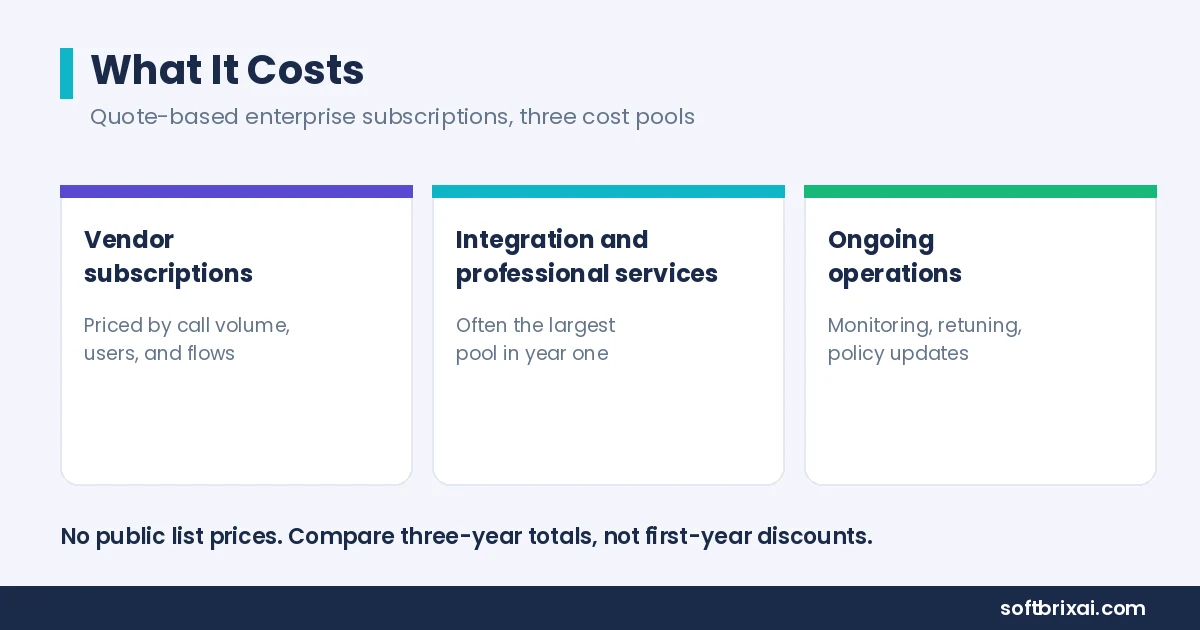
Pricing for this stack is quote-based. Pindrop and Anonybit both sell enterprise subscriptions priced by volume, use case, and contract terms, and neither publishes list prices. Expect costs to scale with call volume, number of enrolled users, and the number of integrated flows. Agentic orchestration adds licensing or internal engineering cost, depending on whether you build the decision layer or buy it.
Budget for three cost pools: vendor subscriptions, integration and professional services, and ongoing operations for model monitoring and policy tuning. The integration pool is often larger than buyers expect. Ask each vendor for reference deployments of similar size and for the total cost of ownership over three years, not just year one.
When you request a quote, scope it with your real numbers: monthly call volume, enrolled user count, the flows you want covered, and how long you need flagged recordings retained. Vendors price on those inputs, so a vague request returns a vague quote. Compare three-year totals across vendors, not first-year discounts.
Final Thoughts
Agentic AI Pindrop Anonybit is a layered model, and its strength is that no layer is trusted alone. Pindrop detects deepfake voice fraud in the audio. Anonybit removes the central biometric database and verifies identity without exposing the record. Agentic AI decides, acts, and logs the reasoning. The three layers work together to stop deepfake voice fraud at the points where single controls fail.
The model is not a product. It is an architecture that security teams assemble from separate vendors, and it carries real limits: evolving attacks, audio quality, accessibility, consent rules, and integration cost. Deploy it on one high-risk flow, measure results on your own audio, and expand only when the numbers hold. The threat is automated. The defense should be too.
Frequently Asked Questions
What is agentic AI Pindrop Anonybit?
Agentic AI Pindrop Anonybit is a conceptual security framework that combines three separate technologies: Pindrop’s voice analysis and deepfake detection, Anonybit’s decentralized biometric storage, and an agentic AI decision layer. It is not a single product sold by one company. Security teams assemble the stack from independent vendors to verify callers in real time. The framework targets deepfake voice fraud by layering detection, privacy-preserving biometric matching, and autonomous decision-making, so an attacker must defeat three independent controls rather than one.
Are Pindrop and Anonybit the same company?
No. Pindrop and Anonybit are separate companies with separate products and separate founders. Pindrop, founded in 2011 and led by Vijay Balasubramaniyan, builds voice security, deepfake detection, and fraud analytics for contact centers and enterprises. Anonybit, co-founded by Frances Zelazny and others, builds decentralized biometric infrastructure that stores biometric data as encrypted fragments instead of a central database. The two companies are complementary in the layered model, but they are not affiliated, merged, or jointly selling a combined product. The two firms sell different products, and any joint deployment is an integration project, not a bundle you buy once.
How does Pindrop detect a deepfake voice?
Pindrop detects a deepfake voice by analyzing the audio signal for artifacts that synthetic speech leaves behind. The system examines the channel and device characteristics, compares the voice to the enrolled voiceprint, computes a liveness score that estimates whether a live human is speaking, and weighs behavioral signals such as response timing and pressure tactics. A cloned or replayed voice typically scores lower on liveness and shows channel inconsistencies. Pindrop reports high accuracy in its own testing; buyers should validate results on their own call audio.
How is Anonybit different from normal biometrics?
Anonybit differs from normal biometrics in where the data lives and how matching works. Standard biometric systems store templates in a central database, which creates a single breach target and a permanent exposure if compromised. Anonybit breaks biometric data into encrypted fragments called shards, stores each shard in a separate location, and verifies identity through distributed matching without reassembling the full record. A breach of one node yields an encrypted fragment, not a usable voiceprint. This is cryptographic fragmentation, not a pure zero-knowledge proof system.
Is this a product I can buy?
No. Agentic AI Pindrop Anonybit is a reference architecture, not a purchasable product. You can buy Pindrop’s voice security products and Anonybit’s decentralized biometric infrastructure separately, and you can build or license an agentic orchestration layer to connect them. The framework describes how the three components work together. Organizations that want the full stack must integrate the pieces themselves or work with systems integrators and managed security service provider (MSSP) partners that assemble and manage multi-vendor security deployments. Treat vendor claims about joint deployments carefully, and confirm each product’s current capabilities directly with the vendor.
Does it work for video calls and meetings?
Partly. Pindrop’s detection is built for voice channels, and its core analysis applies to any audio stream, including the audio track of a video call. Anonybit’s biometric matching supports face and voice modalities, so video adds a second factor. The limits are practical: video platforms compress audio differently, background noise varies, and injection attacks on video are a separate threat class. Deployments for video need their own testing. The framework’s decision layer can incorporate video signals, but the vendor tooling is optimized for phone and contact center audio.
Is it GDPR and HIPAA compliant?
Compliance depends on how you deploy, not on the framework itself. Voice is biometric data under GDPR, which requires a lawful basis, explicit consent where applicable, data minimization, and retention limits. HIPAA applies when protected health information is involved, and biometric identifiers used in healthcare flows fall under its safeguards. Anonybit’s fragmented storage supports data minimization and limits breach exposure, and Pindrop’s detection processes audio in real time. Neither vendor’s product makes an organization compliant on its own. Consent processes, retention schedules, business associate agreements, and audits remain the deployer’s responsibility.
How much does it cost?
Pricing is quote-based, and neither Pindrop nor Anonybit publishes list prices. Both sell enterprise subscriptions priced by call volume, enrolled user count, use case, and contract length. Expect three cost pools: vendor subscriptions, integration and professional services, and ongoing operations for model monitoring and policy tuning. The integration pool is often the largest in year one. Ask vendors for reference deployments of similar size and for three-year total cost of ownership figures rather than first-year pricing alone. Include integration and monitoring costs in your budget, since the subscription price alone understates the first-year total.