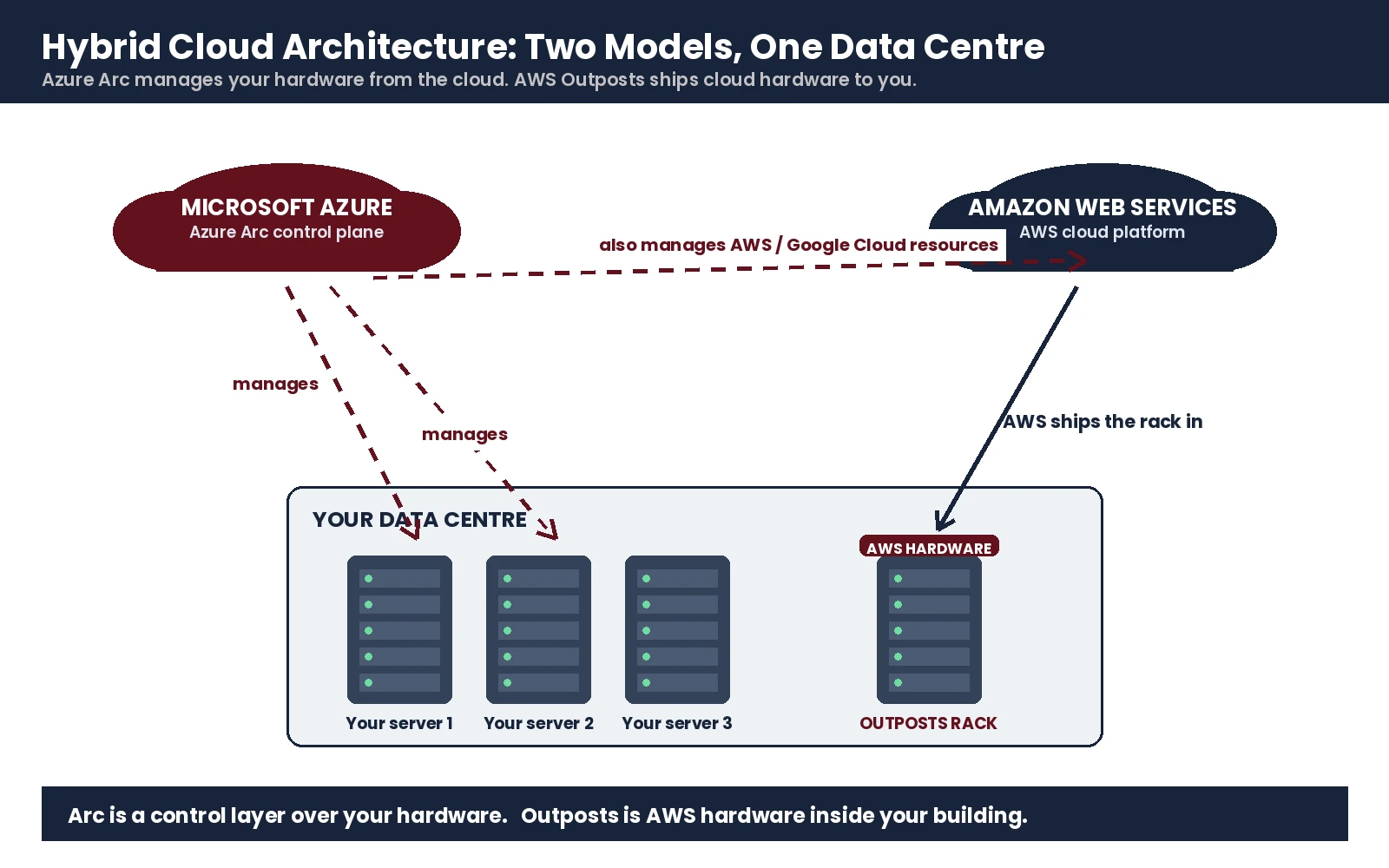
Any honest droven io aws vs azure comparison ends with the same answer, because each platform wins a different kind of workload. AWS gives engineering teams deeper control over infrastructure, backed by the widest service catalog in cloud computing. Azure gives Microsoft-centered companies tighter integration with existing systems, stronger hybrid cloud tooling, and real licensing value. Choosing between the two platforms therefore starts with your current stack, your team’s skills, and your migration plans. Market data confirms how close the race has become at the top of the cloud infrastructure market. Synergy Research Group gave AWS 28 percent of worldwide cloud infrastructure revenue in the second quarter of 2026. Microsoft took 20 percent in the same quarter, while Google Cloud took third place with 15 percent. Spending across the market reached 143 billion dollars in that single quarter, growing 43 percent year over year.
AWS vs Azure at a Glance
The table below sums up the droven io aws vs azure comparison before the detailed sections begin.
| Factor | AWS | Azure |
|---|---|---|
| Launched | 2006 | 2010 |
| Market share, Q2 2026 | 28 percent | 20 percent |
| Regions | 34 regions in Amazon documentation | 60+ regions, per Microsoft |
| Strongest fit | Cloud-native builds, custom infrastructure | Microsoft estates, hybrid cloud |
| Hybrid model | AWS Outposts hardware on site | Azure Arc management across sites |
| AI focus | Model choice through managed AI services | OpenAI models inside enterprise tools |
| Pricing lever | Savings Plans for committed usage | Azure Hybrid Benefit for existing licenses |
Popularity alone settles nothing, because market share says little about fit for one specific workload. Fit depends on the services you need, the licenses you hold, and the skills your team already has.
What Is Droven.io in This Comparison?
Droven.io is a technology publication covering cloud computing, artificial intelligence, software development, and cybersecurity for technical readers. Droven.io is not a cloud provider, so no Droven.io product competes with AWS or Azure directly. Amazon Web Services and Microsoft Azure supply the platforms; Droven.io supplies the reading material. Readers land on a droven io aws vs azure comparison while checking a platform decision against an independent summary. Search behavior explains the query better than any branding theory, since buyers verify big infrastructure choices across several sources.
AWS vs Azure Services Compared
Microsoft Learn publishes an official mapping between AWS services and Azure services for migration planning. The table below condenses that mapping into the categories buyers compare first.
| Category | AWS | Azure | Practical difference |
|---|---|---|---|
| Compute | Amazon EC2 | Azure Virtual Machines | EC2 offers more instance families, including Graviton processors |
| Serverless functions | AWS Lambda | Azure Functions | Lambda carries the longer event-driven track record |
| Containers | Amazon EKS | Azure Kubernetes Service | Both run managed Kubernetes with different tooling habits |
| Object storage | Amazon S3 | Azure Blob Storage | S3 tooling enjoys the widest third-party support |
| Analytics storage | Amazon S3 data lakes | Azure Data Lake Storage Gen2 | Gen2 adds a hierarchical namespace for analytics |
| Relational databases | Amazon RDS | Azure SQL Database | RDS spans more database engines |
| Networking | Amazon VPC | Azure Virtual Network (VNet) | VPC expects manual routing design work |
| Identity | AWS IAM | Microsoft Entra ID | Entra ID doubles as the Microsoft 365 identity layer |
| DevOps | AWS CodePipeline | Azure DevOps with GitHub | Azure DevOps bundles boards, repos, pipelines together |
| Monitoring | Amazon CloudWatch | Azure Monitor | Both merge metrics, logs, alerting |
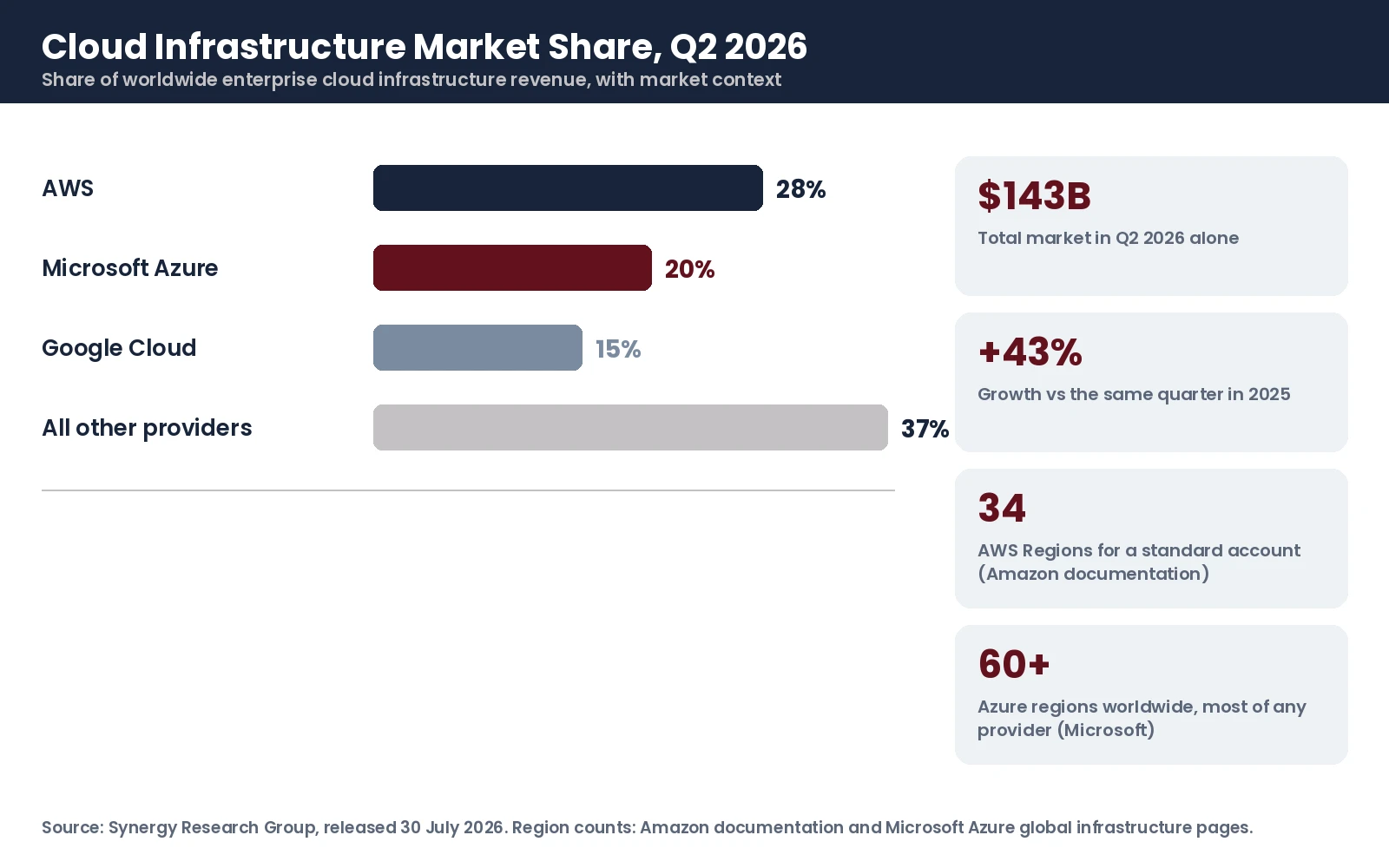
| Hybrid cloud | AWS Outposts | Azure Arc and Azure Stack | Arc manages existing hardware; Outposts ships new hardware |
| Platform services (PaaS) | AWS Elastic Beanstalk | Azure App Service | Both hide server management behind deployment tooling |
| AI platform | Amazon SageMaker | Azure AI Foundry | Foundry centers generative AI development |
| Generative AI models | Amazon Bedrock | Azure OpenAI | Azure OpenAI serves OpenAI models such as GPT-4o |
Names differ across the two catalogs, yet most categories have a direct equivalent on the other side. Equivalence on paper hides real differences in limits, pricing units, and day-to-day tooling behavior. Serverless architecture on both platforms removes server management, yet serverless design also removes some low-level control. Migration teams should test one representative workload on both platforms before trusting any mapping table fully.
Pricing: Why Neither Platform Wins on Cost Alone
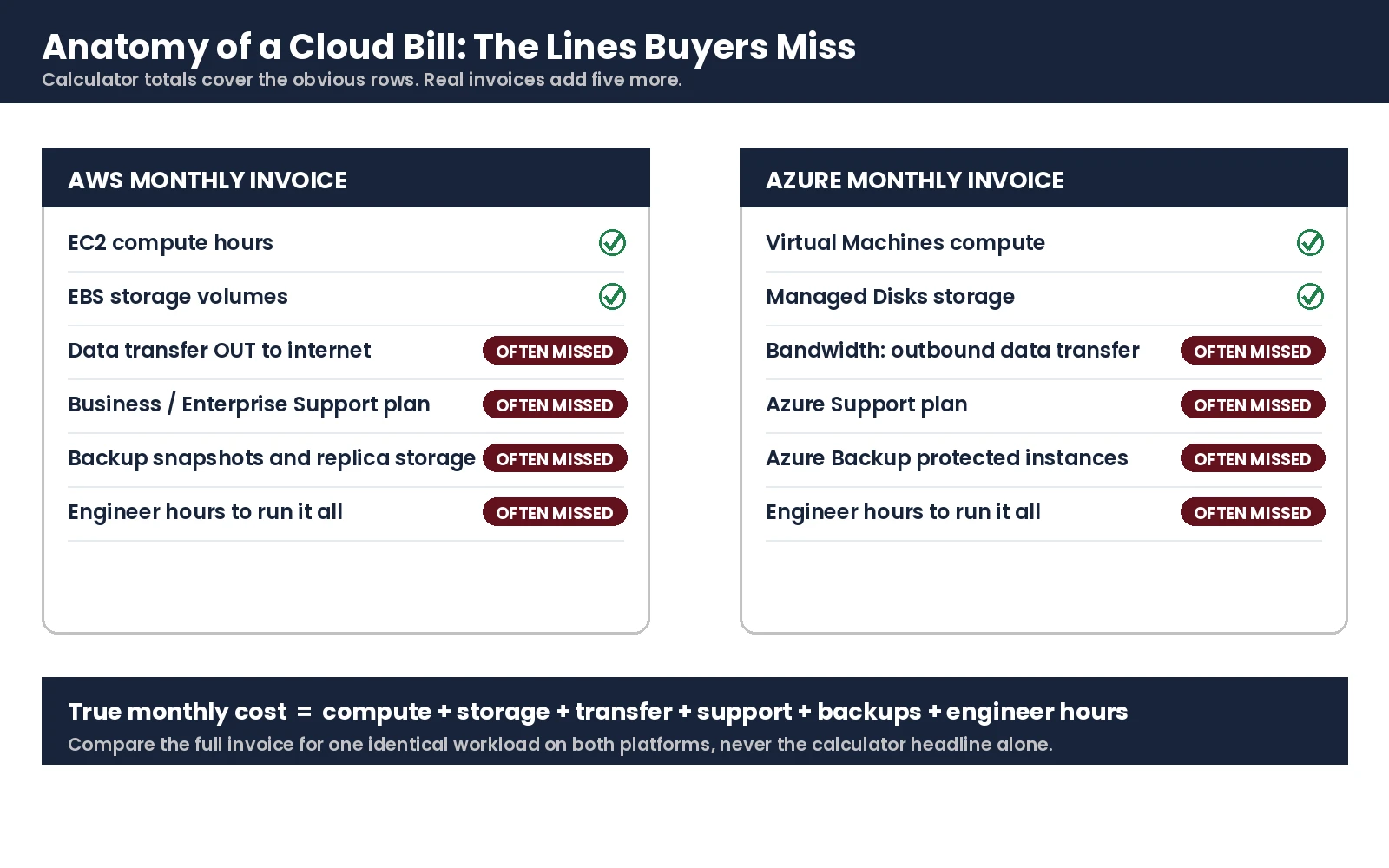
AWS pricing rewards commitment through Savings Plans, which trade a one-year or three-year promise for lower hourly rates. Azure pricing rewards loyalty differently, mainly through Azure Hybrid Benefit for licenses a company already owns. Microsoft states savings of up to 40 percent on Azure Virtual Machines through Azure Hybrid Benefit. Combining the benefit with reserved instances raises the published ceiling to 80 percent, according to Microsoft figures. AWS offers no equivalent licensing lever, since Amazon sells no Windows Server license estate of its own. Data transfer charges surprise more buyers than compute charges, especially where applications pull data out of the cloud regularly.
How to Compare Cloud Costs for One Workload
A fair aws azure cost comparison follows the same five steps on both platforms.
- List every resource the workload needs, covering compute, storage, database, backup, monitoring, and support.
- Price the identical resource list inside both calculators, using the same region and the same usage hours.
- Add data transfer, support plans, and backup storage before comparing any monthly totals.
- Apply commitment discounts only where usage is stable enough to justify a one-year or three-year term.
- Record the engineer hours each platform demands, because staffing cost belongs inside any honest cloud cost comparison.
Workload shape decides the winner, since Linux-heavy estates often price better on AWS while Windows estates price better on Azure.
Performance and Global Reach
Amazon documentation currently lists 34 AWS Regions for a standard AWS account. Every AWS Region contains at least three Availability Zones. Microsoft states that Azure runs more than 60 regions, more regions than any other cloud provider claims. Region counts measure footprint breadth, while zone design inside each region decides real resilience for applications. AWS designs its own Graviton processors, giving EC2 an Arm-based option beside Intel and AMD chips. Raw benchmarks settle little here, because database design and network distance dominate response times in production systems. Any serious aws azure latency comparison runs the same workload from the same cities on both platforms. Serious buyers run latency tests from their own customer locations before signing any long commitment.
Hybrid Cloud and Microsoft Integration
Hybrid cloud capability separates the platforms more clearly than any compute benchmark ever will. Azure Arc extends Azure management onto servers running on premises, inside AWS, or within Google Cloud data centers. Azure Stack extends that model further, running Azure services on dedicated hardware inside a customer’s own facility. AWS Outposts takes the opposite route, shipping AWS-built racks into customer facilities under Amazon’s own operating model. Companies already familiar with Microsoft tooling feel the difference daily, since one identity system covers office apps and cloud resources. Microsoft 365, Windows Server, and Active Directory estates plug into Azure without new identity plumbing. AWS answers with breadth instead, offering Outposts hardware and Local Zones rather than one unified management plane.
AI and Machine Learning
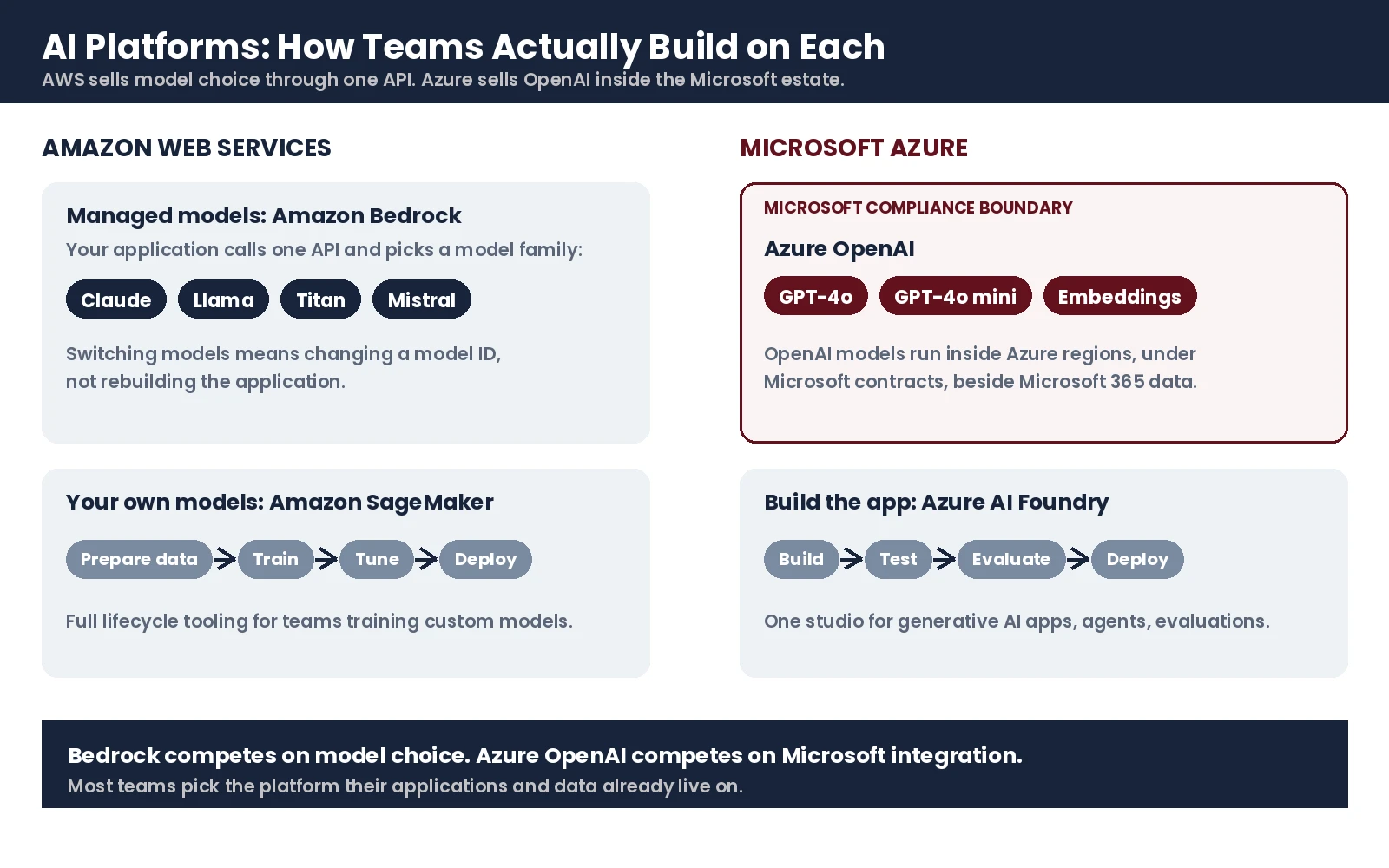
Azure OpenAI gives Azure customers managed access to OpenAI models, including GPT-4o, inside Microsoft’s compliance boundary. Azure AI Foundry wraps those models with tooling for building, testing, and deploying generative AI applications. Amazon Bedrock takes a marketplace approach, offering models from several providers through one API for builders. Amazon SageMaker covers the full machine learning lifecycle for teams training and hosting their own models. Choice here follows data gravity, because AI features work best near the applications and records feeding them. Teams deep in the Microsoft estate usually reach Azure AI first, while model-agnostic teams usually test Bedrock first.
Security and Compliance
Both providers publish a shared responsibility model, splitting duties between platform security and customer configuration. Amazon guards the facilities, hardware, and global network beneath every AWS service. Customers guard their data, access policies, and workload configuration on either platform. AWS IAM allows extremely detailed permissions, which rewards careful teams and punishes sloppy setup habits. Microsoft Entra ID gives Azure an advantage where staff already sign into Microsoft 365 every morning. Microsoft Defender for Cloud, formerly Azure Security Center, scores configurations and flags risky settings across subscriptions. Compliance catalogs run deep on both sides, covering healthcare, finance, and government frameworks across many jurisdictions. Certification lists rarely decide deals alone, since auditors test your configuration rather than the provider’s marketing pages.
Which Cloud Should You Choose?
The right cloud platform depends on evidence from your own estate, not on brand loyalty or headline pricing. Customer lists at both providers include Fortune 500 companies across finance, retail, healthcare, and manufacturing. Enterprise Agreements bend pricing further at scale, especially where Microsoft already supplies office software estate-wide. Every azure vs aws debate returns to the same evidence: existing licenses, team habits, workload shape.
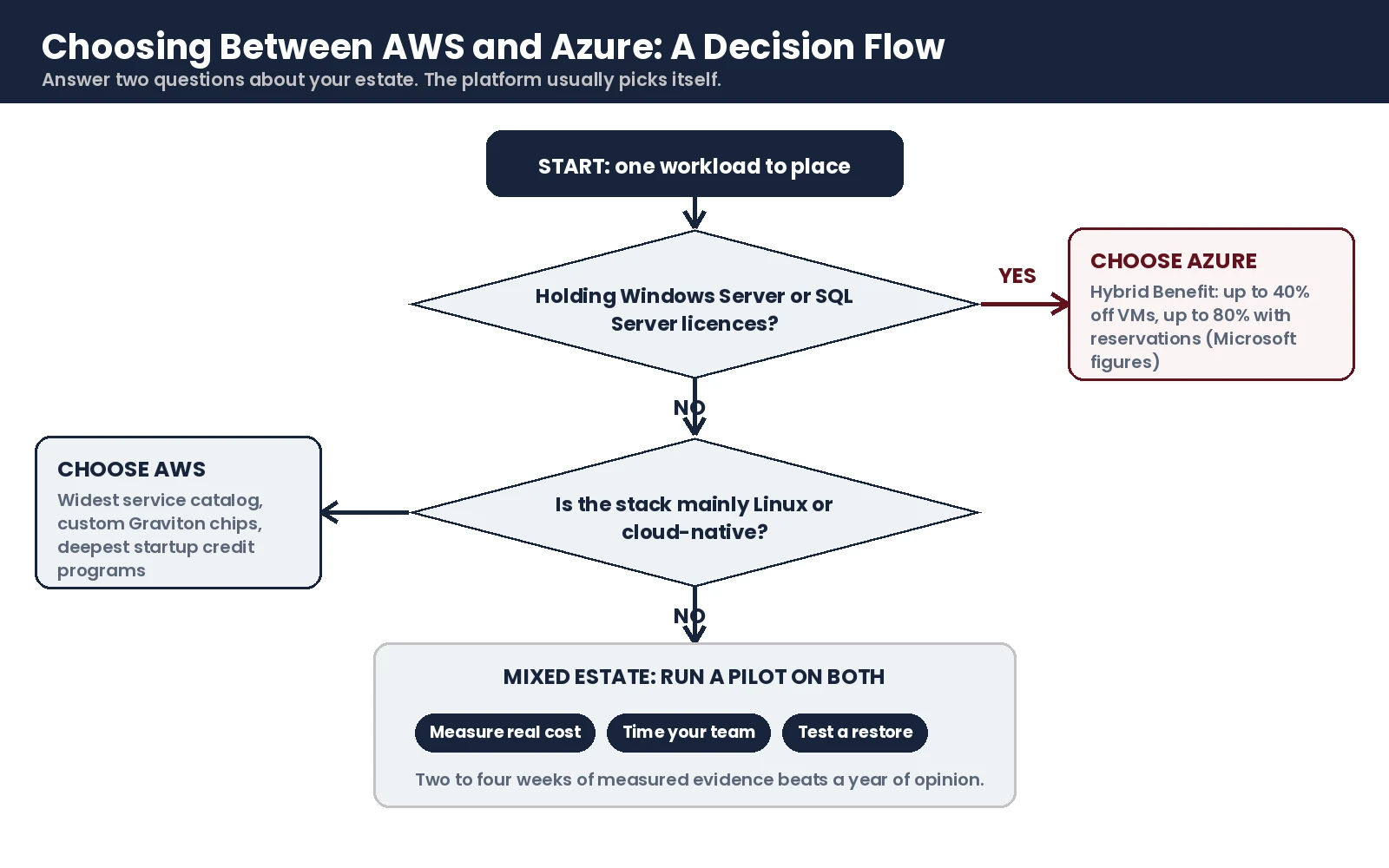
- Choose AWS where your team builds cloud-native products and wants the widest catalog of aws services available.
- Choose AWS where custom infrastructure control matters more than guided setup or bundled enterprise tooling.
- Choose AWS where Linux workloads dominate and startup credits or community knowledge speed up delivery.
- Choose Azure where Microsoft 365, Windows Server, and SQL Server already anchor daily operations.
- Choose Azure where strong hybrid cloud requirements keep some systems on premises for years.
- Choose Azure where Azure Hybrid Benefit turns existing licenses into measurable monthly savings.
Many enterprises choose both, running each workload on the cloud platform that fits it best. A multi-cloud strategy adds operational overhead, so two platforms need a concrete reason rather than fashion. Neither AWS nor Azure fits every buyer, since regional or specialist providers win some regulated or local workloads. Google Cloud stands third in market share behind the two leaders. Data and Kubernetes conversations often start with Google Cloud tooling.
Conclusion
Fit settles this droven io aws vs azure comparison: skills, licenses, workload shape, and operating habits. Run one pilot workload on each platform, then let measured cost and team speed settle the remaining argument. SoftBrixAI builds production AI systems on both platforms through its custom AI software development services.
Frequently Asked Questions
What does the droven io aws vs azure comparison actually compare?
The comparison weighs both platforms across services, pricing, hybrid cloud, AI tooling, security, and global reach. Droven.io publishes the explainer content, while Amazon and Microsoft supply the platforms being compared.
Is AWS better than Azure in 2026?
AWS is better for cloud-native builds, custom infrastructure, and teams wanting maximum service choice. Azure is better for Microsoft estates, hybrid deployments, and buyers holding licenses with Software Assurance.
Which platform is cheaper, AWS or Azure?
Neither platform holds a permanent price lead, because region, workload shape, and licensing change every estimate. Windows-heavy estates often save through Azure Hybrid Benefit, while Linux-heavy estates often price lower on AWS.
Which cloud is better for hybrid deployments?
Azure leads hybrid cloud through Azure Arc, which manages servers across on-premises sites and other clouds. AWS Outposts suits buyers wanting AWS hardware and services running inside their own buildings.
Can a business use AWS and Azure together?
Many businesses run both platforms, placing each workload where pricing, skills, or compliance fit best. Dual operation raises training and tooling costs, so the split needs a workload-level reason.
Which platform should a startup choose in 2026?
Startups usually prefer AWS for its service breadth, startup credits, and large hiring pool. Startups built on Microsoft tooling often start on Azure through the Azure portal.
How do AWS and Azure compare for AI workloads?
Azure provides better access to OpenAI models through Azure OpenAI, including GPT-4o for enterprise applications. AWS provides wider model choice through Amazon Bedrock, while SageMaker covers custom model training for data teams.
References
- Synergy Research Group. Cloud infrastructure services market data, second quarter 2026. Released 30 July 2026.
- Microsoft Learn. Azure for AWS Professionals: AWS to Azure services comparison. Microsoft, 2026.
- Amazon Web Services. AWS Regions and Availability Zones documentation. Amazon, 2026.
- Microsoft Azure. Global infrastructure and global network. Microsoft, 2026.
- Microsoft. Azure Hybrid Benefit savings figures. Microsoft, accessed November 2026.