An AI implementation consultant for small local businesses turns scattered AI experiments into working systems inside daily operations. Most owners have already tried a chatbot for drafting emails or social posts. Few owners have connected AI to bookings, invoices, follow-ups, or customer records.
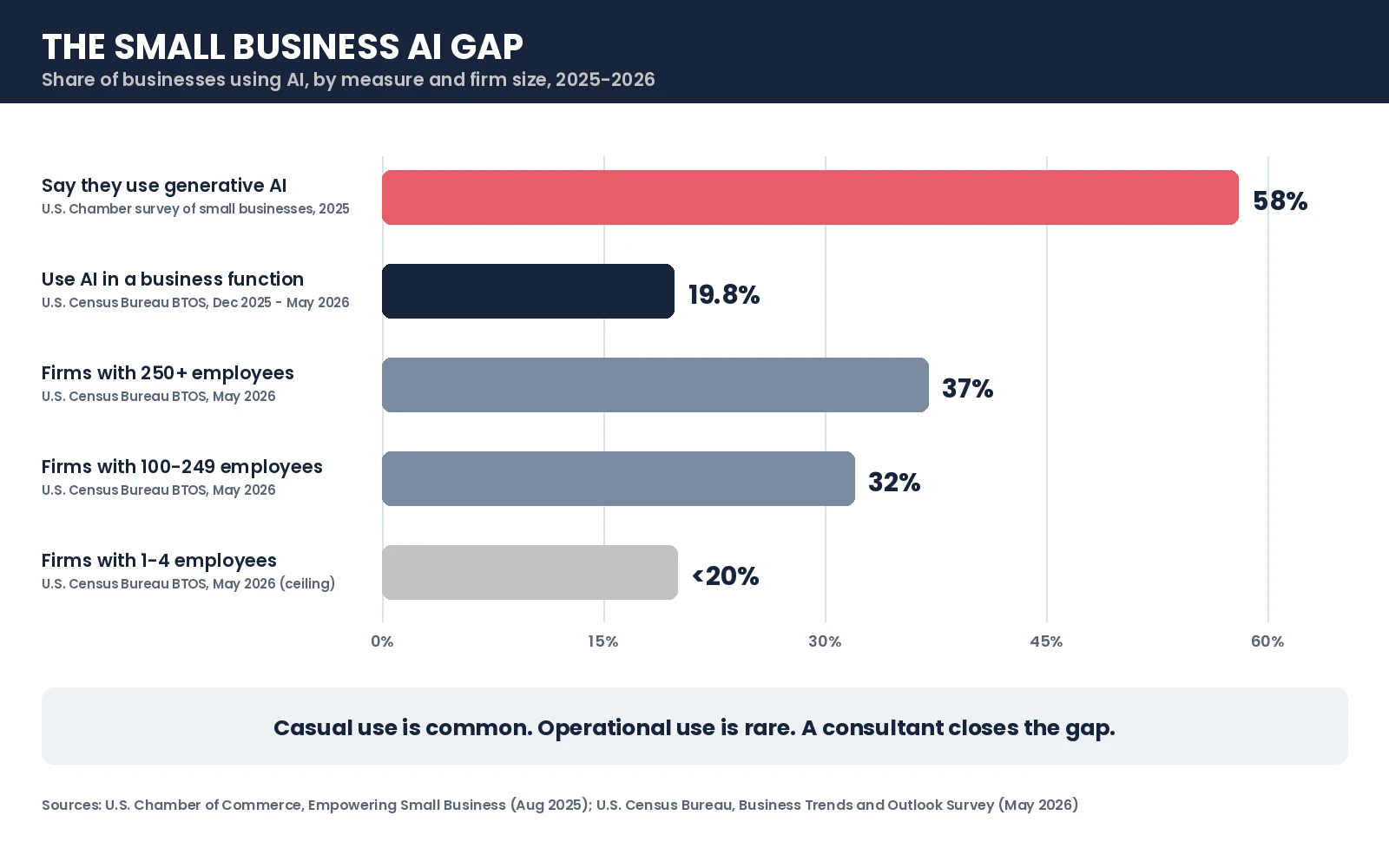
The U.S. Chamber of Commerce found 58 percent of small businesses using generative AI in 2025. The Chamber figure climbed from 23 percent in 2023 through 40 percent in 2024. The U.S. Census Bureau counted AI use in a business function at 17 to 20 percent of firms from December 2025 to May 2026. Different questions explain the distance between the two figures. Chatbot trials count in one survey and disappear in the other.
A consultant closes the gap by choosing a few use cases with fast payback. Local firms feel the gap hardest because every missed call carries visible cost. Practical guidance on costs, consultant types, selection criteria, plus fifteen ranked ideas follows below.
What an AI Implementation Consultant Actually Does
An AI implementation consultant for small local businesses starts with daily workflows rather than software demos. A typical engagement produces six concrete deliverables for the owner.
- A workflow audit maps every repetitive task across the front desk, the office, plus the field.
- An AI readiness assessment scores data quality, current software, staff skills, available budget.
- A prioritized AI roadmap ranks use cases by payback speed, cost, plus operational risk.
- Working systems get built inside tools the business already pays for each month.
- Staff training covers daily use, error spotting, and escalation to a human.
- A measurement routine tracks hours saved, response times, plus revenue per lead monthly.
General IT providers usually stop at installation and licensing. Implementation consultants stay accountable for adoption and measured results after launch.
Good consultants sell careful diagnosis before any software subscription. Fees buy sequencing, integration skill, plus accountability for measurable business outcomes.
Start With an AI Readiness Assessment
An AI readiness assessment examines the business before any tool gets recommended or purchased. The review covers data quality, workflow documentation, plus software contracts. A second pass covers team skills, security duties, plus a realistic budget. U.S. Census Bureau research shows why the check matters for very small firms.
Firms with four or fewer employees reported AI use below 20 percent through May 2026. Firms with 250 or more employees reached 37 percent during the same survey window. Access to tools explains little of the gap between small and large firms. Data habits, documented processes, plus one accountable owner explain most of the difference.
Written AI use policies remain rare among small firms despite daily staff experimentation. A one-page policy covering approved tools, customer data, plus review duties supports AI compliance from day one. The AI Risk Management Framework from the National Institute of Standards and Technology gives owners a free governance structure for larger rollouts.
Quick Self-Check Before Hiring Anyone
Owners can answer six questions before paying for any formal assessment.
- Which three tasks consume the most staff hours every single week?
- Where does customer information live today, inside one system or across several inboxes?
- Which records contain personal data covered by privacy duties or industry rules?
- Who inside the business will own AI results after the consultant leaves?
- What monthly budget can the business commit for at least six months?
- Which single result would prove the first project earned its cost?
Honest written answers turn a sales pitch into a useful diagnosis.
AI Implementation Ideas That Pay Back First
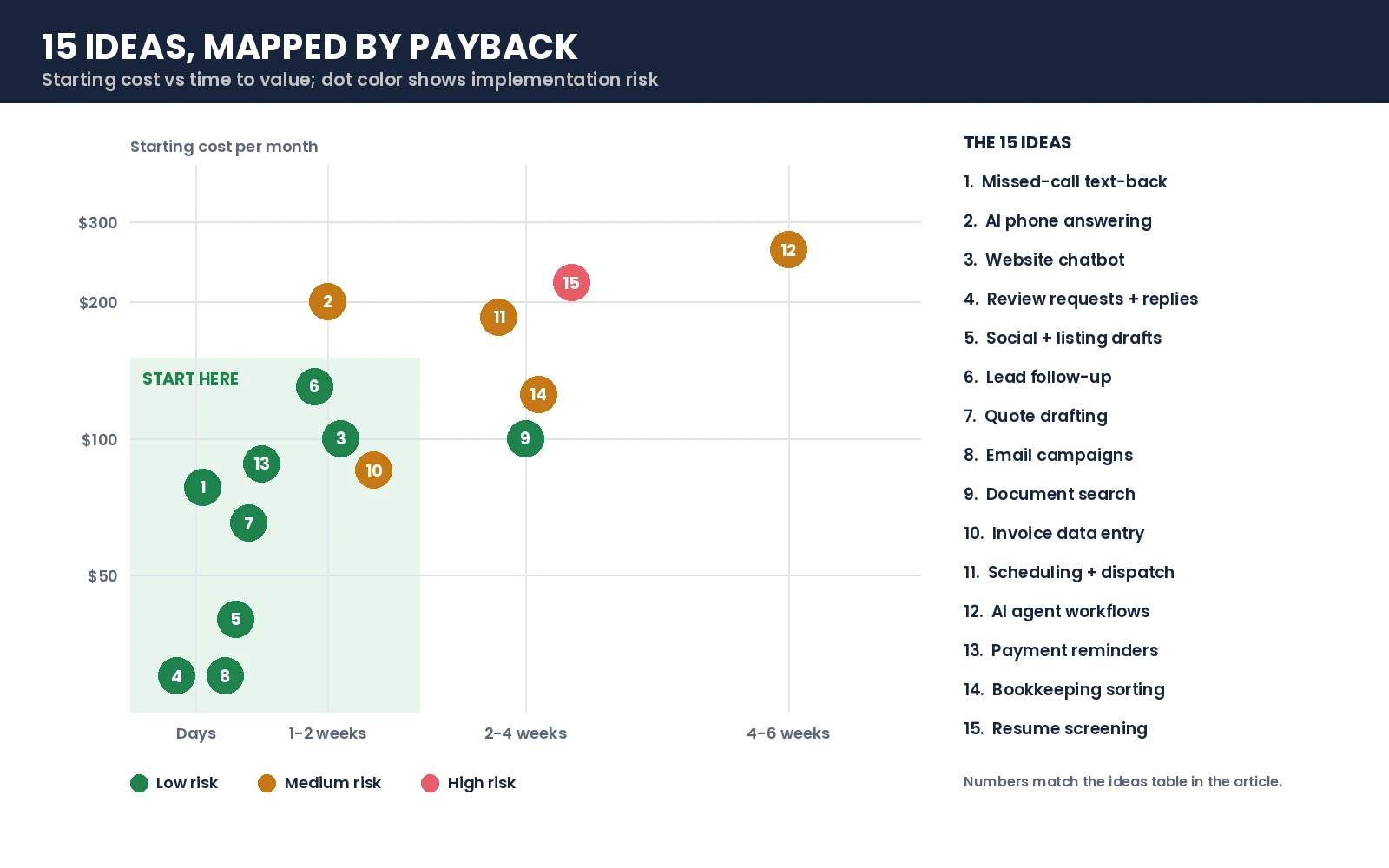
Fifteen ideas below cover the front office, marketing, operations, finance, plus hiring. Each idea carries a starting cost band, an expected time to value, plus a risk level. Cost bands reflect common subscription pricing for small-business AI tools in 2026.
Among firms already using AI, 57 percent run the technology in three or fewer business functions, per Census Bureau researchers. Narrow starts beat broad rollouts at small firms almost every time.
| Idea | What it fixes | Fits best | Starting cost | Time to value | Risk |
|---|---|---|---|---|---|
| Missed-call text-back | Enquiries lost after hours | HVAC, plumbing, electrical | Under $100/mo | Days | Low |
| AI phone answering with booking | Calls missed during busy hours | Dental, clinics, salons | $100 to $300/mo | 1-2 weeks | Medium |
| Website chatbot trained on business documents | Repeated basic questions | Law firms, real estate, agencies | $50 to $150/mo | 1-2 weeks | Low |
| Review requests with drafted replies | Few reviews, slow responses | Restaurants, retail, home services | Under $50/mo | Days | Low |
| Social posts with listing updates drafted weekly | Inconsistent online presence | Retail, restaurants, salons | Under $50/mo | Days | Low |
| Automated lead follow-up sequences | Slow first response to enquiries | Contractors, real estate | $50 to $200/mo | 1-2 weeks | Low |
| Quote drafting from job notes | Slow estimates after site visits | Contractors, lawn care firms | Under $100/mo | Days | Low |
| Email campaign drafting with list cleanup | Irregular marketing to past customers | Retail, e-commerce, gyms | Under $50/mo | Days | Low |
| Search across manuals, policies, past jobs | Staff knowledge trapped in files | Trades, clinics, agencies | $50 to $150/mo | 2-4 weeks | Low |
| Invoice data entry with expense sorting | Manual bookkeeping hours | All local services | $50 to $150/mo | 1-2 weeks | Medium |
| Scheduling with dispatch assistance | Double bookings, idle crews | HVAC, cleaning, repair | $100 to $300/mo | 2-4 weeks | Medium |
| AI agent workflows across business apps | Copy-paste work between tools | Firms with 10+ staff | $200+/mo | 4-6 weeks | Medium |
| Payment reminders with polite chasing sequences | Late payments from customers | B2B services, trades | Under $100/mo | Days | Low |
| Bookkeeping categorization with monthly summaries | Messy accounts at month end | All small firms | $50 to $200/mo | 2-4 weeks | Medium |
| Resume screening with interview scheduling | Slow hiring for frontline roles | Restaurants, retail, care services | $100 to $300/mo | 2-4 weeks | High |
Front Office and Customer Contact
Front-office ideas win early because missed calls convert directly into lost revenue. Phone answering tools need a human fallback for complaints, emergencies, plus angry customers.
A website chatbot trained on real business documents answers routine questions without inventing prices. Owners should test front-office tools with real customer questions before launch day.
Marketing and Sales
Marketing ideas pay back through consistency rather than volume. Drafting tools prepare posts, campaigns, plus follow-ups while owners approve every message before sending. AI automation handles the repetitive sending while owners keep approval rights.
In the Thryv survey, 58 percent of AI users reported saving more than 20 hours every month. Follow-up speed decides many local sales because enquiries often contact three competitors.
Operations and Back Office
Operations ideas remove copy-paste work between systems that never shared data. Document search succeeds early because staff already trust the underlying manuals and records.
Agentic workflows, where an AI agent chains steps across apps, sit last because one error can repeat everywhere. Owners should pilot operations tools on one team before wider rollout.
Finance and Hiring
Finance ideas deserve human review on every output during the first ninety days. Resume screening carries the highest risk inside the table.
Screening models can inherit bias from historical hiring data within the business. Owners should audit screening outcomes by group before any wider rollout.
Ideas to Skip as a First Project
Four popular ideas regularly disappoint small firms during a first engagement.
- Sales forecasting fails early because small firms rarely hold clean, consistent sales histories.
- Fully automated customer replies damage trust whenever tone or facts go wrong publicly.
- Custom AI model training costs more than any plausible saving at small-business data volumes.
- Enterprise AI platforms assume dedicated IT staff, integration budgets, plus long procurement cycles.
Each skipped idea becomes viable later, after clean data and proven workflows exist.
DIY, Off-the-Shelf Tool, or Hire a Consultant?
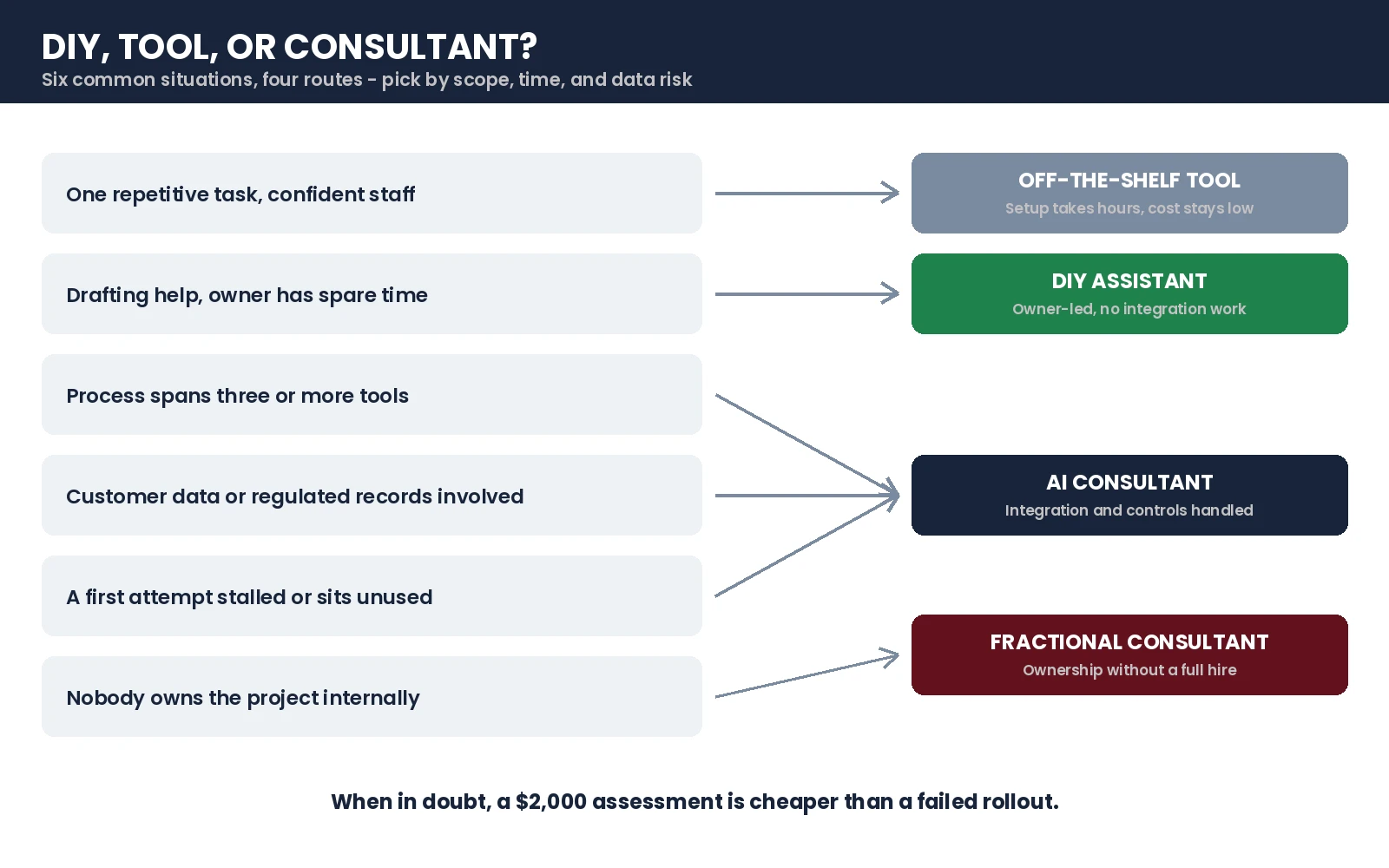
The right route depends on task scope, internal time, plus data sensitivity. Hybrid routes work well where one internal champion owns the rollout. The U.S. Small Business Administration advises owners to start small and test free tools before paying for subscriptions.
| Situation | Best route | Why |
|---|---|---|
| One repetitive task, confident staff | Off-the-shelf tool | Setup takes hours, cost stays low |
| Drafting help, owner has spare time | DIY assistant | No integration work required |
| Process spans three or more tools | Consultant | Integration decides success or failure |
| Customer data or regulated records involved | Consultant | Privacy duties need documented controls |
| A first attempt stalled or sits unused | Consultant | Diagnosis finds the real blocker |
| Nobody owns the project internally | Fractional consultant | Ownership keeps momentum after launch |
Cost alone misleads business owners because unused subscriptions waste more than consulting fees.
Types of AI Consultants for Small Businesses
Four engagement types cover nearly every AI consulting arrangement a small business will meet in 2026. Fractional arrangements suit firms needing monthly guidance without project-scale budgets.
| Type | Typical cost | Best for | Watch out for |
|---|---|---|---|
| Fractional AI consultant | Monthly retainer for set days | Ongoing guidance without a full project | Limited hands-on build time |
| Independent specialist | $25 to $149 per hour, or fixed fees | One defined problem | Availability depends on one person |
| Boutique AI firm | Project fees from $10,000 | Owners wanting design, build, training together | Minimum project sizes apply |
| MSP with AI services | Bundled inside an IT contract | Firms already on managed IT support | AI depth varies widely between providers |
Published hourly rates across SMB-focused firms run from $25 to $149 per hour. Rate cards cluster lower for narrow specialists and higher for full implementation teams.
How to Choose the Right Consultant
Strong consultants diagnose before recommending any platform, tool, or subscription.
- A credible AI consulting engagement starts with workflow evidence rather than a capabilities deck.
- Vendor-neutral advice matters because resellers earn commissions from specific software platforms.
- Implementation responsibility should sit inside the contract, covering build, training, plus handover.
- Post-launch ownership needs a named person, a review cadence, plus agreed success metrics.
- References from businesses of similar size reveal more than polished case studies.
- Named team profiles with verifiable specialists reveal more than anonymous agency pages.
- AI governance duties deserve explicit discussion wherever customer data or health records are involved.
Weak signals usually appear early in most bad consulting engagements.
- A consultant pitching one named tool during the first call is selling software.
- Guaranteed return figures without baseline measurements signal marketing rather than diagnosis.
- Long lock-in contracts before any pilot result exists transfer every risk to the buyer.
- Vague timelines without milestones usually hide weak delivery capacity.
What Does an AI Implementation Consultant Cost?
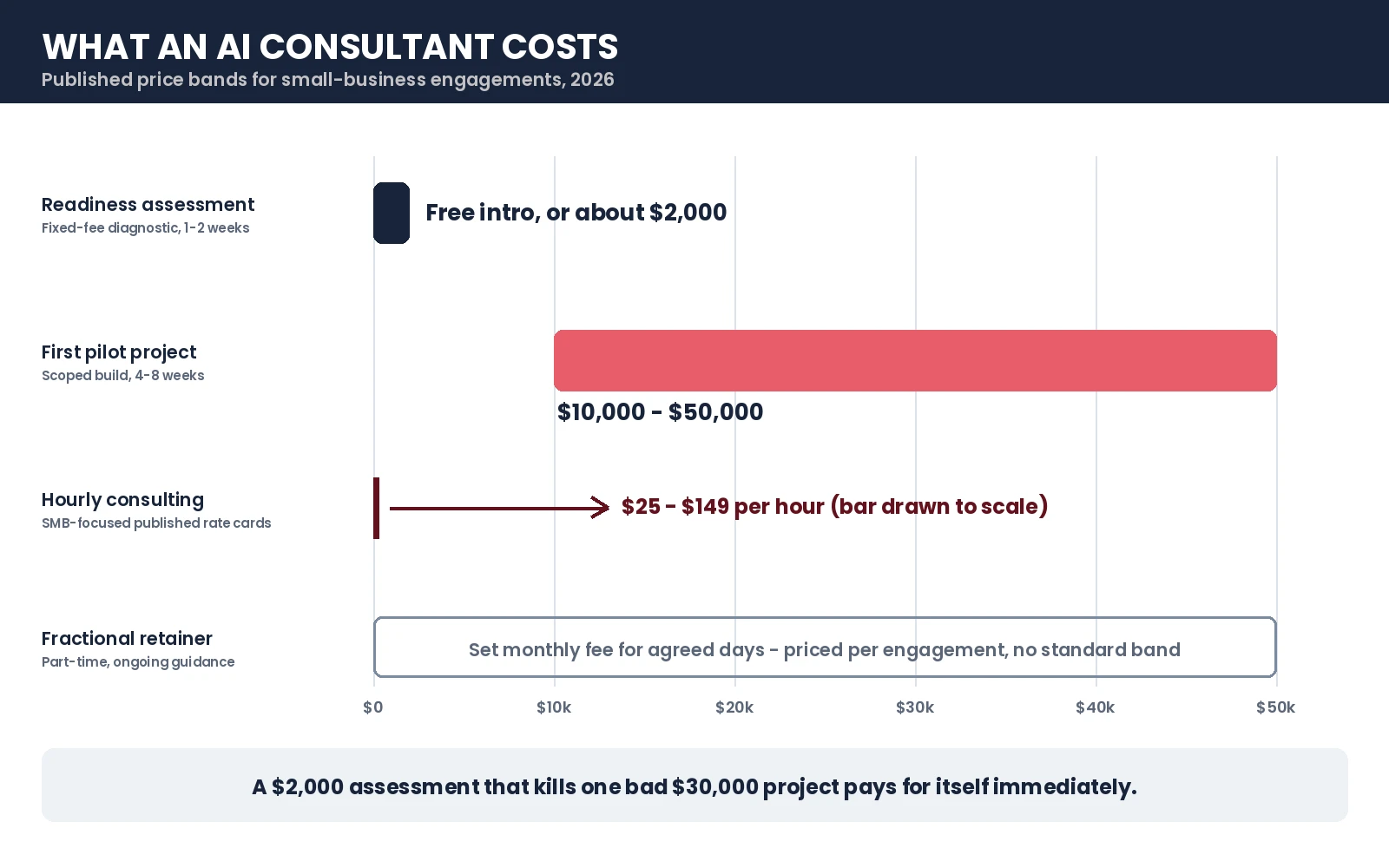
Hiring an AI implementation consultant for small local businesses costs less than a failed software rollout. Published prices cluster into four predictable bands for small-business engagements.
| Engagement | Typical cost | Typical duration |
|---|---|---|
| AI readiness assessment | Free introductory version, or about $2,000 | 1-2 weeks |
| First pilot project | $10,000 to $50,000 | 4-8 weeks |
| Hourly consulting | $25 to $149 per hour | As needed |
| Fractional retainer | Set monthly fee for agreed days | Ongoing |
Owners should compare total cost against hours saved per month, not hourly rates alone. A $2,000 assessment that kills one bad $30,000 project pays for itself immediately. Owners should also budget staff time for training during the first month.
The First 30 Days of a Good Engagement
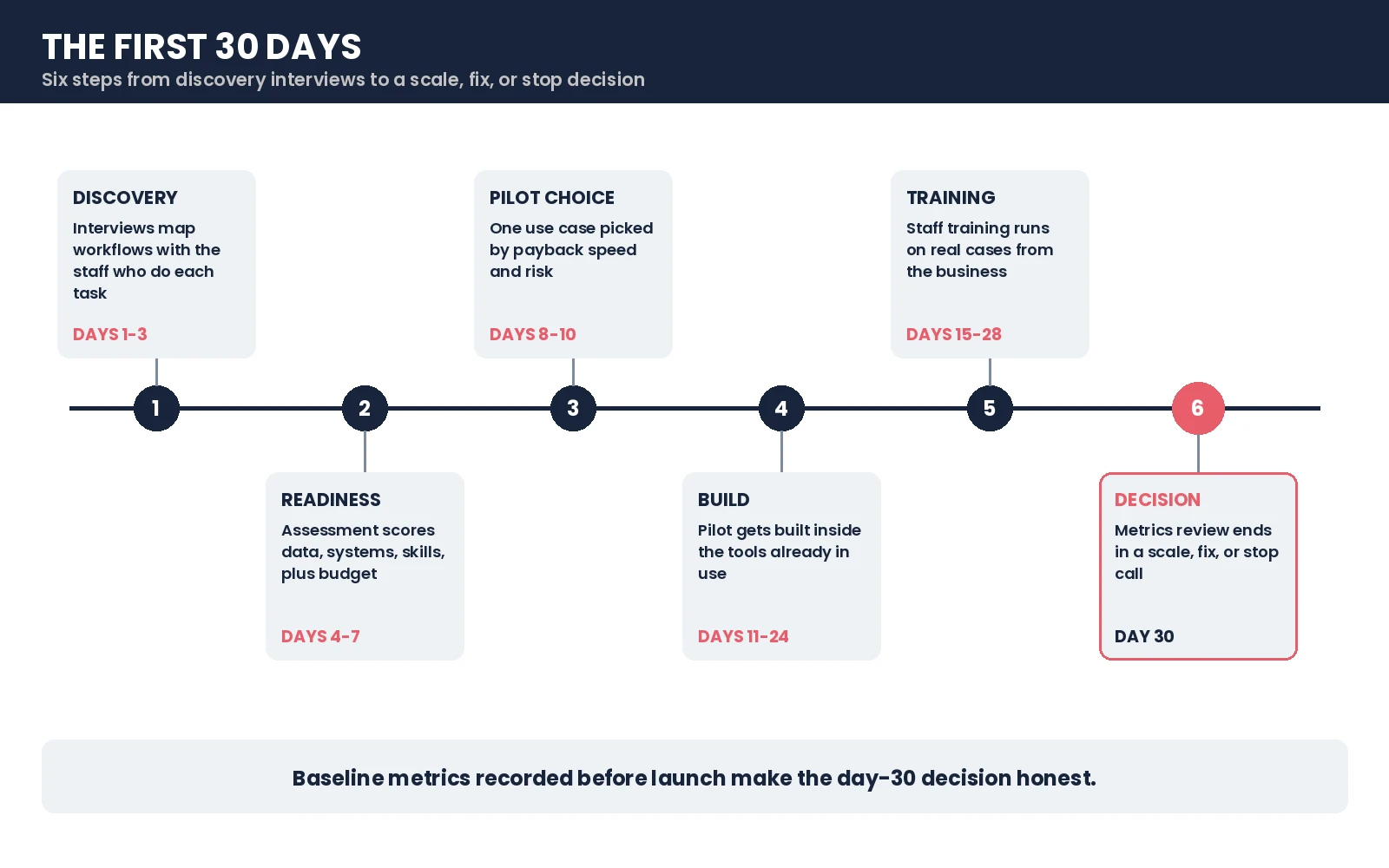
A disciplined first month follows six steps in a fixed order.
- Discovery interviews map workflows with the staff who perform each task daily.
- The readiness assessment scores data, systems, skills, plus budget against candidate use cases.
- One pilot use case gets selected using payback speed and implementation risk.
- The pilot gets built inside existing tools wherever the current stack allows.
- Staff training runs alongside the build, using real customer cases from the business.
- Baseline metrics get recorded before launch, then reviewed again at day thirty.
Weekly check-ins keep the pilot aligned with the original success metric. Day thirty ends with a scale, fix, or stop decision based on measured results.
Conclusion
The right AI implementation consultant for small local businesses starts with ideas that repay effort within weeks. Readiness first, one narrow pilot, honest measurement, then careful expansion beats every broad rollout.
Owners who follow that order join the minority already saving serious hours each month. The ideas table above gives every owner a starting shortlist today.
Frequently Asked Questions
What does an AI implementation consultant do for a small business?
A consultant audits daily workflows, scores readiness, then ranks use cases by payback speed. The engagement then covers build work, staff training, plus measurement after launch.
How much does an AI consultant cost for a small business?
Readiness assessments run free as introductory offers or around $2,000 as fixed-fee engagements. First pilot projects usually cost between $10,000 and $50,000 at SMB-focused firms.
What is an AI readiness assessment?
An AI readiness assessment reviews data quality, documented workflows, current software, team skills, plus budget. The output ranks candidate projects by likely payback and flags compliance duties early.
Which AI idea should a local business start with?
Missed-call text-back suits most service firms because setup takes days and results show immediately. Businesses with heavy paperwork should start with document search or invoice entry instead.
Can a small business implement AI without a consultant?
Owners can self-implement single tools for drafting, scheduling, or review replies without outside help. Help becomes worthwhile once a process spans several tools or touches customer data.
How long does a first AI project take to show results?
Simple front-office tools show results within days of launch in most service businesses. Integrated pilots usually need four to eight weeks before measurement means anything reliable. Owners should judge pilots on hours saved and response speed, not impressions.